
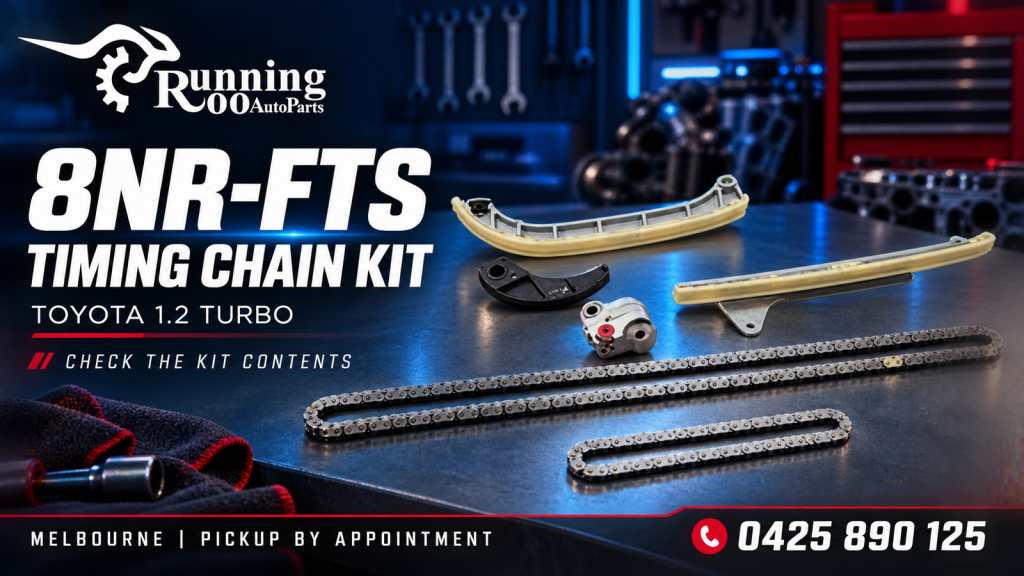
An 8NR-FTS timing chain kit is a specific purchase for a confirmed Toyota 1.2-litre turbo engine. It should not be selected from the words Corolla or C-HR alone. If a workshop has recommended timing-system work, the useful next step is to connect the diagnosis, the VIN-based application and the exact package being supplied. That is particularly important when a catalogue covers vehicles from several markets.
RunningRoo offers a Toyota 8NR-FTS timing chain kit identified as KF8019CT, with a matching RunningRoo eBay listing. Both were checked as on sale for this guide. There is an important detail to resolve before buying: the website description includes the phrase “with gears”, while the main product image does not establish a clear itemised gear package. Ask for the current contents in writing rather than inferring them from either the phrase or the photograph.
For help with that check, call 0425 890 125. RunningRoo is Australian-operated and based in Blackburn, Melbourne, with friendly support, Melbourne local pickup by appointment and fast dispatch subject to confirmed stock and order arrangements. Provide the VIN, engine code and workshop requirements so the enquiry can be resolved before the installation date is booked.
VIN · complete engine code · OE reference
Professional diagnosis · required parts · written contents
Current dispatch estimate · pickup appointment · workshop booking
Why the engine code matters more than the model name
The selected listing uses C-HR, Auris and Corolla in its application wording. Those names help identify the product’s intended market, but they do not establish that every vehicle carrying those badges has the same engine or timing components. The precise target of this article is a vehicle confirmed as 8NR-FTS. If your engine identification is different, stop the comparison and look for the appropriate application.
Send the full VIN, build date and any engine identification recorded by the workshop. If the vehicle is an import, include its original market and documentation where available. A registration lookup can be useful, but do not let a broad model result override a verified engine code. Ask the installer to resolve conflicting vehicle information before a supplier is asked to confirm the kit.
Also distinguish the vehicle’s original specification from what is installed today. A replacement engine or a previous major repair can make the history relevant. Tell the supplier what is known and provide the mechanic’s observations. This is an information problem to solve early, rather than a reason to assume that an advertised year range covers every possible combination.
What Toyota says about the 1.2-litre turbo system
Toyota’s official 2015 engine announcement identifies the 8NR-FTS as a turbocharged direct-injection petrol engine. It describes intake-side VVT-iW, which varies valve timing with operating demand and enables Atkinson-cycle operation under suitable conditions. The point for a buyer is that the engine’s timing system includes controlled valve-timing functions; a chain package and a variable-timing actuator should not be treated as interchangeable product descriptions. See Toyota’s original engine announcement.
The announcement explains engine technology, not replacement-kit contents or repair instructions. It does not certify KF8019CT, establish an aftermarket OE interchange or provide a diagnostic shortcut for an individual car. The technician should use current Toyota service information for the confirmed vehicle. This article therefore avoids universal torque figures, timing sequences and promises that a particular kit will cure a particular sound.
Use the technical distinction to improve the purchase enquiry. Ask the workshop whether it requires chain-drive components only, a separately identified actuator, or a wider scope supported by inspection. Then ask the supplier to confirm what the selected product actually contains. That sequence keeps a useful technology explanation from being mistaken for a recommendation to replace every timing-related part.
Resolve the “with gears” description before checkout
A product image is helpful for recognising a candidate kit, but it may not provide a complete packing list. In this case, the website’s additional note and the main image leave a specific question about gears. Do not assume that a VVT-iW actuator is included, that every visible component is the current version, or that an unshown component will arrive simply because a heading suggests it.
Request an itemised list of chains, guides, tensioners, gears, seals and hardware supplied with the current order. If gears are included, ask for their identity and whether any variable-timing assembly is part of the package. Pass that reply to the workshop. The objective is a shared written understanding, not a debate over which photograph looks most convincing.
| Information to confirm | Evidence to use | Decision it supports |
|---|---|---|
| Engine is 8NR-FTS | Vehicle records and workshop identification | Whether this product is a suitable candidate |
| Correct application | VIN and current parts information | Whether the selected kit matches the vehicle |
| KF8019CT reference | Supplier’s product identification | Which advertised package is being discussed |
| Current gear contents | Written itemised supplier reply | Whether extra gears or actuators are required |
| Additional consumables | Installer’s repair list | What must be ordered outside the kit |
| Dispatch or collection timing | Current supplier confirmation | When the workshop can realistically expect parts |
Use the RunningRoo KF8019CT product page and corresponding eBay item as the exact references in your enquiry. Keep the answer with the order record. If the contents differ between a saved description and the current supplied package, have the discrepancy resolved before payment rather than leaving the installer to discover it during the repair.
Separate a diagnosis from a parts suggestion
Tell the workshop what prompted your enquiry: a noise, a warning lamp, a scan result or a recommendation made during other work. Ask it to identify the evidence behind the proposed repair. A useful diagnosis names the concern, the checks performed and the components requiring attention. A phrase such as “timing issue” does not yet define a shopping list.
If a diagnostic code is available, share the complete report and the technician’s interpretation. Do not order an actuator solely because a code description contains the word camshaft, or a chain solely because someone has called the noise a rattle. Ask what further testing is needed and whether any conclusion remains provisional until the engine can be inspected.
The supplier’s role is then clearer. RunningRoo can help identify the listed product and check the proposed application, while the workshop remains responsible for diagnosing the vehicle and specifying the repair. Keeping those roles clear reduces the chance of receiving a correct part for an incorrectly assumed problem.
Build a useful service-history summary
Gather previous servicing invoices, any records of timing-related work and the date the present complaint began. Note whether another repair immediately preceded it. A short chronological summary is easier to use than a stack of unexplained screenshots. Give the mechanic the facts you know, and mark the details you cannot confirm rather than filling the gaps with assumptions.
For a recently purchased vehicle, distinguish information supplied by the previous owner from work supported by an invoice. You can report both, but they do not carry the same certainty. Ask the workshop whether additional identification or inspection is appropriate in light of the missing history. That decision should occur before a kit is chosen to match an unverified repair story.
If the car has been assessed by more than one workshop, provide the earlier reports. Ask the current technician to explain any difference in diagnosis. It is reasonable to want a clear basis for the recommended parts, especially where one estimate mentions only a chain kit and another includes valve-timing components. Clarification is more useful than combining both estimates into an oversized order.
Request an estimate that shows what is included
The quote should identify the selected kit, any separately required components, consumables, labour and verification work. Ask whether its scope depends on findings after access is gained. Where it does, agree how additional work will be priced and authorised. A staged estimate is understandable when the boundaries of each stage are clear.
Compare estimates for the same vehicle and the same defined work. An online parts price is not a complete installed repair cost, and a workshop total may contain items not included in the advertised kit. If one quotation seems much cheaper, first check whether the package and responsibilities are actually comparable. Avoid relying on generic national cost figures for a vehicle that has not been assessed.
If you intend to buy the parts yourself, tell the installer before ordering. Ask when it wants the parcel delivered and how it will check the application and contents. This is particularly relevant to the unresolved gear wording on the selected product. The mechanic should see the supplier’s confirmation before planning the job around a package it has not approved.
Arrange supply around the workshop appointment
RunningRoo’s Melbourne location gives local customers a practical collection option once the order is confirmed. Pickup is by appointment in Blackburn; it is not an invitation to arrive without checking readiness. Call 0425 890 125 to coordinate the order and collection details. If another person will collect for you, agree what order reference they should bring.
For delivery within Australia, ask about current stock, fast dispatch arrangements and the estimated transit time to the destination. Give the supplier the address type and postcode accurately. If the parcel is going directly to a workshop, include the workshop’s approved delivery details and a clear reference connecting the parcel to your booking.
Allow time for the installer to inspect the package before the vehicle occupies a workshop bay. A delivery notification alone does not establish that the contents have been checked. If the repair depends on additional parts identified separately, confirm their availability as well. A complete order plan is more useful than obtaining the main kit quickly while overlooking another required item.
Check the kit before installation
Keep the package labels, invoice and written contents confirmation together. Ask the workshop to compare what arrived with what was agreed. If a gear is absent, different or unidentified, contact the supplier before installation. Clear photographs and the order reference help make the query specific, while preserving the packaging keeps the supplied items traceable.
Do not modify an unfamiliar component to match an assumption about fitment. Ask the installer to check the relevant catalogue and repair information, and request clarification from the supplier where needed. Similar-looking components may require further identification, while a visible design difference should be explained rather than accepted or rejected solely on appearance.
A good pre-installation check also prevents the terms kit, actuator and complete repair from being used interchangeably. Each describes a different scope. By the time work starts, the workshop should know exactly which supplied items are intended for installation, which additional parts are required and which components are being assessed under the agreed repair plan.
Keep the handover focused on the original concern
Ask the workshop to explain what was fitted and how the result was assessed. If your complaint was intermittent, discuss whether the relevant conditions were reproduced and whether any follow-up observation is needed. The final record should distinguish completed work from advice about future monitoring. Keep that record alongside the supplier’s fitment confirmation.
Record the repair date and odometer reading, and retain the product reference without treating it as a promise of a particular service life. Ask the workshop which maintenance guidance applies to your vehicle going forward. This article does not establish a universal replacement interval or a special oil specification for every market version of the 8NR-FTS.
If a concern remains, return to the diagnosis and completed-work record before buying further parts. Explain the symptom and ask for the next justified step. A chain kit should be part of a defined repair, not the first entry in a sequence of speculative purchases driven by broad search results.
Frequently asked questions
Does this kit fit every Toyota C-HR or Corolla?
No. This guide concerns vehicles confirmed as 8NR-FTS. Model names and advertised year ranges are not sufficient identification. Provide the VIN, build information, engine code and original market where relevant, and obtain confirmation for the specific product before ordering.
Does KF8019CT mean the VVT-iW gear is included?
Do not assume that. The selected website description says “with gears”, but the main image does not resolve an itemised gear package. Request written confirmation of the current contents, including the identity of any supplied gears or actuators, and have your workshop review it.
Does Toyota’s engine announcement approve this aftermarket kit?
No. It explains the 8NR-FTS technology and the role of intake VVT-iW. It does not approve this supplier’s product or establish vehicle-specific interchange. Current application information and the installer’s diagnosis are still required.
Can a fault code decide whether I need a chain or actuator?
A code should be interpreted through the correct diagnostic process. Share the complete report and ask the workshop what evidence supports its proposed component list. The words used in a code description are not a substitute for that assessment.
How do I order with Melbourne support?
Review the RunningRoo 8NR-FTS product and matching eBay listing, then confirm contents and fitment. Call 0425 890 125 or use the contact page for friendly assistance from an Australian-operated business, fast dispatch enquiries or Melbourne local pickup by appointment.
Related RunningRoo guides
For wider background, read Timing chain kit fitment and engine codes and Questions to ask your mechanic before a timing-chain repair. These explain the broader checks; the product and engine references in this article define its specific ordering scope.
Sources and verification scope
Product availability and seller descriptions were checked on 8 October 2026. Stock, contents and terms can change; obtain current confirmation before purchase. Technical context is drawn from the manufacturer-issued material below. Copies on third-party archives are identified as such. They do not certify this aftermarket product or replace current vehicle-specific service information.
- Toyota: Toyota Doubles Turbo Offerings in New Engine Lineup, 6 April 2015 — Official Toyota engine-development announcement. System context, not aftermarket kit approval.