
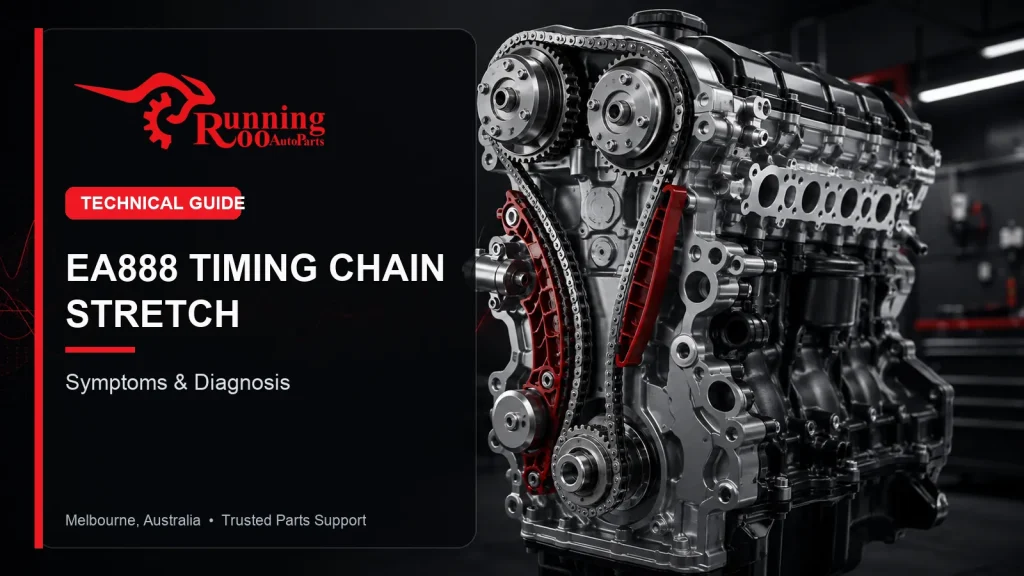
G’day mates, If you are driving a Volkswagen, Audi, Skoda, or Cupra manufactured between 2008 and 2015, chances are there is a 1.8L or 2.0L EA888 engine beating under the bonnet. As the Product Manager here at RunningRoo, I spend my days deep-diving into automotive data, sourcing premium OEM+ replacement parts, and talking to mechanics from Melbourne all the way up to Brisbane.
The EA888 is an absolute powerhouse of engineering—it is highly tunable, fuel-efficient, and provides brilliant torque. However, it harbours one of the most infamous Achilles’ heels in modern motoring history: the timing chain system.
Today, we are going to get highly technical. I am going to walk you through exactly how to determine if your EA888 timing chain is failing or stretched. We will cover the distinct EA888 timing chain symptoms, the dreaded VW engine rattle cold start, what it means when you are faced with an EA888 stretched chain, and why dealing with a sudden dashboard warning is not something you can ignore.
Grab a coffee, and let’s get your engine sorted.
1. The Anatomy of the EA888 Timing System
Before we can diagnose a fault, we need to understand the mechanics. Unlike older engines that used a rubber timing belt needing replacement every 100,000 kilometres, Volkswagen Group (VAG) engineered the early EA888 generations with a steel timing chain. The marketing pitch was brilliant: a maintenance-free, lifetime component. Unfortunately, reality in the harsh Australian driving environment proved otherwise.
The EA888 utilizes a complex timing drive mechanism comprising three separate chains:
- The Main Timing Chain: Connects the crankshaft to the two overhead camshafts.
- The Balance Shaft Chain: Drives the balance shafts and the water pump.
- The Oil Pump Chain: Drives the oil pump from the crankshaft.
The Core Flaw: Why Does the Chain Stretch?
When we refer to an “EA888 stretched chain”, the steel links do not actually behave like rubber bands. Instead, the pivot pins and the inner bores of the chain links suffer from microscopic wear over tens of thousands of kilometres. When you multiply a wear factor of 0.01mm across over a hundred chain links, the total physical length of the chain increases significantly.
Official Backing: According to the official VAG Self-Study Programme (SSP) 436: The 4-Cylinder TFSI Engine, precise timing is maintained by a hydraulic chain tensioner. However, early Generation 1 and Generation 2 EA888 engines (engine codes CCZA, CCTA, CBFA, CDAA) were fitted with a notoriously weak chain tensioner.
The original tensioner relied on a tiny spring clip and a ratcheting mechanism to hold the tension when the engine was off and oil pressure dropped to zero. This clip was prone to shearing off entirely. When the tensioner collapsed, the loose chain would jump the sprocket teeth on the camshaft, causing pistons to collide with valves. This issue was so prevalent globally that it resulted in a major class-action lawsuit (In re Volkswagen Timing Chain Product Liability Litigation, settled in 2018), which forced VW to redesign the system.
Figure 1: Diagram showing the layout of the primary timing chain, plastic guides, and the hydraulic tensioner on a Gen 2 EA888.
2. Recognizing the Warning Signs: EA888 Timing Chain Symptoms
If your engine is approaching the 100,000-kilometre mark and you have not had the updated “Revision K” tensioner installed, you need to be hyper-vigilant. The transition from timing chain failure symptoms to catastrophic engine failure can happen over a single weekend.
Here are the critical symptoms you must monitor:
A. The Infamous “VW Engine Rattle Cold Start”
This is the most common early warning sign. When you start your car first thing in the morning—especially during a chilly Victorian winter—you might hear a loud, metallic rattling, clacking, or “diesel-like” sound coming from the right-hand side of the engine bay (driver’s side in Australian Right-Hand Drive cars).
- Why it happens: When the car sits overnight, the engine oil drains back into the sump. The hydraulic chain tensioner loses its fluid pressure. If the mechanical ratcheting teeth on the tensioner are worn or broken, the tensioner piston retracts. When you crank the engine, the loose chain violently slaps against the plastic chain guides until oil pressure builds up a few seconds later.
- The Verdict: If the rattle lasts for 2 to 5 seconds upon cold start, your tensioner is failing, and the chain has likely stretched beyond the tensioner’s maximum extension limit.
B. The Dreaded Check Engine Light
For our bilingual mechanics and customers at RunningRoo, hearing a customer report Volkswagen engine check light is on, in conjunction with rough running is an immediate red flag.
When the chain stretches, the physical synchronization between the bottom half of the engine (crankshaft) and the top half (camshafts) is thrown out of phase. The Engine Control Unit (ECU) constantly monitors this relationship via the Crankshaft Position Sensor (G28) and the Camshaft Position Sensor (G40).
If the ECU detects that the timing is retarded beyond a specific threshold (usually more than 5 degrees), it will trigger the Check Engine Light (CEL) and log a specific fault code.
- DTC P0016: Crankshaft Position – Camshaft Position Correlation (Bank 1 Sensor A).
- Verdict: If you scan your car and see P0016, do not drive it. The ECU is telling you the chain has stretched to the absolute limit.
C. Rough Idling, Misfires, and Loss of Power
Because the intake and exhaust valves are no longer opening at the precise microsecond they are supposed to, the engine’s volumetric efficiency plummets. You will notice the engine physically shaking at idle, increased fuel consumption, sluggish acceleration, and random misfire codes (P0300, P0301, P0302).
3. Diagnostic Guide: How to Definitively Check Your Timing Chain
As a Product Manager, I do not believe in guesswork. RunningRoo advocates for data-driven maintenance. You do not need to tear the whole engine down to check the chain; you can diagnose it using two methods: Electronic and Visual.
Method 1: The Electronic Check (Using VCDS or OBDeleven)
This is the safest and most accurate way to measure the invisible wear of an EA888 stretched chain. VAG diagnostic software allows you to read the exact degree of phase adaptation the ECU is applying to compensate for the stretched chain.
Step-by-step Guide:
- Ensure your engine is fully warmed up (coolant at 90°C, oil above 80°C).
- Leave the engine idling.
- Plug in your VCDS cable or OBDeleven dongle and open the software.
- Navigate to 01 – Engine.
- Select Advanced Measuring Values.
- Search for and select:
Camshaft adaptation intake bank 1: phase position.
Interpreting the Data:
The readout will be displayed in degrees. Because a stretched chain causes the camshaft to lag behind the crankshaft, the value will be negative.
| Phase Position Value | Condition Status | Required Action from RunningRoo PM |
| 0° to -2.0° | Factory Fresh / Excellent | None. Keep up with 7,500km oil changes. |
| -2.1° to -4.0° | Normal Wear / Moderate Stretch | Monitor closely. Plan for a replacement in the next 10k – 20k kilometres. |
| -4.1° to -5.0° | Severe Stretch / Danger Zone | Order a RunningRoo Timing Chain Kit. Book the workshop immediately. |
| -5.1° or worse | Imminent Catastrophic Failure | DO NOT DRIVE THE CAR. Tow it to the mechanic. |
Official Backing: Volkswagen Technical Service Bulletin (TSB) 15-12-01 outlines these precise tolerance parameters for timing chain elongation diagnostics.
Figure 2: Example of a VCDS interface showing a vehicle in the “Danger Zone” at -4.5 degrees.
Method 2: The Physical/Visual Inspection (The “Tensioner Groove” Count)
If your car will not start or you want physical confirmation, you can visually inspect the tensioner. VAG cleverly designed a small inspection window into the lower timing cover.
Step-by-step Guide:
- Safely raise the front of the vehicle on jack stands.
- Remove the front driver’s side wheel (on Australian RHD vehicles) and the plastic wheel arch liner.
- Locate the lower timing cover on the side of the engine block. You will see a round, black rubber grommet.
- Pry the rubber grommet off with a flathead screwdriver.
- Using an inspection mirror and a strong torch (or a digital endoscope), look inside the hole. You will see the plunger of the timing chain tensioner.
- Count the visible grooves (notches) on the extended plunger.
Interpreting the Grooves:
- 0 to 3 grooves visible: The chain is tight and in good condition.
- 4 to 5 grooves visible: The chain is stretched; start planning for replacement.
- 6 or more grooves visible: The tensioner is at maximum extension. The chain is severely stretched and is likely slapping. Replace immediately.
Furthermore, look at the style of the tensioner. If the body of the tensioner is flat with a retaining clip on the outside, you have the old, fatal “Revision A/AB” style. If the tensioner has a smooth, solid body with internal threading, you have the updated “Revision K” style.
4. Why Do We See This Failure So Frequently in Australia?
From my desk at RunningRoo, looking at warranty claims and parts dispatch data, the failure rate of the EA888 timing chain is noticeably high in Australia. Why? It comes down to two factors: Climate and Maintenance Schedules.
Volkswagen Australia initially specified a standard service interval of 15,000 kilometres or 12 months. In European climates with long highway drives, this is manageable. In Australia, however, our extreme summer temperatures, combined with heavy stop-and-go urban traffic in cities like Sydney and Melbourne, severely degrade the engine oil.
The EA888 timing chain and its hydraulic tensioner are incredibly sensitive to oil pressure and oil quality. As oil degrades, carbon particulates act like liquid sandpaper, accelerating the wear on the microscopic pins of the chain. Furthermore, degraded oil sludges up the tiny oil galleries feeding the tensioner, preventing it from extending fast enough during a cold start.
The RunningRoo Preventative Advice: Throw the 15,000km interval out the window. If you want your EA888 to survive, perform oil and filter changes every 7,500 kilometres or 6 months, using only fully synthetic oils carrying the strict VW 502.00 or 504.00 certification.
5. The RunningRoo Solution: Engineered for Peace of Mind
When it comes to fixing an EA888 stretched chain, you cannot cut corners. As a Product Manager, I have evaluated dozens of aftermarket chain kits, and the variance in metallurgical quality is terrifying. Buying a cheap, unbranded kit off eBay is a surefire way to snap a chain and destroy a $10,000 engine.
At RunningRoo, we have curated the ultimate EA888 Timing Chain Overhaul Kit. Here is what we demand from our supply chain, and what you should demand from your mechanic:
- The BorgWarner Morse TEC Chain: We only supply the latest revision chain (Part No. 06K109158AD or latest equivalent). BorgWarner redesigned the link plates to be thicker and much more resistant to stretching.
- The “Revision K” Tensioner: (Part No. 06K109467K). This fully redesigned tensioner ditches the weak external clip for a robust internal ratcheting system that physically cannot collapse when oil pressure drops.
- Updated Plastic Guides: The old guides become brittle and snap. We supply the updated, reinforced VAG guides.
- A New Lower Timing Cover: (Part No. 06H109210Q). The original lower timing cover is stamped from incredibly thin sheet metal. When a mechanic pries it off to access the chain, it almost always bends. Reusing a bent cover guarantees a massive oil leak. Our kit includes a brand-new cover pre-fitted with the front main crankshaft seal.
Figure 3: The complete OEM+ RunningRoo replacement kit, featuring the redesigned Revision K tensioner and strengthened chain links.
By ensuring your workshop uses a comprehensive, high-quality kit, you are effectively curing the EA888 of its only major design flaw, giving you another 100,000+ kilometres of worry-free, turbocharged motoring.
6. Frequently Asked Questions (FAQ)
Let’s tackle the most common questions that hit my inbox from concerned VAG owners across the country.
Q1: My VW Golf GTI is a 2016 model (Gen 3 EA888). Do I still need to worry about the timing chain?
A: The Gen 3 EA888 (found in MK7 GTIs, late Audi A3s, etc.) received the redesigned chain and tensioner straight from the factory. While catastrophic failure is incredibly rare in these newer models, chains are still physical wear items. They can still stretch past 150,000km if oil maintenance is neglected, but the immediate “ticking time bomb” threat of the Gen 1 and Gen 2 engines is resolved.
Q2: How much does it cost to replace the timing chain in Australia?
A: Depending on your location and whether you use a dealership or an independent Euro specialist, parts and labour generally range between $1,800 to $2,800 AUD. It is a highly labour-intensive job requiring specialised camshaft locking tools. Consider this routine maintenance; it is vastly cheaper than the $8,000+ cost of rebuilding the cylinder head if the chain snaps.
Q3: I have the P0016 code but the car still drives fine. Can I drive it to the workshop?
A: I strongly advise against it. If the ECU has triggered a P0016 correlation code, your chain is hanging on by a thread. A single hard acceleration could cause the chain to jump a tooth, resulting in catastrophic piston-to-valve contact. Get it towed on a flatbed.
Q4: Will a thicker oil stop the VW engine rattle on cold start?
A: No. This is a dangerous myth. The EA888 requires thin oil (usually 5W-30 or 5W-40) to flow rapidly into the tiny ports of the hydraulic tensioner during cold starts. Using a thicker oil (like a 10W-50) will actually delay oil pressure reaching the tensioner, exacerbating the chain slap and accelerating wear. Stick strictly to VW 502/504 approved oils.
Q5: Can I just replace the tensioner and leave the old chain?
A: Absolutely not. This is a false economy. To access the tensioner, you have already paid for 90% of the labour to strip the side of the engine. Furthermore, a stretched chain will quickly destroy a brand-new tensioner. Always replace the chain, tensioner, guides, and seals as a complete set.
Conclusion
Owning a car with an EA888 engine is incredibly rewarding, but it demands respect and proactive maintenance. Do not ignore that metallic VW engine rattle cold start.
By understanding the exact EA888 timing chain symptoms, regularly checking your camshaft phase adaptation via VCDS, and upgrading to our RunningRoo OEM+ components when the time comes, you can ensure your pride and joy stays out of the workshop and out on the open Aussie roads where it belongs.
If you suspect your chain is on its way out, do not panic. Grab one of our comprehensive overhaul kits from the RunningRoo store, book in with your trusted local Euro mechanic, and get it sorted.
Stay safe out there, and happy motoring!
If you have any questions regarding any EA888 Timing Chain-related issues, please feel free to contact us at any time.
We are based in Blackburn South, Melbourne, and provide 24/7 free pickup service (by appointment only) for your convenience.
📞 Phone: 0425 890 125
🔧 Specialising in EA888 Timing Chain Kits, Timing Chain Repairs, and Compatibility Support.
If you have any questions regarding any EA888 Timing Chain-related issues, please feel free to contact us at any time.
We are based in Blackburn South, Melbourne, and provide 24/7 free pickup service (by appointment only) for your convenience.
📞 Phone: 0425 890 125
🔧 Specialising in EA888 Timing Chain Kits, Timing Chain Repairs, and Compatibility Support.
eBay Store: https://www.ebay.com.au/itm/365218282299
Visit Our Website: https://www.runningroo.com.au/product/fits-audi-vw-ea888-gen2-2-0l-gti-jetta-a4-timing-chain-cover-solenoid-kit/
GREAT PRODUCT
Quick delivery. Top quality. Excellent communication.
Awesome thank you!
Awesome product and good communication thank you
Hahahaha You are so good. Already bought more!!
Awesome product! good price, done the job
Thanks mate! 😊 Really appreciate your feedback and support!
— RunningRoo Auto Parts 🇦🇺
Perfect fit
A1 +++++++++++++++++++++
Cheers mate! 😊 Thanks heaps for the A1 feedback — really appreciate your support!
— RunningRoo Auto Parts 🇦🇺
Top seller Top product A+++
Thanks heaps mate! 🙌 Really appreciate the A+++ feedback! Awesome to hear you’re happy with the product and service. Your support means a lot to us! — **RunningRoo Auto Parts 🇦🇺**
Good quality timing chain kit at a great price. Excellent value for money.
Cheers mate! 😊 We believe quality parts should offer great value. Thanks for supporting our small business!
Great timing chain kit, good quality and super fast postage. Highly recommend this seller.
Cheers mate! 🚚 Thanks for the great feedback and recommendation. We’re stoked you’re happy with the kit and delivery!
Thanks mate! 😊 We take pride in providing quality parts with accurate descriptions. Really appreciate your support!
Complete timing chain kit with everything I needed. Good quality components and well packaged.
Thanks heaps mate! Great to hear the kit arrived safely and had what you needed. Appreciate you choosing RunningRoo!
VVT gear arrived well packed and in perfect condition. Looks like a quality product.
Cheers mate! 📦 We always want your parts to arrive safely. Thanks for the kind words and your support!
Very happy with the timing chain kit and the whole buying experience. Would buy again.
Thanks heaps mate! 😊 We really appreciate your support and look forward to helping you out again down the track!
No fuss with this order. The kit arrived in good condition and the components looked as described. The price was fair and the whole process was easy from start to finish. Exactly what you want when sourcing parts for a repair. Cheers for the good service.
Was looking around for a timing chain kit without spending too much, and this one offered good value. The parts look well presented and delivery went smoothly. It’s nice to have an Australian supplier to look at when you need replacement parts. Happy with the overall experience.
The kit was packed well and arrived without any obvious damage. Everything looked tidy when I opened the box, and the quality seemed reasonable for the price. It’s reassuring when engine parts turn up properly protected. Overall, I’m happy with the purchase and would consider buying again.
Ordering was easy and the kit arrived safely. The parts were packaged well and looked good on inspection. Communication and the overall buying process were straightforward. Nothing complicated, just a simple purchase at a fair price. Happy to recommend the seller based on the service received.
I compared a few timing chain kits before making a decision and RunningRoo offered a good price. The kit arrived safely and the supplied components looked tidy. Always important to check the correct part for your engine, but the ordering experience itself was easy and straightforward.
Quite happy with the overall quality of the kit. The parts look neat and the packaging kept everything protected during delivery. The price was reasonable and the transaction was hassle-free. Would definitely keep RunningRoo in mind when looking for engine parts in the future.
Good option if you’re looking for a reasonably priced timing chain kit. Everything arrived in good condition and the components looked as expected. I like having more affordable choices when maintaining an older vehicle. Overall, a smooth transaction and good value for the price.
Easy transaction, quick delivery and a quality VVT gear. Very happy.
Cheers mate! 😊 Thanks for making it an easy transaction. Great to hear everything went smoothly!
Really impressed with the quality of this timing chain kit. Looks and feels well made.
Thanks heaps mate! We put a lot of care into offering quality parts at fair prices. Really appreciate your feedback!
Ordered online and received the kit quickly. Good communication and great service.
Thanks mate! 🙌 We appreciate the feedback. Providing reliable service and keeping things moving quickly is always our goal!
Good quality VVT gear for a reasonable price. Happy with the purchase
Cheers mate! Great to hear you’re happy with the quality and price. Thanks for supporting RunningRoo!
Perfect fit for my car. All parts fitted as expected and the kit looks great.
Thanks mate! 🙌 Awesome to hear everything fitted as expected. We really appreciate your support and choosing RunningRoo!
Great quality timing chain kit. Everything looks well made and arrived in excellent condition.
Cheers mate! 😊 Great to hear you’re happy with the quality and condition of the kit. Thanks heaps for your support!
Top seller Top product A+++
Thanks heaps mate! 🙌 Really appreciate the A+++ feedback! Awesome to hear you’re happy with the product and service. Your support means a lot to us! — **RunningRoo Auto Parts 🇦🇺**
Item arrived quicker than expected and in excellent condition. Will use seller again.
Cheers mate! 😊 Great to hear your order arrived sooner than expected and in perfect condition. We really appreciate your support and look forward to helping you again next time! 🙌
— **RunningRoo Auto Parts 🇦🇺**
For the price, this looks like a decent timing chain kit. The components were neatly packed and arrived safely. I appreciate having an affordable option available locally rather than always looking overseas. Overall, a positive experience with RunningRoo and I’d consider using them again.
Happy with how everything went. The kit arrived in good condition, the packaging was fine and the parts looked good when checked. The price was competitive and there were no hassles during the purchase. Would definitely check RunningRoo again next time I need car parts.
A good experience overall. The timing chain kit was priced fairly, arrived safely and looked well presented. It’s always helpful to have a local supplier offering a decent range of engine parts. Ordering was straightforward and everything went as expected. Thanks RunningRoo, appreciate it.
The whole process was nice and easy. Ordering was straightforward, the kit arrived safely and everything looked as expected. It’s good dealing with a local Australian parts supplier rather than waiting around for overseas shipping. Happy with the purchase and service.
Bought this kit for an engine repair and I’m happy with what I received. Everything looked tidy and well made, and the order arrived in good condition. It’s great to have another option for sourcing car parts locally in Australia without paying a fortune. Happy with the purchase.
Pretty happy with this kit overall. The components look good quality and the packaging was spot on. It’s always good to find reasonably priced engine parts from an Australian seller. Ordering was easy and everything arrived as expected. Cheers RunningRoo!