
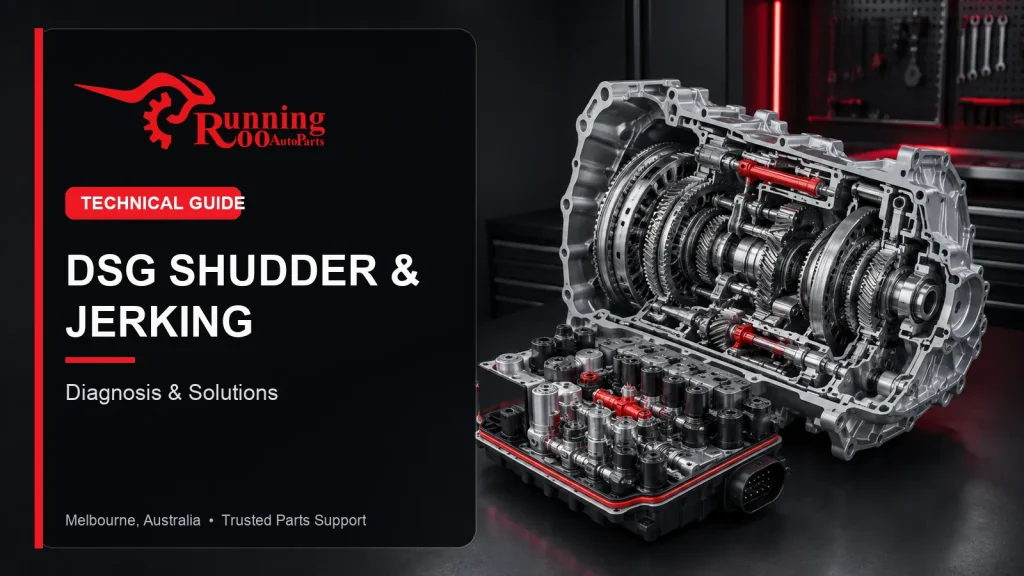
I completely understand how unnerving it is when your vehicle hesitates or violently shakes as you try to accelerate into a busy roundabout. It shatters your confidence in the car and makes daily driving stressful. As the Product Manager here at RunningRoo Auto Parts, I see the aftermath of these faults constantly; we process vast amounts of technical data and official engineering documentation regarding the Volkswagen Group’s DQ200 7-speed dry dual-clutch transmission. It is one of the most common automatic gearboxes on Australian roads, widely equipped in popular models such as the Volkswagen Golf, Polo, Skoda Octavia, and Audi A3.
Many drivers mistakenly believe that any gearbox shudder means the entire transmission is irreparably destroyed. I want to gently correct that misconception: the DQ200 is a modular, highly serviceable unit. The shuddering is simply a symptom of a specific sub-component—usually the clutch pack, the Dual-Mass Flywheel, or the Mechatronic unit—failing to manage torque transfer correctly.
This comprehensive guide provides a deep dive into the dsg7-low-speed-vibration-problem and offers the official, step-by-step dq200-shudder-jerk-acceleration-fix.
1. Identifying Core vw-gearbox-judder-symptoms
Before tearing down a gearbox or ordering replacement units, we must accurately diagnose the symptoms. Problems with the Direct-Shift Gearbox (DSG) system often manifest in highly noticeable ways. Recognising these early warning signs is the first step toward a successful repair.
Here are the most common symptoms reported by drivers and technicians:
- Shuddering on Acceleration: A noticeable vibration or shudder is felt, especially at low speeds or when accelerating from a complete stop. This often feels like the car is hesitating or slipping.
- Rough Odd-Gear Shifts: The vehicle exhibits harsh, clunky gear changes, particularly noticeable in the odd-numbered gears (1st, 3rd, 5th, and 7th), which are controlled by the K1 clutch pack.
- Flashing “PRNDS” Light: The gear indicator on the dashboard begins flashing, which is the transmission’s way of signalling it has detected a serious fault.
- Transmission Temperature Warnings: A gear icon with a thermometer illuminates, often accompanied by dashboard messages like “Transmission temp. is high! Stop safely”.
- Unexpected Neutral Drops: The transmission may suddenly lose drive completely or jump into neutral unexpectedly during transit.
- Delayed Engagement: There is a significant delay when attempting to select Drive or Reverse from Park, or a loss of power during gear changes.
2. Deep Dive: transmission-clutch-shudder-analysis
To understand the fix and supply the right components, we must perform a rigorous transmission-clutch-shudder-analysis. The DQ200 operates uniquely compared to its wet-clutch siblings (like the DQ250) because it relies on a dry dual-clutch system. Unlike wet clutch systems, these dry clutches are not lubricated by oil, which makes them highly susceptible to wear and heat.
The Physics of Clutch Engagement
The Transmission Control Module (TCM) manages clutch engagement based on complex mathematical models. It calculates the required clamping force using a fundamental friction equation:
$$T = \mu \cdot F_N \cdot R_m \cdot n$$
Where:
- $T$ = Torque transferred
- $\mu$ = Coefficient of friction (varies dynamically with temperature and clutch material wear)
- $F_N$ = Normal force (clamping force applied by the Mechatronic hydraulic actuators)
- $R_m$ = Mean friction radius
- $n$ = Number of friction faces (which is 2 per clutch in a dual-clutch setup)
Because the friction coefficient ($\mu$) dynamically changes over the lifespan of the clutch pack, the TCM must constantly adapt its hydraulic pressure ($F_N$) to maintain smooth engagement. When the friction material on the clutch plates wears down, the clutch can no longer fully engage and transfer engine torque efficiently, leading to slip. Judder occurs when this engagement becomes inconsistent or uneven.
The Dual-Mass Flywheel (DMF) Factor
At RunningRoo Auto Parts, we frequently inform our trade customers that a worn dual-mass flywheel is a very common and often overlooked cause of clutch judder. The flywheel is designed to absorb engine vibrations before they reach the gearbox. When the DMF wears out, vibrations are no longer dampened effectively, and the clutch receives uneven torque input, resulting in a violent shudder upon take-off.
3. The Mechatronic Unit: The Brain of the DSG
The Mechatronic unit is the electro-hydraulic control centre of your gearbox, acting as the brain that manages all gear shifts. It integrates the electronic Transmission Control Unit (TCU/TCM) and the electro-hydraulic control module into a single bolted-on component. Faulty DSG mechatronic units can result in damage to the gears and severely reduce the service life of the dual clutch pack.
Accumulator Wall Failure
One of the most critical design flaws in early DQ200 Mechatronic units involves the high-pressure accumulator canister. The valve body has a design flaw where the thickness of the locating cannister wall is too thin. This causes the accumulator to crack and split, leading to a massive loss of high-pressure hydraulic fluid.
When hydraulic pressure drops, the system cannot apply enough normal force ($F_N$) to the clutch plates. The gearbox hesitates while trying to find the right amount of pressure, which manifests as a shudder or vibration when moving off from a stop. If the damage is severe, the vehicle will log specific diagnostic trouble codes (DTCs), such as P17BF (Hydraulic pump system overload protection) or 06300 (Function restriction, due to insufficient pressure build up).
Solenoid Contamination
The mechatronic unit controls clutch engagement using hydraulic pressure. Over time, solenoids can become clogged with metallic debris, causing them to stick and leading to poor shifting performance. If these valves get clogged or stuck, they disrupt the gear changes, making them rough, jerky, or entirely incorrect.
4. The Timeline of Failure: Why You Must Act Quickly
Many drivers notice a slight vibration and choose to ignore it, hoping it is a quirk of the vehicle. This is a costly misconception; DSG faults rarely stay small for long. When one part begins to fail, clutch slip overheats the gearbox, heat damages seals, and pressure loss accelerates further clutch wear.
Here is a timeline illustrating what happens if you wait to resolve the dsg7-low-speed-vibration-problem:
| Failure Stage | Timeframe | Symptoms & Warning Signs | Potential Repair Cost & Impact |
| Early Warning | 0-2 months | Intermittent, mild shudder from a stop in hot weather. Code P2906 may be pending. | $0 added cost. A software update or fluid change might still fix it. |
| Moderate Wear | 2-6 months | Shudder becomes frequent. Transmission warning light illuminates, triggering limp mode. | $200 – $400. Mechatronic repair kits or advanced adaptation required. |
| Severe Damage | 6-12 months | Shifting becomes harsh and jerky. A burning smell is present. Clutch pack is glazed and slipping. | $2,000 – $3,500. A full clutch pack and actuator replacement is required. |
| Catastrophic | 12+ months | The vehicle refuses to move or gets stuck in gear. The entire transmission assembly is compromised. | $4,000 – $8,000. Complete transmission replacement is the only option. |
5. The Ultimate dq200-shudder-jerk-acceleration-fix
Resolving a DQ200 transmission fault requires a methodical, step-by-step approach. Throwing parts at the gearbox without proper diagnostics will only lead to further frustration, which is why we always supply an official dq200-shudder-jerk-acceleration-fix sequence to our trade partners.
Step 1: Software Adaptation and TSB Checks
Before dropping the gearbox, you must rule out software calibration issues. The gearbox relies on precise calibration of clutch bite points, which can drift after repairs, battery disconnection, or simply through gradual wear.
- Check for any official Technical Service Bulletins (TSBs) and perform a software update if applicable.
- If the issue persists, perform a ‘Judder Measurement’ test using a diagnostic tool like VCDS or ODIS to confirm clutch wear.
- Execute a full Basic Settings adaptation. Note that if the diagnostic tool returns Error Code 45 (Clutch clearance out of tolerance), the clutch pack is either excessively worn or the shims are the wrong thickness. The Mechatronic unit cannot mathematically compensate for the physical gap.
Step 2: Mechatronic Hydraulics Repair
If the diagnostics indicate pressure loss (e.g., Code P17BF), the Mechatronic unit must be addressed.
- Remove the Mechatronic unit carefully. Note: The DQ200 clutches are capable of self-adjusting; sudden / strong vibration may cause the clutch to lock itself.
- If the accumulator canister has split, it can be rectified by upgrading the valve body with a new, superseded design which cures this issue.
- Utilise a comprehensive Plate Repair Kit, which includes all necessary components to seal and restore the integrity of the hydraulic circuits.
- Clean the solenoids. Using a specialised Solenoid Cleaning Device allows technicians to effectively clean and test solenoids, restoring their crisp, original functionality.
Step 3: Mechanical Clutch Pack Replacement
If the friction material is gone, no amount of software coding will fix the shudder. The problem can be fixed by installing a new clutch pack, which will improve clutch performance and reduce the likelihood of shuddering.
- Remove the gearbox from the vehicle.
- Inspect the Dual-Mass Flywheel. If there is excessive rotational play or heat scoring, it must be replaced simultaneously to prevent the new clutch from juddering.
- Install the new dry clutch pack. Measure the tolerances meticulously to select the correct shim thicknesses.
- Ensure all shift fork magnets are oriented correctly and are entirely free of metal debris and contaminations.
- Reinstall the Mechatronic unit, ensuring that all selector forks are located in their neutral positions.
Step 4: Fluid Assessment
While the clutches are dry, the Mechatronic unit itself holds a separate, specialised hydraulic fluid (approximately 1 litre). Incorrect fluid in the Mechatronic unit will change the hydraulic viscosity, causing the adaptation programming to miscalculate actuator travel times, leading to shift delays. Old or contaminated oil leads to clutch slip, poor pressure control and overheating. Always use the genuine VAG specified fluids for both the gearbox housing and the Mechatronic circuit.
6. The Australian Driving Context
Why do Australian drivers experience this dsg7-low-speed-vibration-problem so frequently? The answer lies in our environment. Australia is known for its harsh climate and stop-start urban driving conditions.
These DQ200 gearboxes use dry clutches, which are generally fine for highway driving, but city traffic can really wear them out. In heavy, stop-start traffic, the TCM is constantly feathering the clutches to creep the vehicle forward. Because there is no cooling oil bath (as found in wet-clutch systems), the ambient heat of an Australian summer combined with continuous friction generates immense thermal load. This heat glazes the friction material on the clutch plates, permanently altering the friction coefficient and causing the aggressive, unpredictable juddering. Regular inspections and avoiding aggressive “creeping” in heavy traffic are essential for extending the life of this gearbox.
7. Frequently Asked Questions (FAQ)
Q1: How can I tell if my DQ200 clutch is worn out before it completely fails? A: If the clutch begins to fail, you might notice trembling during take-off, difficulty accelerating, rough gear shifts at high RPMs, increased fuel consumption, or even a burnt clutch smell. A highly specific sign is rough shifting particularly in the odd-numbered gears (1st, 3rd, 5th, 7th), which is a strong sign that the clutch packs are on their way out.
Q2: Are DSG repairs in Australia expensive? A: Yes, they can be. Repair costs vary significantly depending on the root cause. A simple software update and adaptation might cost very little. However, if the Mechatronic accumulator has cracked, or the clutch plates are completely worn, costs escalate. Ignoring early shudder symptoms guarantees a more expensive repair, potentially escalating from a minor fix to an $8,000 complete transmission replacement.
Q3: When should I change the oil in my DQ200 DSG-7? A: For dry-clutch DSG-7 units, regular oil changes are generally not recommended like they are for wet clutches, but you should check fluid levels every 60,000 to 80,000 km. However, if the Mechatronic fluid becomes contaminated, it leads to poor pressure control and overheating, so checking its history is vital.
Q4: Can I just keep driving my car if it only shudders slightly on take-off? A: In the early stages, the vehicle will usually remain drivable. However, clutch slip and judder are clear signs that the system is no longer operating as it should, and these symptoms will not resolve themselves. Continuing to drive will cause the slip to overheat the gearbox, which damages seals and sensors, accelerating a small fault into a major failure.
Q5: What does the fault code P17BF mean? A: P17BF stands for “Hydraulic pump system overload protection”. This almost always indicates that the Mechatronic unit has suffered a physical failure—commonly the splitting of the internal accumulator canister—resulting in a loss of high-pressure fluid required to operate the clutch and gear actuators.
Q6: What does the “PRNDS” light flashing indicate? A: A flashing PRNDS gear indicator on your dashboard is the transmission’s way of telling you it has detected a serious fault. It is often accompanied by the vehicle going into a protective “limp mode,” where it may refuse to shift gears or limit power to protect the drivetrain from further catastrophic damage.
If you have any questions regarding any DQ200 gearbox-related issues, please feel free to contact us at any time.
We are based in Blackburn South, Melbourne, and provide 24/7 free pickup service (by appointment only) for your convenience.
📞 Phone: 0425 890 125
🛒 eBay Store: https://www.ebay.com.au/itm/365819799559?_skw=dq200&itmmeta=01KTGWC00ZCHGVEPKYYAZ4QXV0&hash=item552c8f2807:g:np8AAeSwNI1pRHw3
At RunningRoo Auto Parts, we are here to help with any DQ200 diagnostics, parts, or technical enquiries—don’t hesitate to reach out.
Interesting to see a guide on DSG issues like shuddering. Have you personally experienced this problem?
Thanks for your question. We regularly supply remanufactured DQ200 mechatronic units for vehicles experiencing shuddering, warning lights, gear selection faults, and loss of drive. Through handling these common DSG issues, we’ve refined our remanufacturing process to address the typical weak points found in the original units. Our remanufactured DQ200 mechatronic units have proven to be a reliable and cost-effective solution for many DSG owners.
Perfect quality and condition
As described, well made, good price, done the job
Fantastic item, great communication, fast delivery, many thanks