
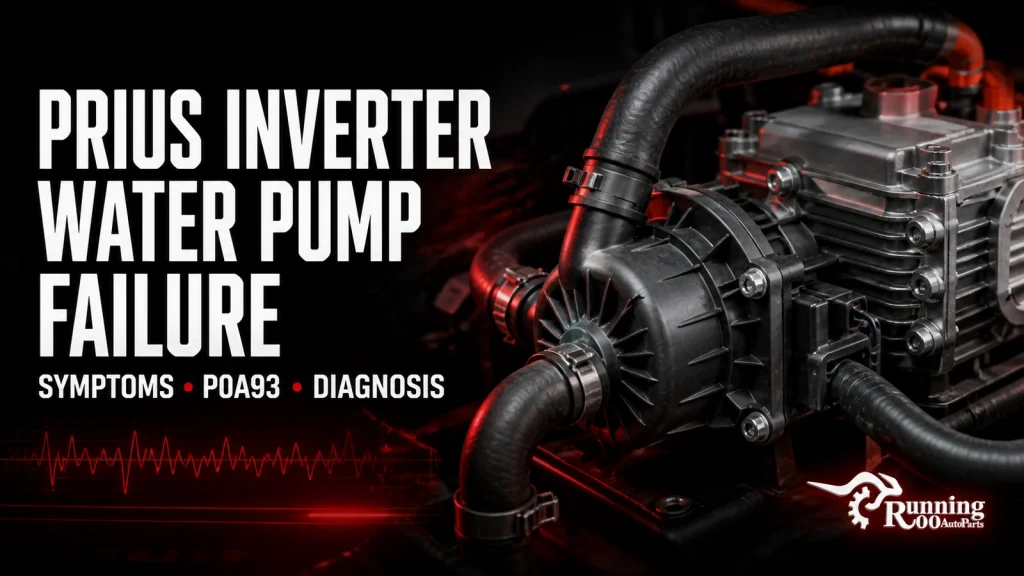
The second-generation Toyota Prius uses a dedicated electric pump to circulate coolant through the inverter and other hybrid-system components. This is not the same component as the engine water pump. When the inverter pump stops working, heat can build quickly and the vehicle may illuminate several warning lights, reduce power or shut down to protect the hybrid system.
Quick answer: common evidence includes a red master-warning light, a hybrid-system warning, diagnostic code P0A93, little or no coolant movement in the inverter reservoir, or a pump that is silent when commanded on. Because similar symptoms can come from low coolant, trapped air, wiring faults or inverter cooling-fan problems, confirm pump operation before ordering parts.
What the Prius inverter water pump does
The inverter converts high-voltage direct current from the traction battery into alternating current for the motor-generators. It also converts electrical energy in the opposite direction during regenerative braking. That work produces heat, so Toyota uses a separate low-temperature coolant circuit for the inverter assembly.
The electric inverter water pump keeps coolant moving through that circuit whenever operating conditions require it. It is independent of engine speed, which is important because the petrol engine frequently switches off while the hybrid system remains active.
Why 2004–2009 Prius pump failures matter
Toyota issued a safety campaign covering certain 2004–2009 Prius vehicles in some markets. Toyota’s campaign information explains that an internal motor-winding issue could stop the hybrid electric water pump. The resulting condition could illuminate warning lights and, in limited cases, open a power-supply fuse.
Toyota also explains that the hybrid pump serves a different purpose from the engine water pump. Owners should therefore be precise when describing or ordering the part. Australian vehicles should be checked by VIN with Toyota Australia or an authorised dealer because campaign coverage can differ by country and production date.
Typical inverter pump failure symptoms
- Red master-warning triangle
- Hybrid-system or check-engine warning message
- Diagnostic trouble code P0A93, often relating to inverter cooling performance
- Reduced-power or fail-safe operation after the vehicle warms up
- Warning lights that appear more readily in hot weather or slow traffic
- No audible pump operation when the pump is commanded on
- Little visible circulation or turbulence in the inverter coolant reservoir
- An open fuse or an intermittent electrical fault
None of these observations proves the pump has failed by itself. For example, P0A93 can be triggered when the cooling system cannot remove enough heat, which may also occur because of low coolant, trapped air, a restriction or an electrical supply problem.
Inverter pump, engine pump or air-conditioning pump?
| Component | Main job | Useful distinction |
|---|---|---|
| Inverter water pump | Circulates coolant through hybrid power-electronics components | Associated with inverter temperature and hybrid warnings |
| Engine water pump | Circulates engine coolant | Associated with engine temperature and the engine cooling circuit |
| Electric A/C compressor | Circulates refrigerant for cabin cooling | High-voltage component, but not a coolant pump |
A safe diagnostic sequence
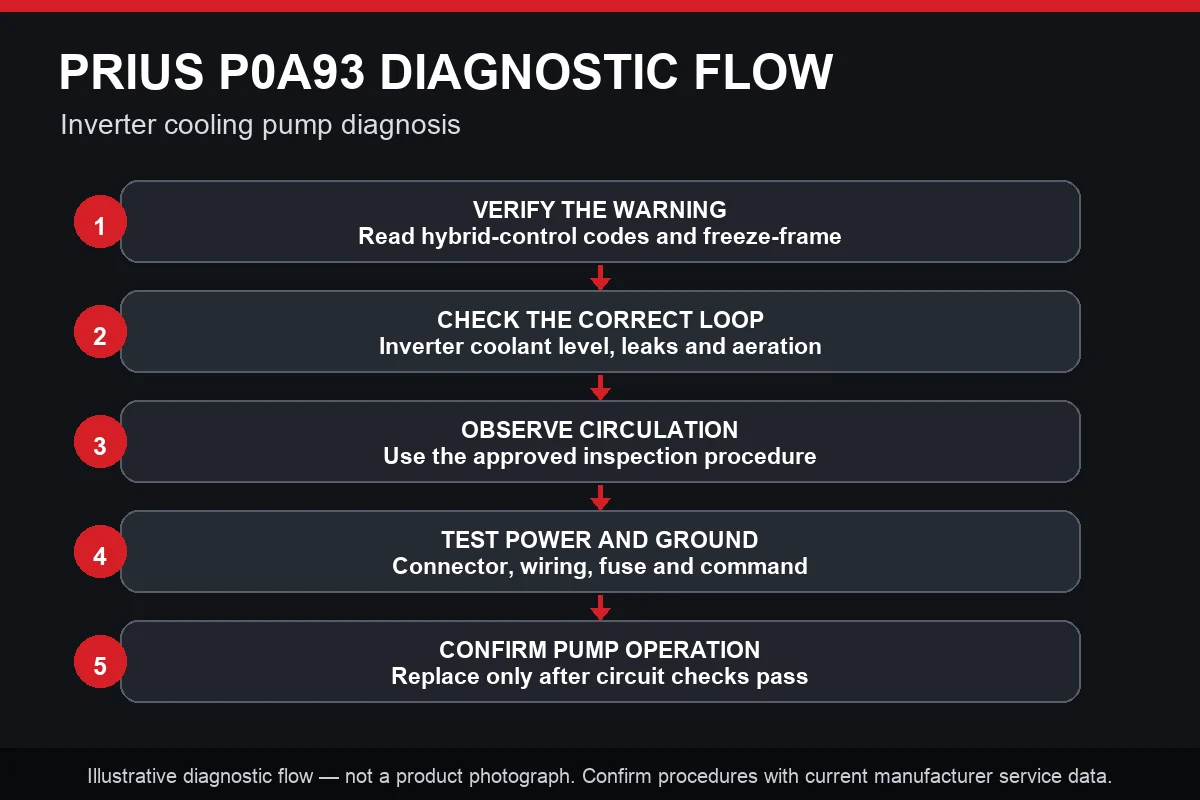
1. Read all control modules
Use a hybrid-capable scan tool and record current, pending and history codes before clearing anything. Freeze-frame information can show inverter temperature and the operating conditions present when the fault was stored.
2. Check the inverter coolant level when cold
Inspect the dedicated inverter reservoir, hoses and visible joints for low level, contamination or leakage. Never open a hot cooling system. If the circuit has recently been serviced, trapped air is a strong possibility.
3. Verify electrical supply
Check the relevant fuse, connector security, wiring condition and power/ground according to the correct wiring diagram. A new pump will not solve a damaged connector or missing supply voltage.
4. Command or observe pump operation
A technician can use the appropriate scan-tool active test where supported. Pump sound and reservoir movement are useful clues, but they must be interpreted carefully: a pump may run weakly, operate intermittently or spin without producing adequate flow.
5. Confirm system circulation and temperature behaviour
Compare commanded pump operation with coolant movement and live inverter-temperature data. If a pump runs but the temperature still rises abnormally, inspect for air, restrictions, hose routing and other cooling-system faults.
Part-number and fitment checks
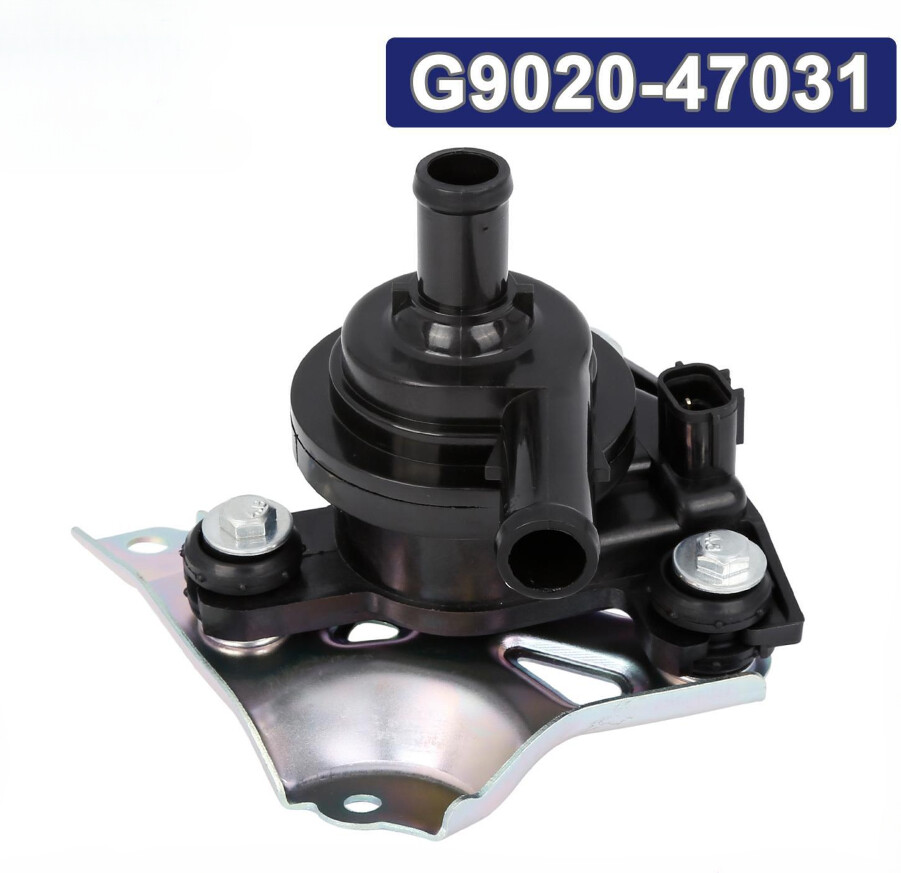
The RunningRoo replacement is listed for 2004–2009 Prius applications against references 04000-32528 and G9020-47031. These numbers are valuable starting points, but the VIN, build date, connector, hose layout and number printed on the removed pump should still be compared before purchase.
View the 2004–2009 Toyota Prius electric inverter water pump.
Replacement and bleeding considerations
- Allow the vehicle and coolant to cool before opening the system.
- Use coolant that meets Toyota’s specification for the exact vehicle.
- Keep dirt out of the reservoir, hoses and pump ports.
- Route hoses correctly and secure every clamp before filling.
- Bleed the inverter circuit using model-specific service information.
- Verify visible circulation, stable coolant level and leak-free operation.
- Clear codes only after recording them, then road-test while monitoring temperatures.
Air bleeding is not an optional finishing step. An air pocket can reduce coolant flow, create misleading pump noise and allow the inverter temperature to rise even when the new pump is operating.
Hybrid safety warning
The inverter and orange high-voltage cables can contain dangerous voltage. Replacing the low-voltage coolant pump does not authorise work on the high-voltage system. Do not disconnect, probe or dismantle high-voltage components unless you are trained, equipped and following Toyota’s isolation procedure. If the fault involves the inverter, high-voltage wiring or an insulation code, use a qualified hybrid technician.
Frequently asked questions
Does P0A93 always mean the inverter pump is faulty?
No. It indicates inadequate inverter cooling performance, not a guaranteed pump diagnosis. Check coolant level, flow, air bleeding, electrical supply and other cooling components.
Can I drive with a failed inverter water pump?
Continuing to drive risks overheating the power electronics and may leave the vehicle in fail-safe mode or unable to continue. If hybrid warnings appear or pump operation cannot be confirmed, arrange prompt diagnosis rather than relying on repeated code clearing.
Should the inverter reservoir show movement?
Normally, pump operation produces visible coolant movement. The amount varies with conditions, and absence of obvious turbulence should be confirmed with electrical and scan-tool testing before condemning the pump.
Is this the same pump used on every Prius generation?
No. Prius generations and production ranges use different pumps and layouts. Match the OE reference and VIN rather than ordering by the Prius name alone.
Final recommendation
For a 2004–2009 Prius with P0A93 or hybrid-temperature warnings, begin with evidence: scan all modules, inspect the dedicated coolant circuit, verify electrical supply and confirm actual pump flow. If the inverter pump has failed, fitment verification and thorough air bleeding are as important as the replacement part itself.
This article provides general technical information. Confirm current Toyota service procedures and recall status by VIN, and use a qualified hybrid technician whenever high-voltage diagnosis is required.