
By RunningRoo Auto Parts — written from the desk of our Product Manager
A timing chain replacement is a significant job, and the quote you receive is only as good as the diagnosis and the scope behind it. Asking the right questions before you approve the work is how you confirm the chain is actually the problem, that the repair is complete, and that you are not paying for a guess or a half-job. A good workshop will welcome the questions; a poor one will dodge them.
This guide lists the questions worth asking before a timing chain repair, why each one matters, and what a good answer sounds like. It is written for Australian owners preparing to approve the work.
RunningRoo Auto Parts – Based in Melbourne, Australia 🇦🇺
📞 Free 24/7 Pickup Available (Contact 0425890125)
💬 Any questions? Message or Call us anytime! We’re here to help.Why Choose RunningRoo?
✅ Aussie Owned & Operated | 🚚 Fast Shipping | 🤝 Friendly Support
Question one: how was it diagnosed?
The first question is how the diagnosis was reached. A good answer describes the fault codes, the cold-start listen and the camshaft-to-crankshaft correlation measurement that quantified the chain stretch. A poor answer is simply “it is a timing chain” with no measurement behind it.
This question matters because the chain, the tensioner and the VVT gear all produce similar symptoms, and the only way to separate them is measurement. A diagnosis that does not mention measurement is a guess.
Question two: what exactly is in the quote?
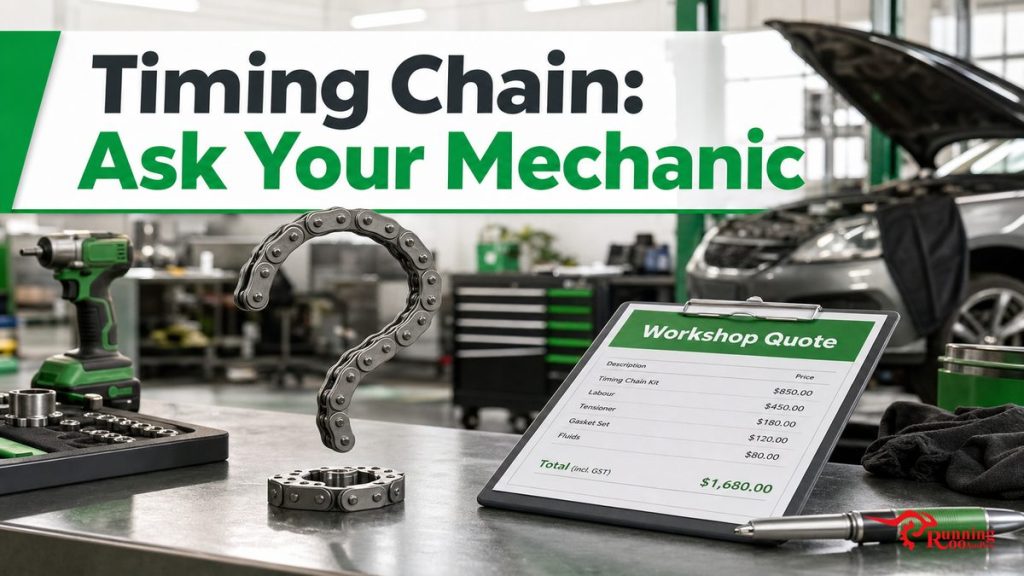
The second question is what the quote includes. A complete timing chain job renews the chain, the guides, the tensioner, the seals and the one-time-use fasteners, and often the VVT gears and the oil-pump chain where they live behind the same cover. The quote should itemise those parts, the oil and the labour.
The table below shows what a complete quote should mention.
| Item | Why it should be there |
|---|---|
| Chain, guides, tensioner | The matched wear set |
| Seals and fasteners | Prevent leaks and reuse |
| VVT gears and oil-pump chain | Renewed where they wear together |
| Oil and filter | Fresh lubrication from the first start |
A quote that lists only a chain is almost certainly incomplete.
Question three: will the VVT gears be checked?
On engines where the VVT gears sit with the timing chain, they wear together, and the question is whether they will be inspected and renewed where needed. A good workshop will explain what it found once the cover is off and renew the gears if they show wear. A workshop that never mentions them may be leaving a worn gear for a second teardown.
This is the same logic as the tensioner and the guides: the parts behind the cover are a set, and the honest repair renews the whole set.
Question four: how is the timing verified?
The fourth question is how the timing is verified. A correct job locks the engine at top dead centre with the manufacturer’s tools, fits the chain to the marks, turns the engine over by hand and re-checks before starting. A workshop that can describe that sequence is following the procedure; one that cannot is a risk.
This is the question that separates a careful repair from a careless one, because the verification is what saves the engine on an interference design.
Question five: what is the warranty?
The fifth question is the warranty, on both the parts and the labour. Under Australian Consumer Law, the work and the parts must be of acceptable quality and fit for purpose, and a written warranty is part of that protection. A workshop that stands behind the repair in writing is giving you the recourse you are entitled to.
The table below summarises what to confirm.
| Area | What to confirm |
|---|---|
| Parts | Written warranty and coverage |
| Labour | Warranty on the workmanship |
| Fitment | Engine code and VIN confirmed |
The warranty turns a verbal promise into something you can enforce.
The red flags to watch for
There are a few red flags that should give you pause. A quote with no measurement behind the diagnosis, a parts list that is only a chain, a refusal to discuss the VVT gears or the verification steps, and a warranty that is vague or absent are all reasons to get a second opinion.
The table below lists the red flags and what they suggest.
| Red flag | What it suggests |
|---|---|
| No measurement | Diagnosis by guess |
| Chain-only parts list | Incomplete repair |
| Vague verification | Risk of a timing mistake |
| No warranty | No recourse if it fails |
None of these means the workshop is dishonest, but together they mean the quote needs more questions.
Getting a second opinion
A significant quote is worth a second opinion, and the right way to ask is “what did you measure, and what is in the quote” rather than “is your price cheaper”. A second workshop that describes the same measurements and a complete parts list confirms the first; a second workshop that tells a different story tells you the diagnosis is not settled.
The goal is not the cheapest number but a complete, measured repair that is done once. The questions in this guide are how you find it.
What a good answer sounds like
When you ask these questions, the quality of the answer is the real test. A good workshop answers with specifics: the correlation measurement, the parts list, the VVT gear condition and the verification sequence. A poor workshop answers in generalities, tells you not to worry about it, or becomes defensive.
The table below contrasts the two.
| Good answer | Poor answer |
|---|---|
| Names the measurement | Says “it is the chain” |
| Itemises the kit | Lists only a chain |
| Explains the verification | Cannot describe it |
| Gives a written warranty | Vague or no warranty |
The answers you receive tell you more than the price ever will.
The parts list in detail
It is worth understanding what each item in a complete kit does, so the quote makes sense. The chain is the wear item, the guides keep it on its path, the tensioner holds it firm, the seals prevent leaks, and the one-time-use fasteners must not be reused. On many engines the VVT gears and the oil-pump chain are also behind the cover and renewed together.
The table below lists each item and its role.
| Part | Role |
|---|---|
| Chain | The primary wear item |
| Guides | Keep the chain on its path |
| Tensioner | Holds the chain firm |
| Seals and fasteners | Prevent leaks and reuse |
A quote that names these parts is complete; one that skips them is not.
The bottom line
The questions in this guide are not about being difficult; they are about confirming that the diagnosis is measured, the scope is complete and the warranty is real. A timing chain replacement done correctly is done once, and these questions are how you make sure of it.
Ask them before you approve the work, and the quote stops being a number and becomes a plan you can trust.
Confirming the diagnosis with a second pair of eyes
The questions in this guide are also the basis of a second opinion. When a second workshop is asked the same questions, the answers either confirm the first or reveal a gap. Two workshops that describe the same measurement and a complete parts list give you confidence; two workshops that disagree tell you the diagnosis is not settled.
That is the real value of asking rather than just comparing prices. The questions test the diagnosis, not the salesmanship, and they are how an owner finds a repair that is measured, complete and done once.
A final word
Approving a timing chain repair without these questions is how owners end up with a chain-only quote, a vague diagnosis or a repair that returns within a year. Asking them is not about distrust; it is about confirming that the work is measured, complete and backed by a warranty, which is exactly what the job deserves.
The right workshop will answer every one of them clearly, and the answers will give you the confidence to approve the work once rather than to pay for it twice.
A note to close
A timing chain quote is only as good as the diagnosis and the scope behind it, and the questions in this guide are how you see both. Ask them, and the quote becomes a plan you can trust rather than a number on a card.
In short
A measured diagnosis, a complete parts list and a written warranty are the three things that turn a timing chain quote into a repair you can approve with confidence. Look for all three, and the questions above will find them.
Frequently asked questions
What is the first question to ask?
How the diagnosis was reached, because the chain, tensioner and VVT gear must be separated by measurement.
What should a complete quote include?
The chain, guides, tensioner, seals, fasteners, oil, and the VVT gears and oil-pump chain where they apply.
Should the VVT gears be checked?
Yes, and renewed where they show wear, because they sit with the chain and wear together.
How is the timing verified?
The engine is locked, the chain fitted to the marks, the engine turned by hand and re-checked before starting.
What warranty should I expect?
A written warranty on both the parts and the labour, consistent with Australian Consumer Law.
What are the red flags?
No measurement, a chain-only parts list, vague verification and no warranty.
Should I get a second opinion?
For a significant quote, yes, and ask what was measured and what is included.
How do I avoid paying twice?
Approve a complete, measured repair that renews the whole worn set in one job.
Shop the products mentioned in this guide
- Timing Chain Kit for Hyundai i45 / Kia 2.4L G4KJ 2009–2017
- Timing Chain Kit for Mazda 3/5/6/Tribute 2.3L with VVT adjuster 2003–2007
- Timing Chain Kit for Nissan Teana J31/J32 VQ23DE VQ25DE VQ35DE 2003–2013
- Timing Chain Kit range — eBay
Watch on RunningRooAuto YouTube
- RunningRoo Auto Parts – trusted Melbourne parts support
- RunningRoo Auto Parts – product and fitment channel
RunningRoo Auto Parts – Based in Melbourne, Australia 🇦🇺
📞 Free 24/7 Pickup Available (Contact 0425890125)
💬 Any questions? Message or Call us anytime! We’re here to help.Why Choose RunningRoo?
✅ Aussie Owned & Operated | 🚚 Fast Shipping | 🤝 Friendly Support
Sources and further reading
- ACCC – Consumer rights and guarantees
- Product Safety Australia – vehicle recalls
- RACV – car maintenance and repair guidance
- API – Engine oil standards
- ACEA – European oil sequences
Engine timing procedures, locking-tool requirements and component wear limits are engine-specific and are set out in each manufacturer’s workshop manual. Confirm the engine code and VIN against the official repair information before approving any repair.
RunningRoo Auto Parts – Based in Melbourne, Australia 🇦🇺
📞 Free 24/7 Pickup Available (Contact 0425890125)
💬 Any questions? Message or Call us anytime! We’re here to help.Why Choose RunningRoo?
✅ Aussie Owned & Operated | 🚚 Fast Shipping | 🤝 Friendly Support