
By RunningRoo Auto Parts — written from the desk of our Product Manager
Variable valve timing is one of the quiet revolutions of the modern engine, improving power, fuel economy and emissions by changing when the valves open and close on the fly. The component that makes it happen is the VVT gear, also called a cam phaser or camshaft adjuster, and understanding how it works is the key to understanding why it fails and why the oil matters so much. The mechanism is simpler than it sounds once it is broken down.
This guide explains how a VVT gear works in plain terms, what the oil-control solenoid does, and why the whole system depends on engine oil. It is written for Australian owners who want to understand the part before they ever have to buy one.
RunningRoo Auto Parts – Based in Melbourne, Australia 🇦🇺
📞 Free 24/7 Pickup Available (Contact 0425890125)
💬 Any questions? Message or Call us anytime! We’re here to help.Why Choose RunningRoo?
✅ Aussie Owned & Operated | 🚚 Fast Shipping | 🤝 Friendly Support
Why valve timing matters
An engine’s valves must open and close at precise moments relative to the pistons, and that timing changes what the engine does well. Opening the intake valves earlier or later, or holding them open longer, trades power, economy and emissions against one another. A fixed timing is a compromise; variable timing lets the engine choose the best timing for the moment.
The VVT gear is the mechanism that changes that timing while the engine runs, and it does so continuously, many times a second.
Where the VVT gear sits
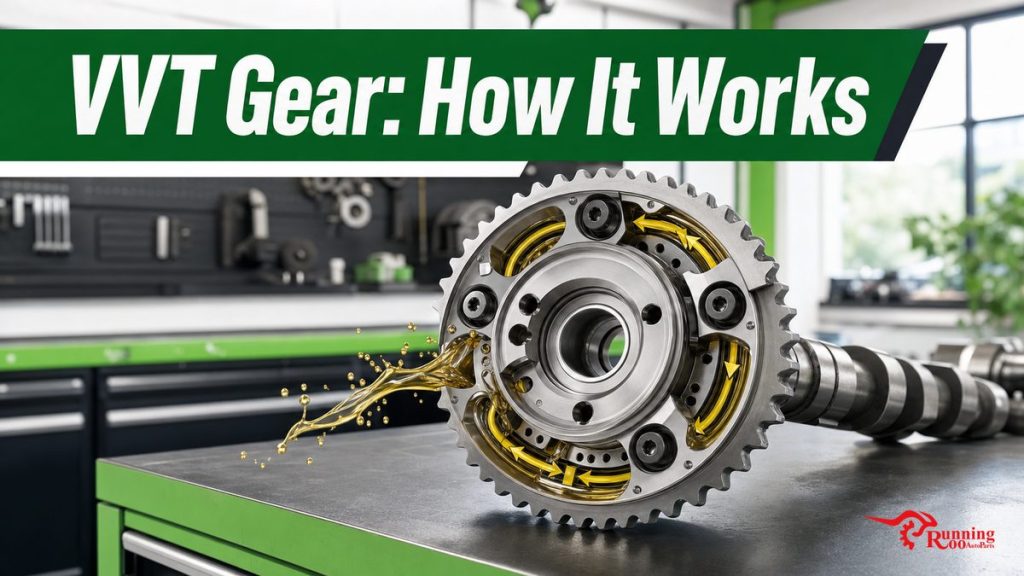
The VVT gear sits on the end of a camshaft and is driven by the timing chain or belt. It looks like a sprocket, but inside it is not solid: it contains a mechanism that lets the outer sprocket and the inner camshaft rotate slightly relative to one another. That relative rotation is what advances or retards the valve timing.
This is why the gear is a precision part. It has to transmit the drive of the chain while allowing a controlled amount of relative movement, all at engine speed.
How the oil does the work
The relative movement inside the gear is driven by engine oil pressure. Pressurised oil is directed into chambers inside the gear, where it pushes a rotor or vanes one way or the other, rotating the camshaft relative to the sprocket. The engine computer decides how far and in which direction, and commands the oil-control solenoid to direct the oil accordingly.
The table below summarises the sequence.
| Step | What happens |
|---|---|
| Computer commands | Decides the desired timing |
| Solenoid directs | Routes oil into the gear |
| Oil pressure pushes | Rotates the camshaft relative to the sprocket |
| Sensor verifies | Confirms the camshaft position |
This is the whole system in four steps, and every step depends on clean, pressurised oil.
The oil-control solenoid
The oil-control solenoid is the valve that directs the oil into one side of the gear or the other. It is commanded by the engine computer and is effectively the gear’s throttle: without it, the gear cannot move even if it is mechanically perfect. This is why a failing solenoid produces exactly the same symptoms as a failing gear.
The solenoid is also usually much cheaper than the gear, which is why it is tested or replaced before the gear is condemned when a VVT fault is diagnosed.
The locking pin and the cold start
When the engine is switched off, oil pressure falls to zero, and the gear needs a way to hold the camshaft in a fixed position until pressure returns. A locking pin does that job: it locks the gear’s two halves together while the engine is parked, then releases once oil pressure builds on start-up.
When that locking pin or its bore wears, the gear rattles for a second or two on cold start until pressure takes over. That brief rattle is one of the most reliable early warnings of VVT gear wear.
Why the oil is the whole story
Everything about the VVT gear points back to the oil. The gear is moved by oil, the solenoid is fed by oil, and the locking pin’s reliability depends on a clean supply. Low oil, the wrong viscosity or sludged oil all degrade the system’s response and wear the gear and the solenoid prematurely.
This is why so many VVT faults turn out to be oil faults, and why the correct oil and a clean supply are the cheapest protection the VVT system has.
The sensors that close the loop
The system is a closed loop. The engine computer commands the timing, the solenoid and the gear carry it out, and the camshaft position sensor reports the result. When the reported position does not match the commanded position, the computer sets a fault code. That code is the first sign that something in the chain, the gear, the solenoid or the oil is not doing its job.
The table below lists the components and their role.
| Component | Role |
|---|---|
| VVT gear | Moves the camshaft relative to the sprocket |
| Oil-control solenoid | Directs the oil |
| Camshaft position sensor | Reports the result |
| Engine oil | Supplies the pressure |
Understanding this loop is how a diagnosis stays honest, because a fault in any link looks like a gear fault.
How the gear is made
The VVT gear is a precision part, and its construction reflects the job it does. Close-tolerance internal components slide against one another under oil pressure, and the locking pin must engage and release reliably millions of times. That demands precise machining, correct materials and consistent tolerances, which is why a quality gear is worth the difference over a cheap copy.
The internal parts are not visible from the outside, which is one reason the gear is judged by its manufacturer and its fitment rather than by appearance alone.
The relationship with the timing chain
The VVT gear is driven by the timing chain, and the two share the same oil, load and service life. This is why a gear that rattles and drags also shortens the life of the chain, and why the two are so often renewed together while the engine is open. They are not separate systems; they are two parts of the same timing system.
Understanding that relationship is how a VVT repair is scoped correctly, because replacing a gear while leaving a worn chain, or a chain while leaving a worn gear, is a repair that invites a return.
Why the system is a loop
The VVT system is a closed loop, and that is why a fault in any link looks the same. The computer commands, the solenoid directs, the gear moves and the sensor reports, and a problem anywhere in that loop produces the same code. This is the reason a correct diagnosis checks the cheap links, the oil and the solenoid, before the expensive gear.
The loop is also why the system is self-correcting until it is not. The sensor catches drift early, but only if the codes are read and acted on rather than cleared and ignored.
Why understanding it protects you
Understanding how the VVT gear works is not just interesting; it is the best protection an owner has. When you know that the gear is moved by oil, that the solenoid directs the oil, and that the sensor closes the loop, you understand why the diagnosis always checks the oil and the solenoid before the gear. That understanding is what stops a cheap fix being skipped in favour of an expensive part.
It also explains why the cold-start rattle and the fault codes matter, and why the correct oil is the cheapest protection the VVT system has. The owner who understands the system is the owner who does not pay for a gear when an oil change would do.
A final word
The VVT gear is a small part doing a big job, and the way it works explains everything about how it fails and how it is repaired. It is moved by oil, directed by a solenoid and verified by a sensor, and that loop is why the diagnosis always starts with the cheap causes and why the oil is the cheapest protection the system has.
Once you understand the loop, the VVT gear stops being a mysterious expensive part and becomes a system you can maintain and diagnose sensibly.
A note to close
The VVT gear is a closed loop of command, oil and verification, and once that loop is clear, the part stops being mysterious. Maintain the oil, read the codes and understand the solenoid, and the gear becomes a system you can care for rather than a surprise expense.
In short
Oil moves the gear, the solenoid directs it, and the sensor verifies it. Hold on to those three facts, and every VVT fault and repair begins to make sense, from the cold-start rattle to the fault code.
Frequently asked questions
What does a VVT gear do?
It rotates the camshaft slightly relative to its sprocket to advance or retard the valve timing.
What moves the VVT gear?
Engine oil pressure, directed by an oil-control solenoid under command from the engine computer.
What is a cam phaser?
It is another name for the VVT gear or camshaft adjuster.
Why does the gear rattle on cold start?
Often a worn locking pin, because it holds the gear while parked until oil pressure builds.
Why is the oil so important?
The gear is moved and lubricated by oil, so the oil’s level, viscosity and condition decide how well it works.
What does the oil-control solenoid do?
It directs oil into the gear to move the camshaft in the commanded direction.
What is the camshaft position sensor for?
It reports the camshaft position so the computer can confirm the timing it commanded.
Why do VVT faults look like gear faults?
Because the gear, the solenoid and the oil are one system, and a fault in any part produces the same symptoms.
Shop the products mentioned in this guide
- Engine VVT Timing Oil Control Valve for Mercedes-Benz SLK250 W204 A2710500578
- Oil Control Valve Solenoid for Jeep / Dodge / Chrysler 3.2–3.6L V6 5184150AF 11–19
- VVT Camshaft Gears Intake & Exhaust for Toyota Corolla 2007–2012 1.8L 2ZR-FE
- VVT gears and oil control valves on eBay
Watch on RunningRooAuto YouTube
- RunningRoo Auto Parts – trusted Melbourne parts support
- RunningRoo Auto Parts – product and fitment channel
RunningRoo Auto Parts – Based in Melbourne, Australia 🇦🇺
📞 Free 24/7 Pickup Available (Contact 0425890125)
💬 Any questions? Message or Call us anytime! We’re here to help.Why Choose RunningRoo?
✅ Aussie Owned & Operated | 🚚 Fast Shipping | 🤝 Friendly Support
Sources and further reading
- ACCC – Consumer rights and guarantees
- Product Safety Australia – vehicle recalls
- RACV – car maintenance and repair guidance
- API – Engine oil standards
- ACEA – European oil sequences
VVT system operation, oil-pressure specifications and component functions are engine-specific and are described in each manufacturer’s workshop manual. Confirm your engine code and VIN against the official repair information.
RunningRoo Auto Parts – Based in Melbourne, Australia 🇦🇺
📞 Free 24/7 Pickup Available (Contact 0425890125)
💬 Any questions? Message or Call us anytime! We’re here to help.Why Choose RunningRoo?
✅ Aussie Owned & Operated | 🚚 Fast Shipping | 🤝 Friendly Support