
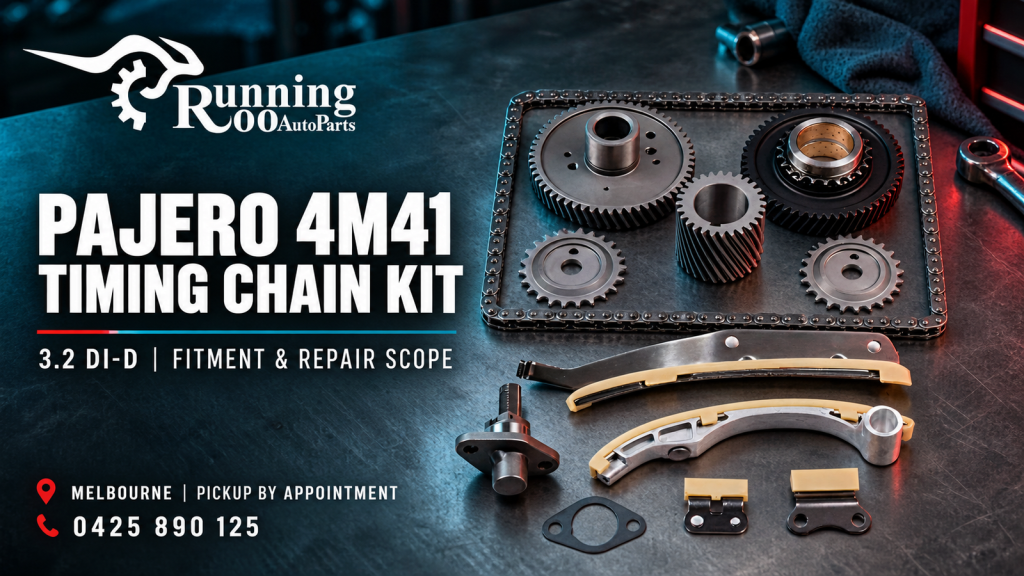
Choosing a Pajero 4M41 timing chain kit starts with identifying the actual 3.2-litre diesel engine and agreeing on the repair scope. A long application list can help you find a candidate product, but it cannot replace a VIN check or a workshop diagnosis. For an Australian owner preparing a touring vehicle, maintaining a family four-wheel drive or repairing a recently purchased Pajero, the right question is what this particular engine needs now.
The RunningRoo 4M41 timing chain kit and matching RunningRoo eBay item were both verified as on sale when this guide was prepared. The selected package is advertised with a chain, tensioner, guides and several gears. That makes the contents particularly important: a quotation for a smaller chain-and-guide package may not describe the same purchase.
RunningRoo is an Australian-operated business based in Blackburn, Melbourne. Call 0425 890 125 for friendly support with vehicle details and product identification. Melbourne local pickup is available by appointment, and fast dispatch can be discussed once the application and current stock are confirmed. Arrange parts readiness before committing the vehicle to a time-sensitive workshop booking.
Listing detail to confirm: At the time of checking, the eBay item-specific quantities appeared doubled compared with the seller description and the website contents list. The table above reflects the described single kit; it does not promise two kits or twice the components. Obtain a written current packing list before comparing prices or paying.
VIN · complete engine code · OE reference
Professional diagnosis · required parts · written contents
Current dispatch estimate · pickup appointment · workshop booking
Start with 4M41, then establish the vehicle version
Send the full VIN, build date and engine identification with your enquiry. Include the model designation shown in the vehicle records rather than relying solely on a badge. If the vehicle is an import, explain that and provide the original market details available to you. An engine code is an essential filter, but the supplier still needs the vehicle context to check the proposed parts.
The selected product title mentions Pajero and Montero, and the description includes Shogun and overseas applications. These names should not be read as an unrestricted compatibility promise. Ask whether the current supplied kit is appropriate for your VIN and the engine identified by the workshop. The answer should refer to your vehicle, not merely repeat the entire marketplace title back to you.
If the engine has been replaced, record what is known about that replacement. A receipt, engine number or previous workshop report may be more useful than a photograph of the outside of the vehicle. Let the installer decide which component markings can be checked without unnecessary dismantling. Where evidence is missing, a clear explanation of the remaining fitment question is preferable to an optimistic guess.
Compare the actual contents, not just the word kit
The website’s current description lists one 110-link chain, one tensioner, four guides, one crank gear, one cam gear, one injector-pump gear and one idler gear. These are seller-stated package details. They help define the enquiry but do not independently prove that every listed item matches every engine version. Request confirmation of the supplied specification before ordering.
| Advertised component | Question for the supplier or installer | Purchase implication |
|---|---|---|
| Chain described as 110 links | Is this the correct chain for the confirmed application? | A length description is not a complete fitment check |
| One tensioner | Is its application confirmed with the kit? | Compare complete quotations on the same basis |
| Four guides | Which supplied pieces correspond to the repair requirement? | Do not infer guide identity from count alone |
| Crank and cam gears | Are these the gears the workshop intends to replace? | Included gears may change the quoted scope |
| Injector-pump and idler gears | Are both required and correct for this engine? | Their names need to match the workshop’s parts list |
| Seals and other consumables | What remains outside this package? | Allow for a complete, itemised repair order |
Open the specific RunningRoo kit and its corresponding eBay listing while discussing the quotation. A mechanic should not have to identify which of several similarly named products you intend to supply. Sharing the exact link prevents a conversation about one kit from becoming an order for another with a different combination of components.
What the original Mitsubishi material tells us
Mitsubishi’s historical 4M41 workshop material treats the chain, tension lever and guide plate as separately inspectable components. Section 11B-19-6 describes a defined chain-clearance assessment and checks for damage on contact surfaces. The useful point is that a replacement decision can be based on an inspection procedure, rather than the sound of a video or the odometer alone. See the Mitsubishi factory-manual extract.
This is original Mitsubishi technical material reproduced in a third-party preview, dated February 2000. It is not a current instruction for every later Pajero. The workshop must establish the applicable procedure and limits for the engine being repaired. This guide therefore does not transplant the historical measurement values, assembly sequence or tightening specifications into a universal Australian repair recipe.
Use that distinction when discussing the job. Ask which current workshop information supports the diagnosis, what was inspected and how the proposed components relate to the findings. A responsible answer may include some uncertainty until access is gained. What matters is that the uncertainty is identified and that additional work requires a clear explanation before you approve it.
Plan diagnosis around the actual complaint
Record the circumstances in which you noticed the concern: first start, warm operation, after a service, or after another repair. Tell the mechanic whether the concern has changed over time and whether warning lamps have appeared. If the vehicle has recently returned from a trip, provide the relevant history without deciding that the trip must have caused the problem.
A sound recording can make an intermittent complaint easier to describe, but it is not a measurement of chain condition. Ask for an assessment of the noise source and the evidence behind the repair recommendation. If a technician proposes opening the engine for further inspection, agree what that initial stage includes and how you will be contacted when the findings are available.
Avoid buying a kit simply because another owner reports the same symptom. The useful information from another repair may be the questions to ask, not the parts to copy. Your Pajero’s records, fitted components and inspection results should determine the order. If professional diagnosis points elsewhere, address that result rather than forcing a timing-chain purchase into the plan.
Decide which gears belong in your repair
A kit that includes gears can be attractive when the workshop has asked for those components. It should still be checked against an itemised list. Ask the mechanic to distinguish components it recommends replacing from those it intends to inspect and retain if suitable. The supplier can then confirm the correct package without being asked to make an unseen diagnosis.
If a quotation specifies only chain, guides and tensioner, ask whether the selected gear-inclusive package is the intended product. There may be a straightforward explanation, or the workshop may prefer a different scope. Either way, settle the question before the parcel arrives. A larger list of included parts is not by itself proof that the workshop should fit every item.
Where an additional component is proposed after dismantling, request a brief description or photograph of the finding and an updated estimate. This keeps the change understandable. It also provides an opportunity to check the new part reference before ordering, rather than assuming the original kit’s broad application wording also validates every additional item.
Touring preparation requires a realistic schedule
If a trip is approaching, tell the workshop the departure date when booking the diagnostic visit. Allow the mechanic to advise on suitability for continued use and the time needed for assessment, parts confirmation and repair. Do not turn a supplier’s dispatch estimate into a promise that the vehicle will be ready for remote travel on a particular day.
Discuss whether the workshop wants to see the vehicle before parts are purchased. When the diagnosis is already established, having a confirmed kit ready may help scheduling. When the cause remains uncertain, an inspection-first arrangement may prevent an unnecessary order. The best sequence is the one agreed with the technician responsible for the vehicle.
For local customers, RunningRoo’s Melbourne pickup by appointment can make an agreed order easier to collect. Call 0425 890 125 to confirm readiness and the Blackburn collection arrangement. For interstate orders, request the current delivery estimate to your postcode and allow for transport variability. Fast dispatch concerns the supplier’s release of the order; it does not control every stage of the carrier’s journey.
Make the estimate suitable for comparison
Ask each workshop to identify the proposed parts package and additional consumables. A headline timing-chain price can omit items that another estimate includes. Compare the agreed diagnosis, included work and completion checks, then consider the total. This gives you a more useful basis for a decision than comparing a website kit price with a fully installed workshop figure.
Ask how the workshop handles owner-supplied parts if you plan to buy directly. Clarify when it will inspect the parcel and what happens if the supplier needs more application information. Keep both parties’ contact details available. The arrangement works best when the workshop knows exactly what is being supplied and the parts supplier receives the mechanic’s requirements clearly.
Do not expect an OE reference in a listing to prove an aftermarket part was manufactured by Mitsubishi. An application reference and a manufacturer’s identity answer different questions. Ask for the product’s actual description, current written terms and fitment confirmation. Avoid adding unsupported claims such as genuine factory supply, guaranteed lifespan or universal upgraded design to your own order notes.
Inspect and document the delivery
Before installation, compare the delivered contents with the written order. Keep labels and packaging until the workshop is satisfied that the kit is correct. If a guide, gear or other component differs from what was expected, photograph it and contact the supplier before proceeding. Identifying a discrepancy early is easier than explaining it after components have been mixed with the removed parts.
Ask the installer to retain enough information to identify what was fitted: the invoice reference, product label and any relevant part markings. This is particularly helpful where a vehicle has had previous engine work. A future technician should be able to understand the recent repair without having to reconstruct it from an old marketplace title.
A visible difference between old and new components deserves a check, but photographs alone may not settle it. Let the workshop and supplier establish whether the difference is an approved application detail or evidence of a mismatch. Do not grind, drill or otherwise alter a part merely to make it fit an assumed location. Resolve the identification question first.
Ask for a clear handover after the repair
At collection, ask the workshop to explain the completed scope, any additional findings and the result of its checks. If the original complaint was intermittent, ask how that condition was assessed. If further observation is needed, agree what you should record and when to contact the workshop. This turns the invoice into useful maintenance information rather than a list of unexplained charges.
Keep the date, odometer reading, diagnostic report, supplier confirmation and repair invoice together. The records support future maintenance decisions and help a new owner understand the work. They do not establish a universal distance at which the next chain replacement will be necessary. Follow the applicable manufacturer guidance and the workshop’s vehicle-specific advice.
If a new concern appears after collection, describe it promptly and objectively. State when it occurs and whether it resembles the original complaint. Refer to the completed work and ask for an assessment. Avoid ordering a second set of parts before the installer has had an opportunity to review the result and explain the next step.
Frequently asked questions
Is a Pajero badge enough to confirm this kit?
No. Provide the VIN, build details and confirmed 4M41 engine identification. The selected listing includes several model names and markets, which should be treated as catalogue leads rather than a universal fitment guarantee. Changed engines and imported vehicles may require additional information.
Does the selected package include gears?
The website description reviewed for this guide lists crank, cam, injector-pump and idler gears alongside the chain, tensioner and four guides. Ask RunningRoo to confirm the current supplied contents and have the workshop check that those components match its intended repair scope.
Should every included gear automatically be installed?
The workshop should decide the repair scope using the appropriate procedure and inspection results. Ask it to explain the proposed component list before buying. The fact that an item is included in a package does not replace an application check or a professional decision about the job.
Does mileage alone establish that the chain is worn?
Use the workshop’s diagnosis and the applicable manufacturer information, rather than a universal mileage claim. This article does not establish a replacement interval for every 4M41. Ask what inspection supports the recommendation and which current vehicle procedure is being followed.
Is the linked factory extract a complete installation guide?
No. It is a historical Mitsubishi extract used to explain the importance of defined inspection. The current vehicle-specific workshop procedure must govern the repair. The linked material does not certify the aftermarket kit or prove compatibility with every vehicle in the seller’s application list.
Where can I order with local support?
Use the RunningRoo 4M41 kit page or verified matching eBay item. For friendly assistance from an Australian-operated Melbourne business, call 0425 890 125 or visit the contact page. Confirm fitment, stock and fast dispatch arrangements, or book local pickup in Blackburn.
Related RunningRoo guides
For wider background, read Timing chain kit fitment and engine codes and Questions to ask your mechanic before a timing-chain repair. These explain the broader checks; the product and engine references in this article define its specific ordering scope.
Sources and verification scope
Product availability and seller descriptions were checked on 8 October 2026. Stock, contents and terms can change; obtain current confirmation before purchase. Technical context is drawn from the manufacturer-issued material below. Copies on third-party archives are identified as such. They do not certify this aftermarket product or replace current vehicle-specific service information.
- Mitsubishi 4M41 Engine workshop manual PWEE9409-DE, February 2000, 11B-19-6 — Original Mitsubishi material reproduced in a third-party PDF preview. Historical inspection context; confirm current vehicle procedure.