
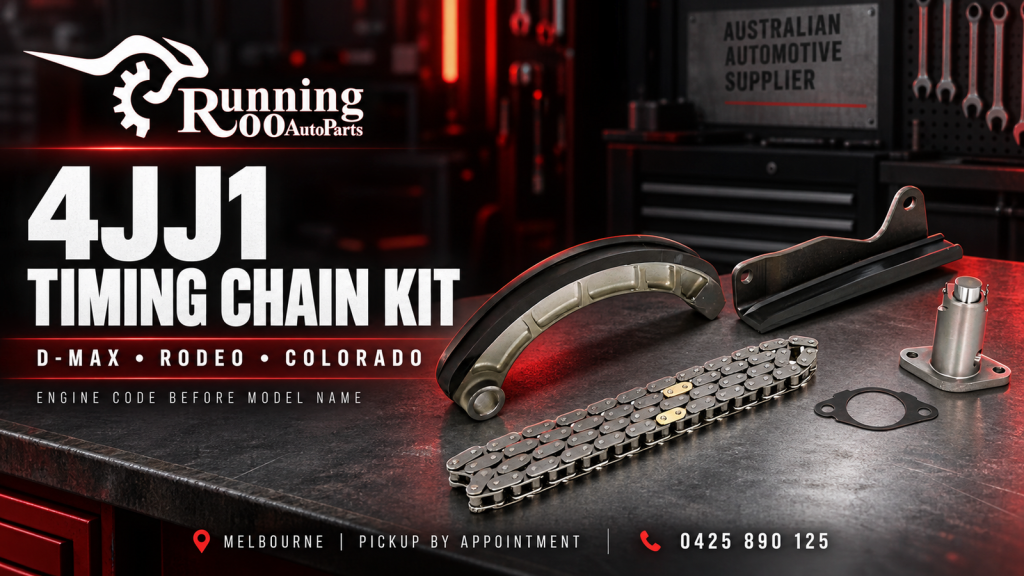
A 4JJ1 timing chain kit should be chosen against the engine in your vehicle and the repair your workshop has diagnosed. The words D-MAX, Rodeo or Colorado are useful starting points, but they are not a parts specification. Before ordering, establish the VIN, complete engine code, build information and the components your mechanic actually needs. That preparation is especially worthwhile when an older working ute has incomplete service records or a replacement engine.
RunningRoo lists a 4JJ1-TC timing chain kit for selected D-MAX, Rodeo and Colorado applications, with a corresponding active RunningRoo eBay listing. Both were checked for this article. The website describes a chain, tensioner, tensioner gasket and two guides. Treat that as a defined package to confirm, rather than a promise that every component in a diesel timing drive is included.
For help assembling the order, call 0425 890 125. RunningRoo is an Australian-operated parts business in Blackburn, Melbourne, offering friendly support, local pickup by appointment and fast dispatch subject to current stock and order arrangements. Send your vehicle details before paying so the supplier and installing workshop can work from the same information.
Listing detail to confirm: The eBay item-specific fields checked for this article label the type as “Clock Spring” and show a different manufacturer reference, despite the timing-chain title and description. Do not use those fields to establish fitment. Ask RunningRoo to confirm the actual kit identification, contents and applicable OE references in writing before ordering.
VIN · complete engine code · OE reference
Professional diagnosis · required parts · written contents
Current dispatch estimate · pickup appointment · workshop booking
Identify the ute before identifying the kit
Begin with a photograph of the vehicle identification plate and the full VIN. Add the registration, build month and year, and the engine identification shown on the vehicle or workshop report. If the mechanic records 4JJ1-TC, include the suffix rather than shortening the enquiry to “Isuzu diesel”. If the identification is uncertain, resolving it is the next step; selecting a listing from a similar-looking vehicle is not a substitute.
A replacement engine deserves a separate note. The VIN describes the vehicle as built, while the installed engine may have a different history. Ask the workshop to tell the supplier what is physically installed, with relevant part markings where accessible. This does not mean dismantling a healthy engine merely to place an enquiry. It means recognising when the usual vehicle-based catalogue lookup needs additional evidence.
Be careful with the Holden model names in broad marketplace titles. A product mentioning Colorado does not establish compatibility with every Colorado diesel. Likewise, an advertised year range cannot settle all production variations, overseas-market versions or changed engines. Keep the requested component tied to the confirmed engine and the applicable parts catalogue, and ask for any remaining uncertainty to be explained before committing to a repair booking.
What is offered in the selected package?
The selected website listing describes one 88-link chain, one tensioner, one tensioner gasket and two guides. Those are seller-stated contents, not an instruction to choose a chain simply by counting links. Have RunningRoo confirm the current supplied version and let the workshop reconcile it with its parts requirement. Small descriptions such as “gasket included” can matter when comparing otherwise similar shopping baskets.
| Item in the listing | What to confirm before ordering | Why it belongs in the quote |
|---|---|---|
| One chain, described as 88 links | Correct application and current chain specification | Link count alone is insufficient identification |
| One tensioner | Correct assembly for the confirmed engine | A separately priced tensioner changes the comparison |
| One tensioner gasket | Included in the current parcel | Sealing consumables should be accounted for |
| Two guides | Correct shapes and mounting arrangements | The workshop needs the intended guide package |
| Sprockets or other gears | Whether any are required separately | They are not promised in this selected contents list |
| Additional seals and fasteners | Mechanic’s itemised requirements | The kit and the complete job are different scopes |
Review the RunningRoo product page alongside the matching eBay item, especially if you are comparing delivery options or buying on behalf of a workshop. Marketplace prices, quantities and terms can change. The current checkout and the written fitment reply should be the commercial reference for your order, rather than a saved search result or a price copied into an old forum discussion.
The technical reason to define the repair scope
The OEM-issued Hitachi manual for an industrial 4JJ1 shows the timing chain working with camshaft and fuel-supply-pump sprockets, separate alignment references, guides and a tensioner. It also includes a post-assembly rotational check. This illustrates why “replace the chain” is an incomplete work instruction: component identification, tensioner handling and timing verification belong to the repair. See the original OEM material reproduced here, Engine Mechanical sections 1A-70 and 1A-71.
That document concerns an industrial engine. It is used here only to explain architecture, not to supply D-MAX or Holden torque values, timing marks or installation steps. Your technician must use the current procedure for your vehicle and engine. Do not transfer an industrial specification into a road-vehicle job because the first four characters of the engine name match.
The practical purchasing lesson is to ask the mechanic for a component list that reflects the actual diagnosis. If the workshop requires gears beyond the advertised package, identify them separately. If it needs only the listed chain-drive components, avoid assuming a bigger box automatically provides a better repair. The decision should be traceable to the vehicle, the inspection and the agreed scope.
Describe the complaint so diagnosis can start efficiently
A useful booking note explains when the concern occurs. Record whether it began suddenly or gradually, whether it is associated with starting, and whether any warning lamp appeared. Include recent servicing, previous timing work and the circumstances in which the vehicle is used. An owner who relies on the ute for work should also tell the workshop how much downtime can be accommodated, without asking it to skip diagnosis to meet a deadline.
Use ordinary observations rather than assigning a cause. “A new noise on the first start of the day” is more useful than confidently calling it chain stretch before testing. A short recording can help communicate the complaint, but it cannot show every internal condition. Let the mechanic decide what checks are appropriate and whether continued use is suitable while the cause is investigated.
Request a written explanation separating findings from possibilities. For example, the report might identify a confirmed component problem and list further parts that can only be assessed after access is gained. That distinction helps you authorise the initial stage while retaining control over additional spending. Ask the workshop to contact you before expanding the repair beyond the agreed parts and labour.
Fault codes need context, not a shopping shortcut
If a diagnostic scan has been performed, keep the complete report, including the exact code wording and the conditions recorded by the technician. Do not reduce the information to “timing fault” in a supplier message. Ask what testing connected the code to the proposed repair and what alternatives were considered. A parts supplier needs the result of diagnosis; it should not be expected to identify an internal fault from a code alone.
Similarly, a report saying that a sensor was checked should state whether it passed the relevant test. If several replacement parts have already been tried, list them and the result of each intervention. This prevents the next workshop from assuming the vehicle has an untouched system. It also helps everyone distinguish the present complaint from an unrelated issue resolved earlier.
Keep diagnostic approval separate from parts approval. You can authorise a workshop to establish the cause before selecting a kit. Once the repair is defined, ask RunningRoo to confirm the proposed product against the vehicle information. This sequence produces a clearer purchase decision than ordering several possible parts and hoping the mechanic can use whichever one proves relevant.
Make the quotation understandable
Ask for the kit, additional parts, consumables, labour and final checks to appear as distinct lines. The purpose is not to challenge every workshop charge. It is to make sure two estimates describe comparable work. An inexpensive kit-only figure and a complete installed estimate answer different questions, and neither should be presented as the other.
For a fleet or work vehicle, include the cost of being without the ute in your planning, but do not convert that pressure into an assumed delivery guarantee. Agree when the vehicle should arrive, whether the parts must be available first, and how the workshop will handle extra findings. A clear communication plan can be more valuable than a vague promise that the entire job will be finished quickly.
If you supply the parts yourself, discuss that arrangement with the mechanic before ordering. Confirm how the workshop will check the parcel, document fitment and communicate a problem. Keep the supplier invoice and the workshop invoice together. They describe different contributions to the repair, and maintaining both records makes later questions much easier to resolve.
Check the parcel before the installation appointment
When the parts arrive, retain the packaging and labels until the workshop has inspected the order. Compare the delivered items with the supplier’s confirmed contents list. Photograph any discrepancy before parts are installed or packaging is discarded. A missing component is easier to resolve while the order remains clearly identifiable and the vehicle has not been scheduled around an incomplete parcel.
Ask the installer to compare the new parts with the application requirements before proceeding. If a component appears different, request a supplier check rather than modifying it to make it resemble the old part. A visual difference may require explanation; a similar appearance is also not enough to prove compatibility. The important outcome is an informed fitment decision, documented before installation.
For Melbourne customers, local pickup by appointment can simplify the handover once the order is confirmed. Call 0425 890 125 to discuss readiness and collection arrangements in Blackburn. For customers elsewhere in Australia, ask about fast dispatch for the confirmed stock item and the current delivery estimate to your postcode. Dispatch and arrival are separate events, so plan the workshop booking accordingly.
Agree on the completion record
Before work begins, ask what documentation you will receive when the vehicle is returned. A useful invoice identifies the kit and any additional components, describes the work completed and records relevant follow-up advice. Ask the workshop to explain how it confirmed the original complaint was addressed, and whether anything remains under observation. “Job finished” should not leave you guessing about the result.
If the initial complaint occurred after the vehicle had been parked for a long period, discuss how that condition can be assessed as part of the handover plan. The mechanic may need a different observation window from a routine collection appointment. Agree this in advance rather than discovering at pickup that the original symptom has not yet been reproduced or checked.
Keep a simple folder with the pre-repair report, fitment correspondence, parts invoice and final workshop invoice. Record the date and odometer reading. This is useful maintenance history for your own reference and for a future owner, without making claims about a guaranteed lifespan or a universal replacement interval that have not been established for the vehicle.
A practical order enquiry you can send
A concise enquiry could read: “I need a timing chain kit for a vehicle confirmed by my workshop as 4JJ1-TC. My VIN and build details are attached. The mechanic has requested a chain, tensioner, gasket and two guides. Please confirm whether your selected kit matches this vehicle and whether any listed component differs from the current supplied version. I would also like the current dispatch estimate or an appointment for Melbourne pickup.”
Add photographs of relevant labels and the mechanic’s part references if available. Avoid sending a long list of unrelated vehicle models copied from search results. The strongest enquiry gives the supplier one identified vehicle, one proposed product and one clear repair requirement. If the supplier asks for more information, pass the question to the workshop rather than guessing the answer.
RunningRoo’s friendly support is useful at this stage because the purchase can be checked before workshop time is committed. Being Australian-operated and based in Melbourne provides a local point of contact, while the online and eBay channels give you a choice of ordering route. Select the channel whose current terms suit your order after the application has been confirmed.
Frequently asked questions
Does this kit fit every D-MAX, Rodeo or Colorado?
No blanket fitment is established by those model names. Provide the VIN, build details and full engine code, and ask for the selected kit to be checked against the actual vehicle. If an engine has been changed, tell both the supplier and the workshop before placing the order.
Does the selected kit include sprockets?
The website contents reviewed for this article list a chain, tensioner, tensioner gasket and two guides. They do not promise a full set of sprockets. If the diagnosis requires additional gears, obtain an itemised confirmation rather than assuming they are included because another listing shows them.
Can a noise recording confirm I need a chain kit?
A recording can help communicate the complaint, but professional diagnosis is still needed. Ask the mechanic to identify the failed component and the appropriate repair scope. Buying a kit before that decision may leave you with parts that do not address the reported problem.
Can I use the industrial 4JJ1 manual to install this kit?
The cited OEM document is background information for this article. It is not the installation authority for every road vehicle using the 4JJ1 name. The workshop should obtain the correct current vehicle procedure, including the applicable inspection, assembly and verification requirements.
How do I arrange Australian delivery or local pickup?
Start with the verified RunningRoo kit page or matching eBay listing, then confirm application and availability. For friendly local assistance, call 0425 890 125 or use the RunningRoo contact page. Melbourne pickup is by appointment in Blackburn; fast dispatch depends on confirmed stock and current arrangements.
Related RunningRoo guides
For wider background, read Timing chain kit fitment and engine codes and Questions to ask your mechanic before a timing-chain repair. These explain the broader checks; the product and engine references in this article define its specific ordering scope.
Sources and verification scope
Product availability and seller descriptions were checked on 8 October 2026. Stock, contents and terms can change; obtain current confirmation before purchase. Technical context is drawn from the manufacturer-issued material below. Copies on third-party archives are identified as such. They do not certify this aftermarket product or replace current vehicle-specific service information.
- Hitachi OEM 4JJ1 industrial engine manual, Engine Mechanical 1A-70/71 — OEM-issued industrial-engine material reproduced on Scribd. Architecture context only; not D-MAX repair specifications.