
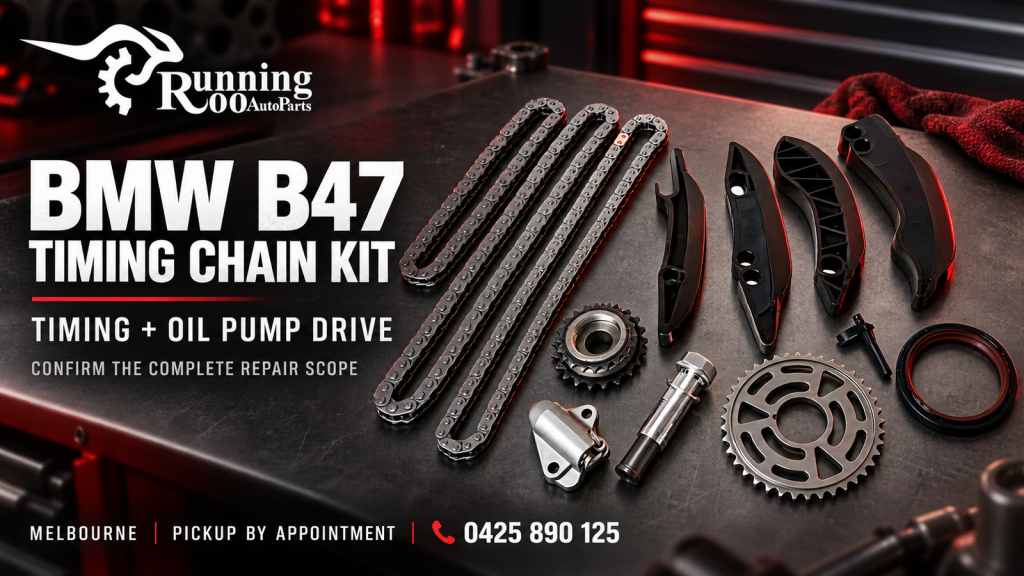
A BMW B47 timing chain kit with an oil pump chain needs to be matched to both the engine version and the workshop’s repair plan. The presence of several chains in a product image does not tell you which job has been diagnosed, which additional parts will be needed, or whether the package suits your particular BMW. Start with the VIN and the complete engine identification, then agree on the scope before ordering.
The RunningRoo B47/B47D20 timing chain kit is advertised with an oil pump chain and an itemised multi-component package. A matching RunningRoo eBay item was verified as active for this guide. This article focuses on that defined purchasing decision, rather than treating every BMW diesel timing complaint as the same problem.
For friendly support from an Australian-operated Melbourne business, call 0425 890 125. RunningRoo is based in Blackburn and offers Melbourne local pickup by appointment, with fast dispatch subject to confirmed stock and current arrangements. Bring the mechanic’s parts list into the conversation so that supply planning follows the diagnosis.
Listing detail to confirm: The eBay structured Type field says “Oil Pump”, while the product title and contents describe a timing-chain package with an oil-pump chain. That field is not evidence that a complete oil pump is supplied. Confirm each required component against the current packing list.
VIN · complete engine code · OE reference
Professional diagnosis · required parts · written contents
Current dispatch estimate · pickup appointment · workshop booking
Read the words “oil pump chain” carefully
The selected product description lists three chains, two gears, two tensioners, four guide rails, one oil spray nozzle and one shaft seal. The title mentions an oil pump chain; it does not promise an entire replacement oil pump. That distinction should appear in your order notes, particularly if a workshop quotation also contains a separately identified pump assembly.
Likewise, two gears in a package do not establish that every sprocket or gear involved in a larger repair is included. Have the supplier identify the current supplied components and ask the workshop to compare that list with its requirements. A kit should be understood as a documented collection of parts, not as an undefined claim to contain everything that might be needed after dismantling.
| Listing item | Advertised quantity | Clarification to request |
|---|---|---|
| Chains | 3 | Identify the chain functions and applicable engine version |
| Gears | 2 | Confirm their identities against the workshop order |
| Tensioners | 2 | Check the current supplied assemblies |
| Guide rails | 4 | Confirm the required guide package |
| Oil spray nozzle | 1 | Confirm inclusion and application |
| Shaft seal | 1 | Identify the seal and any additional sealing items |
| Complete oil pump | Not promised | Quote separately if diagnosed as required |
The table reports the seller’s advertised package, not an independent factory approval. Review the RunningRoo product listing and matching eBay listing, then request confirmation for your VIN. If the written reply identifies a revision or a different current package, resolve that with the installer before checkout.
Understand the architecture without borrowing a repair procedure
BMW’s original B37/B47 training describes a two-part drive for the high-pressure pump and camshafts, plus a separate chain for the combined oil/vacuum pump. It also describes spring-preloaded hydraulic tensioners, guide rails and chain lubrication. This explains why a chain-drive repair can involve more than one chain and why lubrication-related components appear in the system discussion. See BMW Service Product Information, sections 3.2.8 and 4.
The cited document is historical BMW training reproduced on Scribd. Its described versions and market context do not establish that every later B47 uses the same replacement package. Use it to understand the terminology, while the installer uses current BMW information for the actual vehicle. This guide does not provide a universal chain replacement interval, engine-removal instruction or tightening specification.
An informed buyer can therefore ask a precise question: which part of the drive has been assessed, and how does the proposed package support the agreed repair? That is more useful than assuming every chain needs identical attention or that replacing a drive chain also replaces the assembly it drives. The answer belongs in the quotation before parts are purchased.
Establish the exact BMW application
Provide the VIN, build month and year, model designation and full engine identification. The selected listing contains numerous chassis and model references. Treat them as a broad catalogue description requiring confirmation, rather than evidence that any vehicle with a similar badge is covered. If the workshop identifies an engine suffix, include it in the enquiry.
Keep petrol and diesel discussions separate, and do not shorten the enquiry to “BMW two-litre timing kit”. The important identifier is the confirmed engine and its relevant production version. If a supplier asks for further details, obtain them from the vehicle records or installer. Guessing an engine code to complete an online selector defeats the purpose of checking fitment.
A changed engine or uncertain service history should be disclosed. Ask the mechanic whether the fitted engine can be identified confidently from the available records and markings. A VIN remains useful, but it cannot describe undocumented changes by itself. Confirming the installed specification early is preferable to discovering an application question when the car is already dismantled.
Three different enquiries, three different next steps
Consider an owner who has heard a noise but has no diagnostic report. The next step is assessment, not selecting the largest available kit. The owner should describe the conditions, obtain a workshop opinion and ask what evidence supports any proposed timing-drive repair. RunningRoo can discuss product identification, but it cannot examine the vehicle through a product page.
Now consider a workshop that has specified a confirmed B47 chain-drive package and supplied a complete component list. The purchasing task is more advanced: verify the VIN application, reconcile the list with the selected kit and arrange supply. The remaining questions concern exactly what will arrive and what must be ordered separately, rather than whether the symptom has been diagnosed.
Finally, consider a vehicle already undergoing a broader engine repair. The relevant question is whether the chain kit covers the planned scope or only part of it. Ask the installer to list separately required assemblies, seals and fasteners. These are illustrative purchasing situations, not claims about particular customer repairs or evidence that any one repair scope is universally appropriate.
Ask the workshop to define inspection findings
A useful report distinguishes observed conditions from conclusions. Ask what prompted the chain-drive recommendation, which checks were completed and what remains unknown until access is gained. If a scan report is part of the assessment, keep the complete codes and the technician’s interpretation. A generic description such as “engine timing fault” does not yet identify the correct parts package.
If the mechanic recommends a wider scope than another estimate, ask for the reason in plain language. There may be additional findings, a different proposed package or a different allowance for consumables. Compare those details rather than assuming one quotation is automatically excessive or incomplete. The aim is to understand what each estimate actually commits to deliver.
Where the workshop cannot finalise every part before dismantling, agree on a staged authorisation. Ask how it will report further findings and obtain your approval for additional components. This makes the uncertainty manageable. It also gives the supplier a clearer request if another part must be sourced after the initial kit has been ordered.
Separate chain-drive parts from surrounding assemblies
The oil pump wording is worth repeating because it changes the scope of a purchase. A drive chain is one component; a complete pump is another. If the workshop has diagnosed a problem requiring a pump assembly, ask for its specific part reference and do not assume that the selected chain kit includes it. The same discipline applies to other separately named assemblies.
Ask which seals and fasteners are included in the supplier’s package and which belong on the workshop’s additional list. A single advertised shaft seal does not answer every sealing requirement of a larger job. The installer should specify the relevant consumables using the correct procedure, and the quotation should make the extra items visible.
This approach also helps when comparing kits from different listings. A photograph containing more pieces may represent a different scope, not a better version of the same order. Compare identified components and confirmed application. Avoid using a raw piece count as the main purchasing criterion, particularly when the installer has already named the parts required.
Choose the ordering route after application is confirmed
You can use the RunningRoo website or its matching eBay item, but keep one clear order record. Confirm current price, supplied contents, delivery arrangements and written terms in the channel you choose. Do not combine an old website description with a different marketplace variant and assume the resulting package has been agreed.
If the workshop is buying on your behalf, ask it to retain the supplier reference on the repair file. If you are buying directly, share the exact product link and the supplier’s fitment reply with the installer before payment. The most effective arrangement gives both parties the same information and makes responsibility for diagnosis, application checking and installation clear.
Call 0425 890 125 for friendly assistance with that enquiry. RunningRoo’s Australian-operated Melbourne base offers a local contact point. Pickup in Blackburn is by appointment; for deliveries, confirm the available stock and fast dispatch arrangements for the selected item. A current dispatch estimate is more useful than a general promise copied from an old advertisement.
Plan workshop time around a complete order
Ask whether the installer wants all confirmed parts on site before accepting the vehicle. This can matter when the kit is only one part of a wider repair order. A parcel containing the main chains does not mean every required item has arrived. Check the complete order against the workshop’s list before treating the appointment as ready to proceed.
If parts are being sent directly to the workshop, use its approved delivery address and include a reference to your vehicle or booking. Tell the workshop when the parcel is expected and ask who will check it. For collection, agree the appointment and order identification in advance. These small administrative details help prevent a correct package from becoming difficult to locate or assign.
Keep your transport arrangements flexible until the workshop confirms the repair schedule. Avoid equating dispatch speed with a guaranteed completion date. Diagnosis, additional findings, parts checking and the installer’s workload all affect the plan. Clear updates between the owner, workshop and supplier are more useful than an unsupported promise about how quickly every B47 job can be finished.
Inspect the parcel and preserve traceability
Retain packaging, labels and the written contents confirmation while the installer checks the delivered kit. If a chain, guide or gear cannot be identified against the order, ask the supplier for clarification before installation. Photograph the complete parcel and any discrepancy. Keep new and removed components distinguishable so there is no confusion about what was supplied.
A component that looks different should be checked through the appropriate application information. Do not assume it is wrong solely because its appearance differs, and do not assume it is correct solely because the mounting points appear similar. Ask the installer and supplier to resolve the difference before any modification or fitting takes place.
After the repair, retain the product identification on the vehicle’s maintenance record. This is especially helpful for a package containing several related chains and components. A later enquiry should be able to establish which kit was used, which additional parts were fitted and what the workshop’s final findings were, without relying on memory.
Frequently asked questions
Does the B47 kit include a complete oil pump?
The selected listing advertises an oil pump chain and a package of chains, gears, tensioners, guides, a nozzle and a seal. It does not promise a complete pump assembly. If the workshop requires a pump, identify and confirm it separately before ordering.
Why are three chains listed?
BMW’s historical training describes multiple chain-drive functions in the B37/B47 architecture. The seller lists three chains in this package. Have the installer and supplier confirm their identities and application; neither the count nor the training document proves universal compatibility across all B47 versions.
Is this a replacement for an N47 kit?
Do not assume interchange from a similar BMW diesel description. Confirm the engine installed in your vehicle and obtain the correct application check. This article targets the B47 product specifically and does not establish an N47-to-B47 parts substitution.
Should I order before the workshop investigates a noise?
A professional diagnosis should define the repair first. If the cause is still uncertain, agree on the assessment and the evidence needed before buying parts. Once the workshop has specified a package, the supplier can help check that precise order against your vehicle information.
Can I use this article as fitting instructions?
No. It is a purchasing and repair-planning guide. The technician must use current BMW workshop information for the identified vehicle, including applicable inspections, tools, assembly requirements and completion checks. Historical training is context, not a substitute for that procedure.
Where can I obtain the selected kit with Australian support?
Use the RunningRoo B47 product page or verified matching eBay item. Call 0425 890 125 or visit the contact page for friendly support, confirmed fast dispatch options and Melbourne local pickup by appointment from Blackburn.
Related RunningRoo guides
For wider background, read Timing chain kit fitment and engine codes and Questions to ask your mechanic before a timing-chain repair. These explain the broader checks; the product and engine references in this article define its specific ordering scope.
Sources and verification scope
Product availability and seller descriptions were checked on 8 October 2026. Stock, contents and terms can change; obtain current confirmation before purchase. Technical context is drawn from the manufacturer-issued material below. Copies on third-party archives are identified as such. They do not certify this aftermarket product or replace current vehicle-specific service information.
- BMW Service Product Information: B37/B47 Engine, 2013, sections 3.2.8 and 4 — Original BMW training reproduced on Scribd; historical European versions, not all B47 revisions.