
By RunningRoo Auto Parts — written from the desk of our Product Manager
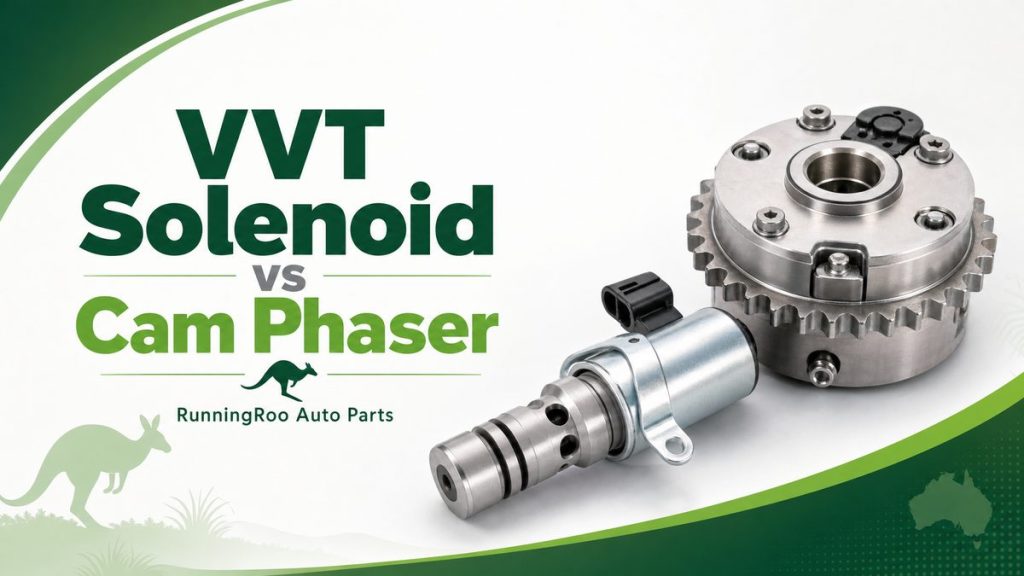
The variable valve timing system has two main parts that fail — the solenoid that controls the oil flow, and the cam phaser that physically adjusts the camshaft. They produce overlapping symptoms and fault codes, which is why so many owners replace the wrong part. The solenoid is cheap and accessible, while the phaser is more expensive and labour-intensive, so getting the diagnosis right saves real money. This guide explains the difference and how to identify which part has actually failed.
RunningRoo Auto Parts – Based in Melbourne, Australia 🇦🇺
📞 Free 24/7 Pickup Available (Contact 0425890125)
💬 Any questions? Message or Call us anytime! We’re here to help.Why Choose RunningRoo?
✅ Aussie Owned & Operated | 🚚 Fast Shipping | 🤝 Friendly Support
The two parts and their jobs
The VVT solenoid, or oil control valve, is an electrically operated spool valve bolted to the cylinder head or timing cover. It directs pressurised engine oil into the cam phaser to advance or retard the valve timing. The cam phaser is the mechanical adjuster on the camshaft sprocket that the oil pressure actually moves.
The solenoid can fail electrically — its coil or connector — or hydraulically, when the spool sticks from sludge. The phaser can fail mechanically, when its locking pin or internal vanes wear. The two failures produce similar symptoms because a stuck solenoid starves a healthy phaser of oil, and a worn phaser leaks the oil a healthy solenoid sends.
The symptoms overlap, but the clues differ
Both a failing solenoid and a failing phaser can cause a rough idle, power loss and VVT fault codes. The difference is in the details. A solenoid fault usually sets a circuit code first, while a phaser fault usually sets a timing-over-advanced or over-retarded code. The table below separates the two.
| Symptom | Points to | Confirm with |
|---|---|---|
| P0010 / P0013 circuit code | Solenoid electrical | Ohm-test the solenoid |
| P0011 / P0014 timing code | Phaser or oil | Test oil pressure; inspect phaser |
| Cold-start rattle | Phaser lock-pin | Isolate the noise |
| Rattle only after oil change | Solenoid or oil | Check oil and solenoid |
Test the solenoid first
Because the solenoid is the cheap, accessible part, it is tested first. Check its electrical winding with a multimeter against specification, and apply 12 volts briefly to confirm the spool clicks. Remove it and inspect the spool and screens for sludge and sticking. A solenoid that tests good electrically but is full of sludge may still be the problem, but a clean, correctly clicking solenoid shifts suspicion to the phaser and the oil supply.
Always check the oil level and condition first, because low or dirty oil mimics both faults and costs nothing to fix. A fresh oil and filter change resolves a surprising number of VVT faults that are really just sludge.
When to condemn the phaser
The phaser is condemned only after the solenoid and oil supply are ruled out. If the solenoid tests good, the oil is clean and at the correct pressure, and the engine still sets timing codes or rattles on cold start, the phaser is the likely culprit. Measuring the timing correlation with a scan tool and inspecting the phaser’s locking pin once the cover is off confirms the diagnosis.
Because reaching the phaser means opening the timing system, the chain, tensioner and guides are usually inspected and renewed at the same time. This is the point where the job becomes a timing service rather than a single-part replacement.
Why the diagnosis order matters
The correct order — oil, solenoid, then phaser — prevents the most expensive mistake in VVT repair: replacing a healthy phaser when a $50 solenoid or an oil change was the real fix. Conversely, ignoring a genuinely worn phaser and replacing solenoids repeatedly wastes time and money without curing the fault.
At RunningRoo we stock both VVT solenoids and cam phasers, with clear engine-code fitment, so you can order the correct part once the diagnosis points to it.
The oil factor
The VVT solenoid and the cam phaser are both oil-actuated, which makes the engine oil the most important part of the diagnosis. Sludge from extended oil-change intervals clogs the solenoid’s tiny spool and screens, and the same dirty oil accelerates wear in the phaser’s internal vanes. A car that presents with VVT codes and dirty oil will often respond to a simple oil and filter change before any parts are needed.
This is also why a new solenoid should always be paired with fresh oil of the correct specification, and why low oil level is checked before anything else. The oil change is not an optional extra — it is part of the fix.
Common VVT fault codes decoded
The P0010 to P0025 range covers the VVT system. Circuit codes such as P0010 or P0013 point to the solenoid or its wiring, while timing codes such as P0011 or P0014 mean the valve timing is actually wrong — which can be the solenoid, the phaser, a blocked oil passage or a stretched chain. On V6 and V8 engines the same families repeat for each bank.
This is why the same symptom has several possible causes, and why the solenoid, oil and phaser must each be checked before parts are ordered. The code narrows the search, but it does not replace the testing.
A systematic diagnosis order
The reliable order is oil first, then the solenoid, then the phaser. Check the oil level and condition, and change it if it is due. Test the solenoid’s resistance and operation, and inspect its spool. Only after both are ruled out do you open the timing system to inspect the phaser.
This order prevents the two most expensive mistakes: replacing a healthy phaser when a solenoid or oil change was the real fix, and repeatedly replacing solenoids while a worn phaser goes unnoticed. The cheapest correct repair is always the one that follows the evidence.
When to seek professional help
If the oil is clean, the solenoid tests good and the phaser is still suspect, the next step is opening the timing system — which is where many DIYers should hand the job to a professional. Reaching the phaser means removing the timing cover and chain, and it requires the correct locking tools and a confident timing procedure.
A workshop can measure the timing correlation, confirm the phaser wear and renew the chain and phaser in one visit. Buying the quality parts yourself and having a specialist fit them keeps the cost down while leaving the timing-critical work to someone who does it every day.
Key takeaways
The VVT solenoid and the cam phaser produce overlapping symptoms, but they fail differently and cost very differently to fix. Testing the oil, then the solenoid, then the phaser is the order that prevents the expensive mistake of replacing a healthy phaser when a solenoid or oil change was the real fix.
Match whichever part you need by engine code, and remember that a phaser job is usually a timing service, with the chain and tensioner renewed at the same time. A correct diagnosis is the cheapest part of the whole repair.
How to order the right VVT part
Once the diagnosis points to the solenoid or the phaser, order by engine code and position. A VVT solenoid must match the engine’s electrical and hydraulic specification, while a cam phaser must match the camshaft position — intake or exhaust — and the engine’s timing design.
Send the engine code, VIN and original part number to the supplier, and confirm whether the part is sold with its seals and fasteners. Ordering the correct part the first time avoids the frustration of a second diagnosis and a second labour charge.
Quick reference: diagnosis at a glance
Use this order when a VVT fault appears:
- Scan and record every code before clearing anything.
- Check the oil level and condition, and change it if it is due.
- Test the solenoid’s resistance and confirm the spool clicks.
- Inspect the solenoid spool and screens for sludge.
- If the solenoid and oil are good, measure the timing correlation for chain stretch.
- Inspect the cam phaser’s locking pin once the timing cover is off.
Working through this list from cheapest to most expensive ensures you replace the part that is actually at fault, not the one that is easiest to guess.
Frequently asked questions
What is the difference between a VVT solenoid and a cam phaser?
The solenoid controls the oil flow, and the cam phaser is the mechanical adjuster the oil moves. They work together but fail differently.
Which fails more often, the solenoid or the phaser?
The solenoid is more commonly the culprit, and it is also cheaper and easier to test, so it is checked first.
Can a bad solenoid damage the cam phaser?
Yes, over time a sticking solenoid can starve the phaser of oil and accelerate its wear.
How do I test a VVT solenoid?
Check the coil resistance, apply 12 volts to confirm it clicks, and inspect the spool and screens for sludge.
What codes point to a cam phaser?
Timing-over-advanced or over-retarded codes such as P0011 or P0014, often with a cold-start rattle.
Should I change the oil when diagnosing a VVT fault?
Yes. A fresh oil and filter change is the cheapest first step and resolves many VVT faults that are really just sludge.
When should I stop diagnosing and call a professional?
When the oil and solenoid are ruled out and the phaser is suspect, opening the timing system is usually best left to a workshop.
Are VVT solenoids and phasers engine-specific?
Yes, both must match the engine code, and the phaser must also match the camshaft position and timing design.
Can I replace the solenoid and phaser together?
Only if the diagnosis shows both are faulty. Replacing the phaser requires opening the timing system, so it is usually done only when confirmed worn.
How long does a VVT solenoid last?
There is no fixed life. With clean oil it can last the life of the engine, while dirty oil can wear it out early.
Is a VVT fault dangerous to ignore?
It usually will not strand you immediately, but it can strain the timing chain and, on an interference engine, contribute to more serious damage.
Shop the parts mentioned in this guide
- VVT Camshaft Gears (Intake & Exhaust) for Toyota Corolla 2007–2012 1.8L 2ZR-FE
- Engine VVT Timing Oil Control Valve for Mercedes-Benz SLK250 W204 A2710500578
- VVT Oil Control Valve for Mazda CX-7 / 5 / 6 / MX-5 / Tribute L3K9-14-420A
- Intake CVVT Camshaft Gear / Phaser for Kia Forte 2014–2019 — eBay
Watch on RunningRooAuto YouTube
- RunningRoo Auto Parts – trusted Melbourne parts support
- RunningRoo Auto Parts – product and fitment channel
RunningRoo Auto Parts – Based in Melbourne, Australia 🇦🇺
📞 Free 24/7 Pickup Available (Contact 0425890125)
💬 Any questions? Message or Call us anytime! We’re here to help.Why Choose RunningRoo?
✅ Aussie Owned & Operated | 🚚 Fast Shipping | 🤝 Friendly Support
Sources and further reading
- Variable valve timing — Wikipedia
- BorgWarner — variable cam timing systems
- RACV — car maintenance and repair guidance
- CarsGuide — Australian motoring advice
RunningRoo Auto Parts – Based in Melbourne, Australia 🇦🇺
📞 Free 24/7 Pickup Available (Contact 0425890125)
💬 Any questions? Message or Call us anytime! We’re here to help.Why Choose RunningRoo?
✅ Aussie Owned & Operated | 🚚 Fast Shipping | 🤝 Friendly Support