
By RunningRoo Auto Parts — written from the desk of our Product Manager
When a VVT camshaft gear — also called a cam phaser or camshaft adjuster — wears out, the engine rattles on cold start and the valve timing drifts. Replacing it is a precision job that sits at the harder end of DIY work, but it is well documented and achievable with the right tools and a careful sequence. This guide walks through what the job involves, what it costs in Australia and the step-by-step process, so you can decide whether to tackle it yourself or hand it to a workshop.
RunningRoo Auto Parts – Based in Melbourne, Australia 🇦🇺
📞 Free 24/7 Pickup Available (Contact 0425890125)
💬 Any questions? Message or Call us anytime! We’re here to help.Why Choose RunningRoo?
✅ Aussie Owned & Operated | 🚚 Fast Shipping | 🤝 Friendly Support
What a cam phaser is and why it wears
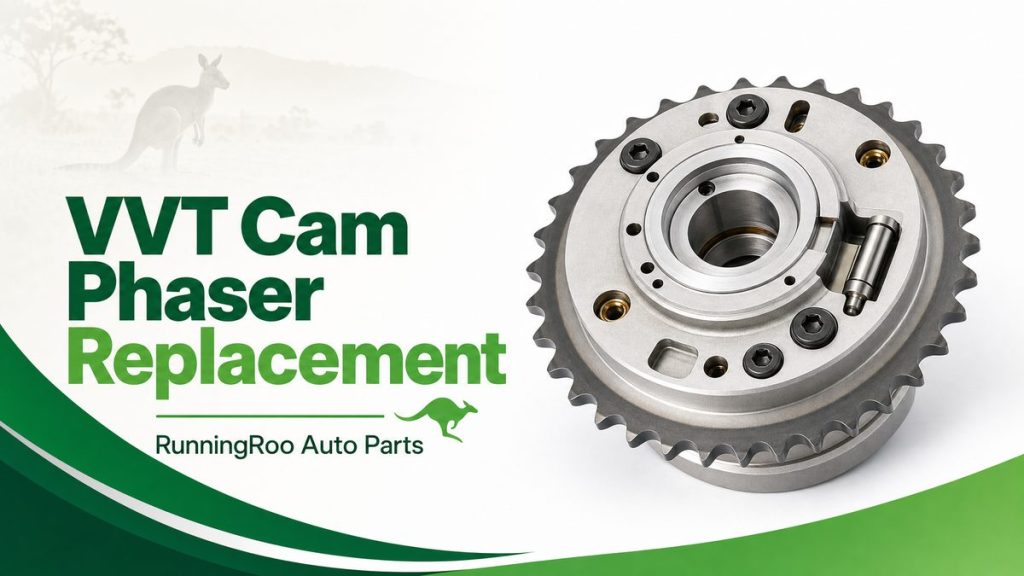
The cam phaser is the adjustable sprocket on the end of the camshaft that the timing chain or belt drives. Inside, a hydraulically actuated mechanism lets the engine computer rotate the camshaft slightly relative to the sprocket, advancing or retarding the valve timing. A locking pin holds the phaser in a fixed position while the engine is off, until oil pressure builds.
The phaser wears in two main places: the locking pin and its bore, and the internal vanes and seals. When the pin or bore wears, the phaser rattles for a second or two on cold start; when the internal seals leak, the phaser cannot hold the commanded timing and the engine loses power and economy.
The symptoms that mean the phaser is failing
The signature symptom is a rattle or knock from the top of the engine on a cold start that lasts one to three seconds. A failing phaser also causes a rough idle, reduced power, poor fuel economy and fault codes such as P0011, P0014 or P0340/P0341. The table below separates the phaser symptoms from the faults that are easily confused with them.
| Symptom | Likely cause | First check |
|---|---|---|
| Cold-start rattle for 1–3s | Cam phaser lock-pin wear | Isolate the noise source |
| Rough idle + P0011/P0014 | Phaser or solenoid | Test the solenoid; check oil |
| Power loss, poor economy | Phaser or stretched chain | Measure timing correlation |
| Rattle plus correlation codes | Chain or phaser | Measure chain stretch |
What the replacement costs in Australia
The phaser itself is usually a few hundred dollars for a quality aftermarket unit, and the labour is the larger part of the job because the timing cover, chain and tensioner often have to come off to reach it. On most engines the total job runs from roughly $800 to $2,500 depending on whether the phaser is accessible on its own or whether the timing chain and tensioner are renewed at the same time.
Because the labour dominates, the sensible approach is to renew the chain, tensioner and guides at the same time when they show wear, and to replace both intake and exhaust phasers where the engine has two. Paying the labour once and doing the system completely is cheaper than a phaser-only job that returns a year later.
The tools you need
A cam phaser replacement needs the correct timing-locking and alignment tools for the engine, a torque wrench, socket and Torx sets, and usually a way to hold the crankshaft and camshafts still while the sprocket bolts are undone. A scan tool that can read live VVT data is also useful for confirming the repair and re-learning the system afterwards.
Do not attempt the job with improvised timing marks, because getting the valve timing even one tooth out can bend valves on an interference engine. The correct locking tools are the difference between a successful repair and an engine rebuild.
The step-by-step process
First, disconnect the battery and remove the covers, intake components and drive belt needed to reach the timing cover. Lock the crankshaft and camshafts with the correct tools before removing anything, then remove the timing cover, chain and tensioner. Unbolt the old phaser and compare it with the new one before fitting, because intake and exhaust phasers can look similar but are not interchangeable.
Fit the new phaser with its bolt torqued correctly, renew the chain, tensioner and guides, and reassemble the timing system with the locking tools still in place. Turn the engine over by hand to confirm no valve-to-piston contact, then refit the covers and run the engine to confirm the rattle is gone and no codes return.
Intake vs exhaust phasers
On many VVT engines there are separate intake and exhaust cam phasers, and they are not interchangeable even when they look identical. The intake phaser usually has a different range of adjustment and a different internal stop to the exhaust phaser, so fitting the wrong one causes the valve timing to be wrong from the first start.
When ordering, identify whether you need the intake, exhaust or both, and match each phaser by its position and part number. On a high-mileage engine where one phaser has failed, the pair are usually at the same stage of wear, so replacing both while the timing system is open is the sensible choice.
VVT gear vs timing chain: which is worn
The cam phaser and the timing chain sit together and produce a similar cold-start rattle, so misdiagnosis is common. A phaser fault tends to produce timing-over-advanced or over-retarded codes and the rattle is usually a short knock. A stretched chain more often produces camshaft-to-crankshaft correlation codes and the rattle may not fully clear once oil pressure builds.
The reliable way to separate them is measurement — a scan tool that shows the timing correlation quantifies chain stretch, while inspecting the phaser’s locking pin confirms phaser wear. Replacing the right part the first time avoids paying for the labour twice.
After replacement: re-learning the VVT system
After a phaser replacement, the engine computer’s learned VVT values should be reset and the system re-learned so the valve timing is correct. On many engines a scan tool runs an adaptation routine, and a test drive confirms the rattle is gone and the timing codes do not return.
Skipping this step can leave the engine running with the old learned values against a new phaser, which produces poor idle and timing codes. A fresh oil change with the correct specification is also part of the job, because a new phaser fitted into a dirty engine will wear quickly.
Common replacement mistakes
The most damaging mistake is getting the valve timing wrong by not using the correct locking tools, which can bend valves. The second is fitting an intake phaser on the exhaust side or vice versa, because they look similar but are not interchangeable. The third is reusing the old chain and tensioner when they are worn, and the fourth is starting the engine before turning it over by hand to confirm the timing.
Each of these is avoidable with care, and each turns a straightforward phaser job into an expensive engine repair. Taking the time to confirm the timing and renew the related wear parts is the cheapest part of the job.
Key takeaways
Replacing a VVT cam phaser is a precision job whose success depends on correct timing, the correct part for the intake or exhaust position, and renewing the related chain and tensioner where they show wear. The phaser is the cheap part of the job, and the labour is the expensive part, so doing the system completely is the best value.
For Australian owners, the most cost-effective path is a quality phaser matched by engine code, fitted with the correct locking tools and followed by a VVT re-learn and an oil change. That combination restores smooth running and quiet start-ups for the life of the repair.
How to order the right cam phaser
Order the phaser by engine code and the camshaft position — intake or exhaust — and confirm the part number with the supplier before ordering. On engines with two phasers, the intake and exhaust units are not interchangeable, and a supplier who asks which position you need is doing the job properly.
Send the engine code, VIN and, where visible, the original part number, and confirm whether the phaser is sold with its bolt and any O-rings or seals. A correctly matched phaser, renewed with the chain and tensioner where they show wear, is the difference between a repair that lasts and one that returns.
Quick reference checklist
Before and during a cam phaser replacement, keep this checklist in mind:
- Confirm the phaser is the fault with a scan and by isolating the cold-start rattle.
- Record the engine code, VIN and the original part number.
- Identify whether you need the intake, exhaust or both phasers.
- Obtain the correct crankshaft and camshaft locking tools for the engine.
- Renew the timing chain, tensioner and guides if they show any wear.
- Turn the engine over by hand before the first start to confirm the timing.
- Reset the VVT learned values and change the oil after fitting.
Following this list turns a precision job into a repeatable, reliable repair, and it avoids the two mistakes that cost the most — wrong timing and the wrong part.
Frequently asked questions
What is a cam phaser?
It is the adjustable camshaft sprocket that changes valve timing under oil pressure — also called a VVT gear or camshaft adjuster.
Can I replace just the cam phaser?
Yes, where it is accessible on its own, but on many engines the chain and tensioner are renewed at the same time because the labour is already spent.
Do I need special tools to replace a cam phaser?
Yes. The correct timing-locking tools are essential, because getting the valve timing wrong can damage the engine.
How much does a cam phaser cost in Australia?
A quality aftermarket phaser is usually a few hundred dollars, with the labour making up the larger part of the total job.
Should I replace both phasers?
On engines with separate intake and exhaust phasers, it is often sensible to replace both while the timing system is open.
Do I need to reset the VVT after replacing a phaser?
Yes. The learned VVT values should be reset and the system re-learned, and the oil should be changed at the same time.
Can I fit a cam phaser without special tools?
No. The correct timing-locking tools are essential, because getting the valve timing wrong can destroy the engine.
Do I need to replace the phaser bolt?
On many engines the phaser bolt is one-time-use and should be renewed. Check the specification for your engine.
Shop the parts mentioned in this guide
- 2x Cam Phaser VVT Gears for Peugeot 207 / 208 / 308 / 508 / RCZ 1.4–1.6L
- 2x Camshaft Adjusters for Mitsubishi Lancer EVO X 2.0 / ASX / Outlander 4B11
- Camshaft Adjuster for Audi Q7 / Touareg / Cayenne / Passat 3.6L 03H109087A
- Intake Camshaft VVT Actuator / Phaser for Toyota Camry 2AR-FE — eBay
Watch on RunningRooAuto YouTube
- RunningRoo Auto Parts – trusted Melbourne parts support
- RunningRoo Auto Parts – product and fitment channel
RunningRoo Auto Parts – Based in Melbourne, Australia 🇦🇺
📞 Free 24/7 Pickup Available (Contact 0425890125)
💬 Any questions? Message or Call us anytime! We’re here to help.Why Choose RunningRoo?
✅ Aussie Owned & Operated | 🚚 Fast Shipping | 🤝 Friendly Support
Sources and further reading
- Variable valve timing — Wikipedia
- BorgWarner — variable cam timing systems
- RACV — car maintenance and repair guidance
- CarsGuide — Australian motoring advice
RunningRoo Auto Parts – Based in Melbourne, Australia 🇦🇺
📞 Free 24/7 Pickup Available (Contact 0425890125)
💬 Any questions? Message or Call us anytime! We’re here to help.Why Choose RunningRoo?
✅ Aussie Owned & Operated | 🚚 Fast Shipping | 🤝 Friendly Support