
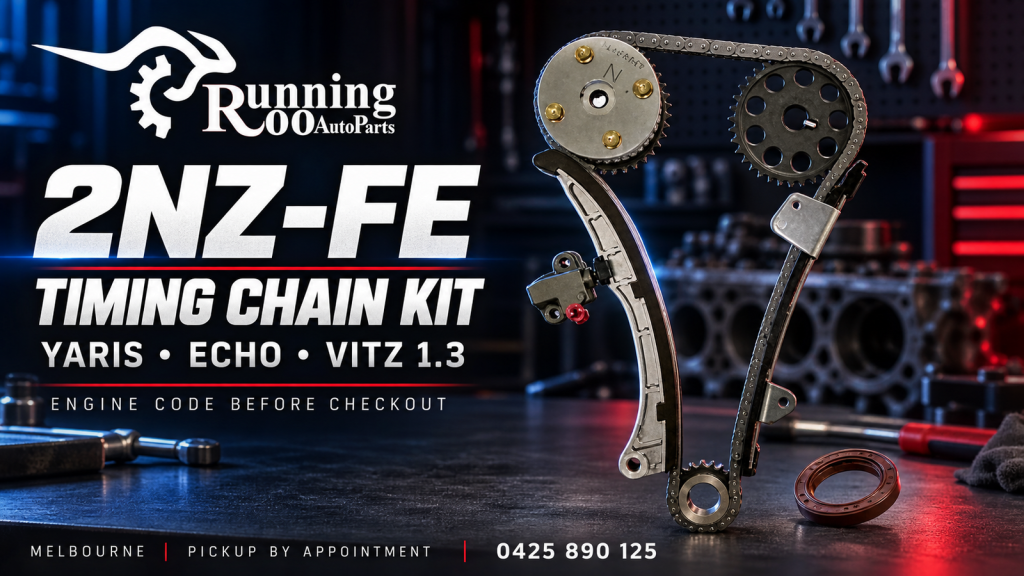
A 2NZ-FE timing chain kit should be selected for a vehicle confirmed to have the 1.3-litre 2NZ-FE engine. Yaris, Echo and Vitz are useful search terms, but a model badge or registration year alone does not establish the correct kit. Before buying, connect the vehicle identity, the workshop diagnosis and the exact package offered by the supplier.
RunningRoo lists a Toyota 2NZ-FE timing chain kit with gears, with a corresponding active RunningRoo eBay item. Both were checked when this guide was prepared. The selected website description includes a chain, crankshaft gear, camshaft gear, VVT cam gear, tensioner and two guides. Confirm the current supplied contents and application before using that list as the basis of a workshop booking.
For friendly help with identification, call 0425 890 125. RunningRoo is Australian-operated and based in Blackburn, Melbourne, offering Melbourne local pickup by appointment and fast dispatch subject to confirmed stock and current arrangements. A complete vehicle enquiry is the best way to make those supply options useful.
VIN · complete engine code · OE reference
Professional diagnosis · required parts · written contents
Current dispatch estimate · pickup appointment · workshop booking
Confirm 2NZ-FE before comparing products
Ask the mechanic to record the engine code in full and provide the VIN, build date and relevant vehicle details. Do not reduce the enquiry to “small Toyota timing chain”. If the vehicle is an import, include its original market and identification documents where available. The supplier needs a defined application, especially when a model name is used across different versions.
Toyota’s factory engine material identifies the 2NZ-FE as a 1.3-litre, four-cylinder, double-overhead-camshaft engine with a timing chain and VVT-i. That is the engine context for this article. The original Toyota technical material reproduced by iFixit does not certify the aftermarket kit or prove compatibility with every model named in a seller’s application list.
The selected product description contains a much broader collection of Toyota model names than this article targets. Do not treat those names as verified applications here. In particular, no hybrid or Prius fitment is established by this guide. Restrict the purchase enquiry to the confirmed engine and vehicle, then obtain the appropriate catalogue check.
Keep 1NZ-FE, 2NZ-FE and 2SZ-FE searches separate
Similar engine names can produce overlapping search results, but this article does not establish parts interchange between them. If your paperwork or workshop report identifies a different code, use that code in the enquiry. Do not assume that a kit is correct because a marketplace search has returned it alongside another Toyota engine family.
Where an engine has been changed, the VIN still provides useful vehicle information, but the installed engine also needs to be identified. Tell the supplier about the change and share available documentation. The workshop can advise which markings or component references should be checked before the order is confirmed.
If two records disagree, resolve the discrepancy rather than selecting whichever code appears in the preferred listing. A correct part for the wrong assumed engine is still an unsuitable purchase. The small amount of time spent establishing identity can prevent a much larger delay once the vehicle is scheduled for repair.
Understand the advertised package
The selected website lists one timing chain described as 05Ex120L, a crankshaft gear identified as S-845, a camshaft gear identified as S-846, one VVT cam gear, one tensioner and two guides. These are the seller’s package descriptions. They should not be presented as independently verified Toyota OE numbers or as a complete description of every part needed for installation.
| Advertised item | What to verify | What not to assume |
|---|---|---|
| Timing chain, 05Ex120L | Correct chain for the confirmed engine application | That a chain description alone proves fitment |
| Crankshaft gear, S-845 | Identity and application of the supplied gear | That the seller’s identifier is a Toyota OE approval |
| Camshaft gear, S-846 | Match to the workshop’s requirement | That all similar-looking gears interchange |
| VVT cam gear | Correct assembly for the vehicle | That the oil control valve is also included |
| Tensioner | Current supplied version and application | That every Toyota tensioner is equivalent |
| Two guides | Correct guide package | That count alone establishes compatibility |
| Other consumables | Installer’s separate list | That seals and hardware are automatically included |
Compare the RunningRoo 2NZ-FE kit page with the matching eBay listing. Ask the supplier to confirm the current contents in writing, particularly if the workshop has specified a seal or other item not explicitly included in the selected list. Keep the reply with the order record.
How the chain and VVT descriptions fit together
Toyota’s factory material describes the intake and exhaust camshafts as chain-driven and places a VVT-i controller at the front of the intake camshaft. It also identifies oil passages supplying the VVT-i system. The useful distinction is between the timing drive and the variable-timing controller: they are related parts of the engine’s valve mechanism, but the words do not describe the same component. See the Toyota engine description and valve-mechanism section.
For purchasing, ask the workshop whether the proposed repair requires the advertised VVT gear as well as the other chain-drive components. If the mechanic has recommended a particular package, share that list with the supplier. If the diagnosis is incomplete, avoid using the inclusion of a VVT gear as evidence that it must be the cause of the complaint.
The factory material is historical engine-system context. It is not a current fitting procedure for every Australian Yaris or imported Vitz, and it does not approve this specific aftermarket package. The installer should use the appropriate current vehicle information for diagnosis, component selection and installation.
Decide whether the vehicle needs diagnosis or parts supply
An owner who has only noticed a new sound needs an assessment before a shopping list. Describe when the sound occurs, whether it changes over time and whether any warning lamp has appeared. Include recent servicing and earlier repairs. These observations help the mechanic organise the diagnosis without asking the owner to identify an internal component.
An owner with a completed workshop report is further along. Ask the mechanic for the exact required component list and relevant references, then obtain a supplier application check. The supplier can help confirm the product being offered, while the workshop remains responsible for the diagnosis and the repair plan.
A vehicle already dismantled for other work presents a different enquiry again. Ask the installer to distinguish parts that have been inspected from those proposed as part of the wider job. Send that information to the supplier so the order reflects the agreed scope. These situations should not all be reduced to the same instruction to buy a timing kit immediately.
Give the workshop a useful history
Bring previous servicing invoices and records of any engine or timing work. If the vehicle was bought recently, separate documented repairs from statements made by the previous owner. Both can be mentioned, but the mechanic should know which details are confirmed. A short timeline often communicates the history more effectively than several unrelated screenshots.
If a diagnostic scan has been performed, keep the complete report and ask the technician to explain its significance. Do not order a chain kit solely because a code description contains the word camshaft or timing. Ask what tests or inspections support the proposed repair and whether any further assessment is needed before ordering.
Tell the workshop about any parts already replaced in an attempt to resolve the concern. Include whether the complaint changed afterwards. This avoids repeating an assumption that has already proved unhelpful and gives the next decision a clearer basis. The objective is a justified repair, not a sequence of speculative component purchases.
Compare the repair against the vehicle’s practical needs
For an older daily driver, it is reasonable to ask for an itemised estimate and an explanation of any uncertainty. Request separate lines for the kit, additional parts, consumables, labour and completion checks. This helps you compare the proposed repair with your budget without confusing a website parts price with the entire installed job.
If other known work is pending on the vehicle, tell the workshop so you can plan sensibly. That does not mean the timing concern can be ignored or that every unrelated item must be repaired at once. It means the owner should understand the current recommendations and decide on a practical schedule with the mechanic.
Avoid relying on a universal replacement distance or a fixed national repair price from an unrelated article. The correct decision depends on the identified vehicle, its condition and the scope of work. Ask the installer what evidence supports the recommendation and what the quotation includes before comparing numbers.
Make the VVT gear decision explicit
The selected package includes a VVT cam gear in its advertised contents. If the workshop intended to order a chain-only package, ask whether this is the product it wants to use. If it specifically requested the VVT component, have that requirement matched to the supplied assembly and application. Do not let the decision remain implicit in a photograph.
If the installer recommends retaining some components and replacing others, ask it to explain the basis of that scope. If it recommends a wider replacement package, ask the same question. This guide does not establish that every included component must always be fitted or that the smallest possible order is always sufficient.
The useful outcome is a parts list that both workshop and supplier understand. Any separately required control valve, seal or fastener should be identified outside the kit where necessary. That prevents the phrase “with VVT” from being interpreted as a promise that every part associated with the system is supplied.
Order through one clearly documented channel
You can review the selected product on the RunningRoo website or eBay. Confirm the current price, package description, delivery details and written terms in the channel you choose. Keep the exact listing and the fitment reply with the order so that later questions refer to the same product and vehicle.
If the workshop will purchase the parts, ask it to retain the supplier reference on the repair file. If you will supply them yourself, confirm that arrangement before payment. Agree who checks the parcel, when it should arrive and how an application query will be handled. A clear arrangement is more useful than assuming the mechanic will accept any kit delivered on the appointment day.
Call 0425 890 125 for friendly product support from RunningRoo’s Australian-operated Melbourne business. Confirm stock before arranging local pickup by appointment in Blackburn. If you need delivery, ask about fast dispatch and the current estimate to your postcode, allowing time for the workshop to inspect the package.
Check the delivered parts before installation
Keep the labels, invoice and packaging together until the installer has accepted the kit for the application. Compare the parcel with the supplier’s written contents confirmation. If something appears missing or different, photograph it clearly and contact RunningRoo before the part is fitted or altered.
Do not rely entirely on appearance. A part that looks similar may still need an application check, while a visible difference needs an explanation rather than an assumption. Ask the workshop to compare the supplied components with the relevant information and resolve any uncertainty before proceeding.
If the repair also requires separately ordered items, check that the complete order is ready. A main kit arriving quickly does not establish that every required consumable is present. Coordinate the appointment around the agreed parts list and the mechanic’s schedule rather than a single delivery notification.
Keep the finished repair understandable
At handover, ask which components were fitted and how the original complaint was assessed. If additional work was approved, make sure it appears clearly on the final invoice. Keep the supplier confirmation, diagnostic report and workshop record together with the repair date and odometer reading.
If the initial concern was intermittent, ask whether the relevant conditions were checked and whether any follow-up observation is needed. Report a continuing or new concern promptly to the installer. Refer to the completed scope before buying further parts, so the next step follows assessment of the result.
Follow the maintenance guidance applicable to the identified vehicle. This article does not prescribe a universal oil grade, service interval or future chain-replacement distance. A new kit is a documented repair component, not a promise that every engine concern has been permanently eliminated.
Frequently asked questions
Does this kit fit every 1.3-litre Yaris, Echo or Vitz?
No blanket fitment is established by those names or displacement alone. Confirm the 2NZ-FE engine, VIN, build information and relevant part references. Imported vehicles and replacement engines may need additional identification before the supplier can confirm the application.
Does the selected kit include a VVT cam gear?
The website contents reviewed for this guide list one VVT cam gear along with the chain, other gears, tensioner and two guides. Ask RunningRoo to confirm the current supplied package and have the installer match it to the intended repair.
Are S-845 and S-846 Toyota OE numbers?
This article treats them as identifiers printed in the seller’s package description. It does not establish them as Toyota OE approvals or independent interchange evidence. Use the vehicle and the appropriate parts information to confirm the supplied components.
Can I use the listing for a 1NZ-FE, 2SZ-FE or hybrid application?
No such interchange is established here. Use the engine actually identified in the vehicle and obtain a separate product check. Broad model names on the selected listing should not override the confirmed application or the workshop’s parts requirement.
Should I buy the kit before diagnosing a noise?
Have the concern assessed professionally and ask for the supported repair scope. A sound recording or a code description can help communicate a problem, but neither by itself selects the correct package. Order once the vehicle and required components are sufficiently identified.
Where can I arrange supply and Melbourne pickup?
Start with the RunningRoo 2NZ-FE product page or verified matching eBay item. Call 0425 890 125 or use the contact page for friendly support, fast dispatch enquiries and Melbourne local pickup by appointment from Blackburn.
Related RunningRoo guides
For wider background, read Timing chain kit fitment and engine codes and Questions to ask your mechanic before a timing-chain repair. These explain the broader checks; the product and engine references in this article define its specific ordering scope.
Sources and verification scope
Product availability and seller descriptions were checked on 8 October 2026. Stock, contents and terms can change; obtain current confirmation before purchase. Technical context is drawn from the manufacturer-issued material below. Copies on third-party archives are identified as such. They do not certify this aftermarket product or replace current vehicle-specific service information.
- Toyota factory New Car Features: 2NZ-FE Engine, valve mechanism section — Original Toyota technical material reproduced by iFixit; visible engine architecture context, not aftermarket kit certification or current repair procedure.