
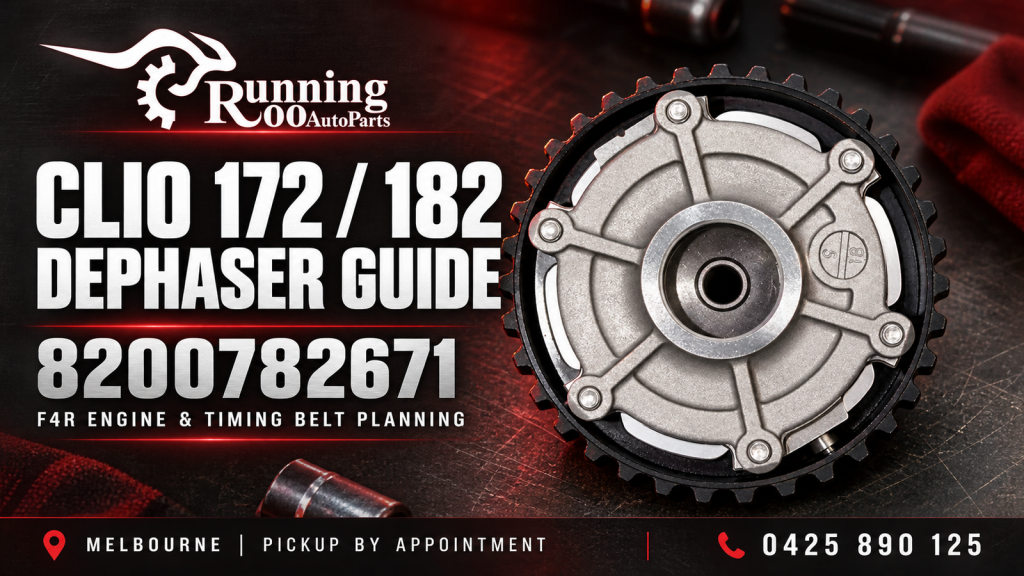
Buying a Clio 172/182 dephaser 8200782671 is best treated as a component-identification and repair-planning task. Confirm the F4R engine version, the full part reference and what your Renault specialist intends to replace. A product title containing several Renault models should not be read as proof that every two-litre engine uses the same adjuster.
The RunningRoo Renault camshaft adjuster 8200782671 and corresponding RunningRoo eBay item were verified as on sale for this guide. The website identifies a single camshaft adjuster and lists F4R 730, F4R 736 and F4R 738 among its Clio Sport application details. Those seller descriptions should be checked against the actual vehicle before purchase.
RunningRoo is an Australian-operated business based in Blackburn, Melbourne. Call 0425 890 125 for friendly support with the product enquiry. Melbourne local pickup is by appointment, while fast dispatch depends on confirmed stock and current order arrangements. Coordinate the part with the installing workshop before arranging a collection or repair date.
VIN · complete engine code · OE reference
Professional diagnosis · required parts · written contents
Current dispatch estimate · pickup appointment · workshop booking
What the word dephaser means in this enquiry
Renault’s original F4R 730 technical note uses the term camshaft phase shifter, while later Clio Renault Sport material refers to a hydraulic inlet camshaft dephaser and its control solenoid. These terms provide useful context for the adjuster being discussed. They should not blur the distinction between the mechanical assembly and a separately identified control component. The original English factory documents are available through the Renault manual archive.
Technical Note 3286A also contains a timing-belt section and specified tooling for the relevant F4R 730 work. The purchasing implication is that this is a dephaser enquiry within a belt-timed engine repair context; it should not be turned into a generic timing-chain-kit order. The installer must use the correct current procedure for the actual engine version.
The documents are historical Renault factory material hosted by a third-party archive. They support the terminology and system context, not universal interchange of the numbers in a modern aftermarket listing. This article does not reproduce a belt-tensioning sequence or supply torque values for every Clio 172 and 182.
Identify F4R 730, 736 or 738 accurately
Ask the workshop to record the full engine designation, including the three-digit suffix. Send the VIN, build details and model information with the enquiry. If you know the engine has been replaced, disclose that and provide the available records. A full engine identity is more useful than an informal description such as “the two-litre Renault Sport motor”.
The listing’s Clio-specific detail is narrower than its broader collection of Renault model names. Use the precise engine information to guide the check. Do not infer compatibility with an Espace, Laguna, Mégane or Scénic solely because the same product page mentions those names. Each proposed application needs its own confirmation.
If the mechanic’s identified engine version does not agree with the vehicle paperwork, resolve the discrepancy before ordering. The supplier may need additional component information, while the installer may need to establish the fitted engine’s history. Avoid choosing the version that happens to appear in the cheapest search result.
Check 8200782671 without assuming every listed number is equivalent
The selected website page identifies 8200782671 and also mentions 7700108671 and 8200539619 as other references. That is a seller-stated association. It is not, by itself, a current Renault supersession record covering every vehicle. Ask for the proposed match to be checked against the VIN, engine suffix and existing component identification.
Photograph the old marking if the part is already accessible, and copy the number carefully into the enquiry. If a digit is unclear, say so. Do not silently substitute a similar reference. A supplier can investigate a clear question, but a mistaken number presented as certain can lead the entire conversation in the wrong direction.
| Information | What to establish | Why it changes the enquiry |
|---|---|---|
| Vehicle identity | VIN, build details and market | Defines the specific car |
| Engine suffix | F4R 730, 736, 738 or another confirmed version | Prevents broad engine-family assumptions |
| Existing reference | Complete marking or catalogue identification | Supports the replacement comparison |
| Proposed product | RunningRoo 8200782671 listing | Keeps everyone discussing the same item |
| Required component | Dephaser/adjuster or a different diagnosed part | Avoids substituting a gear for another component |
| Repair scope | Dephaser alone or a wider specified job | Identifies separately required parts |
| Current contents | Supplier confirmation of one adjuster | Prevents assuming a belt kit is included |
Review the specific RunningRoo adjuster and matching eBay listing with that table in mind. The selected package is not presented here as a complete timing-belt service kit. Ask the workshop to identify the rest of the required order separately.
Plan the dephaser decision alongside the belt-work discussion
If the vehicle is already booked for timing-belt work, tell the specialist that you are considering the selected dephaser. Ask whether it is required, recommended on the basis of identified findings, or not part of the current scope. The answer should connect to the vehicle’s condition and service history rather than a universal rule applied to every owner.
If the dephaser is the primary concern, ask the workshop to explain the complete repair it proposes around that component. Identify any belt components, seals, fasteners or other items it requires. Do not assume that a single adjuster purchase contains everything needed to carry out the work, even if the product photograph appears substantial.
A practical quote distinguishes the component being purchased from the full workshop operation. This makes it easier to compare a parts-only price with a complete repair estimate without confusing the two. It also prevents a scheduling problem in which the dephaser has arrived but another required item has not been ordered.
Use the service record as evidence, not as a guess
Gather invoices for previous belt-related work and any earlier adjuster replacement. Record the date and odometer reading where available. If the previous owner mentioned a repair but supplied no documentation, report that as unverified information. Ask the specialist how the missing history affects the assessment and the proposed scope.
Do not calculate a maintenance deadline from a generic online interval intended for another market or engine version. Ask for the applicable manufacturer schedule and vehicle-specific advice. This guide does not establish a universal belt interval for every Clio 172 or 182, nor does it suggest that a dephaser purchase replaces scheduled maintenance requirements.
Keep modifications and replacement-engine history in the discussion. If the car has had work beyond ordinary servicing, give the specialist the relevant details and receipts. The aim is to avoid assuming an original configuration when the repair plan may need to account for changed components or incomplete documentation.
Describe the complaint before naming the failed part
If a noise prompted the enquiry, explain when it occurs and whether it changes between starts or operating conditions. Include when you first noticed it and any work performed shortly beforehand. A safe recording can help communicate the sound, but it cannot establish the internal condition of the dephaser on its own.
If a warning lamp or scan result is involved, retain the complete report and ask the workshop what it means for this vehicle. A broad description such as “camshaft problem” is not enough to select the correct component. The specialist should explain the evidence supporting replacement and identify any further checks needed before the parts list is final.
Avoid treating another owner’s successful repair as proof of your diagnosis. Their experience may suggest a question worth asking, but the actual decision should follow your car’s inspection. If the workshop finds a different cause, follow that evidence rather than proceeding with a dephaser order simply because it was your first assumption.
Ask the specialist six useful questions
First, what is the confirmed engine suffix? Second, which component has been diagnosed as requiring replacement? Third, what part reference supports that recommendation? These questions establish the identity of the job before price and scheduling become the focus. Ask for the answers to be written on the estimate or parts request.
Fourth, which additional parts and consumables are required? Fifth, what information or inspection remains outstanding? Sixth, how will the workshop assess the result and document the completed work? These questions do not replace technical expertise. They help you understand the service you are authorising and give the supplier a usable order specification.
If a question cannot yet be answered, ask what the next step is and what that stage will cost. A clearly staged diagnosis is easier to evaluate than an uncertain promise of a complete repair. Agree how the workshop will contact you before expanding the scope or requesting additional parts.
Decide who will purchase the part
If the specialist is ordering the dephaser, ask it to retain the supplier and product reference with the repair record. If you intend to purchase directly, confirm that the workshop accepts owner-supplied parts and is satisfied with the proposed product before payment. This avoids discovering a disagreement about the order after the vehicle is booked in.
Send the exact product link rather than a cropped screenshot without the listing identity. Share the supplier’s written fitment confirmation and current contents reply with the installer. Where the mechanic and supplier use different terms, ask them to clarify the component rather than assuming the words describe the same assembly.
For help with the RunningRoo enquiry, call 0425 890 125. The Australian-operated Melbourne business offers friendly support and a local collection option by appointment in Blackburn. For delivery, confirm stock and fast dispatch arrangements for the selected part, along with the current estimate to the destination.
Keep the commercial details tied to the actual order
Check the current price, delivery terms, product description and written policies in the channel you choose. An old search result or saved image may not reflect today’s offer. Do not combine a price from one listing with the contents of another, particularly where different packages or reference numbers are involved.
An OE-style reference is useful for identification, but it does not prove that an aftermarket adjuster was manufactured by Renault. Ask for the actual product description and avoid making unsupported claims about factory origin, lifetime performance or an automatic cure for every rattle. The relevant question is whether the proposed part is appropriate for the confirmed application and repair.
The website and matching eBay item provide genuine purchasing routes, but neither route eliminates the need for professional installation planning. Keep diagnosis, fitment confirmation and the commercial order connected through written records. That makes the decision easier to review if a question arises before or after the repair.
Check the delivery before the car is dismantled
Ask the installer to inspect the supplied part and labels against the order before proceeding. Retain the packaging until the application has been accepted. If a marking or physical detail differs from what was expected, take clear photographs and contact the supplier. Resolve the query before fitting or altering the component.
If the repair involves several separately sourced items, check the complete order together. A correct dephaser does not mean every other required part is present. Ask who is responsible for confirming readiness before the appointment. This is especially helpful when the owner supplies one component and the workshop supplies the rest.
For local pickup, confirm the collection appointment and order reference. For direct-to-workshop delivery, use the workshop’s approved details and include a booking reference. Fast dispatch is useful only when the parcel reaches the correct recipient and can be matched promptly to the intended job.
Document the completed repair clearly
At collection, ask the specialist to explain which parts were fitted, which additional findings were addressed and how the original concern was assessed. Keep the invoice alongside the earlier service records. A clear entry distinguishing a dephaser replacement from a complete belt-related service is more useful than an ambiguous note saying “timing done”.
If the complaint persists or changes, report the conditions promptly to the installer. Refer to the original diagnosis and completed scope before buying another part. The next step should follow assessment of the result rather than a new speculative order based on a different online description.
Keep maintenance planning separate from unsupported lifespan promises. Follow the manufacturer information applicable to your vehicle and the specialist’s specific advice. The purchase of a replacement adjuster does not establish a new universal maintenance interval for every related component.
Frequently asked questions
Does the selected product include a timing-belt kit?
The website description identifies one camshaft adjuster. Do not assume that belts, tensioners or other service items are included. Have the workshop specify the complete repair order and ask RunningRoo to confirm the current contents of the selected product.
Are all F4R engines covered by the same dephaser?
No universal fitment is established here. Confirm the engine suffix, VIN and part reference. The seller’s F4R 730, 736 and 738 application wording should be checked for the individual vehicle rather than extended to every F4R engine.
Are the other numbers on the listing automatic supersessions?
Treat them as seller-stated references until the proposed match is confirmed. This article does not independently establish a current Renault supersession chain. Provide the existing number and vehicle details so the supplier and installer can resolve the application properly.
Should I replace the dephaser whenever belt work is booked?
Ask the specialist to explain the appropriate scope for your vehicle using its condition, history and applicable service information. This guide does not impose a universal replacement rule. The quotation should make any recommended additional component understandable.
Where can I buy with Australian support?
Use the RunningRoo 8200782671 product page or verified eBay item. Call 0425 890 125 or visit the contact page for friendly support, fast dispatch enquiries and Melbourne local pickup by appointment from Blackburn.
Related RunningRoo guides
For wider background, read Intake versus exhaust VVT gear fitment and VVT gear versus solenoid diagnosis. These explain the broader checks; the product and engine references in this article define its specific ordering scope.
Sources and verification scope
Product availability and seller descriptions were checked on 8 October 2026. Stock, contents and terms can change; obtain current confirmation before purchase. Technical context is drawn from the manufacturer-issued material below. Copies on third-party archives are identified as such. They do not certify this aftermarket product or replace current vehicle-specific service information.
- Renault Technical Notes 3286A (July 1999) and 3819A (April 2004), original English documents — Original Renault factory PDFs in the linked archive, 172 182 specific folder. Historical F4R versions; current vehicle procedure and part interchange must be confirmed.