
By RunningRoo Auto Parts — written from the desk of our Product Manager
A timing chain is often marketed as a “lifetime” part, but in the real world it wears, elongates and eventually needs replacement just like any other component that runs at engine speed under constant tension. The word “stretch” is actually a slight misnomer: the chain does not stretch like a rubber band, but the pins and rollers wear, and as they do the chain’s pitch increases, effectively making it longer. That increased length is what technicians call chain stretch, and it is the root cause of a long list of engine problems.
The challenge for an owner is that chain stretch happens gradually and can be easy to ignore until it is serious. This guide explains the symptoms of a stretched chain, how a workshop actually measures stretch, how much is too much, and when the only sensible fix is replacement. It is written for Australian drivers who want to catch the problem at the cheap stage rather than the engine-rebuild stage.
RunningRoo Auto Parts – Based in Melbourne, Australia 🇦🇺
📞 Free 24/7 Pickup Available (Contact 0425890125)
💬 Any questions? Message or Call us anytime! We’re here to help.Why Choose RunningRoo?
✅ Aussie Owned & Operated | 🚚 Fast Shipping | 🤝 Friendly Support
What timing chain stretch actually means
Inside the engine, the timing chain runs around the crankshaft sprocket and the camshaft sprockets, held in position by guides and a tensioner. Each link is made of pins, bushings and plates that rub against one another as the chain flexes. Over tens of thousands of kilometres, that rubbing wears metal away at each joint, and the cumulative wear allows the links to sit slightly further apart. The result is a chain that is physically longer, even though no individual part has “stretched”.
That extra length matters because the chain’s job is to keep the crankshaft and camshafts in exact rotational relationship. When the chain lengthens, the camshafts fall slightly behind or ahead of where they should be, and the engine computer notices the change long before the driver feels it. The tensioner can take up a limited amount of slack, but once the stretch exceeds the tensioner’s range, the timing begins to drift and trouble follows.
The symptoms of a stretched chain
The earliest symptom is often a rattling or ticking noise, typically worse on a cold start before oil pressure builds. As stretch worsens, the engine may set camshaft-to-crankshaft correlation fault codes, run roughly, lose power or economy, and in the worst case skip a tooth, which on an interference engine can bend valves and destroy the engine. The table below groups the symptoms by how serious they are.
| Stage | Symptoms |
|---|---|
| Early | Brief cold-start rattle, no warning light |
| Moderate | Persistent rattle, rough idle, correlation fault codes |
| Advanced | Loss of power/economy, misfire codes, risk of skipped timing |
The important distinction is between a chain rattle and a VVT gear or tensioner rattle, because the three share a very similar sound. A correct diagnosis separates them by measurement rather than by ear, which is why a proper check is worth the small cost.
How stretch is measured
There are two main ways a workshop measures timing chain stretch, one electronic and one physical. The electronic method uses the engine’s own sensors: the computer compares the crankshaft and camshaft position signals and calculates how far out of phase they are, which is reported as a correlation value. Many diagnostic tools display this live, and comparing it against the manufacturer’s specification shows how much the chain has lengthened.
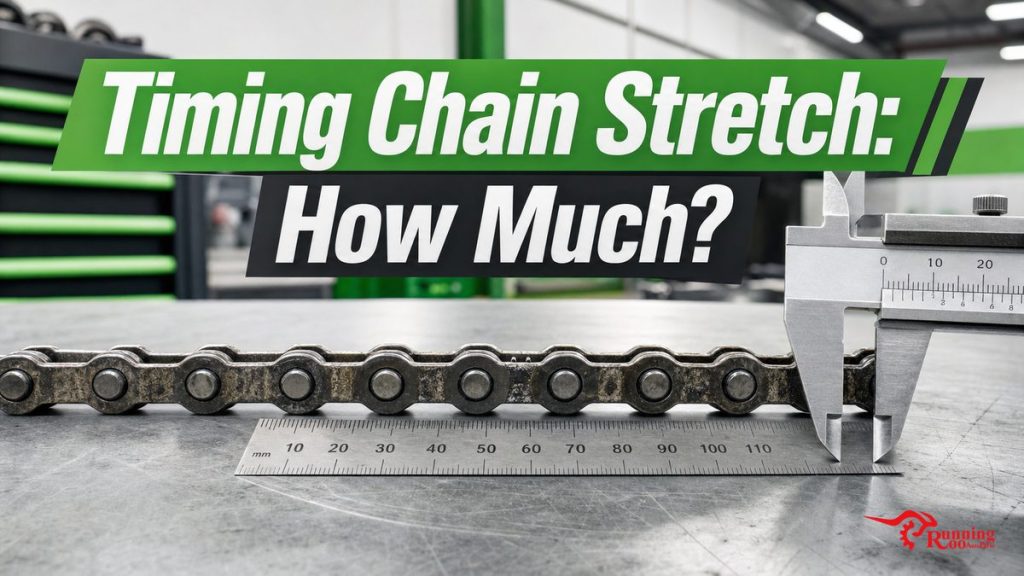
The physical method is used when the engine is already open or when a precise measurement is needed. The chain is checked against the manufacturer’s specification using the specified measuring points, sometimes with a ruler or gauge over a set number of links, or by checking how far the tensioner has extended. The exact method and limit vary by engine, which is why the manufacturer’s workshop manual is the authority rather than a generic rule of thumb.
How much stretch is too much
There is no universal number, because every engine has its own specification. Some engines tolerate only a small amount of wear before the correlation codes appear, while others run further before the computer complains. The correct approach is to compare the measured value against the manufacturer’s limit for that specific engine. Once the chain is at or beyond the limit, or once the tensioner is fully extended and can no longer take up slack, the chain is due for replacement.
The practical guidance is to act at the first reliable sign of stretch rather than waiting for the warning light. A chain that has stretched enough to rattle on cold start is already telling you the wear is advanced, and every additional kilometre adds wear to the guides, tensioner and sprockets that share the same system.
What happens if a stretched chain is ignored
Ignoring a stretched chain is a gamble with a very poor payout. The chain can jump a tooth under hard acceleration or when the engine is shut off and restarted, and on an interference engine that usually means the valves and pistons meet. The result is a bent-valve engine rebuild costing several times the price of a timing chain kit.
Even short of catastrophic failure, a stretched chain wears the guides and tensioner faster, and the engine runs with degraded timing that hurts power and economy. The cheapest moment to address chain stretch is always today, and the most expensive is after the chain has let go.
Stretch, tensioner or VVT gear: telling them apart
Because the chain, tensioner and VVT gear sit together and make similar noises, misdiagnosis is common. A VVT gear fault tends to produce camshaft over-advanced or over-retarded codes, and the noise may change as the engine warms. A tensioner fault classically produces a rattle for the first second or two of a cold start. A stretched chain produces correlation codes and a rattle that may persist once oil pressure is up.
The only reliable way to separate them is to scan the codes, measure the correlation, test the oil-control solenoid, and inspect the parts once the cover is off. Replacing a chain on a guess is expensive; replacing the wrong part is worse, because the noise returns and the job has to be done again.
Replacement: chain, kit or the whole timing system
By the time a chain has measurably stretched, the guides and tensioner have usually worn with it, so the correct repair is a complete timing chain kit rather than a chain in isolation. On engines with VVT gears, those gears should be renewed at the same time if they show wear, and the engine oil and filter should be changed so the new parts start life with clean lubrication.
The parts are the smaller half of the cost; the labour is the larger half. Doing the complete job while the engine is open is therefore the most economical way to repair a stretched chain, because it avoids paying for the labour twice.
Why “lifetime chain” is a marketing term, not a service interval
The phrase “timing chain for the life of the engine” is one of the most misleading bits of language in the modern service bay. It is usually taken to mean the chain never needs replacement, when what it actually reflects is a design intention that the chain should, in ideal conditions, last longer than a belt. Ideal conditions are not guaranteed: they depend on oil quality, service discipline, operating temperature and driving style, and any shortfall in those conditions brings chain wear forward.
The honest way to treat a timing chain is as a service item with no fixed replacement interval but a real wear limit. It should be checked when the engine shows any sign of stretch — a cold-start rattle, a correlation code or rough running — and replaced when the measured wear reaches the manufacturer’s limit. Believing the “lifetime” claim and ignoring the early signs is how a chain reaches the point where it skips a tooth.
Preventing chain stretch with the right oil and habits
Chain stretch is mostly the slow, cumulative wear of the pins and rollers, and the single biggest influence you control is the engine oil. The correct oil specification, changed on schedule, keeps the chain’s joints lubricated and carries away the wear particles that would otherwise accelerate the process. Long intervals, the wrong viscosity or a sludged engine all shorten the chain’s life.
Driving habits play a supporting role. Engines that spend their lives cold, in stop-start traffic or under sustained heat load wear their timing chains faster than the same engine driven gently to temperature and maintained diligently. There is no trick that makes a chain immortal, but the combination of correct oil, on-time changes and prompt attention to the first rattle is the closest thing to one.
Frequently asked questions
What does it mean when a timing chain “stretches”?
The pins, bushings and plates wear, increasing the chain’s pitch and effective length. The metal does not actually elongate.
What are the first signs of a stretched timing chain?
A brief rattle on cold start is the classic early sign, often before any warning light appears.
How is chain stretch measured?
Electronically through crankshaft-to-camshaft correlation values, or physically against the manufacturer’s specification once the engine is open.
How much stretch is too much?
There is no universal number; the measured value must be compared against the manufacturer’s limit for that specific engine.
Can I drive with a stretched chain?
Only far enough to reach a workshop, and carefully. A stretched chain risks skipping timing and destroying an interference engine.
Should I replace just the chain or the whole kit?
A complete kit, because the guides and tensioner wear with the chain and the labour is the same.
Why does my stretched chain only rattle when cold?
Because oil pressure builds once the engine runs, temporarily taking up some of the slack until the wear is too great.
How do I avoid chain stretch in the first place?
Use the correct oil specification, change it on schedule, and investigate any cold-start rattle promptly.
Shop the products mentioned in this guide
- VW GTI / SEAT / Škoda / Passat / Audi A3 A4 A5 2.0 TSI & 1.8 TSI Timing Chain Kit EA888
- Timing Chain Kit for Ford Ranger PX / Mazda BT-50 3.2 TDCi with oil-pump chain 2011–
- Timing Chain Kit for Mazda 3/6/CX-5 Skyactiv-D 2.2 Diesel SH 2013–2018
- Timing chain kits on eBay
Watch on RunningRooAuto YouTube
- RunningRoo Auto Parts – trusted Melbourne parts support
- RunningRoo Auto Parts – product and fitment channel
RunningRoo Auto Parts – Based in Melbourne, Australia 🇦🇺
📞 Free 24/7 Pickup Available (Contact 0425890125)
💬 Any questions? Message or Call us anytime! We’re here to help.Why Choose RunningRoo?
✅ Aussie Owned & Operated | 🚚 Fast Shipping | 🤝 Friendly Support
Sources and further reading
- ACCC – Consumer rights and guarantees
- Product Safety Australia – vehicle recalls
- RACV – car maintenance and repair guidance
- API – Engine oil standards
- ACEA – European oil sequences
Timing-chain wear limits and the crankshaft-to-camshaft correlation specifications are engine-specific and are set out in each manufacturer’s workshop manual. Always confirm your engine code and VIN against the official repair information before measurement or replacement.
RunningRoo Auto Parts – Based in Melbourne, Australia 🇦🇺
📞 Free 24/7 Pickup Available (Contact 0425890125)
💬 Any questions? Message or Call us anytime! We’re here to help.Why Choose RunningRoo?
✅ Aussie Owned & Operated | 🚚 Fast Shipping | 🤝 Friendly Support