
By RunningRoo Auto Parts — written from the desk of our Product Manager
A timing chain replacement is one of those repairs where the parts are the cheap half and the labour is the expensive half. Because the labour to reach the chain is so significant, the single best way to protect your money is to replace everything that sits in that area while the engine is already open. That is what a timing chain kit is for, but not all kits are created equal, and the contents vary far more than most owners realise.
This guide explains what a complete timing chain kit should include, which extra parts are commonly left out of budget kits, and how to choose a kit that lets you do the job once rather than paying to open the engine a second time. It is written for Australian owners and workshops who want to understand exactly what they are buying before the spanners come out.
RunningRoo Auto Parts – Based in Melbourne, Australia 🇦🇺
📞 Free 24/7 Pickup Available (Contact 0425890125)
💬 Any questions? Message or Call us anytime! We’re here to help.Why Choose RunningRoo?
✅ Aussie Owned & Operated | 🚚 Fast Shipping | 🤝 Friendly Support
Why a kit, not just a chain
The timing chain does not wear alone. It runs against plastic or alloy guides, is held firm by a tensioner, and turns sprockets that also wear. By the time a chain has stretched enough to cause a rattle or a correlation fault code, the guides and tensioner are usually at a similar stage of wear. Replacing only the chain would leave the engine with a new chain running on worn guides and a tired tensioner, which is a repair that is unlikely to last.
A kit exists because these parts are a matched wear set. Renewing them together is not an upsell; it is the mechanical reality of how the timing system wears. The labour to access the chain is effectively the same whether you replace one part or the whole set, so the kit is almost always the better value.
What a complete kit should include
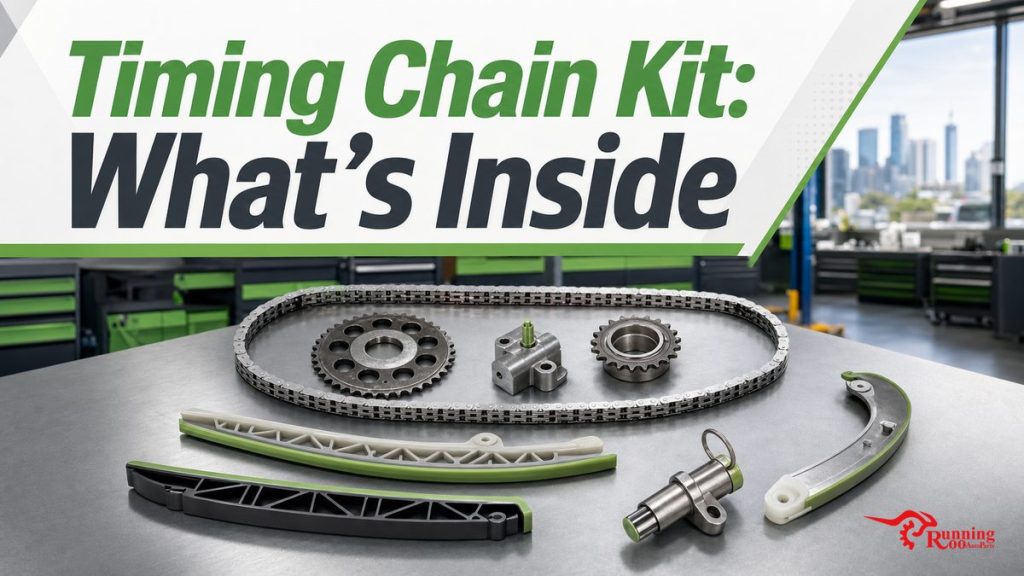
The exact contents depend on the engine, but a complete kit for a modern engine will usually contain the chain itself, the tensioner, the chain guides or rails, and the sprockets or gears where they are part of the wear set. Many kits also include the gaskets and seals needed to reseal the timing cover, and some include one-time-use bolts that must not be reused.
| Kit item | What it does | Why it matters |
|---|---|---|
| Timing chain | Drives the camshafts from the crankshaft | The primary wear item |
| Tensioner | Keeps the chain at correct tension | Prevents slap and skipped timing |
| Chain guides / rails | Guide the chain and damp movement | Wear and crack with age |
| Sprockets / gears | Drive the chain | Teeth wear and affect timing |
| Seals and gaskets | Reseal the timing cover | Prevent oil leaks after reassembly |
The presence of the seals and one-time-use fasteners is often the difference between a kit that is genuinely complete and one that is only mostly complete. An engine that has been opened and resealed with old gaskets is an engine that is likely to leak, and a leak after a timing job means the cover has to come off again.
The parts that are commonly left out
Budget kits frequently omit the pieces that are the least visible and the easiest to skip. The most common omissions are the VVT camshaft gears or cam phasers, the oil-pump chain, the chain guides on the secondary chain run, and the crankshaft or camshaft seals. On engines that have a separate oil-pump chain, leaving that small chain and its tensioner in place is a classic false economy, because it wears on the same schedule and lives behind the same cover.
The table below shows which extras are frequently missed and why they still matter.
| Often-missed part | Why it still matters |
|---|---|
| VVT camshaft gears / phasers | They wear with the chain and can rattle on cold start |
| Oil-pump chain and tensioner | Hidden behind the same cover; wears on the same schedule |
| Secondary guides | Cracking guides can break and damage the engine |
| Cam and crank seals | Old seals leak once the cover is disturbed |
The honest way to think about it is that every part the technician touches on the way in is a part worth renewing on the way out. A kit that is missing these items is not necessarily faulty; it is simply incomplete, and the missing pieces will either cost more later or require the engine to be opened again.
Kit quality: what separates good from cheap
The timing chain is a precision component that runs at engine speed under constant load, so the difference between a quality kit and a cheap copy shows up in chain elongation, guide durability and tensioner behaviour. A quality chain is manufactured to tight tolerances and will hold its pitch over tens of thousands of kilometres, while a poor chain can stretch early and bring the whole repair back to square one.
This is one area where the cheapest price is rarely the cheapest repair. Because the labour is the expensive part, a small saving on the parts is meaningless if the chain stretches or a guide breaks and the engine has to be opened again. The same logic applies to fitment: a kit that is not confirmed against the engine code is a risk regardless of how well it is made.
How to confirm the right kit
Timing chain kits are engine-specific, and the engine code is the reliable identifier. Model and year are helpful but not sufficient, because many engines were fitted across multiple models and changed mid-production. Before ordering, collect the engine code, the VIN and, where relevant, the engine displacement and fuel type. A supplier who asks for the engine code is doing the right thing; a supplier who quotes on “a Mazda 3” alone is guessing.
It is also worth checking whether your engine has a known weakness addressed by a revised part. Several engines have updated chain, tensioner or guide designs released later in production, and fitting the revised version during the service is the best way to prevent the same fault from returning.
What the job should include alongside the kit
The parts are only half the repair. The engine oil and filter should be changed at the same time, because fresh oil is essential to the new chain and tensioner from the first start. The timing should be set and verified against the manufacturer’s marks or locking tools, and the engine should be turned over by hand and rechecked before it is started. Skipping the verification step is how a timing job becomes an engine rebuild.
After the engine is running, the technician should check for leaks, confirm there are no correlation fault codes, and listen for any residual noise. A timing chain kit is a safety-critical part, and the repair is only complete when the engine runs quietly and the timing is confirmed correct.
How to avoid paying twice
The single biggest cause of a repeat timing job is an incomplete kit or a skipped step. Buying the complete kit with the guides, tensioner, seals and VVT or oil-pump components where they apply, and then having the job done to the manufacturer’s procedure, is how you do it once and move on. Cutting corners on either the parts or the procedure simply moves the cost forward, usually with interest.
For Australian owners, this is also a consumer-rights issue. Under Australian Consumer Law, parts must be of acceptable quality and fit for purpose, so buying from a reputable local supplier with clear engine-code fitment and a written warranty is worth far more than the last few dollars of an online discount.
How to read the contents list you are quoted
When comparing kits, do not compare prices; compare line items. List exactly which parts each kit contains — chain, tensioner, guides, sprockets, seals, gaskets and fasteners — and ask which extras are excluded. A kit that looks cheaper is often cheaper because it has dropped the VVT gears, the oil-pump chain or the seals that the dearer kit includes. Adding those parts back usually closes the price gap entirely, and doing so on a second, separate order is how the “cheap” kit becomes the expensive one.
The same discipline applies to the description of fitment. A kit listed for a specific engine code is worth more than a kit listed for a model, because the engine code is what confirms the chain length, tooth count and tensioner design. If the listing cannot state the engine code, ask the seller to confirm it before ordering.
What “complete” means on popular Australian engines
On many of the engines Australians actually drive, “complete” has a specific meaning that budget listings often miss. A Mazda, Hyundai, Kia or Nissan four-cylinder will often have a secondary oil-pump chain and its own tensioner behind the same timing cover, and both should be renewed with the main chain. Many VW Group engines should include the camshaft VVT gears, while several Mercedes-Benz engines should include the camshaft adjusters and the oil-pump drive chain in the same service.
The lesson is not to memorise every engine’s contents, but to recognise that a complete kit is defined by the engine, not by the seller’s marketing. A supplier who can tell you, for your specific engine code, exactly what should be in the kit is the supplier worth trusting.
Frequently asked questions
Do I need a full kit or just a chain?
Almost always a full kit. The chain, guides and tensioner wear together, and the labour to reach them is the same whether you replace one part or the set.
What is usually included in a timing chain kit?
A complete kit usually includes the chain, tensioner, guides or rails, and often the sprockets, seals, gaskets and one-time-use fasteners.
What is often left out of cheap kits?
VVT camshaft gears, the oil-pump chain and tensioner, secondary guides, and cam or crank seals are the most common omissions.
Why does the oil-pump chain matter?
It sits behind the same cover and wears on the same schedule, so leaving it in place risks a second teardown.
How do I confirm the right kit?
Use the engine code, VIN and engine details, and confirm with the supplier before ordering.
Should I replace the engine oil with the kit?
Yes. Fresh oil and a new filter are essential to the new chain and tensioner from the first start.
Are revised or upgraded parts worth it?
Yes. Where the manufacturer released a revised chain, tensioner or guide, fitting the updated version is the best way to prevent the fault returning.
How do I avoid paying twice?
Buy a complete kit with clear engine-code fitment, have it fitted to the correct procedure, and change the oil and filter at the same time.
Shop the products mentioned in this guide
- Timing Chain Kit for Hyundai i45 / Kia 2.4L G4KJ 2009–2017
- Timing Chain Kit for Mazda 3/5/6/Tribute 2.3L with VVT adjuster 2003–2007
- Timing Chain Kit for Nissan Teana J31/J32 VQ23DE VQ25DE VQ35DE 2003–2013
- Timing Chain Kit range — eBay
Watch on RunningRooAuto YouTube
- RunningRoo Auto Parts – trusted Melbourne parts support
- RunningRoo Auto Parts – product and fitment channel
RunningRoo Auto Parts – Based in Melbourne, Australia 🇦🇺
📞 Free 24/7 Pickup Available (Contact 0425890125)
💬 Any questions? Message or Call us anytime! We’re here to help.Why Choose RunningRoo?
✅ Aussie Owned & Operated | 🚚 Fast Shipping | 🤝 Friendly Support
Sources and further reading
- ACCC – Consumer rights and guarantees
- Product Safety Australia – vehicle recalls
- RACV – car maintenance and repair guidance
- API – Engine oil standards
- ACEA – European oil sequences
Engine timing procedures, chain-stretch limits and one-time-use fastener requirements are set out in each manufacturer’s workshop manual. Always confirm the engine code and VIN against the official repair information for your vehicle before ordering and fitting.
RunningRoo Auto Parts – Based in Melbourne, Australia 🇦🇺
📞 Free 24/7 Pickup Available (Contact 0425890125)
💬 Any questions? Message or Call us anytime! We’re here to help.Why Choose RunningRoo?
✅ Aussie Owned & Operated | 🚚 Fast Shipping | 🤝 Friendly Support