
By RunningRoo Auto Parts — written from the desk of our Product Manager
When an engine starts making a rattle from the timing area, the temptation is to name a part and start ordering. In reality, the timing system is a matched set of three main wear items — the chain, the guides and the tensioner — and they usually wear together, which makes “which part is it?” a question with more than one honest answer. Replacing the wrong one, or replacing only one when the others are also worn, is the classic way to pay for the same job twice.
This guide explains what each part does, how each one fails, and how a workshop separates the three so the repair is done once and done properly. It is written for Australian owners who have heard a rattle and want to understand the diagnosis before they commit to parts and labour.
RunningRoo Auto Parts – Based in Melbourne, Australia 🇦🇺
📞 Free 24/7 Pickup Available (Contact 0425890125)
💬 Any questions? Message or Call us anytime! We’re here to help.Why Choose RunningRoo?
✅ Aussie Owned & Operated | 🚚 Fast Shipping | 🤝 Friendly Support
The three parts and their jobs
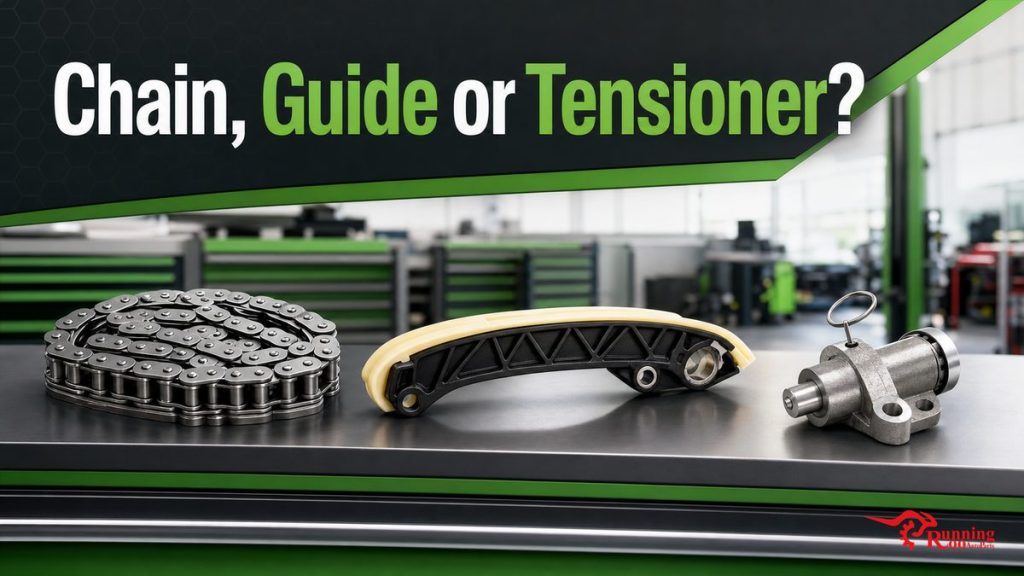
The timing chain transfers drive from the crankshaft to the camshafts, keeping the valves opening and closing in time with the pistons. The guides, sometimes called rails or slippers, are the plastic or alloy surfaces that keep the chain running in the correct path and damp its movement. The tensioner pushes against the chain through a guide, taking up slack as the system wears so the chain never becomes loose enough to slap or jump.
These three parts form a single system, and a fault in any one of them quickly becomes a fault in all of them. A worn tensioner allows the chain to slap, which hammers the guides. Worn guides allow the chain to move off line, which accelerates chain wear. A stretched chain outruns the tensioner, which then wears the guides. Understanding that interdependence is the key to understanding why the repair is so often a full kit.
How each part fails
A hydraulic tensioner usually fails through wear in its internal seal or ratchet, losing its ability to hold the chain firm while the engine is parked. That produces the classic brief cold-start rattle that disappears as oil pressure builds. Guides fail through cracking, grooving or complete breakage, and because they are often plastic, a broken guide can drop pieces into the engine or allow the chain to derail. The chain itself wears at every link joint and effectively lengthens, producing correlation fault codes and a rattle that may not disappear when warm.
The table below summarises the characteristic behaviour of each failure mode.
| Part | Typical failure mode | Characteristic sign |
|---|---|---|
| Tensioner | Worn seal or ratchet | Rattle for 1–3 seconds on cold start |
| Guide | Cracking, grooving or breakage | Persistent rattle; possible debris |
| Chain | Pin and roller wear (stretch) | Correlation codes; rattle that persists |
These are tendencies, not guarantees, which is why a correct diagnosis always combines listening, scanning and inspection rather than relying on the noise alone.
The cold-start rattle: the earliest clue
The single most useful symptom is a rattle that lasts for a second or two when the engine is first started cold, then quietens. That signature points to a loss of oil-pressure hold, which is most often the tensioner, but it can also be a VVT gear with a worn locking pin. The timing of the noise, and what the engine computer reports, is what separates the possibilities.
Because oil pressure hides the problem once the engine is running, the best time to listen is first thing in the morning. If the rattle only happens then, the tensioner or VVT gear is the prime suspect; if it persists warm, the chain stretch or guide wear is more likely. Recording the sound and noting when it occurs gives a workshop genuinely useful information.
What the fault codes reveal
The engine computer is a powerful diagnostic partner. Camshaft-to-crankshaft correlation codes point towards chain stretch or a jumped tooth, while camshaft over-advanced or over-retarded codes point towards the VVT system. A “no communication” code, on the other hand, may have nothing to do with the timing system at all and can be caused by a weak battery or damaged wiring.
A full scan, including stored codes that have not yet turned on the warning light, is the cheapest high-value step in the whole diagnosis. It often narrows the search before a single cover bolt is removed.
The physical inspection that confirms the diagnosis
Ultimately, the parts have to be seen. Once the timing cover is off, a technician can inspect the chain for wear, measure its stretch against the specification, check how far the tensioner has extended, and look for cracks, grooves or missing pieces in the guides. This is the point where the “which part is it?” question is finally answered with certainty rather than probability.
The value of this inspection is not just in finding the failed part, but in assessing the others. It is common to find that the tensioner has failed while the guides are heavily grooved and the chain is near its wear limit, which is exactly why the honest repair is the full kit rather than a single part.
Why the answer is usually “all of the above”
Because the three parts wear together, the most common correct answer is that they are all worn to some degree. The question is not really which part to replace, but whether replacing one part is safe or whether the whole system should be renewed. On a low-kilometre engine with a single failed tensioner and a chain still within specification, a tensioner-only repair can be legitimate. On a high-kilometre engine, the answer is almost always the complete kit.
The decisive factors are the measured chain stretch, the condition of the guides and the extension of the tensioner. Those measurements, not the noise alone, are what determine whether a partial repair will last or will return within a year.
Doing the job once, properly
Whatever the scope, the repair should use quality parts with confirmed engine-code fitment, a fresh oil and filter change, and the manufacturer’s timing and tensioner procedures. Hydraulic tensioners must be primed correctly, one-time-use fasteners renewed, and the timing verified before the engine is started. After the work, a cold-start listen the following morning confirms the rattle is gone.
For Australian owners, the consumer-law angle is worth remembering too. Parts must be of acceptable quality and fit for purpose, so buying from a reputable local supplier who can confirm fitment and provide a written warranty is the sensible way to protect a repair that has so much labour invested in it.
The cost difference between guessing and diagnosing
Diagnosis is cheap; guesswork is expensive. A full scan, a careful cold-start listen and a physical inspection once the cover is off cost a fraction of the parts and labour of a timing job, yet they are the difference between replacing the right part once and replacing the wrong part twice. The most common expensive mistake is to order a chain on the strength of a rattle, only to find the tensioner was the failed part and the chain was still in specification.
The second most common mistake is the opposite: replacing the tensioner alone when the chain and guides were also worn, so the new tensioner simply masks the problem for a while and the rattle returns. Both mistakes are avoided by measuring rather than assuming, which is exactly what a proper diagnosis provides.
Interference vs non-interference engines and why it matters
The urgency of a timing-system fault depends heavily on whether your engine is an interference design. In an interference engine, the valves and pistons occupy the same space at different times, so a jumped or broken chain usually means the two meet and the engine is destroyed. In a non-interference engine, a failed chain stops the engine without bending valves, which is still a breakdown but a far cheaper one.
Most modern engines are interference designs, which is why a timing rattle should never be treated as a “wait and see” item. The consequence of being wrong is not a nuisance; on many engines it is a replacement engine. Knowing your engine’s type, and acting on the first reliable sign of trouble, is the practical difference between a kit and a rebuild.
Frequently asked questions
How do I know if it is the chain, the guide or the tensioner?
The cold-start rattle and fault codes give strong clues, but a physical inspection once the cover is off is what confirms it.
Why does the rattle only happen when the engine is cold?
Because oil pressure builds once the engine runs and temporarily takes up the slack that a worn tensioner or VVT gear can no longer hold overnight.
Are the chain, guides and tensioner usually worn together?
Yes. They are a matched wear set, which is why the repair is so often a complete kit rather than one part.
Can I replace just the tensioner?
On some engines yes, if the chain and guides are still within specification and the tensioner is accessible. On many engines the chain and guides are also worn, so a kit is the better repair.
What fault codes point to timing chain wear?
Camshaft-to-crankshaft correlation codes point to chain stretch or skipped timing, while camshaft over-advanced/over-retarded codes point to the VVT system.
Can a weak battery cause a timing-related code?
A weak battery can cause a “no communication” code that looks like a serious fault, so the battery and wiring should always be checked first.
Why is a full kit better than one part?
Because the parts wear together and the labour to reach them is the same, so renewing the whole set avoids paying for the labour twice.
What should I check after the repair?
Confirm there is no rattle on a cold start, no leak, and no recurring fault codes.
Shop the products mentioned in this guide
- New Mercedes-Benz M271 Kompressor C200/CLK200 Timing Chain Tensioner 2710500611
- Timing Chain Tensioner Kit for Audi A1/A3, VW Golf 1.4 FSI/TSI 1.6 FSI
- Timing Chain Tensioner W0133-1807048-NTN for Honda S2000 2.0L 2000–2009
- Timing chain tensioners and kits on eBay
Watch on RunningRooAuto YouTube
- RunningRoo Auto Parts – trusted Melbourne parts support
- RunningRoo Auto Parts – product and fitment channel
RunningRoo Auto Parts – Based in Melbourne, Australia 🇦🇺
📞 Free 24/7 Pickup Available (Contact 0425890125)
💬 Any questions? Message or Call us anytime! We’re here to help.Why Choose RunningRoo?
✅ Aussie Owned & Operated | 🚚 Fast Shipping | 🤝 Friendly Support
Sources and further reading
- ACCC – Consumer rights and guarantees
- Product Safety Australia – vehicle recalls
- RACV – car maintenance and repair guidance
- API – Engine oil standards
- ACEA – European oil sequences
Tensioner priming, timing-set procedures and component wear limits are engine-specific and are described in each manufacturer’s workshop manual. Confirm your engine code and VIN against the official repair information before diagnosis or replacement.
RunningRoo Auto Parts – Based in Melbourne, Australia 🇦🇺
📞 Free 24/7 Pickup Available (Contact 0425890125)
💬 Any questions? Message or Call us anytime! We’re here to help.Why Choose RunningRoo?
✅ Aussie Owned & Operated | 🚚 Fast Shipping | 🤝 Friendly Support