
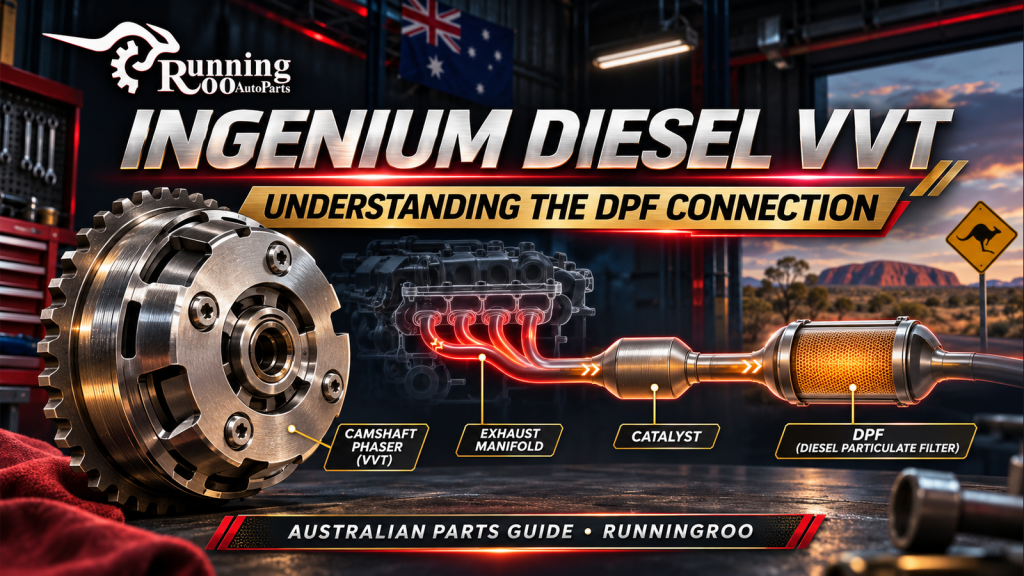
A diesel particulate filter warning and an exhaust camshaft timing concern can appear in the same workshop discussion, but that does not make a replacement VVT actuator a universal DPF repair. For Australian owners of Jaguar and Land Rover vehicles with an Ingenium diesel engine, the useful question is what the workshop has actually established about each system. A connection in engine design is not evidence that one particular component has failed.
This guide explains how to discuss that connection without turning it into an unsupported parts recommendation. RunningRoo lists an exhaust camshaft VVT actuator under references LR073764 and JDE36868 at Exhaust Camshaft VVT Actuator for Land Rover Jaguar 2.0 Diesel LR073764 JDE36868 — RunningRoo, with the corresponding offer at matching RunningRoo eBay listing. Confirm the VIN, fitted engine code and required OE reference before ordering. Call 0425 890 125 for friendly parts support after the repairer has defined the requirement.

What Jaguar's engineering information establishes
Jaguar's official Ingenium engineering release explains that variable exhaust valve timing supports rapid catalyst warm-up and efficient particulate-filter regeneration. That establishes a functional relationship between exhaust timing and emissions-system operation. It does not state that any particular DPF warning identifies a failed camshaft actuator, or that fitting LR073764 will resolve every regeneration concern. The release is engineering background, not a VIN-specific repair procedure or parts catalogue. Jaguar official engineering release: Ingenium diesel exhaust valve timing
For a customer, the distinction is practical. The workshop may be considering more than one system because the engine operates as a coordinated whole. Ask it to explain which observations concern camshaft control, which concern the exhaust system, and whether it has established a causal link in this particular vehicle. A general explanation of the design cannot replace that assessment.
Do not treat the term “DPF-related” as a complete diagnosis. It could describe a warning, a recorded condition, a suspected consequence or the reason for a further test. Ask the repairer which meaning applies. The parts order should follow a confirmed requirement, rather than the most alarming phrase in an initial conversation.
Identify the vehicle and fitted engine first
Provide the full VIN through a private enquiry, the build details and the fitted engine code. If the engine has been replaced, include that history. The model badge and a general description such as “two-litre diesel” are useful starting points but do not establish the exact actuator revision or installation requirements. The repairer should resolve conflicting identifiers before a purchase is made.
RunningRoo's selected listing names several Jaguar and Land Rover applications and uses LR073764 and JDE36868 as product references. Treat that information as a catalogue lead to be checked against the actual vehicle. A broad application title should not be expanded into a promise that the part fits every Ingenium diesel or every model year within a familiar badge.
Where possible, give the supplier the workshop's requested reference and clear photographs of the removed component's identification markings. Photographs supplement the VIN and engine information; visual similarity alone is not a reliable ordering decision. If the installer has specified a superseding number, ask for the documented relationship rather than assuming two references are interchangeable.
Keep two evidence records instead of one vague complaint
Ask the workshop to preserve the exact warning messages and relevant diagnostic findings. Record when the driver first noticed the concern, whether the vehicle's behaviour changed and what maintenance or repair work preceded it. Avoid converting those observations into your own explanation of a failed gear or blocked filter. An accurate timeline is more useful than a confident but untested conclusion.
Separately record the technician's findings about camshaft control. What was tested, under what conditions, and what result supports the proposed replacement? The owner does not need to reproduce the tests or interpret manufacturer data independently. The aim is to obtain a clear statement of the evidence behind the parts recommendation.
If a workshop proposes several operations, ask how they relate. One may address a confirmed component fault, another may involve further investigation, and another may depend on the outcome of the earlier work. An itemised explanation makes those distinctions visible and prevents a package price from implying that every suspected issue has already been proven.
Questions that make the repair plan clearer
| Subject | Useful question for the workshop | What the answer should clarify |
|---|---|---|
| Initial warning | What exact message or recorded condition started the enquiry? | The original concern |
| Camshaft control | What finding supports an actuator recommendation? | Evidence for the component order |
| Exhaust system | What has been assessed separately? | Scope beyond the camshaft component |
| Relationship | Is a causal link confirmed or still being investigated? | Certainty of the explanation |
| Replacement part | Which reference and revision are required? | Fitment and procurement |
| Completion | How will the original concerns be reassessed? | The planned handover evidence |
These are discussion prompts, not a repair sequence. The appropriate tests and their order depend on the vehicle and current manufacturer information. Avoid asking a workshop to perform a particular procedure simply because another owner described it online. The technician must decide what is applicable and safe for the actual condition.
What LR073764 purchasing information can tell you
The selected RunningRoo page describes an exhaust camshaft VVT actuator. It is not presented here as a particulate filter, a complete exhaust-system repair package or a guarantee that an emissions warning will disappear. Confirm the exact item and included components in writing if the workshop's estimate requires more than the actuator itself.
Compare Exhaust Camshaft VVT Actuator for Land Rover Jaguar 2.0 Diesel LR073764 JDE36868 — RunningRoo and matching RunningRoo eBay listing using the current descriptions, relevant references and actual order details. If the workshop needs additional seals, fasteners or other parts, ask for a separate list. Do not infer that every surrounding service item is included because the main component is pictured or because the listing uses a broad vehicle application title.
A useful order note states the vehicle identity, fitted engine, workshop job reference and the requested exhaust-side component. It should also identify any unresolved question. A supplier can help check a defined part enquiry; it cannot confirm a complex vehicle diagnosis from a retail title or a customer's summary of a dashboard warning.
Avoid the single-part cure assumption
A replacement component should be linked to a specific finding. If the quote says “VVT actuator to fix DPF”, ask for a fuller explanation of the diagnosis and the expected scope. That wording may be shorthand for a considered repair plan, but the customer should not have to guess. Ask what remains to be checked after the component work is complete.
Conversely, do not assume that a DPF-related conversation makes the camshaft component irrelevant. The official engineering background explains why the workshop may discuss both areas. The correct response is to request evidence and a clear plan, rather than accepting or rejecting the recommendation solely because the systems sound different.
This article does not provide forced-regeneration instructions, driving routines intended to clear warnings, or emissions-system removal advice. Follow the vehicle's applicable owner guidance and the repairer's assessment. If a warning calls for stopping or assistance, do not continue driving simply to gather more observations for a parts enquiry.
Record maintenance without inventing a cause
Bring available service invoices and details of previous work involving timing components, camshaft control or the exhaust system. Include the dates and recorded odometer readings where known. If the documentation is incomplete, say so. Missing history should not be filled with assumptions about what an earlier workshop probably replaced.
Describe recent use factually, such as a change in journey patterns or the date a warning first appeared. Do not decide that a particular trip caused the fault unless the repairer has established that conclusion. The workshop can determine whether the information matters to its assessment. Accurate context supports diagnosis without becoming a diagnosis itself.
Also record anything changed after the warning appeared. A new part, cleared report or attempted intervention may be relevant to understanding the current state. Give that information to the technician rather than repeating experiments to see whether the warning returns. Preserve the available evidence and ask what the workshop wants documented next.
A staged quotation can be more useful than a broad promise
An initial diagnostic charge may be separate from the final repair estimate. Ask what that stage is intended to establish and what written result will be supplied. If the workshop cannot yet confirm the actuator requirement, keep the parts order provisional. Buying early does not make the diagnosis more certain.
Once the requirement is confirmed, ask the quotation to separate the supplied component, installation work, any additional confirmed parts and the planned checks. If further work depends on inspection findings, agree on an approval point. This helps both the owner and the workshop understand what the current price covers and what remains conditional.
Do not compare two quotations solely by whether both mention LR073764. One may include a broader investigation or a different scope of completion checks. Ask each repairer to describe its work plainly. A fair comparison requires the same confirmed vehicle identity and a clear understanding of the services included.
A hypothetical example of a better enquiry
An owner receives a warning and asks whether buying the actuator will solve it. At that stage the supplier has a product enquiry but no confirmed repair requirement. The next useful step is a qualified assessment. After testing, the workshop can provide its findings and identify whether this exact exhaust actuator is part of the proposed work.
If it is required, the owner sends RunningRoo the VIN, fitted engine code, requested reference and delivery details. If it is not required, the owner avoids purchasing a part merely because the article mentioned a design connection. This example illustrates an ordering process; it does not describe a customer case or predict a particular fault pattern.
The same discipline applies when a workshop is ordering directly. A job number and written reference reduce ambiguity, while a clear receiving contact helps resolve questions before installation. Keep the supplier response with the job record so that the person checking the delivery sees the same information as the person who placed the order.
Melbourne collection and Australian workshop coordination
RunningRoo is Australian-operated and offers friendly support with product identification enquiries. Melbourne local pickup is available by appointment once the exact item and stock have been confirmed. Call 0425 890 125 before travelling to collect. Arrange the appointment around the workshop's needs rather than assuming that a catalogue page alone confirms collection readiness.
For delivery elsewhere in Australia, provide the destination postcode and ask about fast dispatch of confirmed stock. Dispatch timing and carrier arrival are separate matters, so coordinate the repair booking accordingly. If the installer wants to inspect the component before committing to a work date, allow time for that receiving check.
On arrival, ask the workshop to compare the supplied item with its written requirement before fitting. Resolve differences in markings or expected contents with the supplier. A part should not be modified to compensate for an unresolved identification problem. Keep the order documentation available until the installer has confirmed that the component matches the approved job.
Document the result without overstating it
At handover, ask what work was completed and how the original concerns were reassessed. The record should distinguish the actuator replacement from any separate exhaust-system work. If one concern remains under investigation, retain that distinction rather than treating the invoice as proof that the entire engine and emissions system has been renewed.
Keep the final references, invoice and workshop explanation for future servicing. If a warning returns, record the new event and contact the repairer. Do not assume that a later warning automatically proves the new component has failed or that the earlier work was unrelated. The new situation needs its own assessment against the documented repair history.
Frequently asked questions
Does exhaust VVT have a connection with DPF operation?
Jaguar's official engineering release describes a role for variable exhaust valve timing in catalyst warm-up and particulate-filter regeneration. That is system background, not proof that a particular actuator is responsible for a warning on your vehicle.
Will LR073764 clear every DPF warning?
No such guarantee is made. A workshop must diagnose the actual concern and confirm whether the actuator is required. Separate exhaust-system assessment may also be part of its plan.
Is this a complete emissions repair kit?
The selected listing is for an exhaust camshaft VVT actuator. Confirm the precise package contents and any additional required items before ordering.
Are LR073764 and JDE36868 enough to establish fitment?
They are useful catalogue references, but the VIN, fitted engine and installer-confirmed requirement still matter. Resolve revision or supersession questions before purchase.
Can RunningRoo help with an Australian order?
Yes. Send the identified part requirement for friendly support, confirm current stock, and discuss fast dispatch or Melbourne pickup by appointment. Diagnosis and installation remain matters for the qualified repairer.
Related reading and RunningRoo video
Read the related RunningRoo product-identification guide. Use that guide for the catalogue discussion and this article for the specific workshop question above.
Watch RunningRoo: Variable Valve Timing Explained. This is general background from the RunningRoo AutoParts channel, not a demonstration of this exact supplied component, confirmation of fitment or a substitute for the vehicle-specific repair procedure.
Confirm your parts enquiry with RunningRoo
Send your VIN privately, fitted engine code, relevant OE number and the installer-approved parts list before ordering. Contact RunningRoo support or call 0425 890 125. RunningRoo is Australian-operated in Blackburn, Victoria. Melbourne local pickup is by appointment; ask about fast dispatch after stock, fitment and order timing are confirmed. Friendly support can help clarify the product enquiry while the qualified repairer remains responsible for diagnosis and installation.
Technical references and scope
Jaguar official engineering release: Ingenium diesel exhaust valve timing. Manufacturer material provides the technical background described in the article. Archived training and general system explanations are not current VIN-specific repair instructions. The discussion questions and planning examples are editorial guidance. Retail descriptions establish the seller’s stated offer, not manufacturer approval or universal compatibility.