
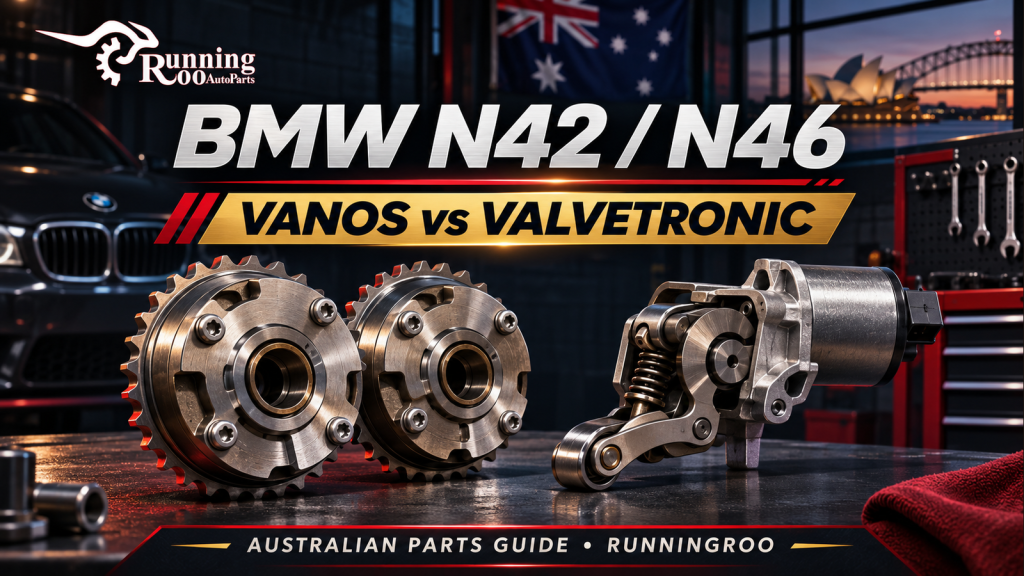
A BMW N42 or N46 owner can hear “VANOS”, “Valvetronic”, “VVT” and “servo motor” in the same repair conversation. Those words should not be treated as interchangeable names for one replacement part. Before ordering a pair of camshaft gears in Australia, ask which system the workshop has identified and what evidence supports the recommendation. A correct parts match cannot compensate for an unclear repair scope.
This guide focuses on choosing a clear diagnostic path between camshaft timing adjustment and valve-lift control. It complements the existing RunningRoo part-number guide rather than repeating its catalogue information. The relevant VANOS gear pair is Camshaft VVT Gear(Intake+Exhaust)For BMW N40 N42 N45 N46 11367500032 11361707315 — RunningRoo, also offered through matching RunningRoo eBay listing. Call 0425 890 125 for friendly parts support once the workshop has identified the required component and the fitted engine.

The distinction established by BMW
BMW's N42 service-training material treats VANOS camshaft adjustment and Valvetronic as separate functions within the engine-management discussion. It describes Valvetronic's eccentric-shaft adjustment motor and related sensing and control components. The technical distinction is between changing camshaft timing and controlling valve lift. This is original BMW training background, reproduced by an archive; it is not a current repair instruction for every N46 derivative. BMW N42 Service Training, chapter 4 (transcribed original BMW document)
That distinction matters at the counter. A camshaft gear pair is not a Valvetronic motor, and neither description should be shortened to “the VVT unit” when placing an order. Ask the workshop for the specific component name, relevant OE reference and its reason for selecting that part. The supplier can then match the enquiry to a defined product rather than guessing from a symptom.
The article does not claim that a rough idle, warning light or performance change uniquely identifies one of these systems. Such symptoms require assessment. The aim is to help the owner recognise when a repair explanation has moved from a general complaint to a specific finding, and to ensure the final parts list follows that finding.
Identify the actual engine, not only the model badge
An E46, E87 or E90 model description can cover different engine versions. Provide the VIN, build details and actual engine code. If there has been an engine replacement, state that clearly and give the workshop's identification of the fitted assembly. A supplier's application table is useful for narrowing an enquiry but should not replace the installer’s confirmation.
The selected gear-pair listing names several related BMW engine families. This article's VANOS-versus-Valvetronic discussion is specifically about the N42/N46 enquiry and must not be extended to every engine named in that retail title. Shared catalogue wording does not establish that all listed engines have identical control systems, components or test procedures.
Ask the workshop to resolve conflicting identifiers before ordering. A registration result, removed-part number and engine marking may need to be considered together. If the evidence is incomplete, the order should remain conditional. Waiting for a clear identifier is usually more useful than buying several similar-looking parts and asking the installer to choose after delivery.
Read a scan report as evidence, not a shopping instruction
If a diagnostic report mentions a system, ask what the technician concluded from it. Was the reported concern reproduced? Is the component recommendation confirmed or provisional? What further check, if any, is needed before replacement? These questions help the owner understand the scope without attempting to interpret BMW-specific data independently.
Keep the full report where available, including the workshop's explanation. Do not reduce it to a remembered phrase such as “cam motor code”. That wording can refer to different things in an informal conversation and may lead to the wrong product enquiry. If the workshop provides a part number, retain the number and the position or function associated with it.
A fault label should not become an automatic order for the most familiar component. Nor should the absence of one particular code be represented as proof that a system is healthy. The technician must interpret the available evidence in context and use the correct current service information. The owner can insist on a clear explanation without prescribing the test outcome.
A component-language worksheet
| Term in the conversation | Clarification to request | Why it helps |
|---|---|---|
| VANOS gear or adjuster | Intake, exhaust or both, with references | Identifies the supplied camshaft component |
| Valvetronic motor | Exact motor and fitted-engine application | Prevents ordering gears for a motor enquiry |
| Position sensor | Which sensor and what finding supports replacement | Avoids treating all sensing faults alike |
| Timing concern | Mechanical timing, adjustment response or both | Makes the repair scope understandable |
| Adaptation or setup | Applicable manufacturer procedure and reason | Prevents assuming a reset is a repair |
| Complete repair | Actual included parts and checks | Replaces a vague promise with a defined job |
Use the worksheet when a quotation contains abbreviated descriptions. It is not a list of components that every customer should buy. Some rows may be irrelevant to the actual job. The value lies in naming the part and the finding correctly, so the supplier and installer are not working with different interpretations of the same short phrase.
What the RunningRoo VANOS pair actually describes
The selected page lists an intake camshaft gear with reference 11367500032 and an exhaust gear with reference 11361707315. It describes one of each in the package and identifies the products as aftermarket replacements. Those references and contents should be checked against the specific fitted engine before ordering. They are not a promise that the pair fixes any N42/N46 running complaint.
The listing does not turn the pair into a Valvetronic motor, eccentric-shaft assembly, sensor set or complete timing-chain package. If the workshop needs one of those other components, ask for a separate itemised requirement. A photograph showing two gears should not be interpreted as a complete inventory of everything that may be needed during the repair.
Compare Camshaft VVT Gear(Intake+Exhaust)For BMW N40 N42 N45 N46 11367500032 11361707315 — RunningRoo with matching RunningRoo eBay listing and obtain written confirmation if the workshop needs a particular revision or only one position. Do not use the intake and exhaust references interchangeably. Keep the order record specific enough that the receiving workshop can check the package without reconstructing several earlier phone calls.
Separate confirmed work from investigation
A workshop may need an initial diagnostic appointment before it can produce a final parts list. Ask what that stage is intended to establish and what information you will receive afterwards. A provisional concern about a system is not the same as a confirmed failed component. The estimate should make that difference visible.
If the workshop recommends opening an assembly, agree on the next approval point and how unexpected findings will be communicated. Request photographs or a written description where appropriate. Do not assume that permission to investigate one system automatically includes replacement of every adjacent component. A clear approval process helps prevent the parts order from expanding without an explanation.
Equally, do not demand that the technician reduce a complex concern to a single cheap part before inspection. The most useful question is what evidence is needed to choose the next step. This guide is intended to make that decision understandable, not to replace a qualified diagnosis with a simplified internet rule.
Include previous work and maintenance information
Bring invoices for earlier timing, camshaft-control or related engine work. If someone replaced a motor, sensor or gear, identify it precisely. “VANOS repaired last year” may be too broad to show what was actually done. The workshop needs the parts and procedure history that is available, not assumptions about a complete rebuild.
Provide the known oil-service information and note any changes made after the complaint started. If the details are unknown, leave them unknown. Do not alter the oil, disconnect components or repeatedly clear faults simply to see what happens before the appointment. Ask the workshop what it wants preserved for assessment.
If the vehicle has been modified or has a replacement engine, disclose that without trying to predict its significance. The technician can decide how it affects the applicable information and tests. A supplier should receive the resulting confirmed identity, so that an order based on the original vehicle record does not conflict with what is actually fitted.
A hypothetical ordering mistake to avoid
An owner hears “variable valve system” and buys the two camshaft gears. The workshop later explains that its confirmed requirement concerns a different component. The gears may be valid products for an application, but the order did not follow the diagnosis. This is an illustrative communication problem, not a claim that a particular component commonly fails.
The opposite mistake is also possible: ordering a motor because the word Valvetronic was mentioned during an explanation, when the final recommendation concerns the camshaft adjustment gears. The solution is not to guess which term sounds more technical. Ask for the final written component list and the finding that supports it before purchasing.
A clear request might state the fitted engine identity, the intake or exhaust position, the OE references and the workshop job number. That gives RunningRoo a defined question. It also lets the installer verify the package before fitting, rather than assuming that a box labelled for the engine family necessarily contains the required part.
Melbourne support and Australian delivery planning
RunningRoo is Australian-operated, with friendly support for both owners and workshops. Melbourne pickup is available by appointment after the exact item and stock are confirmed. Call 0425 890 125 before collecting. A local parts conversation can save time, but it does not remove the need for professional diagnosis or accurate engine identification.
Interstate customers should provide the receiving postcode and ask about fast dispatch for the confirmed stock. Coordinate delivery with the workshop rather than assuming that an estimated arrival date guarantees a repair booking. If the installer wants to inspect the parts first, allow time for that check before the vehicle is dismantled around an expected package.
Keep the supplier's written response and the order reference. If a marking, package or component position differs from what the workshop expected, resolve the issue before installation. Do not modify a supplied part to make it resemble another version. The correct response to a mismatch is an identification discussion, supported by the actual item and vehicle details.
Handover and future service records
Ask the repairer to describe the completed work using the same precise component names used in the quotation. Keep the invoice, relevant references and a summary of how the original complaint was reassessed. If manufacturer setup or adaptation procedures were applicable, ask the workshop to record what was completed without treating that entry as a substitute for mechanical or electrical findings.
If a separate concern remains, record it separately. Work on one function does not establish that every aspect of engine control has been renewed or tested. A well-documented repair should explain its own scope and limitations. That is more useful for future maintenance than a broad claim that “all VVT issues” have been solved.
Use precise names in the final purchase approval
Before paying for parts, read the workshop's final list back against the supplier's description. Check the intake or exhaust position, the quantity and each reference. If the list still says only “variable valve unit”, request the specific component name. Resolving that wording at this point is simpler than discovering that the installer expected a different assembly after delivery.
Retain the final approved list rather than an earlier provisional version. If the diagnosis changed during investigation, make sure the purchasing instruction reflects the latest confirmed requirement. This is a routine communication check: it does not replace professional diagnosis, but it keeps the supplied gears tied to the repair that was actually approved.
Frequently asked questions
Are VANOS and Valvetronic the same thing?
No. They describe different functions in the N42/N46 discussion. Ask the workshop to identify whether its recommendation concerns camshaft timing adjustment, valve-lift control or another confirmed part of the repair scope.
Does the gear pair include a Valvetronic motor?
The selected RunningRoo listing describes one intake gear and one exhaust gear. It does not describe a Valvetronic motor as part of that package. Confirm all required items separately.
Can I choose a part from a fault-code name alone?
A fault description is evidence for professional interpretation, not a complete purchasing instruction. Ask the technician for its findings and the final recommended component references.
Why is the engine code needed if I have a VIN?
The VIN is important, but replacement-engine history or conflicting records may need additional identification. Give the supplier the workshop-confirmed fitted engine and relevant OE references as well.
Can I buy locally in Melbourne?
Contact RunningRoo to confirm the exact item, current stock and a pickup appointment. Fast dispatch options for other Australian locations can be discussed after the product match is established.
Related reading and RunningRoo video
Read the related RunningRoo product-identification guide. Use that guide for the catalogue discussion and this article for the specific workshop question above.
Watch RunningRoo: Variable Valve Timing Explained. This is general background from the RunningRoo AutoParts channel, not a demonstration of this exact supplied component, confirmation of fitment or a substitute for the vehicle-specific repair procedure.
Confirm your parts enquiry with RunningRoo
Send your VIN privately, fitted engine code, relevant OE number and the installer-approved parts list before ordering. Contact RunningRoo support or call 0425 890 125. RunningRoo is Australian-operated in Blackburn, Victoria. Melbourne local pickup is by appointment; ask about fast dispatch after stock, fitment and order timing are confirmed. Friendly support can help clarify the product enquiry while the qualified repairer remains responsible for diagnosis and installation.
Technical references and scope
BMW N42 Service Training, chapter 4 (transcribed original BMW document). Manufacturer material provides the technical background described in the article. Archived training and general system explanations are not current VIN-specific repair instructions. The discussion questions and planning examples are editorial guidance. Retail descriptions establish the seller’s stated offer, not manufacturer approval or universal compatibility.