
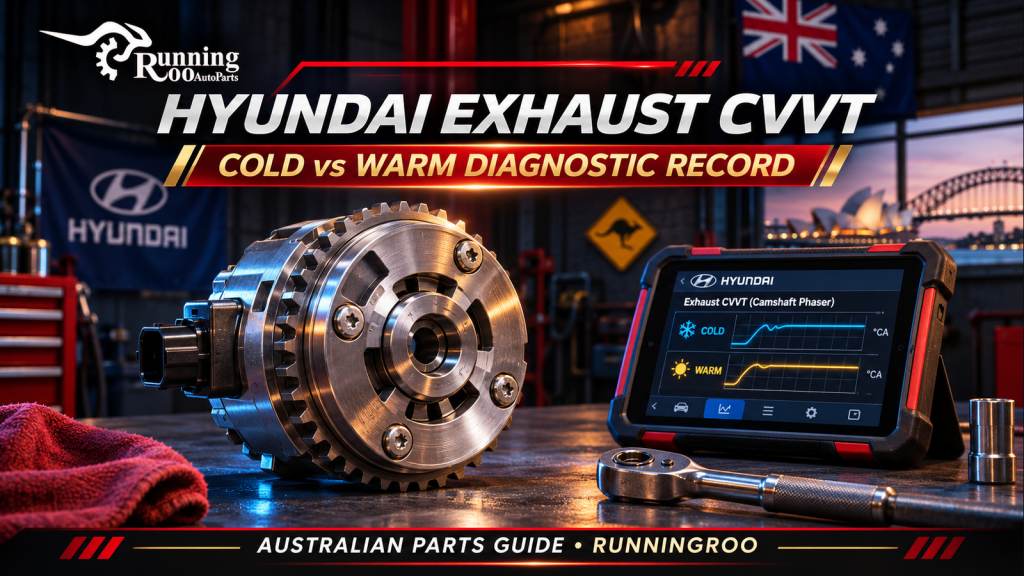
A Hyundai exhaust CVVT enquiry can start with a complaint that appears only after an overnight stop, only after a drive, or inconsistently from one appointment to the next. Before ordering a camshaft gear, give the workshop a clear record of those conditions. “It happens when cold” is useful context, but it is not a diagnosis and does not establish that a particular exhaust gear needs replacement.
This Australian guide focuses on comparing observations without turning temperature into a parts-selection shortcut. The selected RunningRoo product is the exhaust CVVT gear referenced 24370-2E650 at Elantra GT 18-20 Hyundai Exhaust CVVT Gear Camshaft VVT Sprocket 24370-2E650 — RunningRoo, also listed at matching RunningRoo eBay listing. Confirm the VIN, fitted engine code, exhaust-side requirement and OE reference with the installer. Call 0425 890 125 for friendly parts support once the requirement is defined.

Manufacturer background and its limits
Kia's manufacturer technical publication explains oil-control-valve operation within hydraulic CVVT and discusses professional comparison of commanded and actual camshaft behaviour. It also distinguishes different CVVT arrangements. This is useful manufacturer background for understanding a diagnostic conversation, but it is not a Hyundai-specific test specification or proof of fitment for 24370-2E650. The repairer must use current information for the actual Hyundai engine. Kia Tech Times 2017 volume 20 issue 1, CVVT diagnosis pages 17–18 (NHTSA-hosted manufacturer document)
The practical lesson is to ask what the workshop measured and under which conditions. Do not interpret a graph or a recorded value using limits borrowed from another engine. The same broad term, CVVT, does not establish identical components, test prerequisites or acceptable results across every vehicle that uses variable valve timing.
This article supplies an observation framework for the owner and an ordering framework for the parts enquiry. It does not prescribe test temperatures, electrical values, timing angles or installation settings. Those details belong to the applicable manufacturer procedure and the qualified technician's assessment of the specific vehicle.
Define cold and warm in useful language
Instead of recording only “cold”, note when the vehicle last operated and approximately how long it had been parked. Describe whether the observation occurred at the first start of the day or after a shorter stop. Those details give the workshop a more useful starting point than a label that different people may interpret differently.
For a warm observation, record the circumstances without trying to infer component temperatures. For example, state that the concern occurred after the normal trip to work, or after the vehicle had been parked following that trip. A driver's description should remain a description. The technician can decide which measured conditions are relevant to reproducing and assessing the complaint.
Do not repeatedly start, rev or drive a vehicle to create a comparison if a warning or the repairer's advice indicates that it should not be operated. Ask the workshop how it wants to receive the vehicle and the existing observations. A useful record never requires ignoring the applicable owner guidance or creating an unnecessary test on the road.
Record what happened before deciding why
Write down the symptom in plain language: the warning displayed, the change in behaviour or the sound that prompted the appointment. Include the approximate duration and whether it disappeared without intervention. Avoid adding a component name unless a technician has already identified it. “Exhaust gear failure” is a conclusion, while “brief noise at the first start” is an observation.
If a recording already exists, retain the original file and tell the workshop when it was made. A recording can provide context, but it cannot establish the source of every sound or replace an examination. Do not place a phone near moving parts, reach into the engine bay during operation or remove covers simply to obtain a clearer clip.
Keep observations that do not fit the initial pattern. If the concern occurred once after a warm stop as well as after overnight parking, include both events. Selecting only evidence that supports a suspected part makes the record less useful. The workshop should see the actual pattern, including uncertainty and occasions when the complaint was absent.
A simple comparison record for the appointment
| Record item | First-start observation | Later observation |
|---|---|---|
| Date and context | Note the date and parking interval | Note the preceding journey or stop |
| Complaint | Describe the actual behaviour | Describe whether it changed or was absent |
| Warning message | Keep the wording or a safe photograph | Record any different message |
| Recent intervention | State what had already been changed | Note any changes between observations |
| Technician evidence | Leave interpretation to the workshop | Request comparison under appropriate conditions |
| Unknown information | Mark it unknown | Do not replace uncertainty with a guess |
The table is not a pass-or-fail test. It helps the technician decide what information is available and whether the complaint needs a particular appointment arrangement. If the workshop wants the vehicle left overnight, confirm that before arrival. The practical scheduling discussion may be more useful than trying to reproduce the concern yourself.
Ask how the workshop reached the component recommendation
When a report mentions camshaft response, ask whether the result is a confirmed finding or a reason for further investigation. What applicable procedure was used, and what conclusion does the repairer draw? The customer need not interpret the technical data independently, but should understand why the proposed part follows from the evidence.
If the workshop compares requested and observed operation, ask it to explain the outcome in plain language. A supplier does not need a guessed interpretation of every data point. It needs the final confirmed component requirement, the correct vehicle identity and any relevant reference or revision information supplied by the installer.
A symptom changing between cold and warm conditions does not, by itself, distinguish a gear from every other possible area of investigation. Avoid ordering on that basis alone. Likewise, a complaint that is absent during one short visit should be documented accurately rather than treated by the owner as proof that nothing needs assessment.
Keep service history attached to the observations
Bring the available service invoices and details of any earlier timing or camshaft-control work. Record which components were actually replaced if that information exists. “The timing was done” is too broad to establish whether a particular gear was included. Ask the previous repairer for clarification when the documentation does not answer the current workshop's question.
Provide the known oil-service information without inventing missing specifications or intervals. If a service record is unavailable, say so. The technician can determine what needs checking. Do not change oil products, add treatments or clear diagnostic records merely to create a different result before the appointment unless the repairer has specifically directed an appropriate step.
Include the date of any recent battery disconnection, diagnostic visit or component change if known. This is a factual history for the workshop, not a claim that any one event caused the problem. A chronological record helps keep the discussion grounded in what happened rather than in a sequence of unverified explanations.
Identify 24370-2E650 precisely
The selected RunningRoo listing describes an exhaust CVVT gear with reference 24370-2E650 and names an Elantra GT application in its title. Australian model naming and the vehicle's actual configuration must still be checked. The article does not expand that retail title into a guarantee for every Australian Hyundai with a similar badge, capacity or year.
Provide the VIN, build information and fitted engine code. If a replacement engine is present, identify it rather than relying only on the original vehicle record. Ask the installer to confirm that the requested component is on the exhaust side and that the reference matches the approved repair. Intake and exhaust descriptions should not be shortened to an ambiguous “VVT gear”.
Compare Elantra GT 18-20 Hyundai Exhaust CVVT Gear Camshaft VVT Sprocket 24370-2E650 — RunningRoo and matching RunningRoo eBay listing with the written requirement. If a different number appears on the removed component, ask the supplier and installer to resolve the relationship before purchase. Similar photographs or a near match in digits are not enough. Keep any written fitment discussion with the order so that the receiving workshop can review it.
Define what the package and quotation include
The product enquiry concerns the exhaust gear. Do not assume that the order also supplies a timing chain, an oil-control valve, seals, fasteners or every part needed to complete access and reassembly. Ask for the actual current package contents and obtain the workshop's separate list of additional required items.
A repair estimate should distinguish diagnosis, the confirmed component, installation work and any conditional findings. If the workshop needs further inspection before finalising the parts list, agree on the next approval point. That is clearer than buying a broad set of components because the first conversation used several related technical terms.
Compare quotations by their stated scope rather than by the price of the gear alone. One may include an overnight assessment or further checks that another does not. Ask both repairers to explain what is covered and how they will assess the original complaint after the work. The aim is a transparent decision, not a prediction of a universal repair price.
A hypothetical cold-start enquiry
An owner reports that a concern appears at the first start but is absent when the car reaches the workshop. Instead of concluding that the exhaust gear must be responsible, the owner provides the original observations and arranges the appointment conditions requested by the technician. The workshop then performs the applicable assessment and explains its findings.
If the confirmed recommendation is this exhaust gear, the order can proceed with the vehicle details and reference. If the workshop identifies a different requirement, the observation record has still served its purpose. It helped the repairer investigate the complaint without committing the owner to a part selected from a symptom alone.
This example is a communication scenario, not a reported customer repair or a claim about the frequency of a particular failure. Its value is the order of decisions: observe accurately, obtain professional findings, identify the component, then purchase. That sequence also gives the supplier a much clearer question to answer.
Coordinate the parts order with the workshop
Ask who will receive and check the delivery, especially if the owner is buying the part and the workshop is installing it. Include the job reference and a contact who can answer identification questions. Make sure the installer has access to the supplier's written confirmation rather than relying on a verbal summary passed through several people.
On receipt, compare the item, markings and contents with the agreed requirement before fitting. If something differs, pause the installation discussion and resolve it with RunningRoo. Do not alter a component to compensate for an uncertain match. A clear receiving check protects the usefulness of all the identification work completed before ordering.
RunningRoo is Australian-operated and offers friendly support for parts enquiries. Melbourne local pickup is available by appointment after stock and the exact item are confirmed. Call 0425 890 125 before travelling. For other Australian destinations, provide the postcode and discuss fast dispatch of confirmed stock alongside the workshop's booking requirements.
Make the handover comparable with the original complaint
Ask the workshop to describe how it reassessed the concern under appropriate conditions after the repair. A note that the vehicle ran during a brief handover may not answer every question raised by an intermittent first-start complaint. The repairer should explain what was checked, what was observed and whether any further monitoring or assessment is required.
Keep the invoice, part reference and the original observation record together. If the concern recurs, record the new circumstances rather than assuming they are identical. A later event should be compared with the documented history by the technician. It does not automatically prove that the replacement gear has failed or that the earlier diagnosis was wrong.
The strongest result is a clear chain of evidence from the customer's observations to the workshop's findings, the selected component and the completed checks. That gives future service providers useful information and keeps the parts purchase connected to a defined job rather than a general internet description of CVVT symptoms.
Frequently asked questions
Does a cold-only symptom prove the exhaust CVVT gear is faulty?
No. It describes when the concern occurs. A qualified technician must assess the vehicle and explain the evidence for any component recommendation.
Should I repeatedly start the engine to make a recording?
Do not create unnecessary operating tests. Follow the applicable warnings and ask the workshop how it wants the existing observations supplied or the vehicle delivered.
Is the Kia publication a fitment source for this Hyundai part?
No. It provides manufacturer background on CVVT diagnosis. The actual Hyundai engine, current service procedure and part application require separate confirmation.
What should I send RunningRoo before ordering?
Provide the VIN privately, fitted engine code, requested OE reference, exhaust-side confirmation and any installer-specified revision details. Include the delivery postcode or request a Melbourne pickup appointment.
Does the listing include a complete timing repair package?
Do not assume so. Confirm the current exhaust-gear package and ask the workshop to identify any additional parts needed for the approved repair.
Related reading and RunningRoo video
Read the related RunningRoo product-identification guide. Use that guide for the catalogue discussion and this article for the specific workshop question above.
Watch RunningRoo: Variable Valve Timing Explained. This is general background from the RunningRoo AutoParts channel, not a demonstration of this exact supplied component, confirmation of fitment or a substitute for the vehicle-specific repair procedure.
Confirm your parts enquiry with RunningRoo
Send your VIN privately, fitted engine code, relevant OE number and the installer-approved parts list before ordering. Contact RunningRoo support or call 0425 890 125. RunningRoo is Australian-operated in Blackburn, Victoria. Melbourne local pickup is by appointment; ask about fast dispatch after stock, fitment and order timing are confirmed. Friendly support can help clarify the product enquiry while the qualified repairer remains responsible for diagnosis and installation.
Technical references and scope
Kia Tech Times 2017 volume 20 issue 1, CVVT diagnosis pages 17–18 (NHTSA-hosted manufacturer document). Manufacturer material provides the technical background described in the article. Archived training and general system explanations are not current VIN-specific repair instructions. The discussion questions and planning examples are editorial guidance. Retail descriptions establish the seller’s stated offer, not manufacturer approval or universal compatibility.