
By RunningRoo Auto Parts — written from the desk of our Product Manager
The Volkswagen Group 7-speed DQ200 dry dual-clutch gearbox is now a familiar sight on Australian roads, fitted to a huge range of Volkswagen, Audi, Škoda and SEAT vehicles. When the mechatronic unit fails, owners are usually told two very different stories: one workshop says the whole unit must be replaced, while another says only the TCM board needs attention. The truth depends on the fault, the part number and how the diagnosis was done. This guide explains the mechatronic’s common faults, how fitment is matched and why coding is not optional, so you can plan the repair without paying twice.
RunningRoo Auto Parts – Based in Melbourne, Australia 🇦🇺
📞 Free 24/7 Pickup Available (Contact 0425890125)
💬 Any questions? Message or Call us anytime! We’re here to help.Why Choose RunningRoo?
✅ Aussie Owned & Operated | 🚚 Fast Shipping | 🤝 Friendly Support
What the DQ200 mechatronic actually does
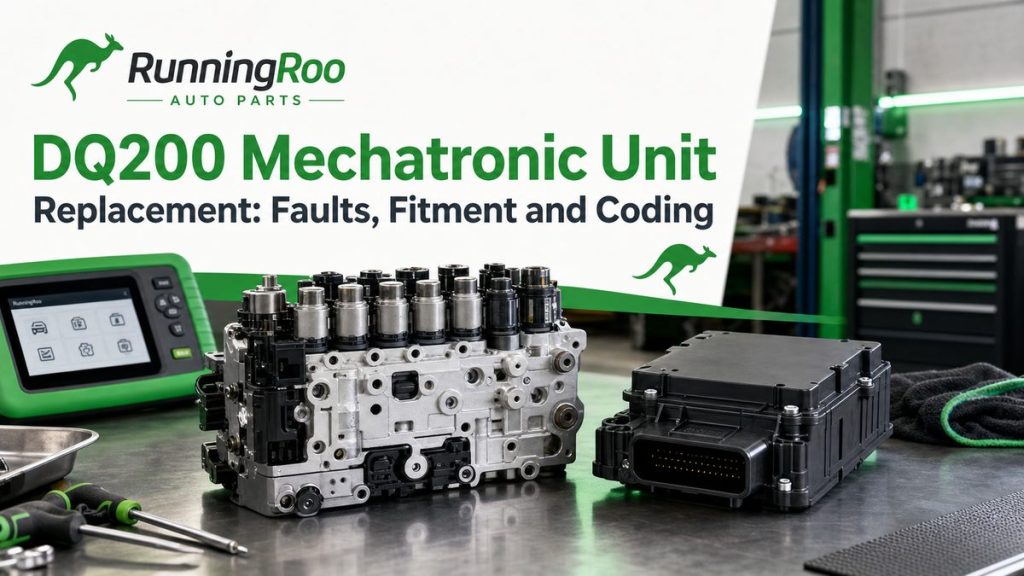
The DQ200 mechatronic combines the electronic transmission control module with the hydraulic valve body that operates the gearbox. The TCM reads the vehicle’s inputs and commands the solenoids, while the valve body directs hydraulic pressure to the clutches and selector forks. Because the electronics and hydraulics live in one unit, a fault in either side often presents as the same symptom: harsh shifting, no drive, flashing PRNDS or permanent limp mode.
That combination is also why diagnosis matters. A communication code can be a failed TCM, a wiring fault or a battery problem, while a mechanical code can point to the valve body, the forks or the clutch itself. Replacing the complete mechatronic without confirming the cause is the most expensive way to guess.
The most common DQ200 mechatronic faults
The symptoms below are the ones owners report most often. They overlap heavily, which is why the scan-tool codes and a live data check are more useful than the symptom alone.
| Symptom | Typical cause | First check |
|---|---|---|
| No communication with TCM | TCM board, connector or battery | Power, earth and CAN lines |
| Flashing PRNDS and limp mode | TCM or hydraulic fault | Full scan and live data |
| Jerky or delayed engagement | Valve body, clutch or adaptation | Basic settings and clutch data |
| Gears missing or stuck | Selector forks or mechatronic | Fork position and fault codes |
| Harsh 1-2 or 2-3 shift | Mechatronic or clutch wear | Adaptation and clutch condition |
Repair or replace the mechatronic
Where the TCM board is the confirmed fault, a specialist repair or a replacement TCM can be cheaper than a complete mechatronic. Where the valve body, solenoids or selector forks are worn, the complete mechatronic is normally the better choice, because the hydraulic side cannot be reliably repaired by swapping the board alone.
The part number and generation also matter. The early 0AM unit and the later 0CW unit are not directly interchangeable without confirming software and coding compatibility. A supplier who asks for the original part number and software version before recommending a unit is doing the job correctly.
Matching the correct mechatronic
Fitment starts with the original part number, which usually begins with 0AM927769 or a related 0CW suffix. The vehicle VIN and gearbox code confirm the exact build, and the current software version determines whether the replacement unit can be coded without extra work.
The table below summarises the details to record before ordering.
| Detail | Why it matters |
|---|---|
| Original mechatronic part number | Confirms the exact hardware suffix |
| Gearbox code | Confirms 0AM or 0CW generation |
| Vehicle VIN | Confirms model, year and market |
| Current software version | Determines coding compatibility |
| Existing fault codes | Confirms the diagnosis before buying |
The coding and basic-settings stage
A replacement DQ200 mechatronic is protected by Volkswagen Group component protection, so it must be matched to the vehicle with a suitable diagnostic tool before it will operate. After coding, a basic-settings routine lets the gearbox relearn the clutch kiss points and selector-fork positions. Skipping this stage leaves a mechanically perfect unit that shifts badly or stays in limp mode.
Because this stage needs the correct tool and procedure, many owners buy a quality unit themselves and have a VW or DSG specialist perform only the coding and adaptation. That keeps the part cost down while leaving the technical stage to a professional.
The oil and preparation stage
The DQ200 has two separate oil circuits: the gearbox oil and the mechatronic hydraulic oil. Both should be drained before the unit is removed and refilled with the correct specification and level during reassembly. Cleanliness is critical because a single particle of grit can cause a sticking valve and a repeat failure.
The fill level is usually set by a measured quantity or at a specific temperature, and the procedure must be followed exactly. Incorrect oil, the wrong level or contamination is one of the most common causes of a mechatronic that fails again shortly after installation.
Step-by-step replacement sequence
The mechanical sequence is predictable, but every step has a consequence.
| Step | What happens |
|---|---|
| Prepare | Disconnect the battery, raise the vehicle and drain both oil circuits |
| Remove | Disconnect the loom and remove the mechatronic with the selector forks kept in order |
| Transfer | Confirm or transfer the selector forks in the correct order and orientation |
| Refit | Bolt the new unit in the correct sequence and torque |
| Refill | Refill both oil circuits to the correct level |
| Code and adapt | Remove component protection, code the unit and run basic settings |
Choosing DIY or a specialist
The mechanical fit is achievable for an experienced owner with the correct tools, but the coding and basic settings need specialist diagnostic equipment and knowledge. Many owners choose the middle path: fit the unit themselves, then have a Volkswagen or DSG specialist complete the coding and adaptation.
That keeps the cost down while leaving the part most likely to go wrong to a professional. If the mechanical side is also outside your comfort zone, buying the unit yourself and having a specialist do the complete job is still far cheaper than a dealer repair.
The cost difference between repair and replacement
The total cost of a DQ200 mechatronic repair depends on whether the fault is electronic or hydraulic. A TCM-only repair can be the cheapest option where the board is confirmed as the problem, because the coding is sometimes reduced or the original coding is retained. A complete mechatronic replacement costs more for the part but is the right choice when the valve body, solenoids or selector forks are worn.
The table below gives indicative Australian figures.
| Repair scope | Part cost | Coding and labour | Ballpark total |
|---|---|---|---|
| TCM repair | Low | $200–$450 | $450–$850 |
| Tested used mechatronic | Mid | $300–$500 | $700–$1,200 |
| Remanufactured mechatronic | Mid-high | $300–$500 | $900–$1,600 |
| New genuine mechatronic | High | $300–$500 | $1,800–$3,000+ |
The coding labour is similar regardless of the part, so the part’s reliability is the real decision. A cheap unit that fails again means paying for the coding a second time, which wipes out the saving.
How to avoid paying for the job twice
The most common reason a DQ200 mechatronic replacement returns is not a defective part; it is a mismatch, contamination, an oil error or an incomplete coding stage. Confirm the part number before ordering, keep the hydraulic circuit clean during the job, refill both oil circuits correctly and complete the coding and basic settings before the car is driven.
Checking the battery and wiring where the fault was a communication code is also important, because a weak battery can repeat the fault on the new unit. These checks are cheap compared with the cost of fitting and coding the unit twice.
Key takeaways
A DQ200 mechatronic replacement is not a single-part decision. It requires the correct part number, the correct oil and preparation, and a coding and basic-settings stage that cannot be skipped. Confirming whether the fault is electronic or hydraulic before ordering is the cheapest part of the job.
For most Australian owners, the best path is a quality, correctly matched mechatronic with a written warranty, fitted cleanly and programmed by a VW or DSG specialist. That combination gives a reliable gearbox at a fraction of a dealer repair.
Quick reference: replacement checklist
Work through this list before and during a DQ200 mechatronic replacement:
- Record the original part number, gearbox code, VIN and software version.
- Confirm whether the fault is electronic or hydraulic.
- Drain and refill both oil circuits with the correct specification.
- Keep the selector forks in their correct order and orientation.
- Torque the unit in the correct sequence.
- Code the unit, remove component protection and run basic settings.
A checklist-driven replacement is what separates a gearbox that shifts correctly from one that returns in limp mode.
Frequently asked questions
What is the difference between a DQ200 TCM and a mechatronic unit?
The TCM is the electronic board, while the mechatronic combines the TCM with the hydraulic valve body.
Can I replace only the TCM instead of the mechatronic?
Yes, where the fault is confirmed to be the board. A hydraulic or mechanical fault usually needs the complete mechatronic.
How do I know which DQ200 mechatronic I need?
Match it by the original part number, gearbox code, VIN and software version.
Does a replacement mechatronic need coding?
Yes. Component protection, coding and basic settings are required before the gearbox will shift correctly.
Can I fit the mechatronic myself?
The mechanical fit is possible for an experienced owner, but the coding and adaptation usually need a specialist.
What oil does the DQ200 mechatronic use?
A dedicated mechatronic hydraulic oil, separate from the gearbox oil, in the correct specification.
What happens if I skip basic settings?
The gearbox can shift poorly or stay in limp mode even with a correctly fitted unit.
How long does the complete replacement take?
The mechanical fit usually takes a few hours, with coding and adaptation adding another hour or so.
Shop the parts mentioned in this guide
- DQ200 0AM 7-Speed DSG Mechatronic (Valve Body & TCU) 0AM927769D + programming
- 0CW DQ200 7-Speed DSG Mechatronic (Valve Body & TCU) 0AM927769K
- DQ200 0AM Automatic Transmission Valve Body for VW / Audi / Škoda
- DQ200 0AM 7-Speed DSG Mechatronic 0AM927769E + program — eBay
Watch on RunningRooAuto YouTube
- RunningRoo Auto Parts – trusted Melbourne parts support
- RunningRoo Auto Parts – product and fitment channel
RunningRoo Auto Parts – Based in Melbourne, Australia 🇦🇺
📞 Free 24/7 Pickup Available (Contact 0425890125)
💬 Any questions? Message or Call us anytime! We’re here to help.Why Choose RunningRoo?
✅ Aussie Owned & Operated | 🚚 Fast Shipping | 🤝 Friendly Support
Sources and further reading
- Direct-shift gearbox — Wikipedia (DQ200 0AM)
- BorgWarner — transmission control systems
- Volkswagen Australia
- RACV — car maintenance and repair guidance
RunningRoo Auto Parts – Based in Melbourne, Australia 🇦🇺
📞 Free 24/7 Pickup Available (Contact 0425890125)
💬 Any questions? Message or Call us anytime! We’re here to help.Why Choose RunningRoo?
✅ Aussie Owned & Operated | 🚚 Fast Shipping | 🤝 Friendly Support