
By RunningRoo Auto Parts — written from the desk of our Product Manager
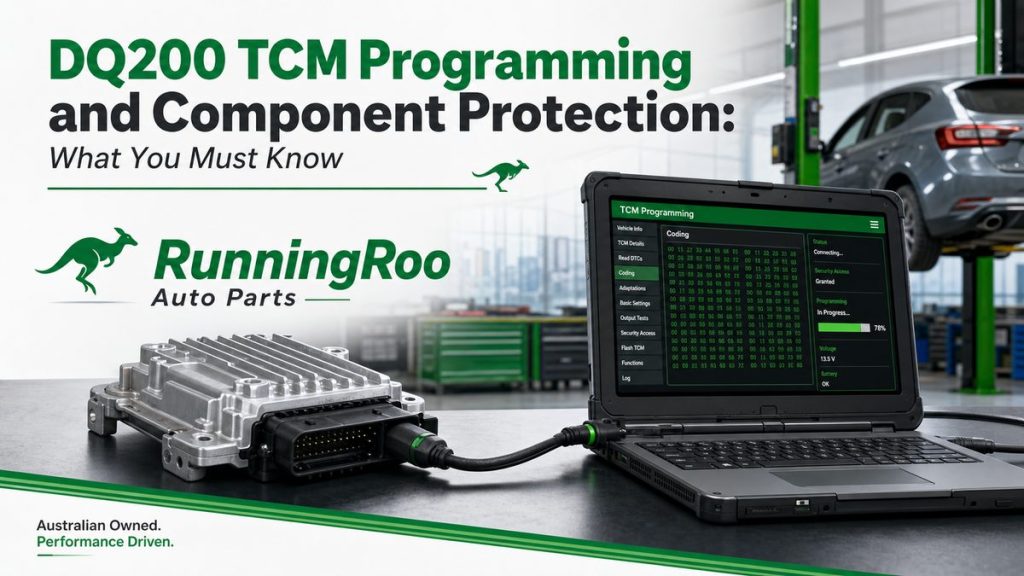
The electronic transmission control module in the DQ200 gearbox is not a plug-and-play part. A replacement TCM will not simply work when it is bolted in, because Volkswagen Group component protection ties the module to the vehicle. Until that protection is removed and the correct coding and basic settings are completed, the gearbox will usually remain in limp mode or refuse to operate normally. This guide explains what component protection is, what coding involves and how to avoid the mistakes that turn a simple TCM replacement into a repeat repair.
RunningRoo Auto Parts – Based in Melbourne, Australia 🇦🇺
📞 Free 24/7 Pickup Available (Contact 0425890125)
💬 Any questions? Message or Call us anytime! We’re here to help.Why Choose RunningRoo?
✅ Aussie Owned & Operated | 🚚 Fast Shipping | 🤝 Friendly Support
What component protection does
Component protection is a Volkswagen Group anti-theft and configuration system that links certain electronic modules to the vehicle. When a replacement TCM is fitted, the vehicle recognises that the module identity does not match and prevents normal operation until a diagnostic tool with the correct access removes the protection and matches the module to the car.
This is not a simple fault-code clear. The process requires the correct diagnostic equipment, an online or authorised connection where applicable, and the correct procedure for the gearbox and controller generation.
Coding versus adaptation
Coding and adaptation are two related but separate stages. Coding writes the vehicle-specific configuration into the module, while adaptation and basic settings let the gearbox learn the clutch and shift-fork positions. Both are required after a TCM replacement.
The table below summarises the difference.
| Stage | What it does |
|---|---|
| Component protection removal | Matches the replacement module to the vehicle |
| Coding | Writes the vehicle configuration and software parameters |
| Basic settings | Relearns clutch kiss points and fork positions |
| Road adaptation | Fine-tunes shifting behaviour after basic settings |
The tools used for DQ200 coding
The most common tools for DQ200 TCM work are VCDS and the factory-level ODIS system. VCDS can handle many coding and basic-settings tasks on these gearboxes, while ODIS is often used when online access or a guided procedure is required. The tool must match the vehicle and the procedure must follow the correct sequence.
Using the wrong tool or skipping a step usually produces a unit that appears fitted but will not shift correctly. That is why the programming stage is best left to a specialist who has done the job before.
Matching the TCM before ordering
The TCM part number is the most important detail. DQ200 controllers carry suffixes such as 0AM927769D, E, G or K, and the 0AM and 0CW generations are not always interchangeable. Ordering by model name alone is the most common cause of a wrong TCM.
The table below lists the details to confirm before ordering.
| Detail | Why it matters |
|---|---|
| Original TCM part number | Confirms the exact hardware suffix |
| Gearbox code | Confirms 0AM or 0CW generation |
| Vehicle VIN | Confirms model, year and market |
| Current software version | Determines coding compatibility |
| Existing fault codes | Confirms the board is the actual fault |
The cost of coding and programming
The programming labour is usually the same regardless of whether you buy a cheap or expensive TCM, because the component-protection removal, coding and basic settings do not change. That is why the part’s reliability matters more than its price.
The table below gives indicative Australian figures.
| Option | Part cost | Coding and labour | Ballpark total |
|---|---|---|---|
| Tested used TCM | Low | $250–$500 | $500–$900 |
| Remanufactured TCM | Mid | $250–$500 | $700–$1,200 |
| New genuine TCM | High | $250–$500 | $1,500–$2,500+ |
The most common coding mistakes
The first mistake is buying a TCM by model name instead of part number. The second is assuming the replacement is plug-and-play and skipping component protection. The third is clearing the codes but not completing basic settings, and the fourth is fitting a TCM when the real fault was a battery, wiring or connector issue.
Each mistake can send the car back into limp mode or cause a repeat failure, which means paying for the labour twice. The programming is not the place to save money.
Step-by-step after fitting a TCM
After the replacement TCM is mechanically fitted, the following sequence should be completed.
| Step | What happens |
|---|---|
| Scan | Read all faults and confirm communication |
| Remove component protection | Match the module to the vehicle |
| Code | Write the vehicle-specific configuration |
| Run basic settings | Relearn clutch and fork positions |
| Road test and adapt | Confirm shifting and complete adaptation |
Choosing repair or replacement
If the original TCM has a known, repairable fault such as a cracked solder joint or failed capacitor, a specialist repair may retain the original coding and reduce the programming stage. If the board has corrosion, burn damage or multiple failed components, replacement is the safer choice.
For most owners, a tested or remanufactured TCM with a written warranty is the best balance. It gives a verified board without the full cost of a new genuine unit, while avoiding the gamble of an anonymous second-hand part that may already be carrying the same fault.
A realistic DQ200 TCM programming example
To make the programming cost concrete, a common Australian repair looks like this:
- Tested or remanufactured TCM: roughly $250–$550 depending on the part number and generation.
- Specialist component-protection removal, coding and basic settings: roughly $250–$500.
- Gearbox and mechatronic oil with filter where applicable: roughly $80–$180.
- Total: approximately $580–$1,230, plus any downtime.
The total only reaches $1,500–$2,500 or more when a new genuine TCM is fitted, or when the mechatronic is replaced as a complete unit rather than the TCM alone. The programming stage does not become cheaper because the part was cheaper.
How to prepare for the programming appointment
Before taking the car to a VW or DSG specialist for coding, confirm the replacement TCM is the correct part number and that the vehicle’s battery is fully charged and stable. A battery that drops voltage during coding can interrupt the process and leave the module in an incomplete state.
Record the original fault codes and the current software version before clearing anything. If the coding specialist can see the original information, the job is quicker and less likely to require a repeat visit.
Key takeaways
A DQ200 TCM replacement is only half finished when the board is bolted in. Component protection must be removed, the module must be coded, and basic settings must be completed before the gearbox will work normally. The programming labour is the same regardless of the part, so the part’s reliability is the real decision.
For the best result, confirm the exact part number before ordering, buy a tested or remanufactured board with a warranty, and have a Volkswagen or DSG specialist complete the coding and adaptation.
Why the supplier matters
The best-value TCM suppliers state the exact part number, describe the testing or rebuilding performed and offer a written warranty. A supplier who confirms the coding path and helps match the part number before dispatch is worth a small price difference, because that support prevents the most common cause of a failed replacement — a part-number or coding mismatch.
Avoid the cheapest untested board from an anonymous listing. On a part that requires coding and labour to fit, a board that fails again costs you the labour twice, which usually leaves you worse off than buying a warranted unit the first time.
Quick reference: TCM programming checklist
Use this list when planning a DQ200 TCM replacement:
- Record the original part number, gearbox code and VIN.
- Confirm the TCM is the fault, ruling out battery, wiring and connector issues.
- Choose a tested or remanufactured TCM with a written warranty.
- Budget for component protection removal, coding and basic settings.
- Have the coding and adaptation completed before road testing.
- Confirm the gearbox shifts correctly before the car is returned.
Working through this list prevents a TCM that looks fitted but still leaves the car in limp mode.
Frequently asked questions
Why does a DQ200 TCM need programming?
Component protection and vehicle coding tie the module to the car, so it will not work until it is matched and coded.
Is component protection the same as coding?
No. Component protection removal matches the module to the vehicle, while coding writes the vehicle configuration and basic settings relearn the gearbox.
Can I code a DQ200 TCM myself?
It requires specialist tools such as VCDS or ODIS and the correct procedure, so most owners use a specialist.
How do I avoid buying the wrong TCM?
Match the module by the exact part number, gearbox code and VIN rather than by model name.
Why is the programming cost the same for a cheap and expensive TCM?
Because the component protection, coding and basic settings are identical regardless of the part.
Should I change the gearbox oil with the TCM?
Usually yes, because the oil and often the mechatronic oil are renewed while the unit is out.
Can a weak battery cause a TCM communication fault?
Yes, a voltage drop can trigger communication faults, so the battery and wiring should be checked first.
Is a remanufactured TCM better than a used one?
It is usually the best balance of price and reliability, because it has been rebuilt and re-tested with a warranty.
Why should I confirm the part number before ordering?
DQ200 TCMs carry different suffixes and generations, and the wrong part will not code correctly, so matching the exact number avoids the most common replacement failure.
Can a coding specialist fix a wrong TCM?
Usually not reliably. Component protection and software compatibility depend on the correct hardware, so the part must be right before programming.
How long does the coding appointment take?
It is usually under two hours when the part is correct and the battery is stable, but online access or software issues can add time.
Shop the parts mentioned in this guide
- DQ200 0AM Transmission Control Module (TCU) for Audi / VW 0AM927769D
- DQ200 0AM TCU 0AM927769K for Audi / VW — eBay
- DQ200 0AM Transmission Control Module (TCU) 0AM927769K — eBay
- 0CW DQ200 7-Speed DSG Mechatronic (Valve Body & TCU) 0AM927769K
Watch on RunningRooAuto YouTube
- RunningRoo Auto Parts – trusted Melbourne parts support
- RunningRoo Auto Parts – product and fitment channel
RunningRoo Auto Parts – Based in Melbourne, Australia 🇦🇺
📞 Free 24/7 Pickup Available (Contact 0425890125)
💬 Any questions? Message or Call us anytime! We’re here to help.Why Choose RunningRoo?
✅ Aussie Owned & Operated | 🚚 Fast Shipping | 🤝 Friendly Support
Sources and further reading
- Direct-shift gearbox — Wikipedia (DQ200 0AM)
- BorgWarner — transmission control systems
- Volkswagen Australia
- RACV — car maintenance and repair guidance
RunningRoo Auto Parts – Based in Melbourne, Australia 🇦🇺
📞 Free 24/7 Pickup Available (Contact 0425890125)
💬 Any questions? Message or Call us anytime! We’re here to help.Why Choose RunningRoo?
✅ Aussie Owned & Operated | 🚚 Fast Shipping | 🤝 Friendly Support