
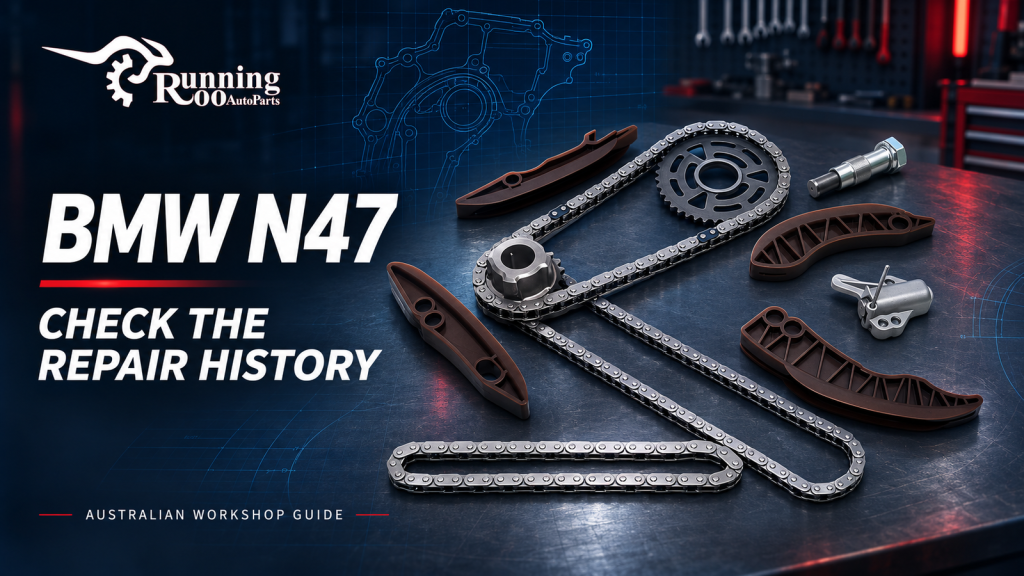
A BMW N47 timing chain replacement record is useful only when it identifies the vehicle, the work performed and the parts actually fitted. An invoice saying “timing done” leaves important questions unanswered. For an Australian owner buying a used diesel BMW, or planning another repair after an earlier visit, the most valuable next step is to turn that short description into a clear repair history. This guide explains what to request, how to compare documents and when a new parts enquiry becomes appropriate.
RunningRoo supplies a Timing Chain Kit For BMW N47 116d 118d 120d 123d 125d (E81 E82 E87 E88) and the corresponding matching RunningRoo eBay listing. Those listings are starting points for a confirmed repair, not proof that every N47 needs the same work. Send the VIN, complete engine code, available OE references and your workshop’s diagnosis before ordering. RunningRoo is an Australian-operated parts business in Blackburn, Melbourne, with friendly support, local pickup by appointment and fast dispatch arrangements for confirmed stock. Call 0425 890 125 to discuss the documents you already have.

What “the timing chain was replaced” actually tells you
An owner’s statement may be entirely honest while still being incomplete. The previous owner might remember the symptom and final bill but not the workshop’s precise scope. A dealer advertisement may shorten several invoice lines into one sentence. A service-book stamp may record a visit without identifying a timing component at all. These records have different levels of detail, and none should be silently expanded into a promise that every part of the timing drive was renewed.
Start by asking for the original itemised invoice rather than a photograph of a handwritten summary. Look for a registration or VIN, repair date, odometer reading, labour description and part references. If there are several pages, request all of them. A second page may contain the qualifying wording, additional parts or declined recommendations that explain the first page. Keeping the pages together also helps the next workshop understand what was authorised and what was merely suggested.
A clear record does not guarantee the engine’s present condition. It does establish a more reliable starting point than mileage alone. A documented repair followed by a new noise still needs assessment. Equally, an incomplete receipt is not proof that the work was poor. Treat missing information as a reason to ask a focused question, not as evidence of dishonesty or a reason to replace parts immediately.
Why the manufacturer history matters
BMW’s archived Service Information 0011540300, dated 15 January 2015, describes a VIN-selected N47 action involving the tensioner and, where required, timing chains. Its decision process distinguishes tensioner work from upper-chain work and work involving upper and lower chains. The document also discusses oil quality and maintenance intervals in relation to chain extension. This is useful historical evidence that different repair scopes existed; it is not a current Australian eligibility notice or a universal replacement interval. Read BMW Service Information 0011540300, 15 January 2015 (archived manufacturer document), and ask a BMW-capable workshop to check the current instructions applicable to your VIN.
The practical implication for a buyer is straightforward: the phrase “BMW timing campaign completed” should lead to a request for the actual work record. Do not assume that the largest possible repair was performed. Ask which action applied to that vehicle, when it was completed and what the invoice or dealer record says was replaced. A historical bulletin number on its own is less informative than a vehicle-specific completion record.
Build a timeline before comparing quotes
Put the available records in date order. Include the purchase date, any engine replacement, timing-related visits, oil services and the first occurrence of the current complaint. Use the recorded odometer reading rather than an estimate wherever possible. A timeline makes inconsistencies visible without requiring an owner to interpret mechanical measurements. For example, it can reveal that the chain invoice belongs to the original engine while the vehicle now has a replacement unit.
If an engine was replaced, the chassis VIN remains important but may no longer identify every installed component. Ask the workshop to record the engine identification and any available donor or replacement-engine documentation. Do not alter the vehicle’s history to make the paperwork look simpler. A short note explaining why the engine reference differs from the original build is more useful than assuming that a familiar model badge settles compatibility.
Keep uncertainty visible. “Invoice requested” and “part number unreadable” are acceptable entries. Filling those gaps with guesses creates a false sense of precision. RunningRoo can help compare a proposed parts list with a live listing, but a supplier cannot reconstruct undocumented workshop labour from a product photograph. The person who performed the repair, or a workshop inspecting the vehicle now, is the appropriate source for that information.
A repair-record checklist for an Australian N47 owner
| Record | What to obtain | What it helps establish |
|---|---|---|
| Vehicle identity | VIN and engine identification | Whether the paperwork belongs to the installed engine |
| Repair timing | Date and odometer reading | Where the repair sits in the maintenance history |
| Authorised work | Itemised labour description | The actual scope approved by the owner |
| Parts fitted | References, quantities and supplier invoice | Which components were supplied for the job |
| Diagnostic basis | Workshop findings or report | Why the repair was recommended |
| Completion evidence | Final invoice and verification notes | Whether the work was completed rather than only quoted |
| Unresolved items | Written recommendations or exclusions | What the earlier repair did not address |
Use this table as an enquiry aid, not a grading system for workshops. Older paperwork may be less detailed than a modern digital invoice. A sensible follow-up request is to ask the original workshop whether it can clarify one or two missing points. Sending a concise list is usually more productive than asking for an unrestricted explanation of everything that happened years ago.
Distinguish a quote, a parts receipt and a completed repair
A quotation shows proposed work. A parts receipt shows that components were purchased. A final workshop invoice records charged labour and supplied items. These documents can support one another, but they are not interchangeable. A box of unused parts in the boot does not establish that those parts were fitted. A booking confirmation does not establish that the vehicle attended. When evaluating a used car, ask what evidence connects the proposed work to the completed vehicle.
If the owner supplied the kit, there may be two invoices: one from the parts seller and one from the installer. Keep both. Ask the installer to identify any components from the kit that were not used and any additional items sourced separately. This avoids a common misunderstanding in which the contents of a purchased kit are later treated as a list of everything renewed on the engine.
The same distinction matters when arranging your own repair. Before buying the Timing Chain Kit For BMW N47 116d 118d 120d 123d 125d (E81 E82 E87 E88), send its contents to the workshop and ask for confirmation that they match the approved scope. If you prefer the marketplace checkout, use the matching RunningRoo eBay listing and retain the order reference with the labour invoice. The purchasing channel should not change the need for a clear fitment check and an agreed installation plan.
How to discuss a new symptom after an earlier repair
Describe the current symptom without diagnosing it in the first sentence. Record when it started, whether it occurs at startup or during driving, and whether any warning appeared. If you have a recording made safely from outside the engine bay, label it with the date and circumstances. Do not repeatedly run a concerning engine just to produce a better recording; let the workshop decide how to inspect it.
Tell the workshop that a timing repair is recorded and provide the documents. Avoid presenting the previous repair as either proof that the timing system must be fine or proof that the new symptom must be a warranty issue. Both conclusions require evidence. Ask the technician to explain what has been checked, what remains uncertain and which observation supports any recommendation for further timing work.
If the workshop proposes replacement components, request an itemised list before ordering. This gives RunningRoo a defined enquiry and helps avoid a purchase based only on an online noise comparison. Professional diagnosis and parts supply serve different roles: the workshop establishes the repair requirement, while the supplier helps confirm the listed components and availability for that requirement.
Compare the proposed kit with the job, line by line
The N47 kit linked here is a real retail listing with its own contents and fitment description. It should not be treated as a generic package that automatically completes every possible N47 repair. Ask the installer to compare each required component against the current listing, including the relevant part references and quantities. If a required item is not explicitly listed, obtain confirmation rather than assuming it will be in the box.
An OE reference is a useful identification aid, but it is not a statement that an aftermarket product was manufactured by BMW. Keep manufacturer identity, reference numbers and vehicle compatibility separate. The same applies to a broad model list: it is a screening aid, not a substitute for matching the installed engine and the intended repair. Photographs can assist the enquiry, but they do not replace reference checks.
For broader product scope, see BMW N47 Timing Chain Kit: Checking the Three-Chain Repair Scope. That existing guide covers the kit question. This article concentrates on documentary evidence so that an Australian owner can approach a supplier or workshop with a better-defined request. Using the two together is more useful than treating another general buying guide as a substitute for the car’s actual records.
Plan the booking around confirmed information
Ask the workshop when it needs the parts and whether it wants to inspect the delivered package before the vehicle is dismantled. A short receipt inspection can identify an obvious mismatch while there is still time to resolve it. Keep packaging, labels and the order confirmation until the installer has accepted the supply. Do not discard identifying information just because the components appear similar to a photograph.
RunningRoo offers Melbourne local pickup by appointment from Blackburn and can discuss fast dispatch for available stock. Confirm the current stock position, collection arrangements and delivery estimate before relying on a workshop booking. Dispatch and arrival are separate events, especially for regional Australian destinations. A realistic plan includes time for the workshop’s own checks rather than assuming that parcel arrival is the same as repair readiness.
Call 0425 890 125 with your VIN, engine code, OE numbers and the written parts requirement. If the information is incomplete, say so. Friendly support is most useful when the unresolved point is clear: for example, whether a particular listed component matches the installer’s reference, or whether an additional item must be ordered separately.
An example of a useful enquiry
A practical enquiry might explain that you own an N47-powered BMW, have an invoice from an earlier timing visit, and now have a workshop recommendation for further work. Attach the relevant invoice lines, identify the current engine and include the new parts list. Ask RunningRoo to confirm whether the linked kit matches that list and whether any exclusions need to be discussed with the installer.
This example is an enquiry format, not a report of a RunningRoo customer repair. Its purpose is to reduce ambiguity. It avoids claiming that all timing components were previously replaced when the paperwork says only “tensioner”, and it avoids ordering another complete kit merely because an old invoice cannot immediately be found. The useful outcome is a documented decision, even if that decision is to obtain more information before buying.
Frequently asked questions
Does a service-book stamp prove the timing chain was replaced?
Usually it does not identify enough detail by itself. Look for an itemised repair invoice or a vehicle-specific workshop record. A stamp can support the timeline, but the scope should come from the associated documentation. If the document is unavailable, record that limitation and ask a qualified workshop how to assess the vehicle’s current condition.
Does an N47 campaign record mean every timing component was renewed?
Do not assume that. Ask for the vehicle-specific completion details and compare them with the action that applied at the time. Historical manufacturer material can help explain terminology, but current eligibility and the actual work performed must be checked against the individual vehicle’s records.
Should I buy a kit simply because the previous invoice is missing?
Missing paperwork is a reason to investigate, not a diagnosis. Have the vehicle assessed and agree a repair scope first. Once the workshop identifies the required components, compare that list with the current RunningRoo listing and confirm VIN, engine code and OE references before purchase.
Can a supplier confirm what a previous workshop fitted?
Only if there is adequate supporting documentation. An order history may show what was sold, but it does not prove every item was installed. Ask the installer to clarify the labour and keep supplier and workshop records together so that future owners have a clearer account.
Can I collect an N47 kit in Melbourne?
Contact RunningRoo to confirm stock and arrange Blackburn pickup by appointment. Interstate and regional customers can ask about dispatch and delivery options. Call 0425 890 125 or compare the current Timing Chain Kit For BMW N47 116d 118d 120d 123d 125d (E81 E82 E87 E88) with the matching RunningRoo eBay listing before arranging the repair.
Related RunningRoo video and next step
Watch Timing Chain Rattle: Wear Symptoms & When to Replace for general timing-chain background. It is an explanatory RunningRoo video, not evidence of the condition of your N47 and not an installation procedure for this kit. Use it to prepare questions, then rely on the vehicle-specific workshop assessment.
A useful repair history ends with a clear next action: obtain a missing invoice, arrange diagnosis, clarify the parts list or place a confirmed order. RunningRoo’s Australian-operated team can help with the last two steps, including Melbourne pickup by appointment and stock-dependent fast dispatch. Keep the completed paperwork afterwards; it will make the next service, diagnosis or sale easier to explain.