
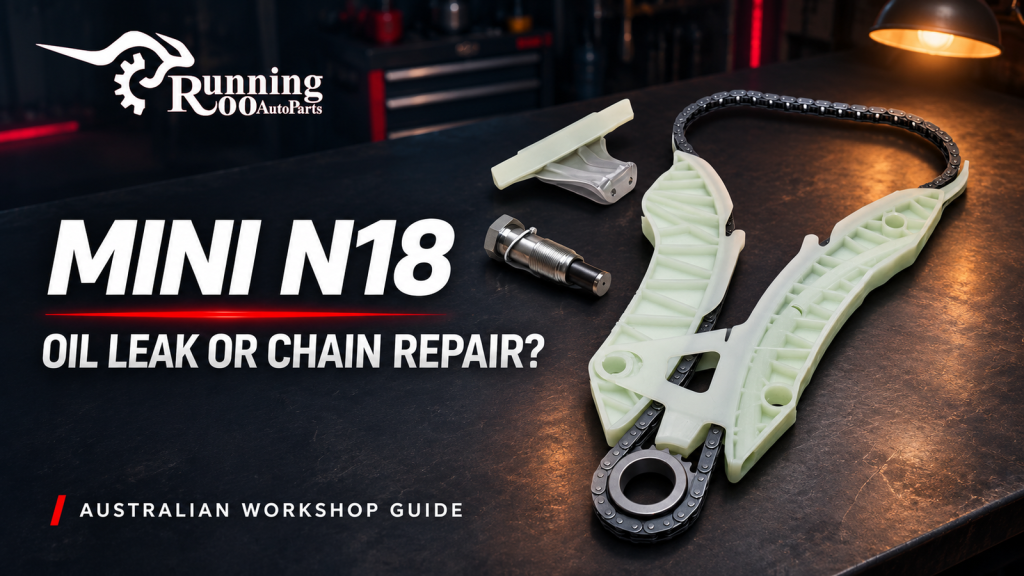
A MINI N18 timing chain tensioner oil leak and a worn timing chain are different repair questions. Finding oil near the tensioner does not, by itself, justify buying a complete chain kit. For Australian MINI owners, the sensible starting point is to identify the leak source, confirm the engine and ask the workshop to separate the sealing problem from any independent timing-system findings. That distinction can prevent both an unnecessary purchase and an incomplete repair.
RunningRoo lists a Timing Chain Kit Fit MINI COOPER R56 R57 R58 R59 R60 R61 N16 N18 1.6L+Crank Gear, with a related N16/N18 RunningRoo N16/N18 eBay listing — confirm package contents. Consider this kit when a professional assessment establishes a chain-repair requirement and confirms compatibility. It is not presented here as the automatic cure for an external oil leak. For help comparing a workshop parts list, call 0425 890 125. RunningRoo is Australian-operated in Blackburn, Melbourne, with friendly support, local pickup by appointment and fast dispatch arrangements for available stock.

Start with the exact complaint
“Oil around the timing chain” is a location description, not a diagnosis. Ask the workshop to identify the first point where fresh oil appears and to distinguish that observation from oil that has spread across surrounding surfaces. An old stain, a recently cleaned area and an active leak are not equivalent records. A useful report states what was observed and under what conditions the inspection took place.
Tell the technician whether the concern is an oil mark, a smell, an oil-level change, a noise or several symptoms together. Do not combine them into one presumed failure before inspection. If there is a warning lamp, a significant leak or an unusual mechanical noise, ask the workshop how to handle the vehicle safely. Avoid repeatedly starting the engine simply to see whether the symptom becomes more obvious.
The repair discussion becomes clearer when each complaint has its own finding. A workshop may identify an external sealing issue while finding no evidence that a chain kit is needed. It may also identify a separate timing concern that requires additional work. Both outcomes are possible; the important point is that the second conclusion should not be inferred merely from the first.
What MINI’s bulletin actually establishes
MINI SI M11 03 11, April 2012, addresses oil leakage and timing-chain tensioner sealing on specified N12, N14, N16 and N18 applications produced up to the listed dates. For a diagnosed tensioner leak, it directs attention to the sealing ring and explicitly distinguishes that repair from replacing the tensioner. It also identifies an updated ring and addresses its use when a tensioner is replaced. Read the original MINI SI M11 03 11, April 2012, manufacturer bulletin. The bulletin is historical manufacturer guidance, not proof that every Australian MINI falls within its scope or that a particular retail kit contains the specified ring.
This is a useful example of why the component name on an invoice matters. “Tensioner seal replaced” and “timing chain replaced” describe materially different work. An owner should retain that distinction in maintenance records. It also helps the parts enquiry: a workshop seeking a sealing item should not receive a complete chain kit simply because both products relate to the same area of the engine.
Confirm N18 rather than relying on the Cooper badge
MINI model names, body codes and registration years can help narrow an enquiry, but they are not the final compatibility check. Provide the VIN, production information if available, complete engine code and any relevant OE reference. If the engine has been changed, tell the supplier and installer. A replacement engine can make an apparently straightforward model-year lookup less reliable.
The linked RunningRoo kit is described for N16 and N18 applications. That description should be checked against the individual vehicle and the installer’s requirements. Do not extend its application to N12 or N14 simply because those engines appear in the same historical sealing bulletin. A document covering a shared service issue does not establish that all timing kits for those engines are interchangeable.
Photographs of the removed component, packaging and readable markings can assist a discussion, provided they are taken safely and labelled. A photo is particularly useful when it accompanies a reference number. It is much less useful when it is offered as the only reason two parts should interchange. The workshop should resolve the engine identity before the supplier confirms the proposed kit.
Separate the two repair scopes on the estimate
Ask for one line describing the confirmed leak repair and another describing any proposed timing-system work. If the technician recommends both, ask which finding supports each recommendation. This is not a request for free diagnosis from a parts seller; it is a way of making an already proposed repair understandable before authorising expenditure.
The estimate should identify included parts, labour, consumables and verification. It should also say whether the scope may change after inspection. A conditional recommendation is reasonable when access is required to inspect a component, but the condition should be clear. “Replace if inspection confirms damage” is more informative than a vague list of everything that could conceivably be renewed.
If only a sealing repair is justified, confirm the exact sealing item through the appropriate supply channel. The linked chain kit should not be represented as a substitute for that item. If chain work is independently justified, use the Timing Chain Kit Fit MINI COOPER R56 R57 R58 R59 R60 R61 N16 N18 1.6L+Crank Gear or RunningRoo N16/N18 eBay listing — confirm package contents to compare the current contents with the workshop’s list. Call 0425 890 125 if a required component is not explicitly identified.
Questions that distinguish leakage from chain repair
| Question | Useful evidence | Purchasing consequence |
|---|---|---|
| Where does fresh oil originate? | Workshop inspection identifying the source | Select the correct sealing repair rather than guessing |
| Is there a separate timing complaint? | Recorded symptom and diagnostic findings | Decide whether further timing assessment is required |
| Which engine is installed? | VIN plus engine identification | Screen the N16/N18 kit for the actual application |
| What does the repair require? | Itemised parts list and OE references | Compare each required item with the listing |
| Is an updated seal specified? | Current vehicle-specific repair information | Confirm the exact seal separately |
| What will be checked afterwards? | Agreed leak and symptom verification | Establish a meaningful completion record |
Keep the completed table with the estimate if it helps your discussion. It is not a substitute for the repair manual and does not contain installation instructions. Its purpose is to ensure that the owner, workshop and supplier are talking about the same job before money is committed and the vehicle is taken off the road.
Why “while it is apart” needs a defined boundary
There can be practical reasons for a workshop to discuss additional work during a repair. The owner should still understand which work is necessary for the confirmed fault, which is supported by inspection and which is an optional recommendation. These categories should appear in the conversation and on the estimate rather than being blended into a single unexplained package.
Ask whether the proposed additional components are included in the kit, supplied separately or not required for the chosen scope. Do not assume that the phrase “complete kit” means every seal, fastener, tool and consumable needed for every vehicle. Retail kit descriptions identify a supply package; the workshop defines the repair procedure and its associated materials.
A sensible purchasing decision can therefore be either smaller or larger than the first enquiry. A confirmed sealing issue may need a focused repair. A separately established timing problem may require a broader parts list. The goal is not to minimise the number of parts at all costs or to maximise replacement. It is to match the order to the documented requirement.
Inspect the supplied package before the booking
Ask your installer whether it wants to compare the delivered parts with the approved list before dismantling begins. Keep labels and packaging intact during that check. If a reference, quantity or component appearance differs from the agreed order, resolve it with the supplier before fitting. Clear photographs and the order number help the conversation move quickly.
There is a specific listing detail to resolve: the website title mentions a crank gear, while the eBay item-specific contents do not expressly list one. Do not assume that the two channels promise identical contents. Ask RunningRoo to confirm the package for the chosen checkout and have the installer approve that exact supply before purchase.
The product image is a retail illustration of the offered package, not a technical drawing that proves the presence of every small sealing item. Read the live description and obtain written clarification where necessary. In particular, do not infer that a tensioner shown in a photograph includes the exact sealing ring required by a historical bulletin or by the current procedure for your vehicle.
RunningRoo can discuss the listed N16/N18 kit, current availability and dispatch arrangements. A friendly parts conversation works best when it includes the VIN, engine code, OE references and the installer’s written requirement. Melbourne customers can arrange Blackburn pickup by appointment; customers elsewhere in Australia should allow for the confirmed delivery estimate rather than booking on an assumed arrival day.
What a useful completion record should say
After the repair, ask the workshop to record what was replaced and what was checked. If the job was a tensioner sealing repair, that wording is more accurate than “timing system renewed”. If timing components were also replaced, the invoice should identify that additional scope. Retain the parts receipt alongside the labour invoice when the owner supplied the kit.
Ask how the workshop confirmed the original complaint was addressed. For an intermittent concern, it may be helpful to record the conditions under which the vehicle was checked and any follow-up instructions. A generic statement that the car was started is less useful than a clear explanation of the agreed verification, especially if the original concern appeared only under particular circumstances.
If the symptom returns, provide the previous repair record and a fresh description. Do not assume that the new observation has the same cause simply because it is nearby. The retained paperwork allows the technician to distinguish a repeat concern from a different issue and helps the supplier identify exactly what was supplied if a product enquiry is needed.
A practical enquiry example
An owner might write: “My workshop has identified an oil leak at the tensioner area on an N18 MINI. It is checking whether a sealing repair is sufficient. If it confirms separate chain wear, I will send the itemised parts list for the N16/N18 kit.” That is a useful first message because it states what is known and what remains under assessment.
A later message can include the confirmed VIN, engine details, OE references and required components. RunningRoo can then compare that list with the live Timing Chain Kit Fit MINI COOPER R56 R57 R58 R59 R60 R61 N16 N18 1.6L+Crank Gear and RunningRoo N16/N18 eBay listing — confirm package contents. This is an illustrative communication example, not a claim about a customer’s repair outcome. It shows how to avoid ordering a large package while the basic repair question is still unresolved.
Frequently asked questions
Does oil near the tensioner prove that the chain is worn?
No. A leak location and a chain-condition diagnosis are different findings. Ask the workshop to identify the leak source and assess any separate noise or timing complaint. The historical MINI bulletin is useful precisely because it distinguishes a sealing repair from broader component replacement within its stated scope.
Can the old bulletin be applied to every N18 MINI in Australia?
No. Check its engine, model and production limitations, then use current vehicle-specific repair information. A US-hosted manufacturer bulletin is technical background, not an automatic Australian campaign, warranty entitlement or fitment confirmation. The VIN and installed engine remain essential.
Is the correct sealing ring definitely included in the linked kit?
Do not assume that. Confirm the current kit contents and the exact seal required by the installer. A photograph of a tensioner or a general “kit” description does not establish the specification of an included ring. If it is not explicitly listed, ask before purchasing.
Should I replace the tensioner whenever the seal leaks?
The decision belongs to the diagnosis and applicable repair procedure. The cited MINI document distinguishes a seal-related leak from a reason to replace the tensioner itself. Ask the workshop to explain whether it has identified an independent component fault rather than treating leakage alone as proof.
Can I use an N14 chain kit because the bulletin also mentions N14?
A shared bulletin does not establish kit interchangeability. The linked product is described for N16/N18 applications and must be checked accordingly. Confirm the complete engine code, VIN and OE references. Do not use a family name or similar appearance as the final compatibility test.
How do I arrange Melbourne pickup or Australian delivery?
Call 0425 890 125 to confirm stock and arrange pickup by appointment in Blackburn. RunningRoo can also discuss fast dispatch for available items and the relevant delivery estimate. Keep the workshop booking flexible until the required components and delivery arrangements are confirmed.
Related reading and video
See MINI Exhaust VVT Gear 11367536085: N12, N16 and N18 Buying Checks for a separate MINI VVT product topic; a VVT gear enquiry should not be confused with this sealing decision. Watch Timing Chain Rattle: Wear Symptoms & When to Replace for general timing-chain background from RunningRoo. The video is not an N18 tensioner-sealing procedure and does not diagnose your vehicle.
The next step is to obtain a clear workshop finding: sealing repair, independently confirmed timing repair, or further diagnosis. Once the required parts are known, RunningRoo’s Australian-operated team can help compare the order, arrange Melbourne local pickup and discuss stock-dependent fast dispatch. A precise enquiry is the best foundation for a useful purchase.