
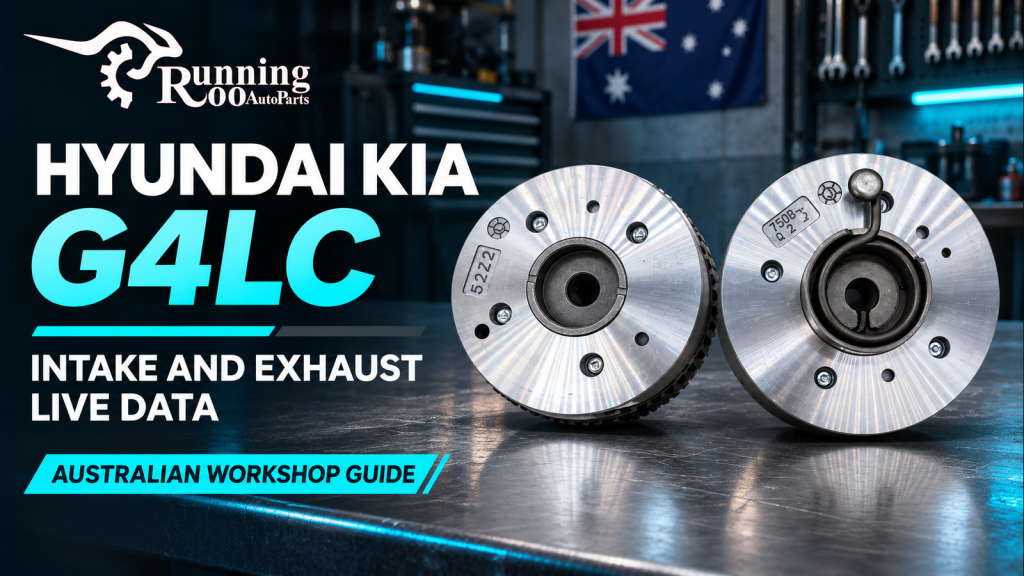
A useful live-data record explains the traces, not just their colours
G4LC intake and exhaust CVVT live data can help an Australian workshop explain what it is investigating, but a screenshot with several moving lines is not a diagnosis by itself. Before an owner orders a pair of camshaft gears, the technician should identify the displayed parameters, the conditions of the assessment and the conclusion supported by the data. The intake and exhaust labels need to remain clear throughout that conversation.
This guide focuses on preparing and understanding the workshop’s record. It does not give universal angle limits, response-time limits or a set of scan-tool commands. Those depend on the correct vehicle-specific service information and the actual diagnostic procedure. The aim is to make the repair recommendation and resulting parts enquiry more precise without asking the owner to interpret an engine-control system independently.
For an installer-confirmed pair requirement, review Camshaft Intake& Exhaust VVT Gears For Hyundai Accent i20 Kia Rio 1.4L G4LC 2010 — RunningRoo and the matching RunningRoo eBay listing. RunningRoo is Australian-operated in Blackburn, Victoria, with friendly support, Melbourne local pickup by appointment and fast dispatch subject to confirmed stock and order timing. Call 0425 890 125 with the VIN, fitted engine code, required references and the workshop’s approved list.

What the Kia technical background explains
Kia’s Tech Times, volume 20 issue 1, describes CVVT control in terms of engine operating conditions, an oil control valve and hydraulic camshaft adjustment. Its general explanation helps distinguish a commanded timing change from the system’s response. See Kia Tech Times 2017 volume 20 issue 1, CVVT principles pages 17–18, particularly the CVVT discussion on pages 17–18. It does not provide a G4LC-specific calibration or a universal acceptable difference between displayed values.
Use that source for the general system principle only. The workshop must select the applicable Hyundai or Kia service information for the actual vehicle and engine. A general technical article cannot supply missing test conditions, define the meaning of every aftermarket scan-tool label or establish that a particular pair of gears is compatible with the car being assessed.
Identify each parameter before comparing numbers
Ask the technician to state which displayed value represents the requested or target position and which represents the reported position, where those parameters are available. Have the intake and exhaust labels identified explicitly. A screenshot is more useful when the reader can tell what each line represents instead of guessing from a colour or abbreviation.
Also preserve the units and the tool’s wording. Do not shorten a label while copying a result into a parts enquiry. If a technician uses different terminology from an online example, ask for clarification rather than assuming the two displays are identical. The professional interpretation should use the actual tool and applicable service information.
The customer does not need to request every possible parameter. A focused record selected by the technician is usually easier to discuss than a crowded screen of unrelated values. The aim is to retain the information supporting the recommendation, not to create a collection of numbers without an explanation.
Record the conditions that belong to the observation
Ask the workshop to note the relevant operating conditions and the stage of the assessment. A result detached from its context is difficult to compare with another recording. The technician should determine what conditions are required and whether the vehicle has met them; the owner should not recreate a test from a general blog.
If the concern is intermittent, provide an accurate description of when it was noticed. Keep that owner observation separate from the workshop’s controlled assessment. A useful report can explain whether the original concern was reproduced, whether a different observation was made and what remains uncertain.
Do not supply a guessed temperature or engine speed from memory as if it were a measured record. State what you know and leave uncertain details identified as uncertain. That gives the technician a more reliable starting point than a precise-looking but unsupported account.
Compare command and response with the right question
The practical question is what the technician’s data shows about the concern being investigated. Ask the workshop to explain its conclusion and the applicable criteria it used. Do not decide that two lines must overlap perfectly at every point, or that a visible separation automatically proves a failed gear, without the proper interpretation.
This article deliberately supplies no universal acceptable number of degrees or milliseconds. A threshold copied from another engine or a different parameter definition can create a false pass or fail. The repairer should use the current procedure and explain the result in a form the owner can understand.
If the report remains inconclusive, keep that status visible. An availability enquiry for parts can be useful during planning, but it should not convert an unresolved trace into a confirmed replacement recommendation. The final order should follow the technician’s actual conclusion.
Keep intake and exhaust records separate
A dual-CVVT discussion involves two named positions. Ask the workshop to identify which observation belongs to the intake side and which belongs to the exhaust side. Do not merge them into a statement such as “both readings are wrong” unless that is the technician’s documented conclusion.
The existence of two positions does not mean their displayed values must always be identical. Their interpretation belongs to the applicable control strategy and test procedure. A side-by-side screenshot is a useful communication tool only when its labels and conditions are clear and a qualified person explains what can be concluded from it.
This distinction matters when the parts recommendation is made. The workshop may request a specific component or a pair as part of its approved scope. A retail package containing two gears does not itself prove that both existing gears have failed or that a pair is always required for every complaint.
A live-data handover table
| Record element | What to retain | Why it helps the enquiry |
|---|---|---|
| Vehicle identity | VIN, fitted G4LC identification and build details | Connects the record to the actual application |
| Parameter labels | Exact tool wording for intake, exhaust, target and reported values | Prevents a colour or abbreviation from being misread |
| Units and context | Units shown and technician-selected operating conditions | Makes the observation interpretable |
| Finding | Workshop’s conclusion and any limitation | Separates evidence from an owner’s guess |
| Next step | Further diagnosis or confirmed replacement requirement | Prevents provisional information becoming an order |
| Approved parts | Exact position, quantity and reference information | Supports the supplier’s compatibility check |
This table is a report template, not a diagnostic sequence. The workshop chooses the necessary parameters and tests. Use it to preserve the reasoning behind the recommendation so that the supplier receives a specific parts request rather than an unexplained screenshot.
Do not interpret a cam-related result as a gear-only diagnosis
A data label or fault description can mention camshaft timing without naming a confirmed failed retail component. Ask the technician what it has established and whether other assessment is required. The repair decision should be supported by the complete professional diagnosis, not by the presence of the word “camshaft” in a scan report.
Preserve any complete diagnostic report and the chronology of previous work. If parts were already changed, provide the invoices and describe what happened afterwards. Do not omit earlier attempts because they did not resolve the complaint. That history may help the workshop understand the current state of the vehicle.
RunningRoo can help identify the offered gears and clarify the product enquiry. It cannot substitute a remote interpretation of a few values for the technician’s examination. Keeping those responsibilities separate helps avoid a sale based on an assumption that nobody has actually confirmed.
What the RunningRoo G4LC pair includes
The current listing offers one intake VVT gear and one exhaust VVT gear for the stated Hyundai/Kia G4LC applications. It is a pair of gears, not a package of oil control valves, a complete timing-chain kit or every consumable required for installation. The workshop should compare its final list with the stated offer.
The listing’s model references include Hyundai Accent, i20 and Kia Rio 1.4-litre G4LC applications. Treat those as catalogue descriptions to verify. Do not infer a missing OE number or copy one from a similar-looking gear in another listing. Ask the supplier and installer to establish the correct references for the actual vehicle.
Check Camshaft Intake& Exhaust VVT Gears For Hyundai Accent i20 Kia Rio 1.4L G4LC 2010 — RunningRoo for the current product description and photographs, or the matching RunningRoo eBay listing if ordering through eBay is preferred. Keep the product link with the enquiry so that everyone is discussing the same pair. A shortened message saying “Hyundai VVT” is too broad to preserve the intended order accurately.
Confirm quantity from the repair scope, not the package name
If the installer recommends a pair, ask it to explain the scope and identify any additional items required. If it requests one position, clarify how that relates to the available retail offer rather than assuming a pair must be installed because it is sold together. The qualified repairer decides the appropriate repair; the supplier explains the product being offered.
This guide does not recommend automatic replacement of both gears or automatic reuse of either one. Those decisions need vehicle-specific evidence and the applicable procedure. The customer’s approval should reflect the technician’s actual recommendation, not a rule inferred from a product photograph.
Where an additional chain, fastener, seal or another component is required, obtain a separate confirmation. The word “pair” defines the two listed gears. It should not be expanded into a promise that the package completes every possible CVVT-related repair.
Plan a meaningful before-and-after discussion
If the workshop records data before and after the repair, ask it to explain whether the observations are comparable and what the result shows. A different screen layout or unexplained change of conditions can make a visual comparison difficult for an owner. The technician’s interpretation matters more than simply placing two screenshots next to each other.
Do not require the repairer to reproduce a particular graph from an online article. The applicable procedure controls the verification. A plain-language summary of the checks and their outcome may be more useful for the owner than raw data without context. Retain the detailed report if the workshop provides it.
If the original complaint was not reproduced during the appointment, ask what that means for the conclusion and any follow-up. Avoid converting an incomplete observation into a guarantee. A good handover states what was established, what work was performed and whether any uncertainty remains.
Supply vehicle information privately and accurately
Give RunningRoo the VIN privately, fitted engine code and the installer’s requested references. Mention known engine changes or uncertainty about the vehicle history. Registration year and model name can start the conversation, but they should not replace the complete application check.
If photographs are needed, use accessible identification or images provided by the workshop during its assessment. Do not dismantle parts for a retail enquiry. An unclear number should remain marked as unclear until it can be verified; guessing a character can undermine an otherwise careful diagnosis and order.
Once the match is confirmed, retain the confirmation with the purchase record. If the workshop changes the scope, update the order instruction before collection or dispatch. This keeps a provisional enquiry from being mistaken for the final approved requirement.
Coordinate Melbourne pickup or Australian delivery
Call 0425 890 125 for friendly support with the confirmed order. RunningRoo offers Melbourne local pickup in Blackburn by appointment. Arrange the time and the person collecting, and make sure the workshop has agreed to a customer-supplied-parts arrangement if that is the plan.
For delivery, discuss fast dispatch from available stock and the carrier’s transit estimate separately. Neither should be presented as a guaranteed completion date for the repair. Keep the workshop informed of the actual order status and resolve any missing components before installation is scheduled to begin.
At completion, keep the product invoice, repair invoice and diagnostic summary together. The record should identify the actual intake and exhaust components fitted, any additional work and the checks performed. That history is more useful for future assessment than the broad statement that the car received “new VVT”.
Frequently asked questions
Should the intake and exhaust live-data numbers be identical?
Do not apply that assumption. The technician must interpret the actual parameter definitions, operating conditions and vehicle-specific procedure. This guide does not prescribe identical readings or a universal difference limit. Ask for the workshop’s conclusion and the criteria used for the actual assessment.
Does a difference between target and reported position prove a bad gear?
Not by itself. The data needs professional interpretation within the complete diagnostic process. Ask what the workshop has established and what further checks are required. A screenshot should support a repair recommendation, not replace the diagnosis with a visual guess.
Does the RunningRoo pair include oil control valves?
The stated offer is one intake gear and one exhaust gear. Do not assume valves, a timing-chain kit or additional installation items are included. Have the installer compare the complete requirement with the current product description and confirm separate items where needed.
Should both gears be replaced because they are sold as a pair?
The repair scope should follow the technician’s assessment and the applicable procedure. A retail package does not establish that both existing components have failed. Clarify the required position and quantity before matching the workshop’s request to the available offer.
How can I confirm the pair and arrange local collection?
Review Camshaft Intake& Exhaust VVT Gears For Hyundai Accent i20 Kia Rio 1.4L G4LC 2010 — RunningRoo and the matching RunningRoo eBay listing, then call 0425 890 125 with the VIN, fitted engine identification and approved parts list. RunningRoo is Australian-operated with friendly support, Blackburn pickup by appointment and fast dispatch subject to current availability and order confirmation.
Related reading and RunningRoo video
Read the related RunningRoo product-identification guide. Use that guide for the catalogue discussion and this article for the specific workshop question above.
Watch RunningRoo: Variable Valve Timing Explained. This is general background from the RunningRoo AutoParts channel, not a demonstration of this exact supplied component, confirmation of fitment or a substitute for the vehicle-specific repair procedure.
Confirm your parts enquiry with RunningRoo
Send your VIN privately, fitted engine code, relevant OE number and the installer-approved parts list before ordering. Contact RunningRoo support or call 0425 890 125. RunningRoo is Australian-operated in Blackburn, Victoria. Melbourne local pickup is by appointment; ask about fast dispatch after stock, fitment and order timing are confirmed. Friendly support can help clarify the product enquiry while the qualified repairer remains responsible for diagnosis and installation.
Technical references and scope
Kia Tech Times 2017 volume 20 issue 1, CVVT principles pages 17–18. Manufacturer material provides the limited technical background cited in the article. Additional technical sources, where used, are linked beside the relevant discussion. Archived training and general system explanations are not current VIN-specific repair instructions. The discussion questions and planning examples are editorial guidance. Retail descriptions establish the seller’s stated offer, not manufacturer approval or universal compatibility.