
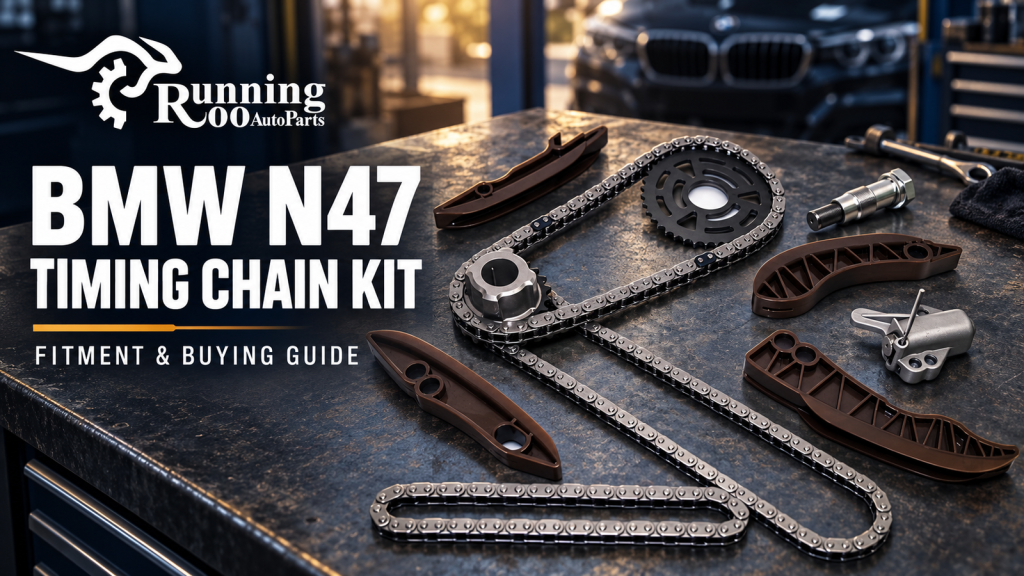
Buying a BMW N47 timing chain kit is easier when the quotation describes the actual repair, rather than simply promising a cure for a diesel rattle. The questions worth answering are which engine is fitted, which chain circuits and related components require attention, and whether the replacement package matches the workshop’s findings. A kit can be the right product for a documented repair without being the answer to every noise from a BMW diesel.
This guide focuses on the RunningRoo N47/N47N timing chain kit and its matching RunningRoo eBay listing. Both were checked as available on 12 October 2026. Availability can change, so obtain confirmation before arranging a workshop booking. The listing covers a range of BMW and MINI diesel applications; those model names are a starting point for a VIN-based enquiry, not a guarantee for every car wearing the same badge.
RunningRoo Auto Parts is Australian-operated and based in Blackburn, Melbourne. For friendly support with the parts enquiry, call 0425 890 125. Melbourne local pickup is available by appointment, and fast dispatch can be discussed once stock, fitment and the delivery destination are confirmed.

Start with the engine that is actually in the car
A useful enquiry includes the VIN, production date, full engine code and any OE numbers identified by the workshop. Supply the complete engine designation if it is available; do not shorten everything to “BMW two-litre diesel”. Also mention any replacement engine or previous chain repair. A registration lookup can help identify the vehicle, but it should not overrule physical evidence that the engine or timing components have changed.
The N47 and N47N wording in a sales listing does not remove the need to check the particular installation. BMW model names can span production changes. A photograph of a 118d badge, an X1 tailgate or a MINI body shape cannot establish which guide, sprocket or tensioner revision is required. Ask the repairer to connect the vehicle identification to the manufacturer’s current parts information before deciding that a kit is suitable.
This is also why the engine number and OE reference have different jobs. The engine code identifies the relevant engine family or variant; an OE number identifies a component or assembly reference. A supplier kit code identifies a commercial package. Keep those fields separate when sending an enquiry so that a supplier code is not accidentally presented as a BMW part number.
What the checked listing actually contains
The eBay description provides an eleven-line packing list. It identifies three chains, two gears, two tensioners and four guides. The website title alone does not provide that level of detail, so the table below summarises the checked seller description. The reference numbers are advertised cross-references; they still require confirmation against the vehicle and the current supplied version.
| Listed component | Advertised reference or description | What to confirm before ordering |
|---|---|---|
| Chain 1 | 11318510014; 06D × 86 links | Correct circuit and revision for the identified engine |
| Chain 2 | 11318506652; 06D × 70 links | Match to the workshop’s parts schedule |
| Chain 3 | 11417797896; 06D × 48 links | Whether the planned repair covers this additional drive |
| Cam gear | 11317797514 / 11318509926; 40 teeth | Applicable reference, mounting and supplied revision |
| Listed lower gear | 13527797906; seller calls it “crank gear” | Exact installation position against the OE diagram |
| Upper tensioner | 11317797901 | Correct version and installation requirements |
| Lower tensioner | 13527797905 | Correct version and installation requirements |
| Upper guides | 11317797898 and 11317797899 | Both required guide positions |
| Lower guides | 13527797903 and 13528515670 | Both required guide positions |
The lower gear wording deserves care. A seller’s short label should not replace the manufacturer’s component diagram. Ask the workshop to identify the reference and position explicitly. Likewise, an advertised pair of alternative cam-gear references is not, by itself, proof that every supersession or production revision is interchangeable.
Review the current N47 kit photographs and description, then compare them with the eBay package information. If the workshop needs seals, fasteners, an oil nozzle or additional damaged components, request those separately unless RunningRoo confirms they are included. A photograph containing several chains is useful for recognition, but it is not a signed inventory of everything needed to complete the job.
Why repair scope matters on an N47
Component manufacturer febi’s official technical case study, The Missing Link, describes an N47 fitted to an E61 520d. It locates the chain drive at the transmission end of the engine and describes damage extending beyond the broken chain, including other timing components. It also distinguishes upper, lower and oil-pump chain work. This is a manufacturer-authored example of why inspection and a complete repair plan matter; it is not a universal removal method for every N47 installation.
That case study discusses febi’s own replacement package. It does not establish that the RunningRoo kit is a febi product, uses the same coating, includes the same parts or carries the same technical revisions. The useful lesson for a buyer is narrower: ask what was inspected and which components the proposed repair addresses. Brand-specific claims must remain attached to the product for which they were made.
A quotation that says only “replace timing chain” leaves several practical questions unanswered. Does it cover all the chain circuits the mechanic has assessed? Are worn guides and sprockets included? Has the repairer allowed for sealing materials and any one-use hardware required by the applicable BMW procedure? Has the possibility of additional internal damage been investigated? These questions help compare quotations without pretending that every vehicle needs an identical repair.
Turn a noise complaint into a useful workshop brief
Describe the symptom in ordinary, specific language. Record whether it occurs after an overnight stop, with a warm engine, at idle, during acceleration or after recent servicing. Note when it first appeared and whether its character has changed. A short recording can help communicate the complaint, but a recording cannot confirm a chain diagnosis or tell a mechanic that the car is safe to continue driving.
Provide the service history that you actually have. An invoice showing the oil specification, filter and service date is more useful than an unsupported statement that the engine has always been maintained perfectly. If records are missing, say so. The mechanic can then assess the car on the available evidence instead of relying on an assumed maintenance history.
Ask for the diagnostic findings before approving the parts order. Useful findings might include the identified source of the noise, relevant fault records, inspection photographs and a list of components judged defective. The repairer should decide which tests are appropriate under the manufacturer procedure. Do not treat a timing-related code, a high odometer reading or an online description of a familiar sound as a complete diagnosis.
If the engine has stopped unexpectedly or the workshop suspects a mechanical timing failure, ask the workshop how to transport and assess it. Repeated starting attempts are not a sensible way to confirm whether a replacement kit will fix the problem. The purchasing decision should follow an assessment of the engine’s condition and repairability.
Compare quotations using a written scope
For a first quotation, separate diagnosis, parts, labour and consumables. This makes it easier to see whether a lower total represents a different job. Two workshops may be discussing different access methods, different chain circuits or a different allowance for damage. Comparing only the kit price will not reveal those differences.
For a revised quotation after dismantling, ask the mechanic to identify what changed. A damaged component that was not visible during the initial assessment should be documented and priced before the repair expands. This is particularly helpful when the first estimate was necessarily provisional. Agreeing an inspection stage and an approval stage can make the process clearer for both customer and workshop.
For a parts-only order, share the proposed kit link with the installer before purchase. The mechanic can compare the advertised references and contents with the vehicle-specific requirements. This avoids a situation where the owner buys a package, the workshop orders another package, and neither party knows which one has been checked against the engine.
What a supplier can help confirm
RunningRoo can help with the product enquiry, current availability, advertised package contents and collection or dispatch arrangements. Send the VIN, full engine code, requested OE references and the workshop’s list together. A clear enquiry reduces the need for several rounds of messages and makes any unresolved point visible before payment.
A parts conversation should also distinguish compatibility from diagnosis. Confirmation that a kit is suitable for an engine does not prove that the engine needs it. Conversely, a mechanic’s conclusion that the chain system needs repair does not identify a particular commercial kit until its contents and references have been checked. Both decisions are necessary, but they answer different questions.
For a Melbourne workshop booking, call 0425 890 125 to discuss the RunningRoo N47 timing chain package. Local pickup in Blackburn is by appointment. For interstate customers, provide the postcode and required workshop date so the team can discuss fast dispatch and the available delivery service without treating an estimate as a guaranteed arrival time.
Agree on verification before the job begins
Ask the repairer what evidence will be retained after installation. A helpful handover records the parts fitted, any additional damage repaired and the final checks carried out under the applicable BMW procedure. The job is easier to understand when the final invoice uses the same component descriptions as the approved quotation.
Also ask how the original complaint will be reassessed. If the concern occurred only after the vehicle had stood overnight, a brief warm-engine demonstration may not answer the customer’s original question. The workshop should decide the appropriate verification conditions and explain any limitations of the test. This is a request for a documented result, not a demand for a blanket promise that an older engine will never make another noise.
Keep the invoice and confirmed product references with the vehicle records. They will help a future mechanic distinguish a completed chain repair from an unverified claim by a previous owner. If the symptom later changes, report the new conditions and reference the earlier work instead of assuming the same component has failed again.
Related RunningRoo video and further reading
Watch Timing Chain Rattle: Wear Symptoms & When to Replace from RunningRoo AutoParts for general background on chain-related complaints. It is an educational overview, not an N47 installation procedure and not evidence that the pictured kit is the exact package fitted to your vehicle. Use current BMW repair information for the actual engine and task.
Owners comparing BMW diesel families can also read our BMW N57 timing chain kit guide. That page concerns a different engine family. Keeping the two enquiries separate helps prevent a broad “BMW diesel chain kit” search from becoming an incorrect parts order.
Frequently asked questions
Does this kit fit every BMW 118d, 120d or X1 diesel?
No universal fitment claim is made here. The listing names several applications, but production details, engine identification and component references must be checked. Send the VIN and full engine code, and have the installer confirm the required OE references and package scope before ordering.
Are all three chains included?
The checked eBay description lists three chains with separate reference numbers and lengths. Confirm the current supplied package before purchase, particularly if the workshop has specified a revised component. The table is a summary of the seller’s description, not an independent measurement of the delivered parts.
Is this a genuine BMW or febi kit?
This guide does not identify it as either. It is offered through RunningRoo’s listing. The febi document is a technical source about an N47 repair example; its branding, coatings and package claims must not be transferred to another supplier’s kit. Ask RunningRoo for the current product specification if a particular brand is required.
Can a new tensioner alone solve the problem?
That decision requires diagnosis and inspection. A buyer should not select a tensioner-only repair merely because it costs less, nor assume that every noise requires every timing component. Ask the workshop to explain which parts are defective and why the proposed repair addresses the recorded complaint.
Does a chain kit repair damage caused by a broken chain?
Only the components actually included in the package are supplied. Any additional engine damage must be identified and dealt with separately. Obtain a repairability assessment and an itemised quotation before assuming that a kit purchase is the complete cost of returning the vehicle to service.
Can I collect it in Melbourne?
RunningRoo offers Melbourne local pickup in Blackburn by appointment. Call 0425 890 125 to confirm the part, stock and collection time. Australian-operated service and friendly support make it easier to coordinate a parts order with your workshop, but collection should be arranged before travelling.
Where should I order after fitment is confirmed?
Use the RunningRoo website product page or the matching eBay item, depending on your preferred checkout. Confirm the latest description, shipping arrangements and supplied contents at the time of purchase. Keep the order reference together with the workshop’s approved parts list.