
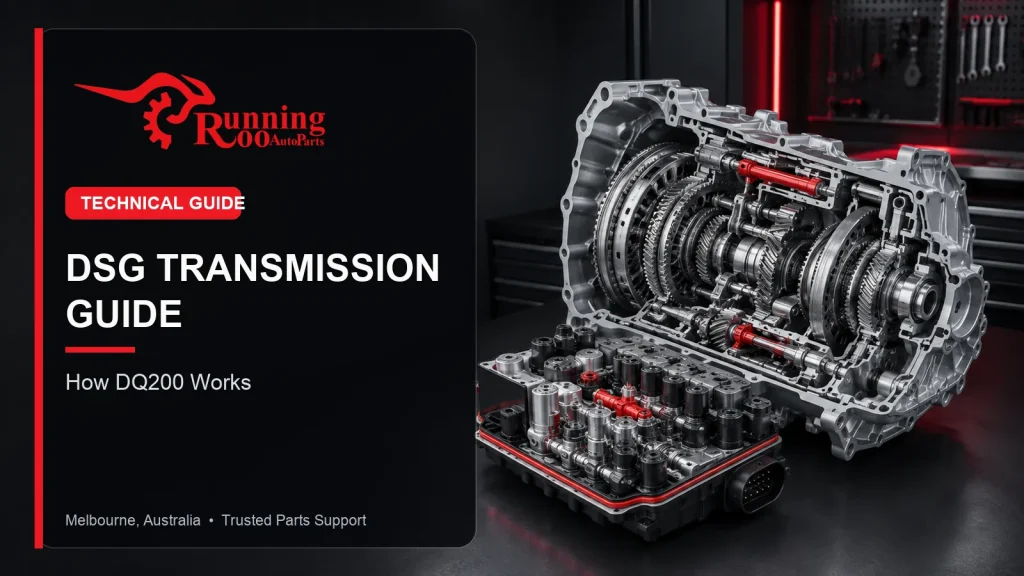
Introduction
If you’ve researched Volkswagen, Audi, Škoda, or SEAT vehicles, you’ve likely come across the term DSG transmission. DSG stands for Direct-Shift Gearbox, Volkswagen Group’s name for its dual-clutch transmission technology.
Over the past two decades, DSG gearboxes have become one of the most significant developments in automotive transmission engineering. They combine the fuel efficiency and direct mechanical connection of a manual gearbox with the convenience of a traditional automatic transmission.
In Australia, DSG-equipped vehicles are extremely common. Models such as the Volkswagen Golf, Polo, Passat, Tiguan, Audi A3, Audi A1, Škoda Octavia, and many others have used DSG transmissions in various forms.
However, many drivers still ask the same questions:
- What exactly is a DSG gearbox?
- How does a dual-clutch transmission work?
- Is DSG an automatic or a manual?
- What is the difference between DQ200, DQ250, DQ381, and other DSG models?
- Why are DSG gear changes so fast?
This guide provides a comprehensive technical overview of Volkswagen’s DSG technology, supported by official Volkswagen documentation and engineering references.
What Does DSG Stand For?
DSG stands for Direct-Shift Gearbox.
According to Volkswagen Australia, DSG combines the convenience of an automatic transmission with the efficiency and responsiveness of a manual gearbox. Volkswagen’s electronic control system continuously monitors vehicle speed, engine speed, accelerator position, and driving conditions to determine the optimal gear selection. Gear changes can occur in less than four-hundredths of a second.
Unlike conventional automatic transmissions that use a torque converter, DSG gearboxes use two clutches and two gear sets to pre-select the next gear before the shift occurs. This design significantly reduces interruption of power delivery.
The Evolution of Automatic Transmissions
To understand why DSG technology was developed, it is useful to compare it with previous transmission designs.
Manual Transmission
Advantages:
- Excellent efficiency
- Strong driver control
- Lower mechanical losses
Disadvantages:
- Requires clutch pedal operation
- More difficult in heavy traffic
- Driver-dependent shift quality
Traditional Automatic Transmission
Advantages:
- Easy to drive
- Smooth operation
- Suitable for urban driving
Disadvantages:
- Torque converter losses
- Slower gear changes
- Reduced fuel efficiency
DSG Dual-Clutch Transmission
Advantages:
- Extremely fast shifts
- Improved fuel economy
- Continuous power delivery
- Automatic convenience
Disadvantages:
- More complex design
- Higher repair costs
- Requires specialised diagnostics
Volkswagen developed DSG technology to bridge the gap between manual and automatic transmissions.
How Does a DSG Transmission Work?
The secret behind DSG technology is surprisingly simple.
Instead of having a single clutch, DSG gearboxes use two separate clutches.
One clutch controls:
- 1st gear
- 3rd gear
- 5th gear
- 7th gear
The second clutch controls:
- 2nd gear
- 4th gear
- 6th gear
- Reverse gear
Volkswagen’s technical documentation explains that DSG effectively contains two independent gearbox units operating simultaneously within a single housing.
When the vehicle is accelerating in first gear, second gear is already engaged internally and waiting for the shift command.
As soon as the transmission controller requests second gear:
- Clutch A disengages
- Clutch B engages
The shift happens almost instantly.
Because the next gear is already prepared, there is virtually no interruption to torque delivery.
DSG Gear Selection Process
The following chart illustrates the basic operation of a DSG gearbox.
This dual-clutch arrangement is the primary reason DSG transmissions shift much faster than conventional automatic gearboxes.
What Is a Mechatronic Unit?
One of the most important components in any DSG transmission is the Mechatronic Unit.
Volkswagen describes the mechatronic assembly as an integrated module containing:
- Transmission Control Module (TCM)
- Hydraulic control system
- Pressure regulators
- Sensors
- Solenoids
All packaged into a single unit that manages clutch operation and gear selection.
The mechatronic unit is essentially the “brain” of the DSG transmission.
It constantly monitors:
- Engine speed
- Vehicle speed
- Throttle position
- Gear selection
- Clutch engagement
It then calculates the optimal shift strategy hundreds of times per second.
Dry Clutch vs Wet Clutch DSG
Not all DSG gearboxes are identical.
Volkswagen Group uses both dry-clutch and wet-clutch designs.
According to Volkswagen technical information:
Dry Clutch DSG
Examples:
- DQ200 (0AM / 0CW)
Characteristics:
- Lighter weight
- Higher efficiency
- Designed for lower torque applications
- Typically used in 1.0 TSI, 1.2 TSI, 1.4 TSI, and 1.5 TSI engines
Wet Clutch DSG
Examples:
- DQ250
- DQ381
- DQ500
Characteristics:
- Clutches operate in oil
- Better cooling
- Higher torque capacity
- Used in GTI, R, TDI, and larger engines
Volkswagen states that low-torque DSG gearboxes generally use dry clutches, while higher-torque applications use wet-clutch systems.
The DQ200 DSG7 Explained
The DQ200 is arguably the most common DSG gearbox in Australia.
Common applications include:
- Volkswagen Golf 1.4 TSI
- Volkswagen Polo
- Audi A1
- Audi A3
- Škoda Octavia
- Škoda Fabia
Key specifications:
- 7 forward gears
- Dry dual-clutch design
- Approximately 250 Nm torque capacity
- Lightweight construction
The DQ200 was designed primarily for fuel efficiency and compact turbocharged engines.
Why DSG Shifts So Quickly
Traditional automatic transmissions must:
- Release one clutch pack
- Apply hydraulic pressure
- Engage another clutch pack
This process takes time.
DSG transmissions already have the next gear prepared before the shift occurs.
Volkswagen Australia states that DSG gear changes occur in less than 0.04 seconds.
This is significantly faster than:
- Manual transmissions
- Conventional automatics
- Most CVT systems
The result is:
- Faster acceleration
- Improved responsiveness
- Better fuel efficiency
DSG vs Conventional Automatic
| Feature | DSG | Torque Converter Auto |
|---|---|---|
| Shift Speed | Extremely Fast | Moderate |
| Fuel Efficiency | Excellent | Good |
| Mechanical Efficiency | High | Moderate |
| Low-Speed Smoothness | Moderate | Excellent |
| Complexity | High | Medium |
| Driving Feel | Sporty | Comfortable |
For enthusiasts, DSG often provides a more engaging driving experience.
For drivers prioritising maximum comfort in stop-start traffic, a conventional automatic may feel smoother.
Why DSG Became So Popular
Volkswagen introduced DSG technology into mass-market vehicles because it offers several advantages:
- Faster shifting
- Lower emissions
- Improved fuel economy
- Better acceleration
- Reduced power loss
Volkswagen Australia notes that DSG systems can be even more efficient than some conventional manual transmissions in certain applications because power losses are minimised.
Common DSG Problems
Although DSG transmissions are highly advanced, no transmission is perfect.
Common issues can include:
Mechatronic Failure
Symptoms:
- Flashing PRNDS lights
- Gear selection faults
- Limp mode
Clutch Wear
Symptoms:
- Shuddering
- Juddering
- Delayed engagement
Hydraulic Pressure Issues
Symptoms:
- Gearbox warning messages
- Harsh shifting
- Gear selection errors
These issues are most commonly discussed in relation to older DSG generations, particularly early DQ200 units.
DSG Maintenance in Australia
Proper maintenance is critical.
Recommended practices include:
- Following manufacturer service schedules
- Performing transmission adaptations when required
- Using approved DSG fluids
- Avoiding excessive clutch slipping
Australian driving conditions can be particularly demanding due to:
- Heavy city traffic
- High summer temperatures
- Frequent stop-start driving
These conditions can accelerate clutch wear, particularly in dry-clutch DSG systems.
Is DSG Reliable?
The answer depends on:
- DSG generation
- Vehicle model
- Maintenance history
- Driving style
Modern DSG gearboxes are generally considered reliable when maintained correctly.
Like any advanced transmission, preventative maintenance is considerably cheaper than major repairs.
Frequently Asked Questions (FAQ)
Is DSG an automatic transmission?
Yes. Although mechanically similar to a manual gearbox, DSG operates automatically without a clutch pedal.
What does DSG stand for?
Direct-Shift Gearbox.
Is DSG the same as DCT?
DSG is Volkswagen Group’s version of a Dual-Clutch Transmission (DCT).
What is the difference between DSG and CVT?
A DSG uses physical gears and clutches, while a CVT uses pulleys and a belt or chain.
Which DSG gearbox is the DQ200?
The DQ200 is Volkswagen’s 7-speed dry-clutch DSG transmission commonly used in smaller petrol vehicles.
Does DSG improve fuel economy?
Yes. Volkswagen states that DSG transmissions minimise power losses and can improve efficiency compared to conventional automatics.
Why does DSG sometimes feel different in traffic?
Because DSG gearboxes use clutch engagement similar to a manual transmission rather than a torque converter.
Can DSG be repaired?
Yes. Common repairs include clutch replacement, mechatronic repairs, adaptation procedures, and complete transmission rebuilds.
Conclusion
The DSG transmission represents one of Volkswagen Group’s most significant engineering achievements. By combining two clutches, advanced mechatronics, and intelligent gear pre-selection, DSG technology delivers lightning-fast gear changes, strong fuel efficiency, and an engaging driving experience.
Whether you’re driving a Volkswagen Golf, Polo, Passat, Audi A3, or Škoda Octavia, understanding how DSG technology works can help you better maintain your vehicle and recognise potential issues before they become costly repairs.
For Australian owners, particularly those driving DQ200-equipped vehicles, understanding the relationship between clutches, mechatronics, and driving conditions is essential to maximising gearbox lifespan and performance.
If you have any questions regarding any DQ200 gearbox-related issues, please feel free to contact us at any time.
We are based in Blackburn South, Melbourne, and provide 24/7 free pickup service (by appointment only) for your convenience.
📞 Phone: 0425 890 125
🛒 eBay Store: https://www.ebay.com.au/itm/365819799559?_skw=dq200&itmmeta=01KTGWC00ZCHGVEPKYYAZ4QXV0&hash=item552c8f2807:g:np8AAeSwNI1pRHw3
At RunningRoo Auto Parts, we are here to help with any DQ200 diagnostics, parts, or technical enquiries—don’t hesitate to reach out.
Thanks for quick delivery.