
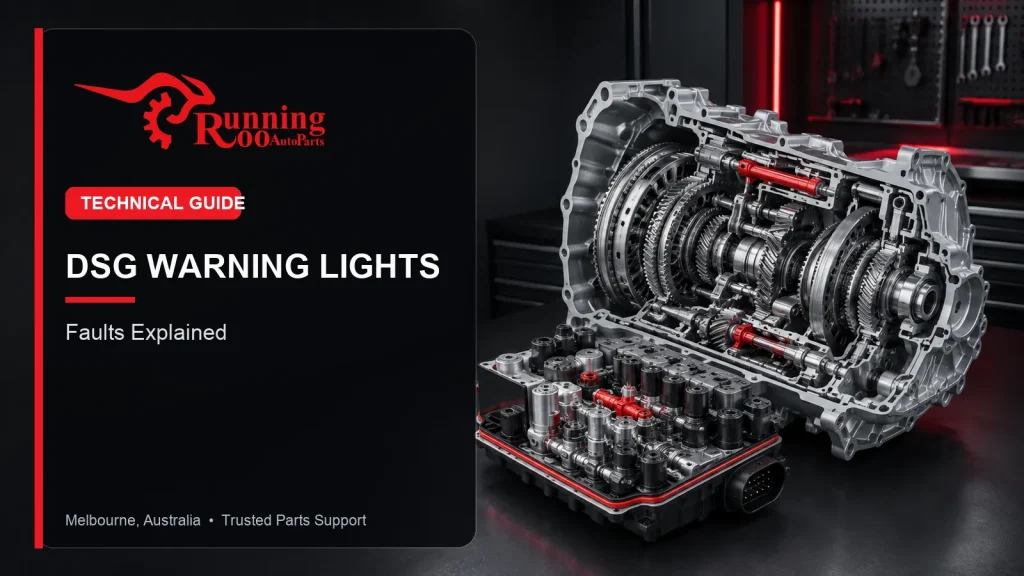
Australian Technical Guide – Volkswagen Group DSG Systems


1. Introduction: What DSG Warning Lights Actually Mean
The DSG (Direct-Shift Gearbox), including the widely used DQ200 7-speed dry clutch system, relies on a highly integrated electronic control system known as the TCM (Transmission Control Module) and mechatronic unit. When a fault occurs, the system does not behave like a traditional automatic transmission with simple mechanical failure symptoms—instead, it communicates through dashboard warning lights, PRNDS flashing, limp mode activation, or message alerts.
According to Volkswagen’s official warning light guidance, transmission-related warnings are categorised as amber (caution) or red (critical stop condition) depending on severity, and may indicate issues ranging from overheating to full transmission malfunction (vw.com).
In DSG-equipped vehicles (VW, Audi, Škoda, SEAT), these lights are not cosmetic—they are directly tied to real-time diagnostic fault detection inside the gearbox controller.
2. How DSG7 (DQ200) Warning Systems Work
The DSG system continuously monitors:
- Clutch engagement position
- Hydraulic pressure inside the mechatronic unit
- Gear selector position (PRNDS)
- CAN-BUS communication between ECU and TCM
- Temperature of transmission components
- Voltage stability from battery/alternator
If any of these values fall outside expected thresholds, the TCM triggers a warning response.
The key point:
👉 DSG warning lights are “system-level protection responses”, not just failure indicators.
For example:
- A minor voltage drop may trigger a temporary gearbox warning
- A hydraulic pressure fault may trigger limp mode
- A CAN communication failure may cause flashing PRNDS and no gear selection
This is why DSG faults often appear “sudden” to drivers but are actually the result of internal threshold monitoring.
3. DSG Warning Light Types and Their Meanings
Volkswagen Group uses a colour-coded system consistent across most models:
🔴 Red Warning (Critical)
- Stop vehicle safely immediately
- Possible transmission overheating or major mechanical failure
- Gearbox may be unable to engage drive or reverse
🟡 Amber / Yellow Warning (Caution)
- Fault detected but limited drivability may remain
- Possible mechatronic issue or sensor irregularity
- System may enter limp mode
⚪ White / Grey Indicators
- Information only (system status, not a fault)
⚠️ PRNDS Flashing (DSG-specific)
- Indicates TCM has detected a transmission control fault
- Often linked to:
- Mechatronic failure
- Communication loss (U0101 / 01315)
- Clutch adaptation error
- Hydraulic pressure instability
4. Most Common DSG7 / DQ200 Warning Scenarios
Based on diagnostic patterns from DSG repair specialists, the most frequent fault triggers are:
4.1 Mechatronic Unit Failure (Most Common)
The mechatronic unit is the “brain + hydraulic actuator” of the DSG system.
Common symptoms:
- PRNDS flashing
- Gear stuck in neutral
- Harsh or delayed engagement
- No reverse or drive
Technical cause:
- Internal valve body wear
- Solenoid failure
- Pressure accumulator cracking
- PCB (electronic board) failure
Industry repair data consistently shows this as the leading failure point in DQ200 systems (Gearbox Gurus).
4.2 TCM Communication Failure (U0101 / 01315)
When the TCM loses communication with ECU or CAN-BUS network:
- Multiple warning lights appear simultaneously
- Gearbox becomes unresponsive
- Scan tools may fail to access transmission module
Typical causes:
- Wiring harness damage
- Battery voltage instability
- Internal mechatronic electronics failure
- CAN-BUS signal interruption
These communication failures are widely documented in DSG diagnostic literature (RunningRoo).
4.3 Hydraulic Pressure Loss
The DQ200 relies on electro-hydraulic pressure control.
If pressure drops:
- Gear engagement becomes inconsistent
- Vehicle enters limp mode
- “Function restricted” warnings appear
4.4 Overheating Condition
Volkswagen explicitly includes DSG overheating as a red warning condition:
- Transmission temperature warning light
- Reduced torque output
- Temporary shutdown of gear engagement system (vw.com)
5. Diagnostic Flow of DSG Warning Lights (Technical Overview)
Below is a simplified diagnostic logic chain used in DSG fault detection systems:
This flow is important because DSG faults are rarely caused by a single event. Instead, they escalate through multiple electronic and hydraulic layers before the driver sees a warning light.
6. Official Volkswagen Interpretation of Warning Lights
Volkswagen’s official documentation confirms that:
- Warning lights vary by model and system configuration
- Transmission warnings should be treated based on colour severity
- Red indicators require immediate stopping
- Amber indicates a fault requiring service attention (vw.com)
This aligns with DSG system logic where:
- Red = active protection mode
- Amber = degraded operation mode
- No light = normal operation
Importantly, DSG systems can still store fault codes without visible dashboard warnings, especially during early-stage mechatronic degradation.
7. Real-World Driver Symptoms (Before Warning Lights Appear)
Many DSG7 failures actually begin before any warning light is triggered:
- Slight hesitation when shifting from 1st to 2nd
- Jerking at low speed (parking manoeuvres)
- Occasional “neutral drop” sensation
- Delayed reverse engagement
- Intermittent PRNDS flicker
Once these symptoms appear, the system is often already operating under stress.
8. Visual Reference Summary (What You See on Dashboard)


Typical DSG-related warnings include:
- Flashing PRNDS indicator
- Gearbox wrench symbol
- “Transmission Fault – Workshop” message
- Limp mode restriction message
- Engine + gearbox combined warning lights
9. Why DSG Warning Lights Should Never Be Ignored
Ignoring DSG warnings can lead to:
- Complete loss of drive
- Mechatronic burnout
- Clutch overheating damage
- CAN-BUS system instability
- Increased repair cost (often significantly higher if delayed)
Because DSG systems are electronically controlled, continued driving under fault conditions often accelerates internal damage rather than allowing gradual degradation like older automatic gearboxes.
10. Frequently Asked Questions (FAQ)
Q1: Can I still drive with DSG warning light on?
Yes—but only in limited cases. Amber warnings may allow short-distance driving, but red warnings or PRNDS flashing should be treated as urgent.
Q2: Does PRNDS flashing always mean mechatronic failure?
Not always. It can also indicate:
- Low voltage
- Wiring issues
- CAN-BUS communication faults
However, mechatronic failure is the most common cause.
Q3: Why does my DSG fault disappear after restarting?
Because the system resets temporary thresholds. However, stored fault codes remain and the issue usually returns.
Q4: Is DSG DQ200 unreliable?
It is sensitive rather than unreliable. Most failures are related to:
- Heat
- Voltage instability
- Mechatronic wear
- Stop-start urban driving patterns
Q5: Can software updates fix DSG warning lights?
Sometimes. Adaptive clutch calibration or TCM updates can improve behaviour, but mechanical or hydraulic faults cannot be solved by software alone.
11. Conclusion
DSG7 (DQ200) warning lights are not simple alerts—they are part of a highly intelligent transmission protection system. Understanding what each warning means allows early diagnosis and prevents expensive failure.
In summary:
- Amber light = early fault detection
- Red light = immediate protection required
- Flashing PRNDS = TCM/mechatronic communication fault
- Overheating = thermal protection triggered
Correct interpretation of these signals is essential for maintaining DSG reliability and avoiding full transmission failure.
If you have any questions regarding any DQ200 gearbox-related issues, please feel free to contact us at any time.
We are based in Blackburn South, Melbourne, and provide 24/7 free pickup service (by appointment only) for your convenience.
📞 Phone: 0425 890 125
🛒 eBay Store: https://www.ebay.com.au/itm/365819799559?_skw=dq200&itmmeta=01KTGWC00ZCHGVEPKYYAZ4QXV0&hash=item552c8f2807:g:np8AAeSwNI1pRHw3
At RunningRoo Auto Parts, we are here to help with any DQ200 diagnostics, parts, or technical enquiries—don’t hesitate to reach out.
Great item as described quick postage
Awesome product awesome seller