
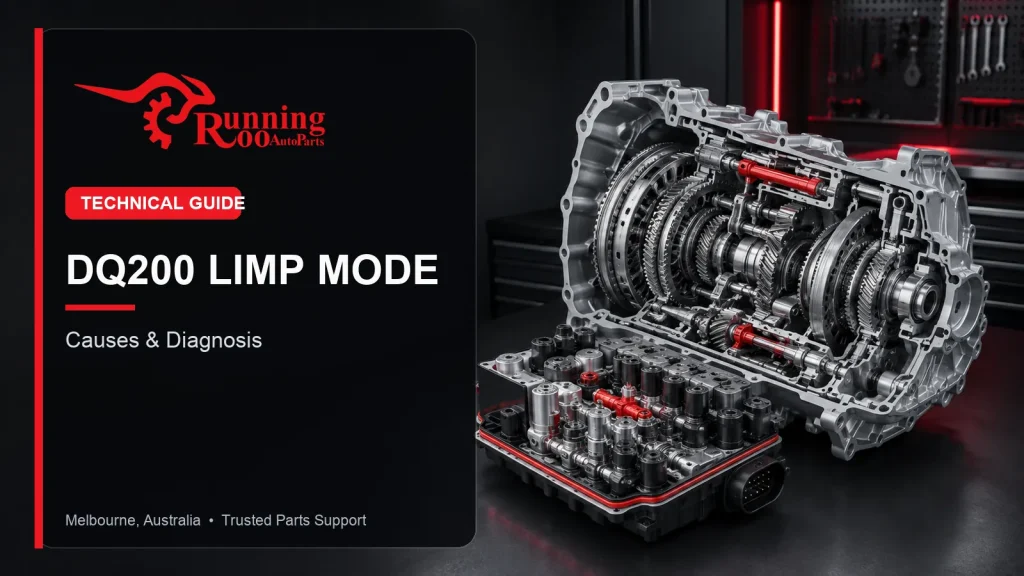
Australian Technical Guide – Volkswagen DSG7 Systems


1. Introduction: What “Limp Mode” Means in DQ200 DSG
In Volkswagen Group vehicles equipped with the DQ200 7-speed DSG (DSG7 dry clutch system), limp mode (also called fail-safe mode or emergency mode) is a built-in protection strategy activated by the Transmission Control Module (TCM).
When the system detects abnormal operating conditions, it intentionally:
- Restricts available gears (often 2nd or 3rd gear only)
- Reduces torque output
- Disables manual or sport shifting
- Activates dashboard warnings (PRNDS flashing or gearbox icon)
According to Volkswagen’s official owner guidance, transmission warning states are part of a protective strategy designed to prevent further drivetrain damage and ensure the vehicle can still be moved safely to a service location (vw.com).
2. How DQ200 Limp Mode Is Triggered (System Logic)
The DSG system constantly evaluates real-time parameters:
- Clutch slip ratio
- Hydraulic pressure in mechatronic system
- Gear selection accuracy
- Electrical voltage stability
- CAN-BUS communication integrity
- Temperature thresholds
When one or more parameters exceed safety limits, the TCM executes a fail-safe protocol.
Simplified activation logic:
- Minor fault → warning light only
- Moderate fault → performance limitation
- Severe fault → limp mode activation
This is not random—it is a tiered protection architecture embedded in DSG control software.
3. Main Causes of DQ200 Limp Mode Activation
Below are the most common technical root causes observed in DSG7 systems:
3.1 Mechatronic Unit Failure (Primary Cause)
The mechatronic unit controls:
- Gear selection hydraulics
- Clutch engagement
- Shift timing logic
Failure modes include:
- Solenoid valve malfunction
- Internal hydraulic pressure leaks
- PCB (electronic board) failure
- Pressure accumulator degradation
When this occurs, the TCM cannot guarantee correct gear engagement → limp mode is triggered immediately.
3.2 Clutch Wear or Excessive Slip
DQ200 uses a dry dual-clutch system, which is more sensitive to wear than wet DSG variants.
Triggers include:
- High clutch temperature
- Excessive slip during stop-start driving
- Worn clutch friction surfaces
- Incorrect clutch adaptation values
When slip exceeds programmed thresholds, the system enters protection mode to prevent complete clutch failure.
3.3 Electrical Voltage Instability
Low or unstable voltage is a major but often overlooked cause.
Examples:
- Weak battery
- Alternator irregular output
- Voltage drop during start-stop cycles
The TCM is highly voltage-sensitive; instability can cause:
- Gear recognition errors
- Sensor misreadings
- Communication loss with ECU
This frequently results in temporary limp mode until restart or voltage stabilisation.
3.4 CAN-BUS Communication Failure
DSG systems rely on continuous communication between:
- ECU (Engine Control Unit)
- TCM (Transmission Control Module)
- ABS / ESP modules
If communication is lost (e.g. U-codes such as U0101), the gearbox defaults to limp mode as a safety precaution.
3.5 Gear Position or Sensor Mismatch
If the TCM detects inconsistency between:
- Gear selector position
- Actual gear engagement
- Input/output shaft speed
It assumes a mechanical fault risk and limits operation immediately.
3.6 Overheating Protection Trigger
Although DQ200 is a dry clutch system, it still has temperature monitoring.
Overheating can occur due to:
- Heavy stop-start traffic
- Hill climbing under load
- Repeated clutch slip conditions
Once temperature thresholds are exceeded, limp mode activates to protect clutch and gearbox components.
4. DQ200 Limp Mode Activation Flow (System Overview)
This illustrates how limp mode is not caused by a single failure point, but rather a progressive escalation of system risk detection.
5. Official Engineering Principle Behind Limp Mode (VW DSG Design)
Volkswagen DSG systems are designed under a core principle:
“Prevent mechanical damage by reducing functionality rather than allowing uncontrolled operation.”
This aligns with OEM drivetrain safety philosophy used across:
- VW Group DSG systems
- Audi S-tronic transmissions
- Škoda DSG platforms
- SEAT DSG platforms
Official Volkswagen documentation confirms that transmission warning states are designed to protect drivetrain components and ensure safe limited mobility (vw.com).
6. Symptoms When DQ200 Enters Limp Mode
Drivers typically experience:
- Vehicle stuck in one gear (often 2nd or 3rd)
- No manual or sport mode response
- PRNDS flashing on dashboard
- “Transmission Fault – Workshop” message
- Reduced acceleration
- Delayed or no gear engagement
In severe cases:
- Vehicle may not move from stationary
- Reverse gear may be unavailable
7. Can DQ200 Limp Mode Reset Itself?
Yes—but only temporarily in some cases.
Temporary reset scenarios:
- Voltage drop corrected after restart
- Minor sensor glitch
- Temporary communication error
Permanent limp mode scenarios:
- Mechatronic failure
- Severe clutch wear
- Hydraulic pressure loss
- Persistent sensor faults
In permanent cases, fault codes remain stored and must be cleared after repair using diagnostic tools (VCDS / ODIS).
8. Diagnostic Logic (Simplified Workshop View)
Common DSG fault codes associated with limp mode:
| Fault Code | Meaning | Typical Cause |
|---|---|---|
| P17BF | Clutch adaptation limit reached | Clutch wear |
| P189C | Hydraulic pressure loss | Mechatronic issue |
| P072C | Gear stuck in neutral | Actuator fault |
| U0101 | Lost communication with TCM | CAN-BUS issue |
These are widely referenced in Volkswagen diagnostic systems and service manuals used across DSG platforms.
9. Reference Visual Summary of Limp Mode Indicators


Typical indicators include:
- Flashing PRNDS
- Amber gearbox warning icon
- “Transmission Fault” message
- Reduced engine power warning
- Limp mode gear restriction
10. Frequently Asked Questions (FAQ)
Q1: Can I drive in DQ200 limp mode?
Yes, but only short distances. The vehicle is designed to allow limited mobility to reach a workshop safely.
Q2: Does limp mode always mean gearbox failure?
No. It can be triggered by electrical or communication faults, not only mechanical failure.
Q3: Why does limp mode disappear after restarting the car?
Because temporary faults may reset, but stored error codes remain in the TCM.
Q4: Is mechatronic failure the most common cause?
Yes. Industry diagnostics consistently show mechatronic issues as the primary cause of persistent limp mode in DQ200 systems.
Q5: Can software updates fix limp mode issues?
Sometimes. Adaptation resets or TCM software updates may resolve calibration-related faults, but not mechanical damage.
11. Conclusion
DQ200 limp mode is a protective engineering response, not a random failure symptom. It is triggered when the DSG control system detects conditions that could damage the gearbox or compromise drivability.
Key takeaways:
- Limp mode = protection strategy, not just failure
- Mechatronic unit is the most critical risk point
- Voltage and communication issues are common triggers
- Early diagnosis prevents costly gearbox damage
Understanding these systems is essential for proper DSG maintenance and avoiding full transmission failure.
If you have any questions regarding any DQ200 gearbox-related issues, please feel free to contact us at any time.
We are based in Blackburn South, Melbourne, and provide 24/7 free pickup service (by appointment only) for your convenience.
📞 Phone: 0425 890 125
🛒 eBay Store: https://www.ebay.com.au/itm/365819799559?_skw=dq200&itmmeta=01KTGWC00ZCHGVEPKYYAZ4QXV0&hash=item552c8f2807:g:np8AAeSwNI1pRHw3
At RunningRoo Auto Parts, we are here to help with any DQ200 diagnostics, parts, or technical enquiries—don’t hesitate to reach out.
Great to deal with great communication
Very happy with this product
Item received in good time
excellent communications. very happy with postage and the extra help after sale. very happy to recommend 5 stars