
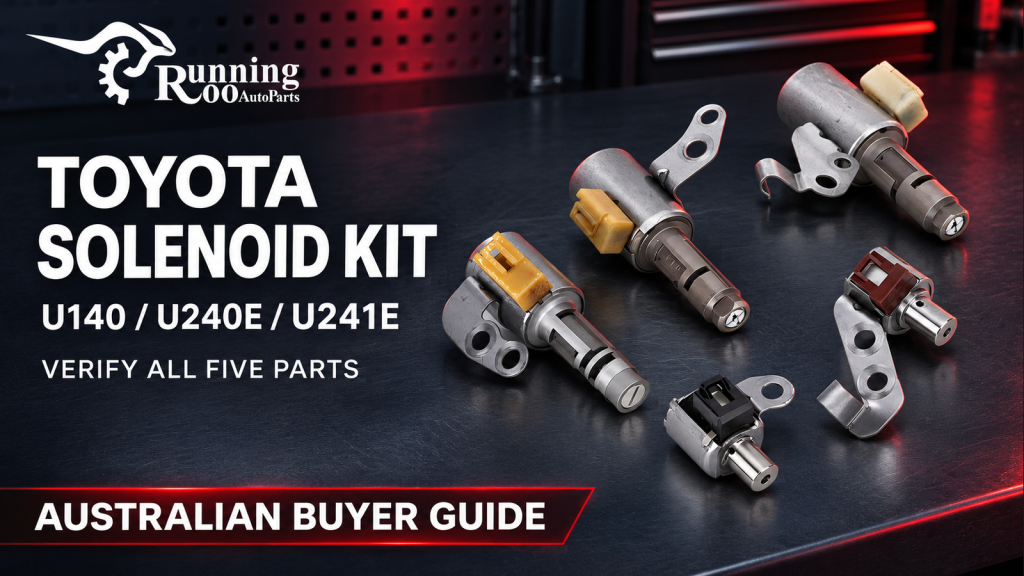
A five-piece Toyota transmission solenoid kit is a defined parts package, not an automatic answer to every shifting complaint. Before ordering a U140, U240E or U241E kit in Australia, establish which transmission is actually fitted, which components the workshop has identified and how the five supplied items correspond with that requirement. The model badge on the boot is not enough.

RunningRoo offers a five-piece solenoid set advertised for selected Toyota and Lexus applications, including Camry and ES300 references in its title. This guide focuses on identifying that package and checking each part before repair. It is separate from a general transmission-symptom article and does not provide a universal wiring test, resistance specification or valve-body installation sequence.
Start with the transmission identification
Give RunningRoo the VIN, complete engine code and the workshop's transmission identification. Include any known gearbox replacement history. A vehicle's model and registration year can guide a lookup, but they do not settle the installed transmission when different variants or later replacements may be involved. Ask the workshop to identify the actual unit before selecting a kit.
Use the complete transmission designation rather than shortening every reference to “U140” or “Toyota auto”. The suffix and application can matter to the parts enquiry. This article does not declare all U140-family and U240-family units interchangeable. The supplier should confirm the advertised kit against the workshop's identified requirement.
If the workshop has already opened the relevant assembly under its repair procedure, obtain the part identifiers and clear photographs it can provide. Do not dismantle components yourself solely to match a marketplace image. The purpose of the photographs is to support an already controlled technical job, not to turn an online shopping comparison into an improvised repair.
Treat the listing's model table cautiously
The current product page contains a broad application table, with entries that need clarification before use. This guide does not reproduce that table as verified fitment information. A safe purchasing approach is to use the exact transmission identity and OE references, then obtain confirmation for the individual vehicle rather than choosing the nearest familiar model name.
Tell the supplier if information from the vehicle, workshop and listing appears inconsistent. For example, a difference in the stated transmission type should be resolved explicitly. Do not assume it is harmless because the product title mentions Toyota or Lexus. A clear application check is more valuable than a long list of unverified model names.
This is also why the headline references Camry and ES300 only as part of the advertised offer, not as blanket approval for every version of those cars. Keep the enquiry specific. The product can be a valid supply option once the correct application is established, but the existence of a listing does not perform that verification automatically.
Identify the five references without inventing their positions
The retailer description lists reference numbers 3529021010, 3524021010, 3523021010, 3521021010 and 3522021010. It states a package of five transmission solenoids. These references should be checked against the workshop's parts information and the current supplied set. Do not assign each number to a valve-body position from connector colour or the order in which the numbers appear online.
Ask the workshop to use the applicable manufacturer documentation to map its required components. The supplier can then confirm how the supplied items correspond with that list. If a reference has been superseded or another identifier is used, ask for the relationship to be explained in writing rather than assuming a similar number is equivalent.
Keep each supplied component associated with its identification until the installer has verified it. A five-piece group photograph is useful for discussing the set, but it is not a position map. The aim is to prevent five individually different items from becoming an anonymous pile on the bench before the application is settled.
| Check | Evidence to obtain | Assumption to avoid |
|---|---|---|
| Vehicle identity | VIN, engine code and replacement history | Model badge proves the installed transmission |
| Transmission identity | Full workshop-confirmed designation | Every related U-series unit uses identical parts |
| Five listed references | Match to the workshop's required components | Number order indicates installation position |
| Supplied contents | Five identified solenoids and seller confirmation | Harness, gasket or complete valve body is included |
| Diagnosis | Recorded findings supporting the parts decision | A fault code alone identifies the entire kit |
| Installation information | Current procedure for the exact unit | Connector colour supplies a fitting instruction |
Understand why diagnosis comes before the kit
Sonnax's official U140/U240/U241 diagnostic information distinguishes hydraulic or solenoid-related concerns from possible electronic-control causes in its discussion of a particular shift complaint. It also explains that a solenoid may have functions beyond the simplified label an owner expects. This manufacturer technical background supports a careful diagnosis rather than a direct leap from a symptom to a five-piece order. Sonnax manufacturer technical information: U140/U240/U241 diagnosis; professional context, not DIY instructions
The Sonnax material is not an endorsement of this supplied kit, and this article does not reproduce its diagnostic test as a do-it-yourself instruction. A transmission specialist must decide which checks apply to the actual vehicle and follow the correct manufacturer information. The buyer should request the resulting conclusion and required parts, not attempt a disconnected-harness test from an online summary.
Keep fault codes, observations and diagnosis in separate parts of the job record. A code can be useful evidence, but it is not automatically a complete parts list. Ask the workshop to explain why the proposed components address its findings and whether it has identified any other work. This makes the order defensible without expecting the owner to interpret the transmission's internal controls.
Five supplied parts do not mean five confirmed failures
A kit may be sold as a convenient group even when the workshop's diagnostic findings are more specific. Ask why the proposed repair uses the complete set rather than an individual item or another scope. The answer should relate to the actual job, available parts and applicable repair approach, not an unsupported claim that every solenoid must always fail together.
Conversely, do not insist on replacing only one item solely because that appears cheaper online. The workshop may have a reason for its recommended scope, and it should explain that reason. This guide does not prescribe the smallest possible order or the largest possible repair. It helps the owner understand the evidence behind the choice.
If the diagnosis is still provisional, say so when asking RunningRoo about availability. A stock enquiry can happen while the workshop investigates, but the final order should follow a confirmed application and parts requirement. An available kit should not become the diagnosis merely because it can be dispatched quickly.
Separate solenoids from the surrounding assembly
The advertised package is five solenoids, not a complete valve body, transmission control module or gearbox. Ask the workshop which additional items are required for its planned work and keep them on separate lines. Do not infer that a gasket, filter, harness or fluid is included unless the seller specifically confirms it for the current offer.
The distinction also matters when comparing quotations. A parts-only kit price cannot be compared directly with a workshop repair that includes diagnosis, access, additional consumables and checking. Request a clear description of each scope rather than treating a difference in price as evidence that one supplier is charging for the same thing differently.
Keep the current product description with the order. If the workshop later changes the repair scope, update the parts list and supplier enquiry before installing an uncertain component. A changed diagnosis may mean that the originally considered kit is no longer the appropriate purchase; the ordering process should follow the evidence rather than the other way around.
Use photographs to support identity, not electrical specifications
Clear photographs can show the body shape, connector arrangement, mounting features and visible identifiers. They are useful for comparing the supplied set with the workshop's reference information. They cannot establish an electrical resistance value, control strategy or suitability for a particular position without the correct technical documentation.
Do not energise a solenoid on the bench using a generic internet method or select a test value from a different transmission. The appropriate equipment and procedure belong to the professional carrying out the repair. This article intentionally omits pinouts, voltage instructions and resistance ranges because it has not established a vehicle-specific service procedure for your unit.
If the supplied set looks different from the expected parts, pause and ask. A different connector colour may or may not be meaningful, but neither conclusion should be guessed. Provide photographs, full references and the order number so RunningRoo and the workshop can resolve the specific discrepancy before installation.
A practical five-part identification sheet
Ask the workshop to create a simple five-line list using its established component references or service-manual names. Add a column for the corresponding supplied identifier and a column for any unresolved question. This is an organisational aid, not a substitute for the service manual's location diagram or installation procedure.
Keep the sheet with the packaged parts until the installer is ready. If one line cannot be reconciled, resolve it rather than assuming the remaining four matches make the complete set correct. A kit purchase should be checked as a complete offer, with each component accounted for in the intended application.
After installation, the workshop can retain the final identification record with the repair invoice. A future technician then has more useful information than a note saying “five solenoids changed”. The record helps explain what was supplied and fitted without claiming that the repair guarantees the condition of every other transmission component.
Australian supply and workshop timing
RunningRoo is Australian-operated in Blackburn VIC, with friendly support for product identification and Melbourne local pickup by appointment. Send the VIN, engine code, full transmission designation, OE references and workshop diagnosis before arranging collection. A precise enquiry is particularly important where the listing's broad model table does not settle the application.
For interstate delivery, provide the actual destination and workshop job reference. Ask about fast dispatch subject to confirmed stock and order preparation, then coordinate the receiving and installation dates separately. A carrier estimate does not confirm that the workshop has the correct service information, additional parts or booking available for immediate repair.
Call 0425 890 125 if you need to discuss the five-reference match. The website product and corresponding eBay item provide current supply routes, while the workshop remains responsible for diagnosis and the vehicle-specific repair. Keep those roles clear so neither a helpful supplier response nor a marketplace compatibility menu is mistaken for a full mechanical assessment.
An example of a well-defined order
Consider an owner whose workshop has identified the installed transmission and recommended a five-solenoid replacement scope after assessment. The workshop supplies its component references, and the owner sends them to RunningRoo with the vehicle identifiers. Any difference between those references and the listing is clarified before the order is finalised.
The delivered set is then checked against the agreed five-line inventory before fitting. If one identifier is unclear, the workshop contacts the supplier while the parts remain identifiable and unmodified. This sequence preserves the information needed to answer the question, rather than discovering a mismatch after several components have been removed from their packaging and mixed together.
A less useful sequence begins with a generic shifting complaint, a model-name search and an immediate kit purchase. It leaves transmission identity, diagnosis and package mapping unresolved. The improvement is not a complicated buying process; it is a short, specific confirmation stage that connects the parts to the actual repair.
Frequently asked questions
Does the kit fit every Toyota Camry or Lexus ES300?
No blanket fitment claim is made here. The vehicle's VIN, engine code, installed transmission and required OE references must be checked. The current listing's broad application table contains entries needing clarification, so use the workshop's identification and supplier confirmation rather than the model name alone.
What does the five-piece package contain?
The description states five transmission solenoids and lists five reference numbers. Confirm the current supplied identities against the workshop's requirement. Do not assume a complete valve body, harness, gasket, filter, fluids or electronic control module is included unless the seller expressly confirms those additional items.
Can connector colours tell me where the solenoids go?
Do not use colour as an installation map. The workshop should identify each component and its location using the correct service information for the transmission. Photographs are useful for enquiries, but they do not replace reference mapping, electrical specifications or the manufacturer's installation procedure.
Does a solenoid fault code mean all five need replacement?
Not by itself. Ask the transmission specialist to explain the diagnostic findings and why the proposed repair uses the complete set. A code is evidence to investigate, not automatically a five-part diagnosis. The appropriate scope depends on the actual vehicle and professional assessment.
Can I test the supplied solenoids with a generic bench method?
Use the qualified workshop and the applicable procedure. This guide does not provide universal voltages, pinouts or resistance values. An improvised test based on another transmission can leave the result meaningless and may affect the component. Resolve identity first and let the installer determine the appropriate checks.
How can I order locally in Melbourne?
Contact RunningRoo with the vehicle and transmission details, OE references and diagnosis. Ask about current stock and arrange Blackburn VIC pickup by appointment, or discuss fast dispatch to your workshop. Call 0425 890 125 for friendly Australian support and confirm the complete five-part match before finalising the order.
Related reading: Transmission Solenoid Failure: Symptoms, Diagnosis and Replacement Guide. This separate guide covers a different component or search question; it does not establish interchangeability with the product discussed here.
Sources and scope
Product details and availability were checked on 11 November 2026. Retailer listings establish the offer; manufacturer sources below support only the technical points identified in the article. Current vehicle-specific workshop information takes priority over general background.