
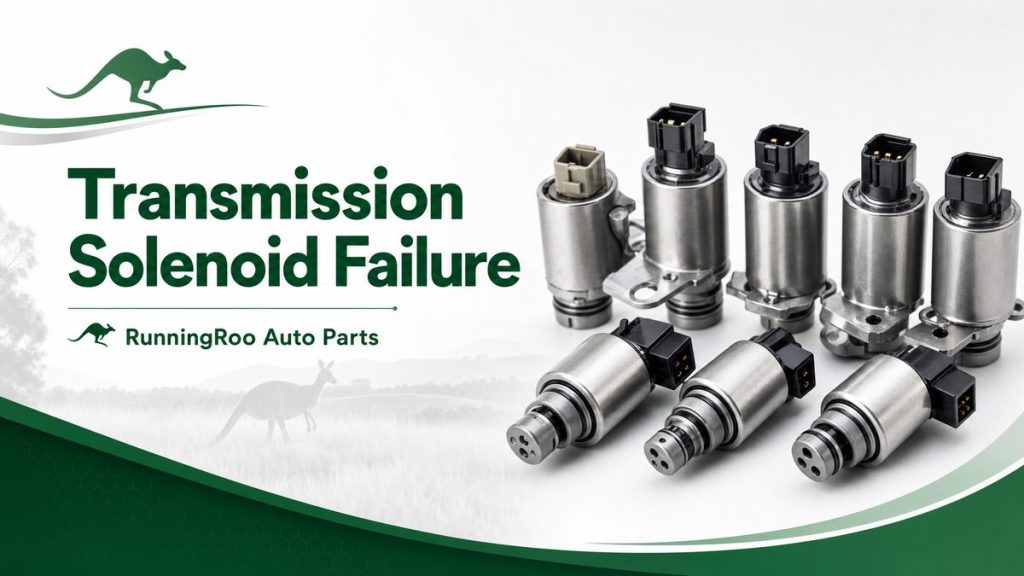
By RunningRoo Auto Parts — written from the desk of our Product Manager
Inside every automatic transmission, a bank of small electro-hydraulic solenoids does the actual work of directing fluid pressure to change gears. When one of these solenoids fails or sticks, the transmission shifts harshly, slips or refuses to engage a gear, and the driver is often told the whole gearbox needs replacing. In many cases, the real fix is a set of solenoids — a fraction of the cost of a rebuilt transmission. This guide explains what transmission solenoids do, how to recognise a failing one and how to approach the repair without paying for a gearbox you do not need.
RunningRoo Auto Parts – Based in Melbourne, Australia 🇦🇺
Free 24/7 Pickup Available (Contact 0425890125)
Any questions? Message or Call us anytime! We’re here to help.
Why Choose RunningRoo?
Aussie Owned & Operated | Fast Shipping | Friendly Support
What transmission solenoids do
Transmission solenoids are electrically controlled valves that regulate hydraulic fluid flow inside the valve body. The transmission control module energises them to open and close fluid passages, which applies and releases clutches and bands to change gear. There are shift solenoids, pressure-control solenoids and torque-converter-clutch solenoids, and they all live inside the transmission, submerged in hot fluid.
Because they are both electrical and hydraulic, solenoids fail in two ways: electrically, when the coil or connector fails, or mechanically, when the valve spool sticks from contamination or wear. Either way, the result is a gear change that happens at the wrong time, too hard, too soft or not at all.
The symptoms of a failing solenoid
The classic symptoms are harsh or delayed shifts, slipping between gears, the transmission staying in one gear or going into limp mode, and a check-engine light with transmission codes. A failing torque-converter solenoid can cause shudder or stalling when coming to a stop. Because these symptoms also occur with low or dirty fluid, a blocked filter or a failing valve body, the first step is always to check the fluid level and condition and to scan the transmission for codes.
| Symptom | Likely cause | First check |
|---|---|---|
| Harsh or delayed shifts | Pressure-control solenoid | Scan codes; check fluid |
| Slipping between gears | Solenoid or worn clutches | Fluid condition; solenoid test |
| Stuck in one gear / limp mode | Shift solenoid or electrical | Scan codes; test solenoids |
| Shudder at stop | Torque-converter solenoid | Test solenoid; check fluid |
Diagnosing the fault correctly
Start with the fluid: low or burnt fluid causes more transmission problems than any single component, and a fluid and filter service fixes a surprising number of shift complaints. Scan the transmission for codes, because the code usually points to the specific solenoid circuit. A multimeter can check each solenoid’s resistance against specification, and a scan tool can often actuate each solenoid individually to confirm it clicks and moves.
If the fluid is good and one solenoid tests out of specification, replacing that solenoid or the solenoid set is the correct repair. If the solenoids all test good but the transmission still shifts badly, the fault is more likely mechanical — a worn valve body or clutch pack — and a deeper diagnosis is needed before parts are ordered.
Choosing a transmission solenoid kit
Transmission solenoids must match the gearbox exactly, so order by transmission code and OE part number rather than by vehicle model. A quality solenoid set is manufactured to the correct resistance and flow specification, while a cheap set can shift harshly, set codes or fail early. Because the solenoid set is replaced with the transmission pan and filter off, it is often sensible to fit a complete set and a fresh filter while you are there.
For the popular Toyota and Lexus transmissions and the VW/Audi dual-clutch units, a complete solenoid kit offers the best value, because replacing one solenoid at a time means paying the labour repeatedly as the others wear in turn.
The repair in practice
Replacing solenoids usually means draining the fluid, removing the transmission pan and filter, unbolting the valve body or the solenoid pack, and fitting the new solenoids with fresh seals. The fluid and filter must be renewed, and the transmission should be refilled to the correct level with the correct specification fluid. On many modern transmissions a scan-tool adaptation or reset is also required so the control module re-learns the shift behaviour.
If you are not confident working inside a transmission, the sensible approach is to buy the quality solenoid kit yourself and have a specialist fit it, which keeps the parts cost down while leaving the labour to a professional.
The types of transmission solenoids
Transmission solenoids are not all the same, and knowing the types helps you understand the fault. Shift solenoids are simple on/off valves that direct fluid to select a gear. Pressure-control solenoids are proportional valves that ramp fluid pressure smoothly, and they are the ones responsible for shift quality. A torque-converter-clutch solenoid locks and unlocks the converter, and its failure shows up as shudder or stalling at a stop.
The failure modes differ too. A shift solenoid that sticks gives a missing or harsh gear, while a pressure-control solenoid that drifts gives slipping or flaring between gears. This is why the exact fault code and the behaviour of the transmission matter more than a generic “solenoid problem”, and why the correct solenoid or kit must match the transmission exactly.
Common transmission fault codes
Transmission codes usually live in the P0700 to P0999 range. P0700 is a general request to read the transmission controller, and the specific solenoid codes that follow — for example P0745 to P0778 for pressure-control solenoids and P0740 to P0744 for the torque-converter clutch — identify the circuit or the solenoid at fault. Reading the transmission controller’s own codes, not just the engine codes, is the key step, because the engine computer often only stores the generic P0700.
Once the specific code is known, a resistance test and an actuation test with a scan tool confirm whether the solenoid is electrically failed or hydraulically stuck. That information decides between a solenoid replacement and a deeper valve-body or clutch problem.
Solenoid vs valve body: knowing when to go deeper
The solenoids sit inside the valve body, and the two wear together. When a solenoid is confirmed electrically failed, replacing that solenoid or the set is the right repair. When the solenoids all test good but the transmission still shifts badly, the fault is more likely to be in the valve body itself — a worn bore, a sticking valve or a failed accumulator — and a deeper inspection is needed before parts are ordered.
The practical rule is to let the diagnosis decide the depth of the repair. A single confirmed solenoid fault is a solenoid job. Widespread shift-quality problems across several gears, with the solenoids testing good and the fluid clean, point to the valve body or the clutches. Knowing the difference prevents both an unnecessary valve-body rebuild and an incomplete solenoid replacement.
For the DIY owner, the solenoid replacement with the pan off is usually achievable with care, while a full valve-body rebuild is best left to a transmission specialist. In both cases, buying a quality kit and having the right filter and fluid on hand keeps the job moving and the cost down.
Transmission fluid service and solenoid life
Transmission solenoids live in the fluid, so the fluid is the biggest factor in how long they last. Old, burnt or contaminated fluid deposits varnish on the valve spools, which is how a perfectly good solenoid becomes a sticking one. A regular fluid and filter service at the manufacturer’s interval is the cheapest way to protect both the solenoids and the clutches from avoidable wear.
When the fluid is due, always use the correct specification — modern transmissions are sensitive to the fluid type, and the wrong fluid can cause harsh shifts and set codes on its own. After any solenoid or fluid work, refill to the correct level using the correct procedure, because an overfilled or underfilled transmission shifts badly and can mimic a solenoid fault.
This is why a fluid service is often the first step in a shift-quality complaint. If fresh fluid and a filter cure the fault, the solenoids were merely sticking from contamination. If the fault remains, the diagnosis moves on to the solenoids and valve body.
Frequently asked questions
What are the symptoms of a bad transmission solenoid?
Harsh or delayed shifts, slipping, a stuck gear, limp mode, and transmission fault codes.
Can I replace just one transmission solenoid?
Yes, but a complete set is often the better value once the pan is off, because the solenoids share the same age and wear.
Will a fluid change fix a bad solenoid?
A fluid and filter change can fix contamination-related sticking, but an electrically failed solenoid must be replaced.
Do I need to reset the transmission after replacing solenoids?
Often yes. Many modern transmissions need a scan-tool reset or adaptation so the control module re-learns the shift behaviour.
How much does a transmission solenoid set cost in Australia?
Far less than a rebuilt transmission. A quality aftermarket set plus a filter is usually a small fraction of a full gearbox rebuild.
What does code P0700 mean?
It is a generic signal that the transmission controller has stored a fault. The specific solenoid or sensor code is read from the transmission controller itself.
What is a pressure-control solenoid?
It is a proportional solenoid that smoothly ramps hydraulic pressure to control shift quality. When it drifts or fails, the transmission slips or flares between gears.
Does the transmission fluid need changing with the solenoids?
Yes. The fluid and filter must be renewed whenever the pan is off, because contaminated fluid is a major cause of solenoid failure and will shorten the life of the new parts.
Can a solenoid problem be fixed without removing the transmission?
Usually yes. The pan and valve body can often be accessed with the transmission in the car, so the solenoids can be replaced without removing the gearbox.
Can a transmission solenoid cause a limp-mode condition?
Yes. When the transmission controller detects a solenoid or shift fault, it often locks the transmission into a single gear as a protection strategy. Reading the transmission codes identifies the faulty circuit.
Shop the parts mentioned in this guide
- 5x U140 / U240E / U241E Transmission Solenoid Kit for Toyota / Lexus Camry ES300
- DQ500 / DL501 / 0B5 Transmission Solenoid 10-Piece Set for Audi A4 / A6 / A7 / Q5 7-Speed
- DQ200 0AM Automatic Transmission Valve Body for VW / Audi / Škoda
- 3x EGR Solenoid Valve Vacuum K5T49090 for Mazda RX-8 / MX-5 / MX-6 / MPV
Watch on RunningRooAuto YouTube
- RunningRoo Auto Parts – trusted Melbourne parts support
- RunningRoo Auto Parts – product and fitment channel
RunningRoo Auto Parts – Based in Melbourne, Australia 🇦🇺
Free 24/7 Pickup Available (Contact 0425890125)
Any questions? Message or Call us anytime! We’re here to help.
Why Choose RunningRoo?
Aussie Owned & Operated | Fast Shipping | Friendly Support
Sources and further reading
- Automatic transmission — Wikipedia
- BorgWarner — transmission control systems
- RACV — car maintenance and repair guidance
- CarsGuide — Australian motoring advice
RunningRoo Auto Parts – Based in Melbourne, Australia 🇦🇺
Free 24/7 Pickup Available (Contact 0425890125)
Any questions? Message or Call us anytime! We’re here to help.
Why Choose RunningRoo?
Aussie Owned & Operated | Fast Shipping | Friendly Support