
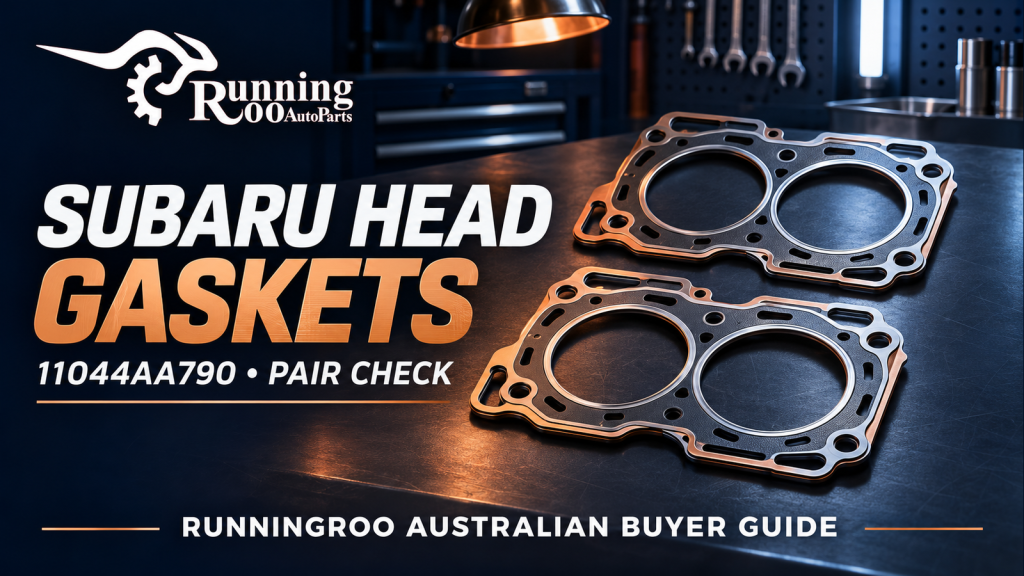
A Subaru head-gasket purchase should begin with the exact engine and repair scope. The model badge and the phrase “left and right” are not enough to confirm a gasket pair. RunningRoo offers a current cylinder-head-gasket listing under reference 11044AA790 with left-and-right wording. For an Australian buyer, the useful next step is to have the VIN, engine code, bank identification and required quantity checked before the workshop proceeds.

This guide focuses on that specific pair listing and the questions that make a head-gasket order reviewable. It does not claim that 11044AA790 fits every Subaru boxer engine, prescribe a universal tightening sequence or diagnose a gasket failure from a single symptom. A qualified technician must establish the cause of the concern and use current manufacturer information for the identified engine. The supplied gasket reference and the condition of the engine need separate confirmation.
Confirm that the enquiry is for the pair listing
The verified RunningRoo website title is “Gasket-Cylinder Head 11044AA790 for Subaru (Left+Right)”, and its matching eBay item is 365265983954. The website also has a separate listing with the same reference but without the pair wording. That difference matters: do not assume that two similarly named pages contain the same quantity or package. Use the exact pair link when discussing this order.
Ask RunningRoo to confirm the number of gaskets supplied and the identification of each item in the package. If the workshop needs a particular bank or a different reference for one side, resolve that before purchase. A seller's left-and-right description should not be expanded into a universal claim that every Subaru engine uses interchangeable gaskets on both banks.
The reviewed pair description does not provide a complete engine application table or a full overhaul-kit contents list. It asks customers to confirm suitability using vehicle information. Follow that instruction rather than inventing a model range from the part number. The supplier should check the actual application, and the technician should specify the repair requirements.
Identify the engine installed in the vehicle
Provide the VIN, model, build details and engine code confirmed by the workshop. If the engine has been replaced, rebuilt or modified, disclose that information. A vehicle's original catalogue record may not fully describe the current assembly. The technician should reconcile the installed engine with the parts request before treating the VIN alone as sufficient.
Where previous repair invoices exist, share the relevant parts information with the workshop. An earlier invoice may help explain a different reference or engine history, but it does not prove that an old installation was correct. Use it as supporting evidence. If the history is unknown, say so plainly rather than selecting a familiar engine name from an internet discussion.
Ask the technician to state the required gasket reference and quantity in writing. This is particularly valuable when the owner is ordering parts separately. A note saying “Subaru head gasket” leaves too much uncertainty for a supplier to resolve. The enquiry should connect the engine identity, required bank or pair, and checked OE reference in one clear request.
Keep diagnosis separate from the parts catalogue
Tell the workshop what the driver observed and when it occurred. Coolant loss, overheating, contamination or other concerns require assessment in context; none should be turned into a confirmed gasket diagnosis by a product page. The technician should explain the findings and why cylinder-head work is recommended before the customer orders a repair package.
If the engine has overheated, include that history even if it appears to run normally afterwards. Do not assume that replacing gaskets alone defines the entire job. The workshop should decide what inspection is required and what the results mean for repairability. This guide does not provide a remote assessment of cylinder heads or the block, nor does it promise that new gaskets can compensate for an unassessed condition.
Where the diagnosis is not yet complete, agree the next inspection stage rather than presenting a final parts list as settled. A staged quotation can identify the initial work and explain when the scope will be confirmed. That allows the owner to make an informed decision after evidence is available, instead of buying a collection of parts based on a suspected cause.
| Question | Written confirmation to obtain | Assumption to avoid |
|---|---|---|
| Which engine? | VIN plus actual engine code and relevant history | Every Subaru boxer has the same gasket |
| Which package? | Exact pair listing and quantity supplied | Similar titles mean identical contents |
| Which bank? | Technician's bank or pair requirement | Left/right wording proves universal interchangeability |
| Which reference? | Application-checked 11044AA790 or confirmed alternative | A familiar number fits every model year |
| What inspection? | Workshop assessment of the relevant components | New gaskets alone define the repair |
| What other parts? | Itemised additional requirements | A gasket pair is a complete overhaul kit |
| How completed? | Manufacturer procedure and workshop handover record | A generic online torque sequence is suitable |
Understand why component condition belongs in the quote
Elring's manufacturer guidance explains that head-gasket designs have requirements for the quality of the mating surfaces. Its installation material calls for careful preparation and inspection and directs installers to follow engine-manufacturer instructions. These are general sealing principles; they do not establish the material, dimensions or fitment of the RunningRoo 11044AA790 pair. Elring: cylinder-head gasket surface requirements, general principles Elring: professional head-gasket installation, general principles; engine instructions prevail
Ask the workshop what component inspection it proposes for this engine and how it will decide whether further work is needed. The customer should receive the findings in understandable terms. Do not prescribe a machining amount, flatness limit or finish value copied from another engine. The correct limits and repair options must come from the appropriate manufacturer information and specialist assessment.
If a machine shop is involved, ask how its findings will be communicated to the installing workshop and owner. The resulting report should identify the relevant components and work performed. This helps keep the final repair traceable. A vague assurance that the heads were “done” is less useful than a record explaining the assessment and the approved work.
Do not turn general gasket guidance into a Subaru recipe
A manufacturer guide can explain why clean surfaces, correct positioning and proper fastening matter. It cannot replace the repair procedure for the engine being worked on. The installer must identify the applicable sequence, fastener requirements and other instructions. This article deliberately does not publish a universal Subaru torque figure or angle sequence because the application has not been established for every reader.
The same caution applies to extra sealing compound. Elring's general head-gasket installation guidance describes fitting the gasket without adding additional sealing compound and refers to engine-manufacturer instructions. Do not interpret that as permission to improvise around a different component or ignore a specific procedure. The technician should use the instructions for the actual gasket and engine. Elring: professional head-gasket installation, general principles; engine instructions prevail
If an owner has found a video or forum repair, share it as a question rather than an instruction to the workshop. Ask whether it applies to the identified engine and gasket. A similar-looking boxer layout does not establish identical specifications. The repair should be based on the correct information, not on the confidence of a presenter working on another application.
Define the additional parts without assuming a full kit
The pair listing should not be described as a complete engine gasket set unless the supplier confirms such contents. Ask what is in the package and have the workshop identify any additional items required by its procedure. Separate gasket quantity from seals, fasteners, fluids and other components. This makes the quotation understandable and prevents a missing item from being discovered midway through the job.
Fastener decisions should follow the correct procedure. Elring explains that head bolts provide the clamping force for the gasket and publishes guidance on replacement. That is useful background for asking the workshop how it has specified the bolts; it is not a Subaru-specific reuse limit or tightening instruction. The technician must make the application-specific decision. Elring: cylinder-head bolts, general clamping guidance
Do not add unrelated parts merely because the engine is being worked on. Equally, do not exclude a required item solely because it is absent from the gasket listing. Ask the workshop to explain each addition by reference to the planned procedure or inspection findings. The result should be a coherent repair scope that the owner can approve, rather than a generic list copied from another vehicle.
Keep left and right identification consistent
Bank terminology can become confusing when photographs are taken from different sides of an engine or when someone describes a part from the front of the vehicle. Have the workshop use the manufacturer's identification convention for the actual engine. The supplier and installer should agree which component is required without relying on an unlabelled image or a casual pointing description.
When a pair is supplied, ask the installer to check both items before assembly. The order confirmation should explain the intended application and quantity. If the physical markings or packaging differ from the expected reference, pause and ask the supplier to clarify. Do not modify openings, coatings or locating features to make a questionable gasket resemble the old one.
The old gaskets may assist the workshop's investigation, but they should not be treated as the only application evidence. Previous work may have introduced an incorrect part. The final check should reconcile the engine, current manufacturer information, supplier confirmation and delivered items. Keep any confirmed reference explanation with the repair file so later questions can be answered accurately.
Plan the repair schedule around inspection results
Head-gasket work may involve findings that cannot be confirmed from the initial parts enquiry. Ask the workshop how it will communicate those findings and obtain approval for a revised scope. A delivery date for the gasket pair is not a promise of a vehicle completion date. The owner should understand the difference between parts availability and the workshop's inspection and repair schedule.
If the car is needed daily, discuss transport and downtime before approving the work. Do not ask the supplier to guarantee the workshop's finish date. RunningRoo can confirm the supply arrangement, while the installer explains the dependencies of the repair. This separation is especially helpful when specialist inspection or additional components may be required.
For interstate orders, provide the correct delivery details and workshop reference after fitment is confirmed. For Melbourne collection, arrange an appointment and confirm the exact pair being collected. Avoid sending someone to pick up “the Subaru gaskets” without an order reference, because the separate single and pair listings can otherwise create an unnecessary misunderstanding.
Ask for a useful completion record
At handover, ask the workshop to summarise the diagnosis, component assessment, parts fitted and checks completed. The record should identify the engine and gasket references and explain any separate recommendations. A line stating only “head gaskets replaced” does not capture the inspection and preparation that may have been central to the repair.
If there are follow-up instructions, have the technician explain them for the actual vehicle. Do not adopt an automatic retightening routine or another owner's post-repair method without manufacturer guidance. The owner should know what to observe and whom to contact if a concern returns, without being expected to perform additional engine work.
Keep the supplier invoice, workshop job sheet and any specialist report together. If a later question arises, those records allow the parties to discuss the same parts and findings. Do not begin by assuming that a recurring symptom proves a defective gasket; the workshop should assess the new observation in context and explain the appropriate next step.
Australian parts support and Melbourne collection
RunningRoo is Australian-operated and based in Blackburn, Victoria. Melbourne local pickup is by appointment, and fast dispatch can be discussed after the correct pair and current stock are confirmed. Friendly support is available on 0425 890 125. Send the VIN, engine code, requested OE reference and the workshop's bank and quantity requirements.
Use the exact website and eBay pair links in this guide. Review the live package description and terms when ordering, particularly if you have also seen the separate single listing. A recorded previous sale helps prioritise this product for a buyer guide, but it is not evidence that the same pair suits every Subaru application.
Frequently asked questions
Does 11044AA790 fit every Subaru engine?
No universal fitment claim is made. The reviewed pair listing does not provide a complete engine application table. Have RunningRoo and the workshop confirm the VIN, installed engine code, required bank or pair and OE reference before ordering, especially where the engine history is uncertain.
Does “Left+Right” mean two identical interchangeable gaskets?
Do not infer that. Ask the supplier to confirm the quantity and identification of each supplied item for your application. The workshop should use the manufacturer's bank identification and check the delivered gaskets before assembly. Pair wording alone does not establish universal interchangeability.
Is this a complete head-gasket repair kit?
The offer discussed here is the cylinder-head-gasket pair listing. Confirm its actual contents and have the workshop specify any additional seals, fasteners or other required items separately. Do not assume a full overhaul package from a photograph or the general phrase head-gasket repair.
Can I use a generic Subaru torque sequence?
No. The technician must use the current procedure for the identified engine and fasteners. This guide intentionally provides no universal tightening values. Instructions for another boxer engine, model year or gasket design should not be transferred without a proper application check.
Does a gasket replacement require component inspection?
Ask the workshop to explain the inspection appropriate to the diagnosed problem and engine. Manufacturer gasket guidance emphasises suitable mating surfaces and correct preparation. The technician should determine the actual condition and repair scope rather than assuming that new gaskets alone resolve every underlying issue.
What should I send RunningRoo before collection?
Send the VIN, installed engine code, workshop-requested reference and required quantity or bank identification. State that your enquiry is for the 11044AA790 left-and-right listing. Call 0425 890 125 to confirm stock and arrange Melbourne pickup by appointment, or discuss dispatch after fitment is checked.
Related reading: Chrysler Dodge EER 2.7 Head Gasket Set Australia: Confirming the Repair Contents. This separate guide covers a different component or search question; it does not establish interchangeability with the product discussed here.
Sources and scope
Product details and availability were checked on 10 November 2026. Retailer listings establish the offer; manufacturer sources below support only the technical points identified in the article. Current vehicle-specific workshop information takes priority over general background.