
Complete Guide to DSG7 Basic Settings, Adaptation and Relearn Procedures in Australia
Introduction
The DQ200 DSG7 transmission is one of Volkswagen Group’s most widely used automatic gearboxes, found in countless Volkswagen, Audi, Skoda and SEAT vehicles throughout Australia.
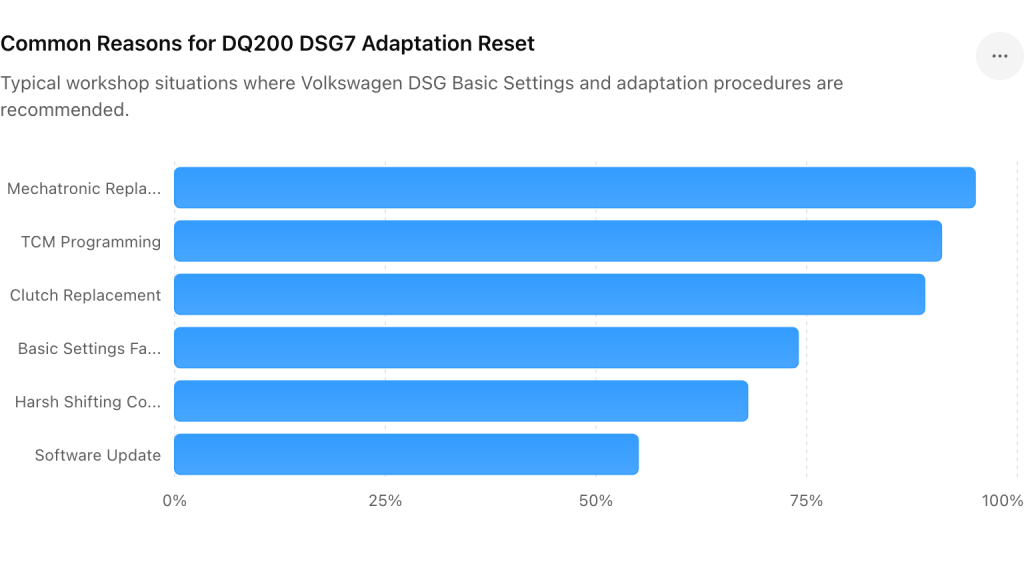
When functioning correctly, the DQ200 provides quick gear changes, excellent fuel efficiency and smooth daily driving performance. However, after clutch replacement, mechatronic repairs, TCM replacement, software updates or certain fault conditions, the gearbox may require a TCM reset and adaptation procedure.
Many Australian vehicle owners search online for phrases such as:
- How to reset DSG7 gearbox?
- Can I reset my DQ200 TCM?
- DSG adaptation procedure after clutch replacement
- Volkswagen gearbox relearn process
The answer is both yes and no.
While the DQ200 transmission can perform a relearn process, Volkswagen does not officially refer to the procedure as a simple “reset.” Instead, factory documentation describes the process as:
- Basic Settings
- Clutch Adaptation
- Gearbox Calibration
- Transmission Relearn Procedure
These procedures are carried out using Volkswagen-approved diagnostic systems and must follow specific operating conditions.
In this guide, we’ll explain what a DQ200 TCM reset actually is, when it should be performed, what tools are required, and how Volkswagen’s official procedures handle transmission adaptation.
What Is a DQ200 TCM Reset?
Many drivers assume that a TCM reset simply clears transmission memory.
In reality, the DQ200 adaptation process is significantly more complex.
The Transmission Control Module continuously learns:
- Clutch wear values
- Engagement points
- Hydraulic pressure characteristics
- Driver behaviour patterns
- Gear selection timing
Over time these learned values become customised to the vehicle’s mechanical condition.
When major transmission components are replaced, the stored values may no longer match the actual hardware.
Volkswagen therefore requires a Basic Settings procedure to erase outdated adaptation values and establish new reference points.
According to Volkswagen DSG Self-Study Program documentation, the Mechatronic Unit must relearn clutch contact points and actuator positions whenever key transmission components are replaced.
When Should a DQ200 TCM Reset Be Performed?
Volkswagen diagnostic procedures commonly require adaptation following:
Mechatronic Unit Replacement
A new or remanufactured mechatronic unit contains different calibration values.
Basic Settings must be completed before normal operation can be restored.
TCM Replacement
A replacement TCM requires:
- Coding
- Parameterisation
- Adaptation
Without these procedures, shifting performance may be severely affected.
Clutch Replacement
When a new clutch pack is installed, the gearbox must learn new clutch engagement points.
Failure to perform adaptation can result in:
- Harsh shifting
- Clutch shudder
- Delayed engagement
- Adaptation fault codes
Software Updates
Some Volkswagen software updates require transmission relearning procedures following installation.
Shift Quality Complaints
Volkswagen technicians may perform adaptation procedures when diagnosing:
- Rough shifts
- Gear hunting
- Low-speed judder
- Hesitation
Official Volkswagen Requirements Before Performing Basic Settings
Volkswagen workshop procedures require specific conditions before adaptation can begin.
These conditions generally include:
No Active Transmission Fault Codes
Stored faults may prevent adaptation from starting.
Faults must be diagnosed and repaired before continuing.
Stable Battery Voltage
Volkswagen workshop documentation recommends maintaining stable system voltage throughout the procedure.
Low voltage is one of the most common reasons for adaptation failure.
Correct Operating Temperature
Transmission and engine temperatures must fall within specified ranges.
Temperature requirements vary by software version and gearbox calibration.
Correct Gear Selector Position
Certain adaptation stages require:
- Park (P)
- Neutral (N)
- Ignition ON
- Engine OFF
while other stages may require the engine running.
Volkswagen’s ODIS software automatically determines the correct sequence for each software version.
Tools Required for a DQ200 TCM Reset
Not all scan tools can successfully perform DSG adaptation.
The most commonly used systems include:
Volkswagen ODIS
ODIS is Volkswagen’s factory diagnostic platform.
It automatically identifies:
- VIN
- Software version
- TCM variant
- Adaptation requirements
ODIS remains the preferred solution for DSG calibration.
VAS Diagnostic Equipment
VAS systems are the official dealer-level tools used within Volkswagen service networks.
VCDS
VCDS can perform many DQ200 adaptation procedures and is widely used by independent specialists.
Professional Aftermarket Diagnostic Tools
Certain advanced tools may provide adaptation functions, although success rates vary depending on software support.
Step-by-Step Volkswagen DSG7 Adaptation Process
The exact sequence varies by software version.
However, Volkswagen’s general workflow follows the structure below.
Step 1 – Scan All Control Modules
Perform a complete vehicle scan.
Identify and record:
- Engine faults
- Transmission faults
- ABS faults
- Communication faults
Any active faults should be addressed first.
Step 2 – Clear Fault Codes
Volkswagen Basic Settings may be blocked if active faults remain stored.
Clear all resolved faults before continuing.
Step 3 – Verify Battery Voltage
Battery voltage should remain stable throughout the procedure.
Many workshops connect a battery support charger before beginning adaptation.
Step 4 – Enter Basic Settings
Using ODIS or a compatible diagnostic tool:
Transmission Control Module → Basic Settings
The software will then initiate:
- Clutch adaptation
- Kiss point learning
- Gear actuator calibration
- Hydraulic system calibration
Step 5 – Allow Initial Calibration to Complete
During this process the transmission may produce:
- Clicking noises
- Actuator sounds
- Hydraulic pump operation
These sounds are generally considered normal while the gearbox calibrates internal components.
Step 6 – Perform Adaptation Drive
Volkswagen adaptation procedures typically require a road test following Basic Settings.
During the drive cycle the TCM learns:
- Clutch pressures
- Engagement timing
- Shift quality characteristics
- Torque transfer behaviour
This stage is often referred to as the relearn process.
Why Adaptation Fails
Many DSG owners become concerned when adaptation cannot complete successfully.
Common causes include:
Low Battery Voltage
The DQ200 is highly sensitive to voltage fluctuations.
Faulty Clutches
Excessively worn clutches may prevent successful calibration.
Hydraulic Pressure Problems
Faults involving:
- P17BF
- P189C
may interrupt adaptation procedures.
Communication Errors
CAN-Bus issues can stop Basic Settings immediately.
Incorrect Procedure Sequence
Some software versions require:
- Ignition ON
- Engine OFF
while others require different operating conditions.
Using the wrong sequence may trigger:
- Conditions Not Met
- Basic Settings Aborted
- Function Cancelled
messages.
Benefits of Performing a Proper TCM Relearn
When completed successfully, drivers often report:
- Smoother gear changes
- Improved take-off performance
- Reduced clutch shudder
- Faster engagement
- Better low-speed drivability
However, adaptation cannot repair mechanical damage.
If the clutch pack, mechatronic unit or hydraulic system is faulty, the underlying issue must still be repaired.
Common DQ200 Fault Codes Related to Adaptation
| Fault Code | Description |
|---|---|
| P17BF | Hydraulic Pump Protection Active |
| P189C | Pressure Build-Up Insufficient |
| U0101 | Lost Communication With TCM |
| P0841 | Hydraulic Pressure Sensor Fault |
| P2711 | Unexpected Mechanical Engagement |
| P072C | Gear Stuck Fault |
These faults should be investigated before attempting a reset procedure.
Frequently Asked Questions
Can I reset a DQ200 DSG without a scan tool?
Not properly.
Volkswagen Basic Settings require diagnostic communication with the Transmission Control Module.
A manual battery disconnect does not perform a complete DSG adaptation reset.
Does disconnecting the battery reset the gearbox?
No.
Some temporary learned behaviour may be lost, but clutch calibration values remain stored within the TCM.
Volkswagen does not recognise battery disconnection as a replacement for Basic Settings.
How long does a DSG adaptation take?
Basic Settings typically take several minutes.
The adaptation drive may require additional driving time before all clutch parameters are fully learned.
Do I need adaptation after replacing a mechatronic unit?
Yes.
Volkswagen service procedures require coding, calibration and adaptation following mechatronic replacement.
Can adaptation fix harsh shifting?
Sometimes.
If the issue is caused by outdated adaptation values, recalibration may improve shift quality.
If mechanical faults are present, repairs will still be required.
Can a failed adaptation damage the transmission?
Repeated failed attempts generally do not damage the gearbox.
However, driving with unresolved clutch or mechatronic faults can eventually lead to further wear.
Final Thoughts
The DQ200 DSG7 transmission does not use a simple reset button. What many owners call a “TCM reset” is actually a structured Volkswagen adaptation procedure involving Basic Settings, clutch calibration, actuator learning and an adaptation drive.
Whether you’ve replaced a mechatronic unit, installed a new clutch, updated software or are experiencing rough shifting, following Volkswagen’s official adaptation process is critical to achieving correct gearbox operation.
For Australian Volkswagen, Audi, Skoda and SEAT owners, professional diagnosis remains the safest approach. Proper coding, calibration and relearning procedures can significantly improve shift quality while helping prevent unnecessary component replacement.
At RunningRoo Auto Parts Australia, we specialise in DQ200 Mechatronic Units, TCM programming support and DSG transmission solutions for customers across Australia.
If you have any questions regarding any DQ200 gearbox-related issues, please feel free to contact us at any time.
We are based in Blackburn South, Melbourne, and provide 24/7 free pickup service (by appointment only) for your convenience.
📞 Phone: 0425 890 125
🛒 eBay Store: https://www.ebay.com.au/itm/365819799559?_skw=dq200&itmmeta=01KTGWC00ZCHGVEPKYYAZ4QXV0&hash=item552c8f2807:g:np8AAeSwNI1pRHw3
At RunningRoo Auto Parts, we are here to help with any DQ200 diagnostics, parts, or technical enquiries—don’t hesitate to reach out.