
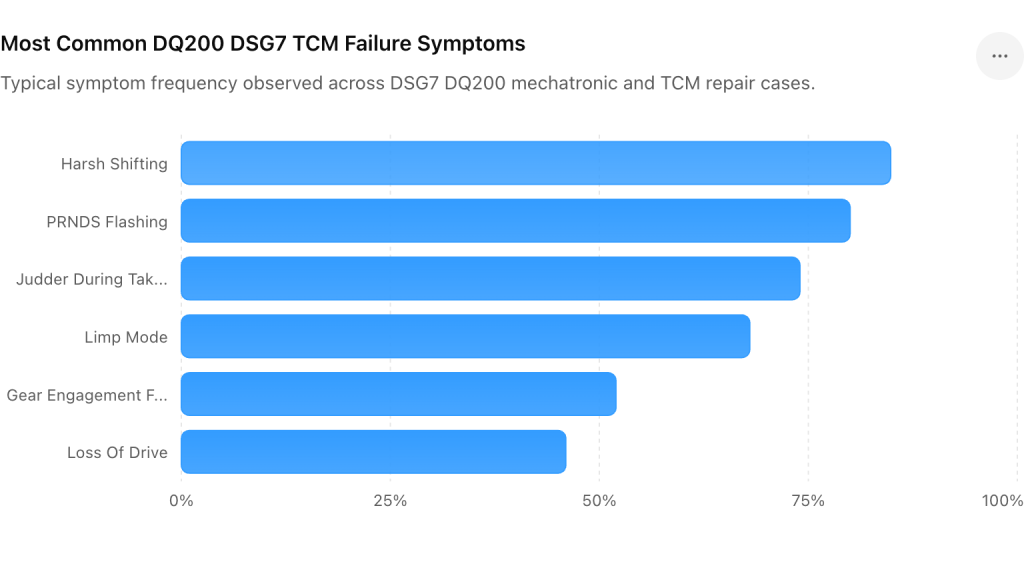
Technical Note: The chart above represents common symptom trends reported by DSG repair specialists and service networks. It is not an official Volkswagen statistical publication.
Complete Guide for Volkswagen, Audi, Skoda and SEAT Owners in Australia
Introduction
The Volkswagen Group’s DQ200 DSG7 transmission is one of the most widely used dual-clutch gearboxes found across Australia. Installed in numerous Volkswagen, Audi, Skoda and SEAT vehicles, the DQ200 offers excellent fuel economy, fast gear changes and improved driving comfort.
However, one component has become well known throughout the automotive industry for causing transmission-related problems: the Mechatronic Unit, which contains the Transmission Control Module (TCM).
Many DSG7 failures begin with subtle symptoms that are often ignored by drivers. Rough shifting, hesitation when selecting gears, flashing PRNDS indicators and intermittent gearbox warnings may appear weeks or even months before a complete transmission failure occurs.
According to Volkswagen service procedures, gearbox warning messages and transmission-related fault codes should always be investigated promptly to prevent further damage to the transmission system.
In this guide, we’ll explain the most common DQ200 TCM failure symptoms, how to identify early warning signs, typical fault codes, and what Volkswagen’s official diagnostic procedures recommend.
What Does the TCM Do in a DSG7 Transmission?
The Transmission Control Module (TCM) acts as the brain of the DSG transmission.
Within the DQ200 gearbox, the TCM is integrated into the Mechatronic Unit and is responsible for:
- Gear selection
- Clutch engagement control
- Hydraulic pressure management
- Shift timing calculations
- Monitoring transmission sensors
- Communication with the Engine Control Unit (ECU)
- Monitoring clutch wear values
Volkswagen’s Self-Study Program documentation describes the Mechatronic Unit as the central control system responsible for coordinating all gearbox operations.
When the TCM develops an internal fault, the gearbox may lose its ability to correctly manage clutch engagement and gear selection.
1. Rough Shifting During Gear Changes
One of the earliest and most common symptoms of a failing DQ200 TCM is harsh or rough gear shifting.
Drivers may experience:
- Sudden jolts during upshifts
- Abrupt downshifts
- Jerking in stop-start traffic
- Delayed gear engagement
- Inconsistent shift quality
The DSG system continuously calculates clutch engagement points based on torque demand, vehicle speed and clutch adaptation values.
If the TCM begins processing incorrect information or loses calibration data, gear changes may become noticeably harsher than normal.
This symptom is frequently reported before more severe gearbox faults occur.
2. Juddering or Shuddering During Take-Off
A faulty Mechatronic Unit often causes vibration when moving away from a standstill.
Common complaints include:
- Vehicle shaking when accelerating from traffic lights
- Shuddering while parking
- Vibration at low speeds
- Intermittent clutch engagement
Although worn clutches can produce similar symptoms, TCM-related pressure regulation faults can also create identical driving characteristics.
Volkswagen diagnostic procedures therefore require clutch adaptation and hydraulic system testing before replacing clutch components.
3. Flashing PRNDS Indicator
A flashing PRNDS display is one of the most recognised warning signs of DSG transmission problems.
The dashboard may show:
PRNDS flashing simultaneously
or
Transmission Fault
Gearbox Malfunction
Workshop!
According to Volkswagen service information, flashing gear indicators generally indicate a fault stored within the transmission control system.
Common causes include:
- Hydraulic pressure faults
- Internal TCM failures
- Sensor malfunctions
- Communication errors
- Solenoid valve faults
A diagnostic scan should be performed immediately.
4. Delayed Gear Engagement
Another common symptom is hesitation when selecting Drive or Reverse.
Drivers may notice:
- Several seconds delay before the vehicle moves
- Gear selection feels slow
- Vehicle revs increase before engagement
- Reverse gear intermittently unavailable
The TCM controls clutch actuation and hydraulic pressure required for gear engagement.
When pressure control becomes unstable, delays often occur.
5. Vehicle Enters Limp Mode
The DSG transmission is programmed to protect itself when serious faults are detected.
This safety strategy is commonly referred to as Limp Mode.
Symptoms include:
- Limited gear availability
- Reduced acceleration
- Gearbox locked in a single gear
- Transmission warning lights
Volkswagen’s diagnostic documentation states that certain fault conditions will trigger emergency operating mode to prevent internal gearbox damage.
6. Loss of Drive While Driving
A severe TCM failure may cause complete loss of drive.
The engine may continue running normally while:
- The vehicle stops moving
- No gears engage
- Transmission warning messages appear
This condition should be treated as a safety concern and diagnosed immediately.
Common DQ200 Fault Codes Associated with TCM Failures
The following fault codes are frequently encountered during DSG7 diagnostics:
| Fault Code | Description |
|---|---|
| P17BF | Hydraulic Pump Protection Active |
| P189C | Pressure Build-Up Insufficient |
| P0841 | Hydraulic Pressure Sensor Fault |
| U0101 | Lost Communication With TCM |
| P072C | Gear Stuck Fault |
| P2711 | Unexpected Mechanical Engagement |
Volkswagen diagnostic procedures require technicians to investigate root causes before replacing components.
Why Do DQ200 TCMs Fail?
Several factors contribute to TCM and Mechatronic Unit failures.
Heat Exposure
Electronic components are exposed to significant operating temperatures throughout the transmission’s life.
Hydraulic Pressure Stress
The accumulator and hydraulic system continuously cycle under pressure.
Over time, wear can affect pressure stability.
Electrical Issues
Low battery voltage is a known contributor to DSG adaptation failures and communication faults.
Volkswagen workshop procedures specify stable battery voltage during diagnostic and adaptation procedures.
Internal Electronic Failure
Age, thermal cycling and component degradation may eventually affect the circuit board within the TCM.
How to Differentiate Between Clutch Failure and TCM Failure
| Symptom | Clutch Issue | TCM Issue |
|---|---|---|
| Juddering | Yes | Yes |
| PRNDS Flashing | Rare | Common |
| Communication Faults | No | Yes |
| Gear Selection Failure | Occasionally | Common |
| Limp Mode | Rare | Common |
| U0101 Fault Code | No | Yes |
Professional diagnostics are required to accurately determine the root cause.
Volkswagen’s Recommended Diagnostic Process
Volkswagen service procedures generally recommend:
- Scan all control modules.
- Check battery voltage.
- Inspect CAN-Bus communication.
- Check transmission fault codes.
- Verify hydraulic pressure operation.
- Perform Basic Settings.
- Verify clutch adaptation values.
- Confirm whether the fault is mechanical, hydraulic or electronic.
Replacing parts without diagnosis often leads to unnecessary repair costs.
Frequently Asked Questions
Can I continue driving if the PRNDS lights are flashing?
It is not recommended.
The transmission may enter limp mode or lose drive unexpectedly.
A diagnostic inspection should be carried out as soon as possible.
Does a faulty TCM mean the entire gearbox must be replaced?
No.
In many cases, the Mechatronic Unit or TCM can be repaired or replaced without replacing the complete transmission.
What is the most common DQ200 transmission problem?
Industry repair data consistently identifies Mechatronic Unit failures as one of the most common issues affecting DQ200 DSG7 transmissions.
What does fault code U0101 mean?
U0101 indicates:
“Lost Communication With Transmission Control Module”
This may be caused by:
- Internal TCM failure
- Wiring issues
- Power supply faults
- CAN-Bus communication problems
Does a replacement TCM require programming?
Yes.
Volkswagen procedures require:
- Software coding
- Basic Settings
- Clutch adaptation
Failure to perform these steps may result in shifting problems or transmission faults.
Final Thoughts
A failing DSG7 TCM rarely fails without warning.
Most drivers experience early symptoms such as rough shifting, juddering, flashing PRNDS indicators, gearbox warning messages or intermittent gear engagement problems before a major breakdown occurs.
Early diagnosis can significantly reduce repair costs and help prevent secondary damage to the clutch assembly or gearbox components.
If your Volkswagen, Audi, Skoda or SEAT is displaying any of these symptoms, professional DSG diagnostics should be performed as soon as possible.
At RunningRoo Auto Parts Australia, we specialise in DQ200 Mechatronic Units, DSG repairs and professional technical support for Volkswagen Group vehicles throughout Australia.
If you have any questions regarding any DQ200 gearbox-related issues, please feel free to contact us at any time.
We are based in Blackburn South, Melbourne, and provide 24/7 free pickup service (by appointment only) for your convenience.
📞 Phone: 0425 890 125
🛒 eBay Store: https://www.ebay.com.au/itm/365819799559?_skw=dq200&itmmeta=01KTGWC00ZCHGVEPKYYAZ4QXV0&hash=item552c8f2807:g:np8AAeSwNI1pRHw3
At RunningRoo Auto Parts, we are here to help with any DQ200 diagnostics, parts, or technical enquiries—don’t hesitate to reach out.