
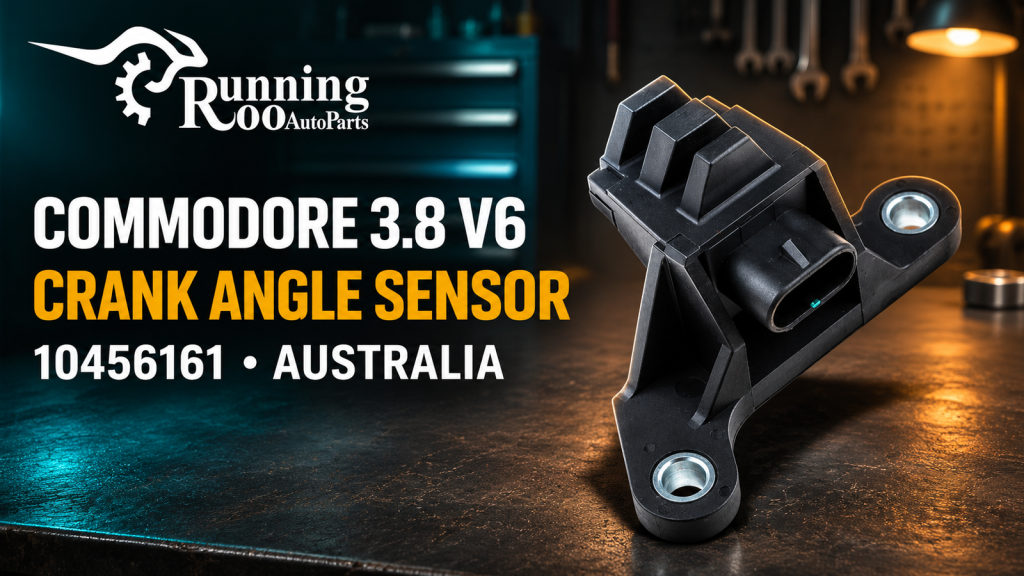
A Commodore crank angle sensor 10456161 in Australia is a specific parts enquiry, not a universal answer to a car that will not start. RunningRoo's listing names 3.8 litre V6 applications across VN, VP, VQ, VR, VS, VT, VU, VX and VY. That gives owners and workshops a real product to consider, but the actual engine, vehicle build and diagnosed requirement must still be matched before ordering.
You can review Commodore crank angle sensor 10456161 Australia at RunningRoo and matching RunningRoo eBay listing for the exact offer. Send the VIN, engine code, build information and OE reference supplied by the repairer, then discuss availability on 0425 890 125. RunningRoo offers friendly Australian-operated support, Melbourne local pickup in Blackburn by appointment and fast dispatch for confirmed available stock. This guide concentrates on the handover from diagnosis to ordering so that a named sensor arrives for a defined job.

Keep the crank sensor separate from the cam sensor
The reference covered here is 10456161, advertised as a crank angle sensor for the listed Commodore 3.8 V6 applications. It should not be confused with the separate 10456162 cam sensor discussed elsewhere on the RunningRoo website. Copy the complete requested number into your enquiry. A one-digit difference matters when it identifies a different product, and the words crank and cam should not be used interchangeably in the order.
Likewise, a Commodore model name does not make this the correct sensor for every engine option or engine conversion. This article is not an LS1 sensor guide. If the engine has been changed, tell the workshop and supplier what is installed now and provide supporting records. A shopping decision based only on the vehicle badge can miss the information that actually determines the required component.
Ask the technician to state the part description and reference together. “Crank angle sensor, requested reference 10456161” is clearer than “position sensor” in a message or handwritten note. If the workshop specifies another number, ask for a compatibility check rather than assuming the linked offer is close enough. Keeping the description precise avoids preventable mistakes between diagnosis, purchasing and receiving the parcel.
What the manufacturer's technical background establishes
HELLA explains that a crankshaft sensor supplies engine control with crankshaft speed and position information. Its troubleshooting guidance considers fault records, wiring, connectors and physical condition, and warns that the sensor type must be identified before selecting a test method. See HELLA: crankshaft sensor function and diagnosis. That is general technical context; it does not provide a validated Commodore 10456161 test value, pinout or installation specification.
The buying implication is that an engine symptom or code should lead to a diagnosis, not an automatic replacement order. Ask the repairer what evidence supports the sensor recommendation and whether another part of the relevant circuit requires attention. This is not an invitation to perform electrical tests yourself. The technician should choose the appropriate equipment and vehicle-specific procedure for the actual sensor and engine.
Do not infer the sensor design solely from the number of visible connector terminals or a retail photograph. This guide deliberately does not prescribe a resistance value or a universal bench test. If you are buying a sensor for a workshop, the useful information is its confirmed parts request, not an improvised test result. A clear request is easier for the supplier to assess and safer for the component.
Make the fault history useful without guessing the cause
Write down what the driver experienced and when. Distinguish a starting complaint from an engine stopping after it had been running, and record whether the issue is repeatable or intermittent. Include recent repair history and any diagnostic report already obtained. The workshop can decide which observations matter; the owner does not need to turn them into a technical conclusion before booking the assessment.
If there is a stored code, provide the actual report rather than an abbreviated description from memory. Ask the technician to explain how that report relates to the recommended work. A code description and a confirmed faulty part are different pieces of information. This article does not assign a particular code to every listed Commodore or claim that one code proves 10456161 must be replaced.
If earlier parts were replaced without resolving the concern, supply those invoices too. They help establish what has already been done and which references were used. Do not assume that a recently purchased component must be correct simply because it was new, or that another identical purchase will complete the diagnosis. The next step should follow the workshop's assessment of the unresolved problem.
Build the vehicle and engine identification record
Provide the full VIN, build information and confirmed engine code. Include the model series, but do not rely on it as the only identifier. The listed VN-to-VY family spans a substantial range of vehicles, and the exact requirement should come from the appropriate parts and service information. A registration description can be useful context without being the final authority for an engine-related component.
If an engine, wiring arrangement or associated hardware has been changed, disclose that history before asking for fitment confirmation. Give the supplier the details the workshop has verified, not a guess based on the car's original badge. The distinction is especially important for older vehicles with incomplete records. An honest statement that the engine history is uncertain is better than an invented code or assumed original specification.
A clear photograph of the old reference can support the enquiry when obtained by the technician during safe access. Ask for the complete marking rather than a cropped image that leaves out a suffix. If it cannot be read, say so and use the VIN and workshop request to identify what further information is needed. The absence of a label is a question to resolve, not a reason to select by appearance alone.
| Handover item | Useful evidence | What it prevents |
|---|---|---|
| Component identity | Crank angle sensor plus the complete requested number | Confusion with the 10456162 cam sensor or unrelated engine sensors |
| Vehicle record | VIN, build details, model series and engine code | Ordering solely from a broad Commodore badge |
| Diagnosis | Workshop findings and relevant diagnostic report | Treating a starting or stalling complaint as proof of one failed part |
| Repair history | Previous invoices and engine-change details | Repeating an uncertain earlier parts selection |
| Supply agreement | Exact offer, contents and stock confirmation | Receiving an item that does not match the workshop's request |
Check the supplied item against the job
The linked offer identifies the sensor, but the title does not establish every additional item the repair may need. Ask the workshop whether its quote requires separate hardware or other components and have those identified individually. Do not assume a sensor listing includes an entire repair kit. The retail package and the complete job scope should be compared before the order is finalised.
Use the real product photograph to ask questions about the supplied form, not to invent electrical specifications. If a mounting feature or connector appears different from the workshop's expectation, send the evidence to RunningRoo and ask for clarification. A visible discrepancy should be resolved before installation. Do not modify the connector or mounting arrangement to compensate for an unconfirmed application.
Keep the item and order identity together when the parcel arrives. The receiving workshop should have the reference, listing link and any fitment correspondence. If the goods appear inconsistent with the agreed description, pause the installation and contact the supplier with clear photographs and the order number. This is easier to resolve before packaging is discarded or the part is mixed with unrelated items.
Installation and final checks belong in the workshop plan
The installer should follow the applicable Holden service information for the actual engine and component. This guide does not specify a universal sensor clearance, mounting torque, access sequence or relearn requirement. Ask the repairer to establish those details from the correct procedure rather than apply an instruction copied from a different Commodore engine or an unrelated online demonstration.
When reviewing the quote, ask whether it covers the original diagnostic concern and the required completion checks. A parts invoice alone does not explain what was tested or what remains unresolved. The workshop should distinguish the confirmed repair from any additional findings. That helps the owner understand the outcome without being expected to interpret specialist signals or compare measurements with an online chart.
At handover, retain the installed reference and ask for any follow-up advice in writing. If the original complaint was intermittent, discuss how the workshop assessed the result and what information it needs if the concern returns. This does not imply that a successful repair is uncertain by default; it simply creates a useful record of the work and the conditions relevant to the original complaint.
Three common purchasing situations
A workshop has diagnosed the fault and requested 10456161: send its request to RunningRoo, confirm the application and current stock, and coordinate supply. In this situation the buyer can focus on obtaining the agreed component rather than conducting a new diagnosis through search results. Keep the written confirmation with the invoice so the receiving technician can see exactly what was ordered.
An owner has a no-start complaint and no report: arrange diagnosis first. The product can remain a candidate, but purchasing it immediately would be speculative. Ask the technician to identify the required work and the appropriate reference. The fact that the listing names the model does not prove that the sensor is the reason the car will not start on that particular occasion.
A car has an engine conversion or uncertain history: provide the verified details of the installed engine and the workshop's recommendation. The original model series is still useful context, but it may not settle the sensor requirement. Do not present an unknown configuration as standard when asking for a guarantee. Clear information gives the supplier a fair opportunity to assess the proposed product.
Compare exact links and plan Australian supply
Open Commodore crank angle sensor 10456161 Australia at RunningRoo and matching RunningRoo eBay listing to compare the current offer. Confirm the complete reference, package description and stock position. If a detail matters to the workshop and is not written on the page, ask before paying. Avoid replacing this selection with a different sensor simply because a marketplace search suggests it nearby or because another listing repeats some of the same model names.
The matching active listing had historical sales at the preparation check, and the website showed stock. Those checks establish that this is a real product rather than an invented recommendation. They do not reserve a unit or establish compatibility with every vehicle. Ask about current availability when the order is ready, especially if the car is already occupying workshop space awaiting the part.
Melbourne buyers can arrange Blackburn pickup by appointment through 0425 890 125. Confirm the order is ready and agree on collection details before travelling or sending someone else. Local support can reduce coordination difficulties, but pickup should not be confused with an installation or diagnostic service. The workshop and supplier should each have the same exact part identity and timing information.
For delivery elsewhere in Australia, provide the postcode and required date. Ask about fast dispatch for confirmed stock and leave room for transit and receiving checks. The promise of prompt dispatch is not a guarantee that every destination will receive the parcel on the same day. Friendly Australian-operated support is most useful when the enquiry combines fitment information with a realistic repair schedule.
Frequently asked questions
Is 10456161 a camshaft sensor?
The offer discussed here is advertised as a crank angle sensor. Do not confuse it with the separate 10456162 cam sensor reference. Ask the workshop to write both the component name and complete number on the parts request. That simple step helps keep the correct item identifiable throughout ordering, delivery and installation.
Does it fit every Commodore from VN to VY?
No universal fitment guarantee is made here. The listing names 3.8 V6 applications across those series, but the actual vehicle, engine code, build and OE requirement must be confirmed. Disclose engine replacements or modifications, and do not assume that another engine option uses the same sensor because the body carries a Commodore badge.
Will it fix a no-start or intermittent stalling problem?
Only diagnosis can establish whether this component is required. The symptom history is useful to the workshop, but it is not proof of a failed sensor. Ask for the findings and the correct parts request before ordering. This guide does not promise that one replacement resolves every starting or running complaint.
Can I check it with a generic resistance test?
Do not apply an unverified test method. The sensor design and vehicle-specific instructions must be established by the technician. HELLA's general guidance cautions against choosing a test without identifying the type. This article supplies no resistance target, pinout or bench-test procedure for 10456161; obtain professional diagnosis using the applicable service information.
Are installation hardware and other parts included?
The title identifies the sensor, not a complete repair package. Ask RunningRoo for current contents and have the workshop identify any separate requirements. Do not infer additional hardware from an editorial cover or assume that every part required to access and complete the repair is included in the sensor price.
Can I collect in Melbourne or order for another state?
Review Commodore crank angle sensor 10456161 Australia at RunningRoo and matching RunningRoo eBay listing, or call 0425 890 125. Ask about current stock, Blackburn pickup by appointment and fast dispatch to your Australian postcode. Supply the VIN, engine code and workshop-requested OE reference with the enquiry. Confirm the package and timing before booking labour around the expected arrival.
Related guide with a different scope
Crankshaft Position Sensor Failure: Symptoms, Codes and Replacement Guide. This covers a different component, engine or background topic. It is not an interchange claim. The specific buying decision in this article remains tied to its named product and verified vehicle requirement.
Sources and evidence boundaries
HELLA: crankshaft sensor function and diagnosis. Manufacturer information supports only the limited context described above. Retail contents and application leads come from the linked seller offers and are not independent OEM certification. Use the applicable complete service information for the actual vehicle and repair.
Review the RunningRoo product and the corresponding eBay offer, or call 0425 890 125. Contact RunningRoo with VIN, engine code and OE details for friendly Australian-operated support. Ask about Melbourne local pickup in Blackburn by appointment and fast dispatch for confirmed available stock; confirm item-specific fulfilment before booking labour.