
By RunningRoo Auto Parts — written from the desk of our Product Manager
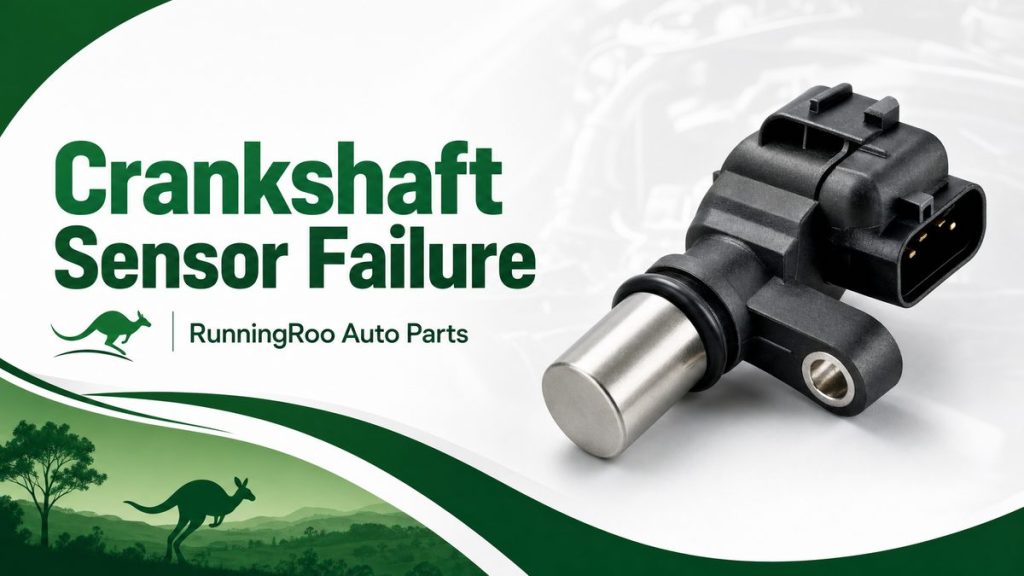
The crankshaft position sensor is the engine’s primary timing reference — it tells the computer exactly where the crankshaft is so the fuel and ignition can be timed to each cylinder. When this sensor fails, the engine usually stops running, often with no warning. It is a small, inexpensive part that is usually accessible, which makes it one of the most satisfying DIY repairs — provided you confirm it is the sensor and not the wiring or a related component. This guide explains what the sensor does, how to recognise a failure and how to replace it correctly.
RunningRoo Auto Parts – Based in Melbourne, Australia 🇦🇺
📞 Free 24/7 Pickup Available (Contact 0425890125)
💬 Any questions? Message or Call us anytime! We’re here to help.Why Choose RunningRoo?
✅ Aussie Owned & Operated | 🚚 Fast Shipping | 🤝 Friendly Support
What the crankshaft position sensor does
The crankshaft position sensor is a Hall-effect or magnetic sensor mounted near the crankshaft pulley or flywheel. It detects the passing teeth of a reluctor ring and sends a signal to the engine computer, which uses it to fire the injectors and ignition at exactly the right moment. The camshaft position sensor works alongside it to identify which stroke each cylinder is on.
Because the crankshaft sensor is the primary timing reference, a failed sensor usually prevents the engine from running at all. It works in a hot, oily, vibrating environment, so its internal electronics and wiring degrade over time, and the failure is often sudden and complete.
The symptoms of a failing crankshaft sensor
The most common symptom is an engine that cranks but will not start, or that stalls suddenly while driving and refuses to restart. A failing sensor can also cause intermittent stalling, rough running and a check-engine light with codes such as P0335 or P0336. In some cases the fault is intermittent and only appears when the engine is hot.
| Symptom | Likely cause | First check |
|---|---|---|
| Cranks, no start | Crank sensor or fuel/spark | Scan codes; test the sensor |
| Sudden stalling | Crank sensor | Test sensor signal |
| P0335 / P0336 code | Crank sensor circuit | Ohm/scope test; check wiring |
| Intermittent faults when hot | Sensor breaking down | Test the sensor warm |
How to test a crankshaft position sensor
Start with a full scan to capture the exact code, then inspect the sensor’s connector and wiring for corrosion, chafing or a loose pin. A multimeter can check the sensor’s power, ground and signal, and on a magnetic sensor the winding resistance can be measured against specification. The most reliable test is an oscilloscope, which shows whether the sensor produces a clean waveform while the engine is cranked.
If the wiring is sound and the sensor signal is missing or erratic, the sensor is the likely culprit. Replace it and re-test before condemning anything more expensive, because a crank sensor fault is often misdiagnosed as a fuel or ignition problem.
Replacing the sensor correctly
Most crankshaft sensors are held by a single bolt and are accessible from the top or bottom of the engine. Disconnect the battery, unplug the connector, remove the old sensor, and fit the new one with its O-ring or seal. Check that the connector is clean and clicks home, clear the fault codes, and confirm the engine starts and runs normally.
The most common mistakes are damaging the wiring when unplugging a brittle connector, leaving the O-ring off, and failing to check the wiring before replacing the part. If the new sensor does not cure the fault, stop and investigate the circuit rather than replacing further parts.
Hall-effect vs magnetic sensors
Crankshaft position sensors come in two main types. A magnetic sensor generates its own voltage as the reluctor teeth pass, and it can be tested by measuring its winding resistance and its output while cranking. A Hall-effect sensor is powered by the engine computer and switches its output as the teeth pass, so it needs a power and ground supply to test.
Knowing the type matters for diagnosis, because a Hall-effect sensor that has no output may simply be missing its power supply, while a magnetic sensor with no output is more likely faulty. The fault code and the wiring check tell you which situation you are dealing with.
Crankshaft vs camshaft sensors
The crankshaft and camshaft sensors work as a pair, and both can cause a no-start. The crankshaft sensor is the primary timing reference, so a failed crank sensor usually stops the engine completely. The camshaft sensor identifies which stroke each cylinder is on, so a cam sensor fault often allows running but causes rough running, stalling or a no-start on some vehicles.
Because the engine computer compares the two signals, a fault in either can set a timing-correlation code that is sometimes mistaken for a mechanical timing problem. Checking both sensor signals is the reliable way to separate an electrical fault from a timing problem.
The most common crank sensor fault codes
The P0335 to P0339 range covers the crankshaft position sensor circuits. P0335 is a general circuit malfunction, while P0336 indicates an erratic or intermittent signal. On many engines the code is accompanied by a no-start, and the fault is confirmed by testing the sensor signal with a multimeter or scope.
As with all sensor faults, check the wiring and connector before replacing the part, because a corroded connector produces exactly the same symptoms as a failed sensor and costs nothing to fix.
Frequently asked questions
What are the symptoms of a bad crankshaft position sensor?
An engine that cranks but will not start, sudden stalling, and codes such as P0335 or P0336.
Can a bad crankshaft sensor cause a no-start?
Yes. Without a valid crankshaft signal, the engine computer will not fire the injectors or ignition.
Is the crankshaft sensor the same as the camshaft sensor?
No. They measure the crankshaft and camshaft respectively, and the computer uses both. A fault in either can stop the engine.
Can a crankshaft sensor fault be intermittent?
Yes. Heat-related failures can cause the engine to stall when hot and restart when cool.
How much does a crankshaft sensor cost in Australia?
A quality aftermarket sensor is inexpensive and usually quick to fit. Always confirm fitment by engine code.
Can a bad crankshaft sensor drain the battery?
Not usually, but a shorted sensor circuit can draw current. The main symptom of a failed crank sensor is a no-start or stalling.
How long does a crankshaft position sensor last?
There is no fixed interval. It normally lasts for many years, but heat, oil and vibration eventually wear it out, so it is replaced when it fails.
Key takeaways
The crankshaft position sensor is the engine’s primary timing reference, and its failure usually means a no-start or sudden stalling. Confirming the sensor signal with a scan and a multimeter or scope before replacing the part prevents the common mistake of swapping the sensor when the real fault is fuel, ignition or wiring.
Matching the sensor by engine code and fitting it with its seal, then clearing the codes and confirming the engine runs, is a quick and reliable repair for one of the most common no-start causes on Australian roads.
How to confirm the right crank sensor
Crankshaft position sensors differ between engines by their type, connector and reluctor-ring spacing, so confirm fitment by engine code and OE part number rather than by vehicle model alone. A sensor with the wrong air gap or connector will not produce a clean signal, and the engine will not start or run correctly.
Send the engine code, VIN and, if visible, the original part number to the supplier before ordering. Confirm whether the new sensor includes its O-ring or seal, because a missing seal lets oil and dirt reach the sensor and shortens its life.
Step-by-step crank sensor replacement
Locate the sensor near the crankshaft pulley or flywheel, then disconnect the battery and unplug the sensor connector carefully, as the plastic can be brittle. Remove the retaining bolt, withdraw the old sensor, and compare it with the new one before fitting. Fit the new sensor with its O-ring or seal and torque the bolt to the correct value.
Reconnect the battery, clear the fault codes and start the engine to confirm it runs. If the same code returns immediately, the wiring, the reluctor ring or the engine’s mechanical timing needs investigation rather than another sensor.
When it is not the sensor
A no-start is not always the crankshaft sensor. Fuel pressure, the fuel pump, the ignition system and the engine computer’s power and grounds can all cause the same symptom. Before replacing the sensor, confirm the sensor signal is actually missing or erratic, and rule out the simple causes such as a blown fuse or a corroded connector.
If the sensor signal is present and clean but the engine still will not start, the fault is elsewhere, and a proper diagnosis is cheaper than replacing parts on a guess. This is why the scope or multimeter test is worth doing before ordering the part.
Can a crankshaft sensor cause a misfire?
Yes. A weak or erratic crank signal can cause misfires and rough running, although a hard no-start is the more common symptom.
Should I replace the camshaft sensor at the same time?
Not necessarily, but if both share the same age and the engine is already being diagnosed, replacing both can save a second labour charge later.
Will a crank sensor fault always set a code?
Usually, but an intermittent sensor can stall the engine before a code is stored, which is why a signal test matters.
Is a crankshaft sensor a DIY job?
Usually yes, as it is held by a single bolt and accessible from the top or bottom of the engine. The key is confirming the diagnosis and checking the wiring first.
Can a crankshaft sensor be cleaned to fix it?
Sometimes a metal-filled sensor tip can be cleaned and restored, but if the internal electronics have failed, cleaning will not help and the sensor must be replaced.
How much is a crank sensor replacement?
The sensor is inexpensive, and the job is usually under an hour, so it is one of the best-value repairs for a no-start fault.
Shop the parts mentioned in this guide
- Crankshaft Position Sensor 23731-EC01A for Nissan Pathfinder R51 / Navara D40 2.5L
- Camshaft Position Sensor 10456162 for Holden Commodore V6 3.8L VR–VY
- Camshaft Position Sensor for Holden Commodore VZ / VE / VF Gen4 6.0–6.2L V8 12591720
- Throttle Position Sensor for Holden Jackaroo / Rodeo 08-22620-4P202
Watch on RunningRooAuto YouTube
- RunningRoo Auto Parts – trusted Melbourne parts support
- RunningRoo Auto Parts – product and fitment channel
RunningRoo Auto Parts – Based in Melbourne, Australia 🇦🇺
📞 Free 24/7 Pickup Available (Contact 0425890125)
💬 Any questions? Message or Call us anytime! We’re here to help.Why Choose RunningRoo?
✅ Aussie Owned & Operated | 🚚 Fast Shipping | 🤝 Friendly Support
Sources and further reading
- Crankshaft position sensor — Wikipedia
- Bosch — engine management and sensors
- RACV — car maintenance and repair guidance
- CarsGuide — Australian motoring advice
RunningRoo Auto Parts – Based in Melbourne, Australia 🇦🇺
📞 Free 24/7 Pickup Available (Contact 0425890125)
💬 Any questions? Message or Call us anytime! We’re here to help.Why Choose RunningRoo?
✅ Aussie Owned & Operated | 🚚 Fast Shipping | 🤝 Friendly Support