
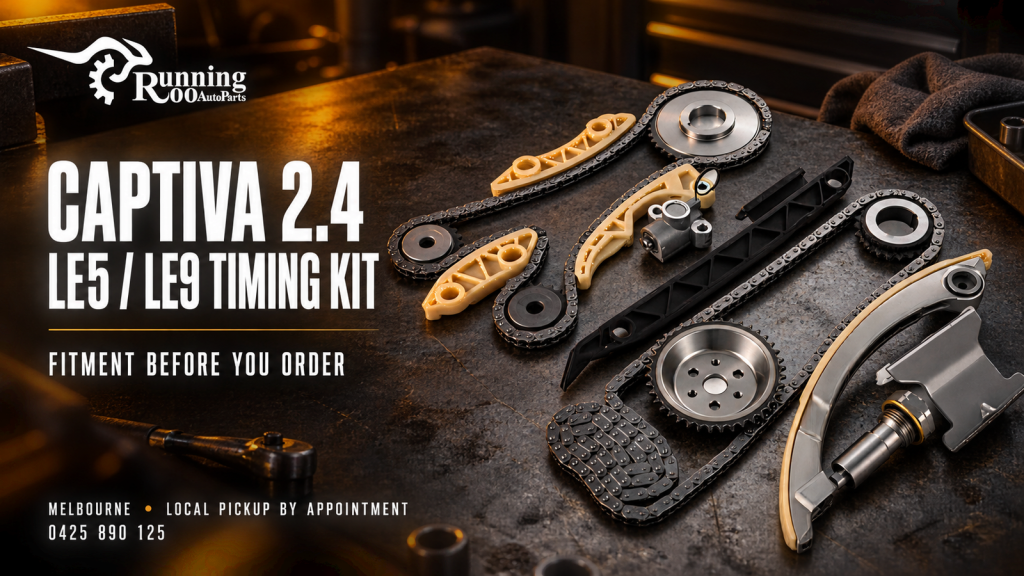
Choose a Captiva 2.4 timing kit by engine identification
A Holden Captiva LE5/LE9 timing chain kit order should begin with the engine code and VIN, especially when online titles contain inconsistent dates. The selected RunningRoo listing is a genuine product offered for Captiva CG 2.4 applications, but its title includes “2001-” while the description refers to later LE5 and LE9 applications. This guide does not turn that title into a fitment promise. It explains what to establish before you spend money or commit a workshop booking.
You can review the RunningRoo Captiva timing chain product and its corresponding active eBay item. Send both the vehicle details and the exact item reference when asking for help. RunningRoo is Australian-operated, offers friendly support, and can discuss fast dispatch or Melbourne local pickup by appointment. Call 0425 890 125 before ordering if the build date or engine identifier is uncertain.
Why the Captiva badge does not settle the order
A vehicle name is useful for starting a catalogue search, but the timing repair concerns the engine installed in that individual vehicle. Do not assume a Captiva article about a V6 engine applies to a 2.4-litre four-cylinder. Likewise, do not assume every overseas Chevrolet Captiva reference describes the Australian Holden build in front of your workshop. Market, engine designation and production information need to be considered together.
Ask the mechanic to identify the engine and record the VIN, build month and any relevant OE numbers. If the vehicle has had an engine replacement, disclose that before the supplier confirms compatibility. The most helpful enquiry identifies both the original vehicle and the currently installed assembly. A clear photograph of an existing part label can support the process, but it should be taken only where the label is safely accessible or the workshop has already removed the component.
Registration year and build date are not interchangeable pieces of information. A car can be registered after it was manufactured, and a catalogue may use a production boundary rather than the registration date. When an advertisement contains an apparent date error, request written clarification. An owner should not have to guess which of two conflicting date statements the seller intended to use.
Read the package as an itemised supply list
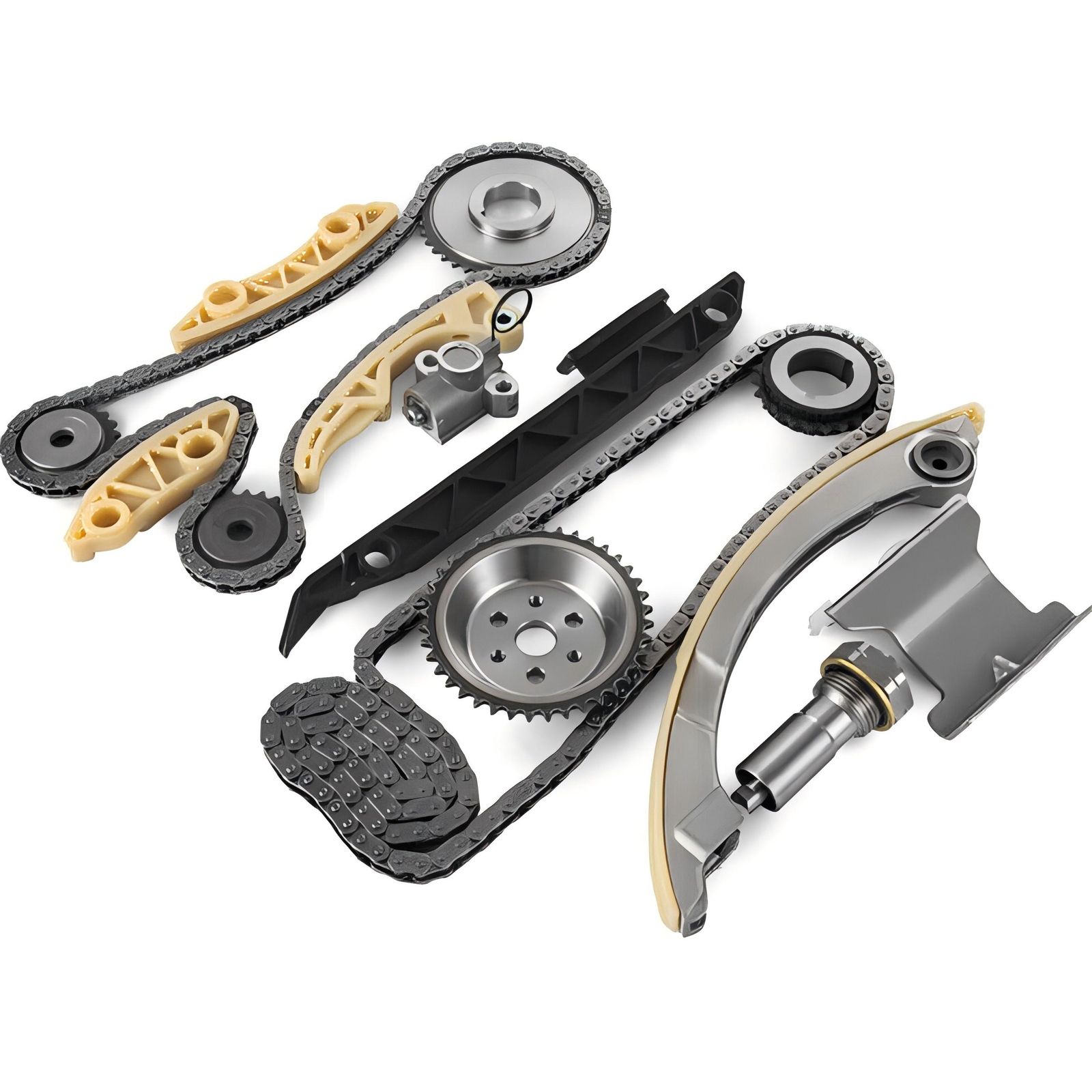
The selected product description lists two chains, two tensioners, multiple guides and several gears. Its wording should be checked against the actual package and your workshop’s required parts list before payment. Do not assume every item called a gear is a variable camshaft adjustment assembly. The installer and supplier should agree exactly which components the order supplies, including their positions and references where relevant. Open the selected package.
| Point requiring confirmation | What to send or ask | What not to assume |
|---|---|---|
| Engine variant | VIN and confirmed LE5 or LE9 code | All Captiva 2.4 builds are identical |
| Production date | Build month and catalogue check | The title’s date is a universal range |
| Chain contents | Itemised list of both chains | A photograph defines every included item |
| Tensioners and guides | Quantities and applicable references | Similar-looking parts are interchangeable |
| Camshaft gears | Exact type and supply scope | Every sprocket is a VVT actuator |
| Other materials | Workshop consumables list | A kit contains everything for the job |
Photographs are helpful for recognising the general package, but an image is not a dimensional drawing. A component can look familiar and still be wrong for a particular application. Have the workshop compare the supplier’s confirmed references with the vehicle information. If clarification changes the proposed package, request a fresh quote so the final checkout matches the final decision.
What GM’s technical bulletin actually says
GM bulletin PIP3535C describes an abnormal whine associated with an overtight balance-shaft chain after a tensioner has ratcheted out. It notes that this can occur during certain service work and directs technicians to the applicable service procedure. Its model table includes LE5/LE9 applications, but the Chevrolet Captiva entry lists different engine codes. The bulletin is therefore technical context, not proof that it directly covers your Australian Holden. Read GM PIP3535C.
The practical lesson is to diagnose the noise and verify bulletin applicability before ordering parts. A noise after previous engine work should not automatically be described as a worn main timing chain. Give the mechanic the history of that work and ask whether the applicable inspection supports the proposed repair. Current Holden/GM service information for the VIN must control the installation and any tensioner procedure.
Separate a new noise from a long-standing complaint
The most useful owner contribution is a reliable timeline. Write down when the sound began, whether it was present before recent work and whether it occurs from cold, when warm or throughout a journey. Include invoices for any related engine or cooling-system work. Avoid trying to reproduce the sound repeatedly if the vehicle is behaving abnormally; explain the circumstances and let the workshop decide how to inspect it.
Ask the mechanic to record the complaint separately from the diagnosis. If the estimate says “timing kit”, request a short explanation of the evidence supporting that recommendation. You do not need to become a technician to ask a reasonable question about the proposed scope. A good answer should distinguish confirmed findings from items that will be inspected once access is available.
This distinction matters for repair approval. You might approve the initial access and inspection, with a separate call required before additional gears or other components are ordered. Alternatively, the diagnosis may already justify a defined package. Either arrangement can work when the scope is written clearly. Problems arise when a provisional suggestion becomes an assumed authorisation for every part shown in an online bundle.
Plan the complete job without guessing the contents
Ask the installer to make two lists: parts supplied in the confirmed kit, and additional materials needed under the applicable procedure. The second list may contain sealing items, fluids or fasteners. Their inclusion should come from the repair requirements for your engine, not a generic internet checklist. A supplier can quote the advertised package while the workshop remains responsible for identifying the complete installation requirement.
Consider how the vehicle will be handled if inspection reveals a different problem. Agree on a communication point, a spending limit for additional work and who will order any extra components. This is particularly useful for a family vehicle that cannot remain off the road indefinitely. A practical plan makes the time estimate more honest and gives both owner and workshop a shared reference.
Do not ask the mechanic to reuse a component solely to fit an initial budget, or replace it solely because the engine has high kilometres. Ask for the condition assessment and the reason for the recommendation. That conversation allows you to consider cost against the actual finding. It also gives RunningRoo a clearer parts enquiry than a request for “everything for a Captiva chain”.
Compare Captiva repair quotations fairly
A quotation with a lower total may include fewer parts, a different diagnostic allowance or no provision for additional materials. A higher total may contain separately justified work. Put the proposals side by side and compare the actual inclusions. Ask which items are confirmed, which are conditional and whether freight is included. Keep the kit price separate from the workshop’s labour so each supplier’s responsibility is clear.
For the purchase itself, use the exact RunningRoo eBay item or the direct website product. Retain the fitment reply and order confirmation together. If the listing title still contains a date discrepancy, the written confirmation should specify your vehicle and the chosen package. Do not rely on an assumption that a broad title has silently resolved the question.
Avoid importing overseas repair prices into an Australian estimate. They may represent a different engine, different parts, another currency or a warranty labour allowance rather than retail workshop work. Ask your local installer for an itemised quote based on inspection. RunningRoo can provide the current parts quotation and delivery options, while the workshop can explain labour and any additional work required.
Coordinate dispatch with the workshop’s calendar
Fast dispatch is useful when the vehicle identification and order scope are already settled. Tell RunningRoo the delivery postcode and the date the installer hopes to receive the package. Ask for the current dispatch estimate and available shipping services, then pass that information to the workshop. Dispatch time and carrier delivery time are separate parts of the schedule, so leave the appointment provisional until the arrangement is clear.
For Melbourne owners, local pickup can simplify the handover. Collection in Blackburn, VIC requires an appointment and confirmation that the order is ready. If a workshop employee or another person will collect, provide the order reference and agree on the collection details first. Phone 0425 890 125 for friendly support instead of sending a driver on the basis of an unconfirmed website enquiry.
Inspect the delivery before fitting
Check the invoice, labels and component list when the order arrives. If the workshop sees a mismatch, pause before installation and contact the supplier with photographs and the order reference. Keep the packaging until the issue is resolved. An early check is more useful than discovering that an unverified component has already been fitted or altered to resemble the old part.
At handover, ask for a record of the work completed and whether the original noise or other complaint was rechecked. Save the workshop invoice with the product confirmation. This gives the next technician a clear history and helps distinguish a completed chain repair from any separate concern that remains under investigation.
Resolve the listing date with a written fitment question
A useful Captiva enquiry should explicitly mention the conflicting date wording instead of hoping the supplier overlooks it. State the vehicle’s build month and year, the full VIN and the workshop-confirmed engine code, then ask whether the selected item is appropriate for that vehicle. This gives RunningRoo the opportunity to answer the real compatibility question without relying on the ambiguous title.
Keep the reply with the order. If the supplier recommends a different product, ask for its exact link and confirmed contents, and have the installer review the change. Do not copy the original fitment approval onto a different package merely because both titles mention Captiva. The approval should apply to the actual item you buy, the actual engine and the agreed repair scope.
For a workshop buying on behalf of an owner, include the vehicle’s job number in the internal paperwork. For an owner buying independently, send the confirmation to the mechanic before the appointment. Both arrangements can work; the essential point is that the person fitting the parts sees the information on which the purchasing decision was made.
Ask for a clear plan if the investigation changes direction
The cited GM document illustrates why repair history belongs in the diagnostic conversation. If a workshop finds that the complaint requires a different investigation, ask it to explain the revised plan before ordering the kit. You can keep the product enquiry open while waiting for that conclusion. There is no advantage in buying a timing package solely because it was the first plausible suggestion.
Once the repair is defined, request a written estimate that separates the confirmed package from conditional additions. Agree how any further findings will be approved and whether they affect the booking. For an owner relying on the Captiva for family transport, this clarity helps with practical arrangements without creating an unrealistic completion promise. The supplier can then discuss stock and delivery against a settled requirement instead of trying to infer the repair from a changing description of the noise.
Captiva LE5/LE9 timing chain kit FAQ
Does the product title prove fitment for a 2001 Captiva?
No. The selected title and description contain inconsistent date information. Treat that as a reason for a VIN and build-date check. This article makes no compatibility promise from the title’s year range. Ask RunningRoo to confirm the exact application in writing.
Is this the same kit as a Captiva V6 timing kit?
Do not assume that. This guide is about a listing for selected 2.4-litre LE5/LE9 applications. Identify the engine before comparing products. A V6 article or kit should not be used to specify parts for a four-cylinder vehicle.
Does the GM bulletin mean I need a new chain kit?
No. It describes a particular diagnostic concern and directs technicians to appropriate service information. It does not diagnose your car or confirm the selected aftermarket kit. The workshop must establish the cause and determine which repair is required.
Are all gears in the kit VVT gears?
Do not infer that from the word “gears”. Ask for the written component list and relevant references. The supplier and installer should agree whether any camshaft adjustment assembly is included and whether the diagnosed repair needs it.
Can I collect the kit in Melbourne?
Discuss local pickup by appointment with RunningRoo in Blackburn, VIC. Confirm fitment, order readiness and the collection time first. If delivery is more convenient, ask about current fast dispatch options and the expected carrier service to your postcode.
Related reading and Australian support
For the broader purchasing process, read Timing chain kit fitment: match the engine and Questions to ask your mechanic before a timing repair. These guides provide supporting context; the engine and product reference in this article remain the focus of your order.
Visit RunningRoo Auto Parts or the contact page to discuss your enquiry. Australian customers can call 0425 890 125; from overseas, use +61 425 890 125. RunningRoo is Australian-operated in Blackburn, VIC, offering friendly support, Melbourne local pickup by appointment and current fast dispatch options subject to stock and order confirmation. Send your VIN or chassis identification, complete engine code, OE number and professional diagnostic findings before ordering.
Factory and official source notes
- GM PIP3535C — Engine Whine Noise, 19 December 2017 — Official US NHTSA document archive. Balance-shaft-chain diagnostic context. Captiva row has LAF/LEA; do not claim direct Holden LE5/LE9 applicability.
Technical context is drawn from the named manufacturer documents. Product descriptions establish advertised supply scope; they do not replace factory fitment or diagnosis. Historical documents are not represented as the latest repair instructions.