
By RunningRoo Auto Parts — written from the desk of our Product Manager
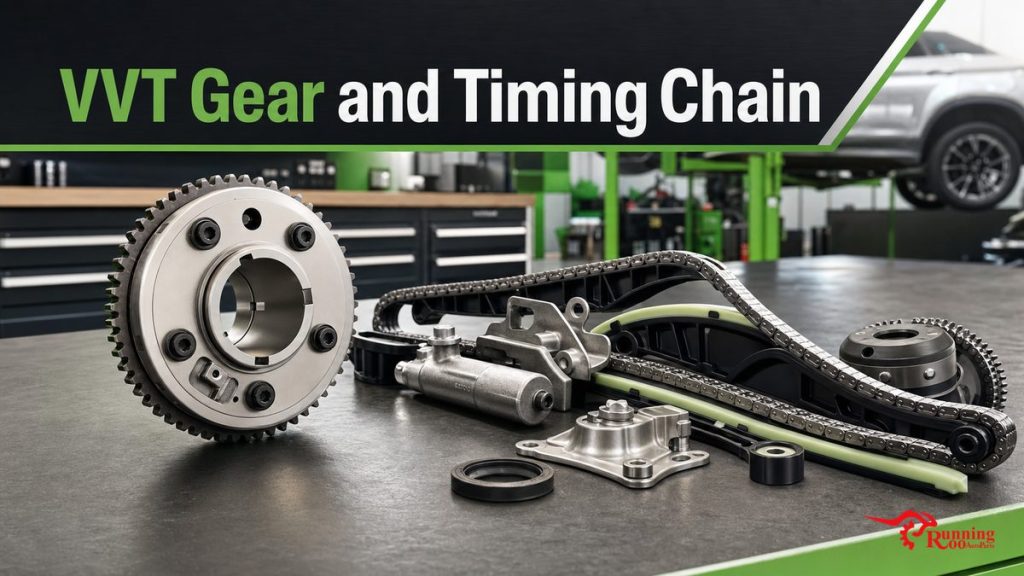
When a VVT camshaft gear, also known as a cam phaser or camshaft adjuster, is diagnosed as faulty, the natural reaction is to replace just that gear and call the job done. In many engines, that is a half-repair. The VVT gear sits at the end of the camshaft and is driven by the very same timing chain that drives everything else, so by the time the gear has worn enough to rattle or set fault codes, the chain, guides and tensioner around it are usually well into their service life too.
This guide explains when a VVT gear can be replaced on its own, when the timing chain and guides should be renewed at the same time, and how doing the combined job while the engine is open saves money. It is written for Australian owners and workshops who want the repair to last rather than to return.
RunningRoo Auto Parts – Based in Melbourne, Australia 🇦🇺
📞 Free 24/7 Pickup Available (Contact 0425890125)
💬 Any questions? Message or Call us anytime! We’re here to help.Why Choose RunningRoo?
✅ Aussie Owned & Operated | 🚚 Fast Shipping | 🤝 Friendly Support
Why the VVT gear and the chain wear together
The VVT gear is not an isolated component. It is bolted to the end of the camshaft and driven by the timing chain, so it shares the chain’s oil, its load and its service schedule. A gear that rattles on cold start is usually a gear whose internal locking pin or rotor has worn, but the chain that drives it has also been flexing and wearing for the same number of kilometres. The two are at similar stages of life far more often than not.
This is the central reason the combined repair makes sense. The labour to reach the VVT gear is essentially the labour to reach the timing chain, because they live behind the same cover and are disturbed by the same teardown. Once that labour is being spent anyway, renewing the chain, guides and tensioner costs little extra in parts and protects the whole job.
When a gear-only replacement is acceptable
There are legitimate cases where replacing only the VVT gear is fine. If the chain measures within specification, the guides are in good condition, the tensioner is not fully extended, and the engine is otherwise healthy, then a failed gear can be replaced on its own. This is most common on lower-kilometre engines where a single gear has failed early while the rest of the timing system is still fresh.
The decision should be made by measurement, not by assumption. A workshop that checks chain stretch, guide condition and tensioner extension before deciding is giving you an honest answer. A workshop that recommends the full job without checking is guessing, and a workshop that recommends a gear-only job without checking is guessing in the opposite direction.
When the chain and guides should be renewed too
The chain and guides should be renewed at the same time as the VVT gear whenever the chain has measurably stretched, the guides are cracked or grooved, the tensioner is near the end of its travel, or the engine has covered high kilometres since the last timing service. On many engines the VVT gear is sold as part of, or alongside, a complete timing kit precisely because the factory expects them to be done together.
| Finding | Recommendation |
|---|---|
| Chain within spec, guides clean, tensioner normal | Gear-only replacement is acceptable |
| Chain stretched or guides worn | Renew gear, chain, guides and tensioner |
| High-kilometre engine, cover already off | Do the complete timing job |
The honest rule is that if the cover is off and the chain or guides show any meaningful wear, the combined job is the sensible repair. Reassembling with a new gear on a worn chain simply moves the next failure a little further down the road.
The parts that make up a combined job
A combined VVT and timing job should include the VVT gear or gears, the timing chain, the tensioner, the guides, the necessary seals and gaskets, and often the one-time-use fasteners. On engines with an oil-pump chain behind the same cover, that chain and its tensioner should be renewed too. The engine oil and filter should be changed at the same time, because the VVT system is hydraulically actuated and depends on clean oil from the first start.
Using quality parts matters here more than in almost any other repair. The VVT gear is a precision, oil-pressure-actuated component, and a cheap copy will show up in noise, timing stability and longevity. Given the labour invested, the parts are the wrong place to save money.
The role of clean oil in VVT life
The VVT system is only as healthy as the oil that feeds it. The gear is advanced and retarded by engine oil pressure directed through a solenoid or oil-control valve, so low oil level, sludged oil or the wrong oil specification can all produce symptoms that look exactly like a failing gear. A surprising number of “VVT faults” disappear after a proper oil and filter service, which is why the oil should always be checked and, where appropriate, changed before the gear is condemned.
After a combined VVT and timing job, the fresh oil is not a nicety but a requirement. The new gear and chain start their lives on that oil, and the correct specification and level are what give the repair its best chance of a long, quiet life.
Diagnosis before parts
The sequence before any parts are ordered should be: scan the codes, check the oil level and condition, test the oil-control solenoid, and measure the chain’s correlation. Only then, with the cover off, should the VVT gear be inspected and the chain and guides assessed. This disciplined order prevents the two most expensive mistakes: replacing a good gear when the fault is the solenoid or the oil, and replacing a gear on its own when the chain is also worn.
The cold-start rattle is the classic shared symptom, and it is shared because the gear, the tensioner and the chain all make a similar sound. The fault codes and the measurements, not the noise alone, are what separate them.
What the combined job should cost and how to protect it
The combined job costs more than a gear alone because more parts are involved, but it is usually the cheaper option over the life of the car, because it avoids a second teardown. The parts remain the smaller share of the total; the labour is the larger share, and the labour is what you do not want to pay twice.
Under Australian Consumer Law, parts must be of acceptable quality and fit for purpose, so the best protection is a reputable local supplier with clear engine-code fitment and a written warranty. Confirming the engine code and VIN before ordering is the difference between a repair that fits first time and one that has to be returned.
Which engines most often combine VVT and chain wear
Some engine families have earned a reputation for wearing the VVT gear and the timing chain together, and if you own one, the combined repair is especially worth planning for. The VW Group’s EA888 engines, several BMW four- and six-cylinder engines, the Mercedes-Benz M271 and M272/M273 families, and a long list of four-cylinder Hyundai, Kia, Nissan and Mitsubishi engines have all seen documented VVT and timing-chain issues. The pattern is not brand loyalty; it is the simple fact that the gear and the chain share the same oil, load and service life.
Owning one of these engines does not mean failure is certain, but it does mean the early signs deserve respect. When a cold-start rattle or a timing fault code appears on a known-trouble engine, planning the VVT gear and the chain together is the economical approach, because the alternative is often a second teardown within a year or two.
Getting a second opinion before a big quote
A combined VVT and timing quote is a significant spend, so it is reasonable to want a second opinion. The right way to ask is not “is your price cheaper?” but “what did you measure, and what exactly is in the quote?” A trustworthy workshop will explain the chain-stretch measurement, the guide and tensioner condition, and the parts list, and will be happy for you to confirm the engine-code fitment.
What you are looking for is a repair that is complete but not padded. A quote that includes the gear, chain, guides, tensioner, seals and fresh oil is usually honest; a quote that adds unrelated work, or a quote that promises a gear-only repair without measuring the chain, is where you should ask more questions. The cheapest quote and the most expensive are both wrong if neither is based on the actual measurements.
Frequently asked questions
Do I have to replace the timing chain when I replace a VVT gear?
Not always, but usually it is wise, because the chain and gear wear together and the labour to reach them is the same.
When can I replace just the VVT gear?
When the chain is within specification, the guides are clean and the tensioner is normal, on a lower-kilometre engine.
How do I know if the chain also needs replacing?
Measure chain stretch against the manufacturer’s specification and inspect the guides and tensioner once the cover is off.
What parts are in a combined VVT and timing job?
The VVT gear or gears, chain, tensioner, guides, seals, gaskets, and often the oil-pump chain and one-time-use fasteners.
Why is clean oil so important for VVT?
The VVT gear is actuated by engine oil pressure, so low or dirty oil can mimic a gear fault and shorten the life of a new gear.
Should I replace the oil-control solenoid too?
If there is any doubt about the solenoid, yes, because a failing solenoid can damage the new gear and is much cheaper than the gear itself.
Can I do a combined job myself?
The mechanical work is possible for a skilled DIYer with the correct tools and locking kit, but the timing must be set and verified exactly.
How do I protect my purchase?
Buy quality parts with confirmed engine-code fitment and a written warranty, and change the oil and filter at the same time.
Shop the products mentioned in this guide
- 2-Piece Camshaft Adjusters for Mitsubishi Lancer Evo X 2.0 / ASX / Outlander 4B11 1147
- CVVT Timing Camshaft Gear for Hyundai Veloster / Tucson / Elantra 24370-2B700
- VVT Camshaft Gears Intake & Exhaust for Toyota Corolla 2007–2012 1.8L 2ZR-FE
- VVT camshaft gears on eBay
Watch on RunningRooAuto YouTube
- RunningRoo Auto Parts – trusted Melbourne parts support
- RunningRoo Auto Parts – product and fitment channel
RunningRoo Auto Parts – Based in Melbourne, Australia 🇦🇺
📞 Free 24/7 Pickup Available (Contact 0425890125)
💬 Any questions? Message or Call us anytime! We’re here to help.Why Choose RunningRoo?
✅ Aussie Owned & Operated | 🚚 Fast Shipping | 🤝 Friendly Support
Sources and further reading
- ACCC – Consumer rights and guarantees
- Product Safety Australia – vehicle recalls
- RACV – car maintenance and repair guidance
- API – Engine oil standards
- ACEA – European oil sequences
VVT system operation, chain wear limits and timing procedures are engine-specific and are described in each manufacturer’s workshop manual. Confirm your engine code and VIN against the official repair information before diagnosis or replacement.
RunningRoo Auto Parts – Based in Melbourne, Australia 🇦🇺
📞 Free 24/7 Pickup Available (Contact 0425890125)
💬 Any questions? Message or Call us anytime! We’re here to help.Why Choose RunningRoo?
✅ Aussie Owned & Operated | 🚚 Fast Shipping | 🤝 Friendly Support