
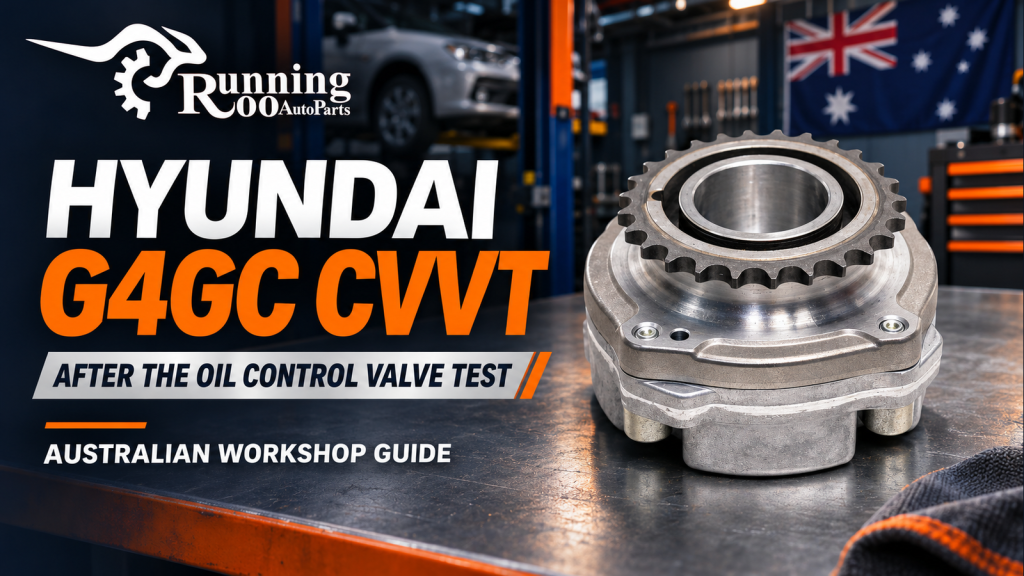
A normal OCV result is a finding, not a diagnosis of the next part
Hyundai G4GC CVVT diagnosis after an oil control valve test can leave an owner with an understandable question: if the valve appears normal, should the camshaft gear be replaced next? The answer should come from further professional assessment, not from moving automatically to the next item in a search result. A test result tells you something about what was assessed under particular conditions; it does not by itself prove that another component has failed.
This article focuses on the report and decision that follow an OCV assessment. It is intended for Australian owners discussing a possible 24350-23800 CVVT sprocket order with a workshop. It complements a product-identification guide by concentrating on what remains unresolved after a test, how to record that uncertainty and when a provisional enquiry becomes a confirmed parts request.
The relevant retail offer is CVVT Camshaft Sprocket For Hyundai Elantra i30 Tucson Tiburon 2.0L 2435023800 — RunningRoo, with the matching RunningRoo eBay listing providing the corresponding marketplace route. RunningRoo is Australian-operated in Blackburn, Victoria, with friendly support, Melbourne pickup by appointment and fast dispatch subject to confirmed stock and order timing. Call 0425 890 125 with the VIN, fitted engine code, OE reference and installer-approved requirement.

The Hyundai bulletin supports continued diagnosis, not automatic substitution
Hyundai TSB 09-EM-002, issued in May 2009, addresses CVVT oil control valve inspection in the context of symptoms and diagnostic concerns. It directs that a normally operating OCV should not be replaced merely on that basis and that other diagnosis is required. See Hyundai TSB 09-EM-002, May 2009 (archived original). This supports a disciplined interpretation of a normal result; it does not identify the next failed component on an unexamined G4GC.
The archived copy appears under an Accent application path, while the bulletin discusses CVVT inspection more generally. That archive location is not proof of the fitment of the RunningRoo gear to every vehicle. The workshop must use the current procedure and specifications for the actual engine. This article supplies no electrical test limits or instructions to energise a valve outside the applicable procedure.
Ask the technician to define the test result
If the report says “OCV OK”, ask what was established and whether any limitation remains. A plain-language explanation should identify the component and the nature of the assessment without requiring the owner to interpret technical measurements independently. The important distinction is between a confirmed result and a shorthand note whose meaning has not been explained.
Record whether the workshop regards the result as complete for the question it was investigating. If the original complaint was intermittent, ask how the assessment relates to that complaint. Do not change a limited observation into an unlimited claim that every part of the system has been ruled out. Let the technician state what the evidence supports.
Keep the original report if available. A later conversation can lose detail when the owner remembers only “the solenoid was fine”. Preserving the actual wording helps the workshop continue from its previous assessment and helps another repairer understand what has already been done if the vehicle changes hands or workshops.
Keep an electrical observation separate from a complete repair decision
An owner may receive a measurement, a scan result or a statement that a component responded during a check. Ask the workshop how that observation fits into the broader diagnosis. Do not treat an isolated number as a universal pass certificate for every operating condition, and do not compare it with a value from another engine without the technician’s confirmation.
The correct specifications and test conditions belong to the applicable service information. This guide deliberately does not supply a generic resistance range, a direct-battery test or a set of scanner commands. Those details would be misleading without the actual application and professional procedure.
For the customer’s decision, the useful output is a clear statement of what the workshop recommends next and why. That could be further investigation or a confirmed component requirement. The supplier should receive the latter only when the repairer has actually reached that stage, rather than a guess inferred from one normal result.
Use a “known, unknown, next step” report
A short structured note can prevent uncertainty from disappearing during a parts enquiry. Ask the workshop to identify what is known, what remains unresolved and the next appropriate step. This is a communication framework, not a replacement diagnostic flowchart. The technician determines the actual tests and their sequence.
For example, an owner might accurately record that an OCV assessment was completed but the original complaint remains under investigation. That is more useful than writing “gear faulty” when the technician has not said so. If a gear replacement is subsequently recommended, update the note with the reason and the required part identification.
The record should be brief enough to use. A page of copied internet possibilities is less helpful than a concise account of the vehicle, the complaint, the findings and the current recommendation. Keep the original detailed report available while sending the supplier only the information needed to establish the product match.
A report template before ordering 24350-23800
| Report field | Useful content | Keep separate from |
|---|---|---|
| Vehicle identification | VIN, fitted engine code and build information | A broad model-name assumption |
| Original concern | Owner’s description and occurrence conditions | A predetermined failed-part label |
| OCV assessment | Technician’s finding and any stated limitation | An automatic diagnosis of the gear |
| Unresolved question | What further assessment is needed | A speculative shopping list |
| Replacement recommendation | Named component and reason for the requirement | A generic “VVT unit” description |
| Parts confirmation | Approved reference and supplier match | The technician’s responsibility for diagnosis |
The table can accompany a workshop conversation or an owner’s repair file. It should not be used to pressure a technician into a conclusion that the evidence does not support. An unresolved field is a reason to clarify the next step, not a reason to fill it with the most popular online answer.
Avoid the “only thing left” assumption
A common reasoning shortcut is to say that if one component was not found faulty, another must be the cause. That conclusion may overlook what was actually tested, the conditions of the assessment and other information the workshop still needs. Ask the repairer to explain the positive basis for the recommended replacement rather than relying on the phrase “nothing else left”.
This does not mean a gear recommendation is wrong. It means the recommendation should be linked to the technician’s assessment of the actual vehicle. The owner can approve a well-explained repair without personally performing the diagnosis. Clear evidence and clear responsibilities make that approval more informed.
If another workshop previously fitted parts, provide the invoices and the sequence of work. Do not present a parts receipt as proof that every associated issue was diagnosed or resolved. The new repairer needs to know what was done, what changed and what remains uncertain, including any gaps in the history.
Understand exactly what RunningRoo is offering
The current linked product is one CVVT camshaft sprocket identified by reference 24350-23800, also shown without punctuation as 2435023800. It is not an oil control valve and should not be ordered as a substitute for one merely because both appear in CVVT search results. The workshop’s requested component name must match the offer.
Review CVVT Camshaft Sprocket For Hyundai Elantra i30 Tucson Tiburon 2.0L 2435023800 — RunningRoo for the current description and photographs, or use the matching RunningRoo eBay listing. The listing names several Hyundai applications, but those catalogue references do not remove the need for VIN, engine and OE verification. Ask the supplier to confirm the specific match to the installer’s requirement before purchase.
Do not assume that bolts, seals, a timing kit or every other item needed for the workshop job are included with the single sprocket. Have the installer identify additional requirements separately. A precise order is more useful than a broad package assumption, especially when the diagnostic conversation has already involved several different components.
Make the reference check specific to the fitted engine
Provide the VIN privately and the fitted engine code, together with any OE number the workshop has identified. Mention a known engine replacement or uncertainty about previous modifications. The vehicle’s badge and registration year should not be the only basis for matching a component.
If the workshop requests photographs, use accessible identification or images it supplies during the appropriate stage of assessment. Do not dismantle the vehicle for a shopping enquiry. When a reference is partially unreadable, show the uncertainty and ask what further information is needed instead of guessing the missing characters.
Keep the supplier’s confirmation tied to the actual product link and approved requirement. If the diagnostic recommendation changes, update that confirmation before ordering. A preliminary availability enquiry should not be mistaken for a final instruction to fit the part.
Discuss the next appointment before committing to the order
Ask the workshop what information or access it needs to finish the assessment and how it will communicate the result. If additional approval is required, agree on the contact person and the point at which a decision will be requested. This is practical planning, not a claim about how long a G4GC diagnosis should take.
For customer-supplied parts, confirm that the workshop accepts the arrangement and will check the item before installation. The owner, supplier and technician should understand who is answering the fitment question and who is responsible for the repair decision. A parcel delivery alone does not settle either issue.
RunningRoo can provide friendly support on 0425 890 125 for the product enquiry. Melbourne local pickup is available by appointment in Blackburn. For delivery, ask about fast dispatch once stock and order details are confirmed, and discuss carrier timing separately from the workshop’s booking.
A useful handover preserves what the normal result meant
When the repair is completed, ask the invoice to identify the components actually replaced and the work performed. If the earlier OCV assessment was part of the diagnostic process, keep that report with the final record. The history should show the path from the original complaint to the approved repair without exaggerating what was ruled out.
Ask how the workshop assessed the result against the original concern. If a symptom was intermittent or a follow-up remains appropriate, record the technician’s advice. Do not turn a successful collection-day check into a lifetime promise that every future CVVT-related complaint will have been prevented.
If the vehicle is later sold, a clear service file helps the next owner understand the work. “OCV assessed, specific gear replaced following diagnosis” is a more informative record than “all VVT fixed”, provided it accurately reflects the invoice. Keep the actual documents rather than rewriting their conclusions from memory.
Preserve the exact wording of a qualified result
If a report says a component operated normally during a particular assessment, retain that qualification when forwarding it. Do not rewrite it as “the entire control system is perfect”. Equally, do not turn “further diagnosis required” into “the gear must be replaced”. Small wording changes can remove the very uncertainty the technician intended to communicate.
A useful follow-up asks the workshop what evidence would support the next decision and when that assessment can be completed. The owner can then plan an appointment or a provisional availability enquiry without creating a premature order. When the final recommendation arrives, replace the provisional parts list with the approved one and keep both records clearly labelled. This makes the history understandable without pretending that an earlier test answered every later question.
Frequently asked questions
If the OCV test is normal, does that prove the CVVT gear is faulty?
No. A normal result does not automatically diagnose a different component. Ask the qualified repairer what further assessment is needed and what evidence supports any replacement recommendation. The gear order should follow a confirmed requirement rather than a simple process of online elimination.
Should a normal OCV be replaced anyway because the symptom remains?
The cited Hyundai bulletin supports further diagnosis rather than automatic replacement of a normally operating valve. The actual vehicle still requires the applicable professional assessment. This guide does not decide the repair remotely or override the technician’s current vehicle-specific service information.
Is 24350-23800 an oil control valve in this listing?
The linked RunningRoo offer is a CVVT camshaft sprocket. It should not be confused with an OCV. Ask the workshop for the exact component name and reference, then confirm that its requirement matches the product being ordered.
Can I use the bulletin’s archive vehicle name as a fitment guarantee?
No. An archive’s page location does not establish compatibility for the retail gear. Supply the VIN, fitted engine code and relevant OE information to the installer and supplier. Keep technical background and the actual product application check as separate steps.
Can RunningRoo help once the workshop confirms the gear requirement?
Review CVVT Camshaft Sprocket For Hyundai Elantra i30 Tucson Tiburon 2.0L 2435023800 — RunningRoo and the matching RunningRoo eBay listing, then call 0425 890 125 with the approved reference and vehicle details. RunningRoo offers Australian-operated, friendly support, Blackburn pickup by appointment and fast dispatch subject to confirmed availability. The workshop remains responsible for diagnosis, installation and final verification.
Related reading and RunningRoo video
Read the related RunningRoo product-identification guide. Use that guide for the catalogue discussion and this article for the specific workshop question above.
Watch RunningRoo: Variable Valve Timing Explained. This is general background from the RunningRoo AutoParts channel, not a demonstration of this exact supplied component, confirmation of fitment or a substitute for the vehicle-specific repair procedure.
Confirm your parts enquiry with RunningRoo
Send your VIN privately, fitted engine code, relevant OE number and the installer-approved parts list before ordering. Contact RunningRoo support or call 0425 890 125. RunningRoo is Australian-operated in Blackburn, Victoria. Melbourne local pickup is by appointment; ask about fast dispatch after stock, fitment and order timing are confirmed. Friendly support can help clarify the product enquiry while the qualified repairer remains responsible for diagnosis and installation.
Technical references and scope
Hyundai TSB 09-EM-002, May 2009 (archived original). Manufacturer material provides the limited technical background cited in the article. Additional technical sources, where used, are linked beside the relevant discussion. Archived training and general system explanations are not current VIN-specific repair instructions. The discussion questions and planning examples are editorial guidance. Retail descriptions establish the seller’s stated offer, not manufacturer approval or universal compatibility.