
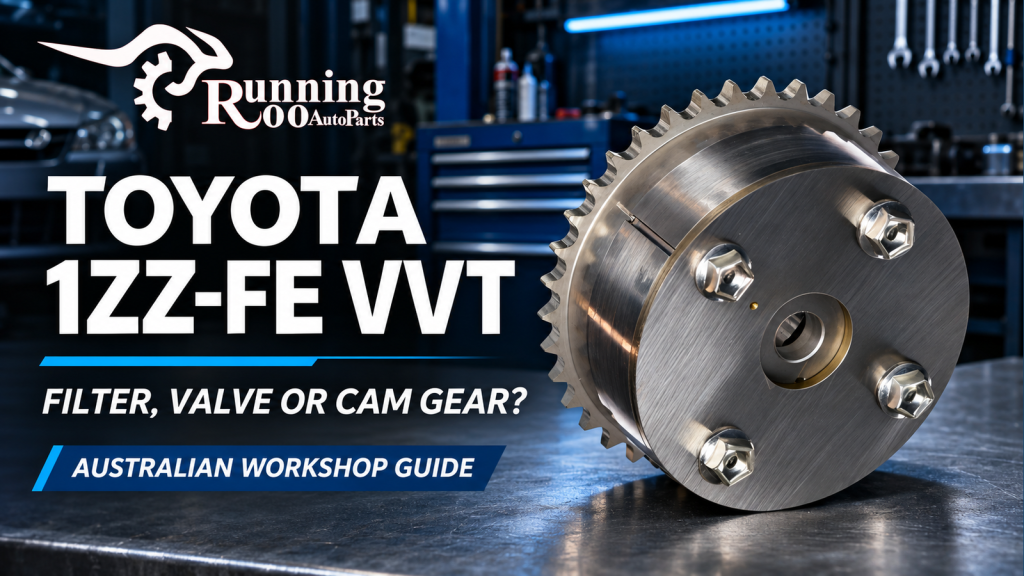
A filter check should answer a question, not trigger an automatic gear order
Toyota 1ZZ VVT oil filter checks in Australia are often discussed when an owner is considering a replacement intake cam gear. The useful question is not simply whether a small filter has been mentioned. It is what the workshop actually checked, what it found and how that finding relates to the recommendation to replace a component. A filter, an oil control valve and a camshaft timing gear should not become interchangeable names in the parts conversation.
This guide is written for owners preparing a 1ZZ-FE repair enquiry. It focuses on the evidence to retain before ordering the intake gear, rather than repeating a broad fitment guide. It provides no cleaning recipe, electrical bypass test or installation sequence. A qualified technician must diagnose the vehicle and use the applicable Toyota procedure for inspection and repair.
The relevant offer is Camshaft Timing Gear Actuator-Left Fit 00-08 Toyota VVT-i 1.8L 1ZZFE 2ZZGE — RunningRoo, with a corresponding matching RunningRoo eBay listing. RunningRoo is Australian-operated in Blackburn, Victoria, offering friendly support and Melbourne local pickup by appointment. Call 0425 890 125 with the VIN, fitted engine code, relevant OE reference and installer’s confirmed requirement. Ask about fast dispatch once availability and order details are settled.

The Toyota manual distinguishes the filter from the gear
Toyota’s RM823E Corolla repair material for the 1ZZ-FE and 3ZZ-FE includes an oil control valve filter as an identified service component. It treats the filter and camshaft timing gear as distinct items. See Toyota Corolla 1ZZ-FE/3ZZ-FE RM823E repair manual (archived original). That distinction supports careful component naming; it does not mean that every VVT complaint is caused by a blocked filter or that a filter inspection establishes gear failure.
The source is an archived original repair document for stated applications. Its presence online does not make every procedure applicable to every vehicle with a similar badge or every engine named in a retail listing. The workshop must verify the correct service information for the fitted engine. The questions below are editorial guidance for the owner’s records, not a replacement diagnostic procedure.
Ask what “the filter was checked” means in the report
A short verbal statement can conceal different levels of assessment. Ask the repairer to describe the actual observation and its conclusion in plain language. If a component was inspected, request that it be named clearly. If the assessment remains incomplete, have that uncertainty recorded rather than treating the phrase “checked” as proof that every related possibility has been excluded.
The owner does not need to demand a particular test method from a blog. The technician chooses the safe and appropriate procedure. What the owner can reasonably request is a clear account of the result and how it affects the next decision. That makes it easier to understand why a part is being recommended rather than simply accepting a list of possible replacements.
Preserve any workshop photograph with its description. An unlabeled close-up of a small part may be difficult to interpret later. A short note identifying the component, vehicle and observation is more useful than a photograph forwarded without context. Do not add a diagnosis to the image that the technician did not provide.
Keep three component names separate
When discussing the repair, ask whether the proposed part is a filter, an oil control valve or the camshaft timing gear. If the estimate says only “VVT unit”, ask for the exact name and reference. The supplier cannot reliably match a broad nickname to a specific order when several different components are being discussed.
A retail gear listing should not be treated as an offer for an oil control valve merely because both appear in search results for the same symptom. Likewise, a successful inspection of one item does not automatically establish the condition of another. Ask the repairer to connect its recommendation to the finding rather than relying on elimination by casual conversation.
This distinction also improves the final invoice. A future technician should be able to see which item was inspected and which was replaced. “VVT repaired” is less useful than a record identifying the actual component and the work performed, particularly if a later concern is being compared with an earlier one.
Record service history without turning it into a diagnosis
Provide available service records and disclose any known work before the current complaint. If the history is incomplete, say so. An owner’s recollection can be helpful, but it should not be presented as a documented maintenance record when no supporting information exists.
If a product, treatment or component has already been changed in an attempt to address the issue, tell the technician. The workshop needs the actual sequence of events rather than a simplified account that begins after several unsuccessful interventions. Do not make another change solely to imitate an internet remedy before the assessment unless the repairer advises it.
This article does not recommend additives, solvents or a home cleaning routine. It also does not promise that cleaning a component will restore the system or that a new gear will correct every related concern. The useful next step follows the professional assessment and the applicable service information.
A filter-to-gear enquiry record
| Record item | Useful detail | Assumption to avoid |
|---|---|---|
| Original complaint | Owner’s observation and when it occurred | Labelling the symptom as gear failure before diagnosis |
| Filter assessment | Named component, finding and technician’s conclusion | Treating “checked” as a complete system diagnosis |
| Oil control valve assessment | What the workshop established or still needs to assess | Assuming it is the same part as the gear |
| Gear recommendation | Reason for replacement and required reference | Ordering because it is a popular search result |
| Vehicle identification | VIN, fitted engine and relevant OE information | Selecting by model name alone |
| Completion record | Actual work and verification summary | Describing every VVT component as replaced |
Use this table to collect information, not to dictate the order of mechanical tests. The workshop may require a different sequence or further assessment for the actual vehicle. Its purpose is to keep observations and conclusions distinct so the parts supplier receives a specific, approved requirement.
Understand the offer’s reference information
The current RunningRoo listing is for one camshaft timing gear actuator and gives references including 13050-0D010 and 13050-22010. The title mentions both 1ZZFE and 2ZZGE applications and uses the word “Left”. Do not turn those catalogue terms into a universal interchange statement or infer a bank position from the title alone.
This article’s workshop discussion is focused on the 1ZZ-FE. The cited Toyota manual is not evidence that every other engine named in the retail title uses the same procedure or component. Ask the supplier and installer to confirm the actual reference for the vehicle before ordering. Similar engine names and a shared search result are not sufficient confirmation.
Check Camshaft Timing Gear Actuator-Left Fit 00-08 Toyota VVT-i 1.8L 1ZZFE 2ZZGE — RunningRoo and the matching RunningRoo eBay listing for the current offer. If the workshop requests a different suffix or reference, preserve it exactly and ask for clarification. Do not shorten a number to make it resemble the listing, and do not assume that another RunningRoo article about a different Toyota gear establishes compatibility for this one.
Confirm the installed engine when history is uncertain
Provide the VIN privately and the fitted engine code. If the engine has been replaced, disclose the available details even if the registration record still describes the original configuration. The supplier may need additional identification from the workshop to resolve a match where the vehicle history is unclear.
Clear photographs of accessible identification or removed components can be useful when requested. Do not dismantle the engine simply to produce a shopping image. Ask the technician what can be identified during its assessment and what evidence is necessary for the parts enquiry. A guessed reference can send the order in the wrong direction.
Keep the final confirmation with the order. If the installer’s recommendation changes after further diagnosis, update the purchasing instruction before payment or collection. A product enquiry made early in the process can establish information, but it should not silently become the final repair decision.
Make the recommendation explain the next step
After a filter or valve assessment, ask the workshop what the result means for the proposed repair. A normal finding may leave further investigation necessary; an abnormal observation still needs to be interpreted in context. The customer should understand which question has been answered and which remains open.
Do not ask the supplier to choose between possible diagnoses based on a few forwarded words. RunningRoo can clarify the product and fitment enquiry, while the technician examines the vehicle. Keeping those responsibilities distinct helps both parties provide a more useful answer.
If the workshop recommends the gear, ask for the approved part reference and any additional components required for the job. The order should include what the technician needs, not whatever happens to be bundled with the first search result. Confirm any separate requirement rather than assuming a single gear listing contains all installation items.
An illustrative enquiry that avoids an unnecessary assumption
Consider an owner who has been told, “We inspected the VVT filter, and the car still needs more diagnosis.” Ordering an intake gear at that point would add a conclusion that the workshop has not made. A better response is to ask what further assessment is required and whether a provisional parts enquiry would be useful.
If the technician later confirms a gear requirement, the owner can send the exact reference, vehicle details and approved list to RunningRoo. This is an illustrative communication example, not a report of a particular customer’s repair. It demonstrates how an incomplete assessment can remain clearly labelled until the evidence supports a purchase.
The same principle applies if the owner already has a gear in hand. Tell the workshop what was purchased and why, but do not let possession of a part dictate the diagnosis. The technician should still assess the actual complaint and confirm whether that component belongs in the repair.
Arrange local support and a sensible workshop handover
Call 0425 890 125 for friendly RunningRoo support once the product question is specific. Melbourne customers can arrange pickup in Blackburn by appointment. Confirm the order and collection time in advance, especially if someone else is collecting on behalf of the vehicle owner or workshop.
For shipped orders, ask about fast dispatch from available stock and the relevant carrier estimate. Distinguish dispatch from delivery and from the workshop’s installation booking. A repair plan is easier to manage when each party states what it can actually confirm instead of promising the whole process from a single estimated date.
Ask whether the workshop accepts customer-supplied parts and when it will check the received item. Keep the listing confirmation and packaging available for that comparison. Resolve any mismatch before installation rather than relying on the product title alone after the engine work has started.
Preserve a useful result, not just a parts receipt
At handover, retain the final repair invoice and the technician’s summary of the outcome. Ask that the record distinguish inspection from replacement. A receipt for a gear establishes what was bought, while the workshop record establishes what was fitted and how the original complaint was assessed.
If the concern returns or changes, bring that history to the repairer. Do not assume every later symptom has the same cause or that the previous filter observation settles a new diagnosis. Clear records allow the next assessment to start with documented facts rather than a broad claim that the whole VVT system was renewed.
Frequently asked questions
Does finding a filter in the Toyota manual prove it causes my symptom?
No. The manual identifies a component; the workshop must determine its condition and relevance to the vehicle’s complaint. This guide does not assign a cause from the existence of a filter or recommend replacing a gear without a confirmed diagnosis.
Can I order an oil control valve through this gear listing?
The linked offer is for the stated camshaft timing gear actuator. Do not treat component names as interchangeable. If the installer requests an oil control valve or another item, obtain the correct specific listing and fitment confirmation rather than substituting the gear.
Does the 2ZZ reference make every 1ZZ and 2ZZ gear interchangeable?
No universal interchange claim is made here. The product title must be checked against the actual VIN, fitted engine and relevant OE reference. The Toyota source used for this article does not establish every application named in the retail listing.
Should I clean the filter myself before the appointment?
This guide supplies no owner cleaning procedure. Ask the qualified repairer what assessment is appropriate and use the correct service information. Unrecorded changes before diagnosis can make the history less clear, so disclose anything already done rather than attempting another remedy from a general article.
Where can I confirm the gear order and Melbourne pickup?
Review Camshaft Timing Gear Actuator-Left Fit 00-08 Toyota VVT-i 1.8L 1ZZFE 2ZZGE — RunningRoo or the matching RunningRoo eBay listing and call 0425 890 125 with the installer’s approved requirement. RunningRoo offers Australian-operated, friendly support and Blackburn pickup by appointment. Fast dispatch can be discussed after current stock and the exact order have been confirmed.
Related reading and RunningRoo video
Read the related RunningRoo product-identification guide. Use that guide for the catalogue discussion and this article for the specific workshop question above.
Watch RunningRoo: Variable Valve Timing Explained. This is general background from the RunningRoo AutoParts channel, not a demonstration of this exact supplied component, confirmation of fitment or a substitute for the vehicle-specific repair procedure.
Confirm your parts enquiry with RunningRoo
Send your VIN privately, fitted engine code, relevant OE number and the installer-approved parts list before ordering. Contact RunningRoo support or call 0425 890 125. RunningRoo is Australian-operated in Blackburn, Victoria. Melbourne local pickup is by appointment; ask about fast dispatch after stock, fitment and order timing are confirmed. Friendly support can help clarify the product enquiry while the qualified repairer remains responsible for diagnosis and installation.
Technical references and scope
Toyota Corolla 1ZZ-FE/3ZZ-FE RM823E repair manual (archived original). Manufacturer material provides the limited technical background cited in the article. Additional technical sources, where used, are linked beside the relevant discussion. Archived training and general system explanations are not current VIN-specific repair instructions. The discussion questions and planning examples are editorial guidance. Retail descriptions establish the seller’s stated offer, not manufacturer approval or universal compatibility.