
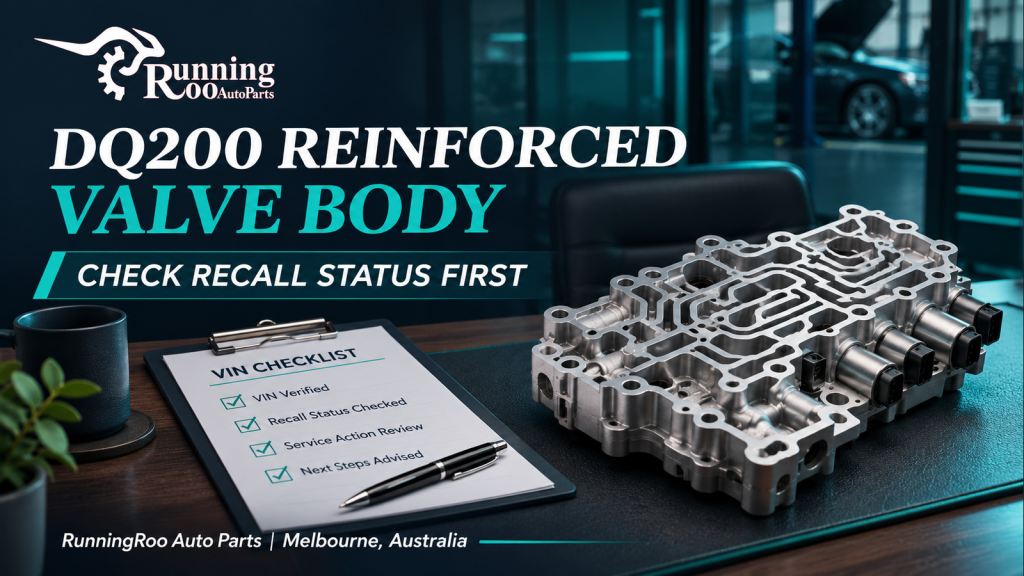
Before buying a DQ200 thickened valve body in Australia, check whether the vehicle has an outstanding manufacturer recall or service campaign. A replacement-parts enquiry and a campaign enquiry answer different questions. RunningRoo can help identify the offered reinforced mechatronic assembly, but an authorised brand representative must confirm the campaign position for the individual vehicle. Starting in that order can prevent an owner from approving a private repair before understanding the available manufacturer pathway.
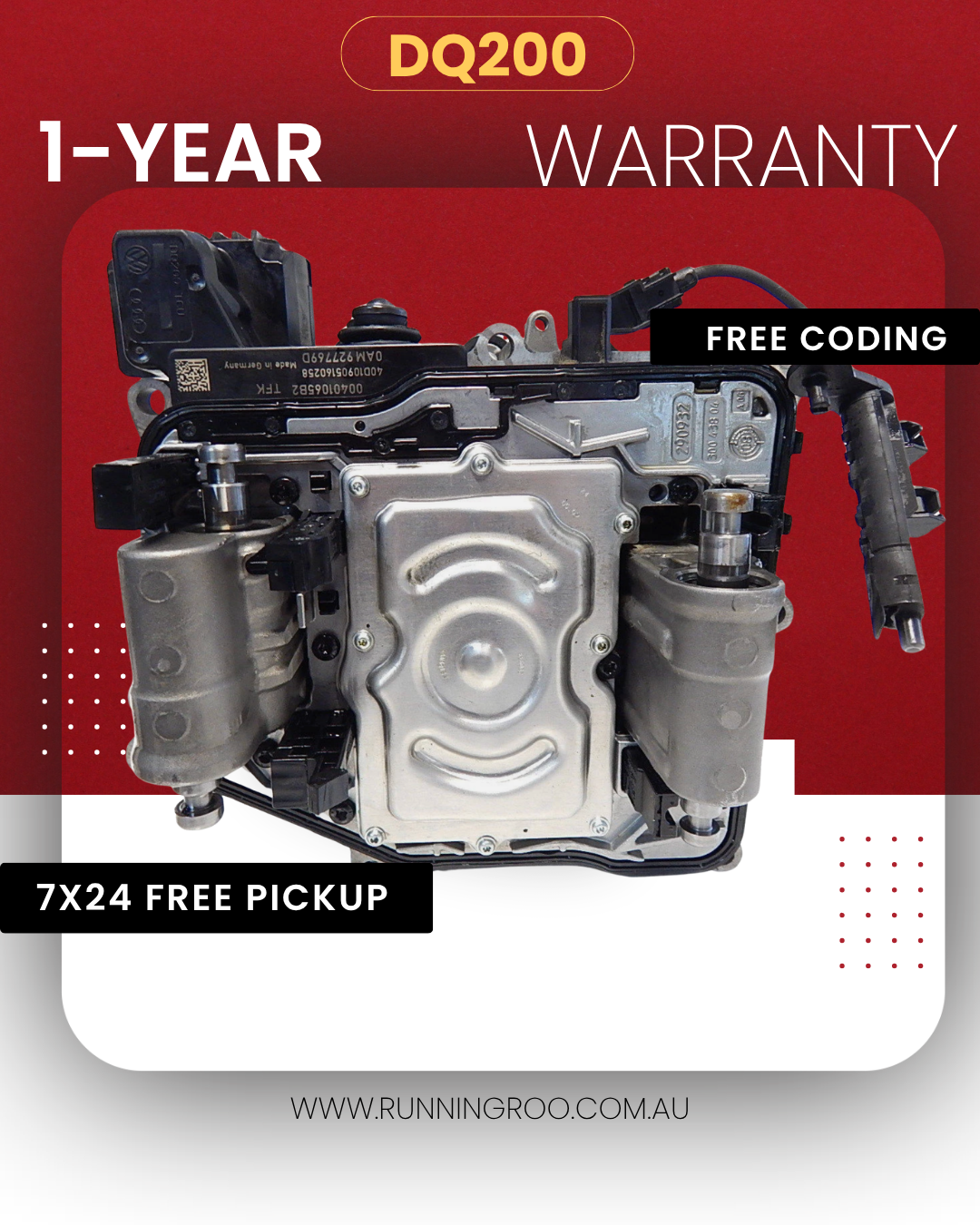
This guide is for the owner who already has a workshop discussing a DQ200 reinforced housing, yet has not established the vehicle's recall status. It explains how to organise the enquiry, separate the records and continue with an informed parts decision. It does not declare any particular Golf, Polo, Audi or Škoda eligible, and it does not describe the RunningRoo product as an authorised recall remedy. The objective is a clear decision before money, parts and workshop time are committed.
Start with the Australian manufacturer record
Volkswagen Australia's official service-campaign and recall page offers a VIN checker covering outstanding and completed actions. It asks for the vehicle's 17-character VIN and warns that an incorrect entry can produce an incorrect result. The page also distinguishes recalls from service campaigns. Use that official route for a Volkswagen, and the relevant Australian brand representative for another marque. A gearbox family name is not a substitute for the vehicle-specific enquiry. Volkswagen Australia: service campaigns and recalls; use the VIN-specific result
Record the date on which you checked and retain the actual result. If a campaign description, completion date or status is unclear, ask the manufacturer or authorised dealer to interpret it before treating the enquiry as finished. The useful output is an answer tied to your vehicle, rather than a screenshot from an owner's group showing a different car. Keep any personal documents private; a public social-media post is not necessary to obtain a parts or campaign assessment.
Australia's government vehicle-recall website is another official starting point for researching notices. Its role is different from a workshop diagnosis: finding a published notice does not establish that the symptom on your car has that cause. Equally, a workshop finding does not by itself establish campaign eligibility. Use the notice to frame the manufacturer's enquiry, then obtain a specific answer for the VIN and market history. Australian Government: Vehicle Recalls
Why a DQ200 search result is not an eligibility decision
Owners often begin with a search such as “DQ200 mechatronic recall Australia” after a dashboard warning. Search results can mix countries, production periods, campaign numbers and different component concerns. Two pages may both mention a seven-speed DSG while describing separate actions. A technically similar photograph is also insufficient: the relevant record may depend on the vehicle's original specification and history rather than the appearance of a replacement casting.
For that reason, do not use the words “all DQ200 cars” in your own notes. Write the actual model, VIN, build information and manufacturer response instead. An imported vehicle deserves particular care because the selling market and current registration market may differ. Ask the Australian brand representative how it wants the original identification documented. Avoid assuming that an overseas bulletin automatically creates the same Australian repair process, or that an Australian website will recognise an imported vehicle without further assistance.
This is also why the blog does not reproduce a universal model-year eligibility table. Such a table can appear convenient while omitting important exceptions. The current official checker and a documented response are more useful to the person arranging a real repair. RunningRoo's product listing remains a separate purchasing option for a professionally confirmed application; its availability does not establish whether a manufacturer action applies.
Keep three decisions separate
The first decision is the campaign enquiry: does the manufacturer identify an outstanding action for this vehicle, and what does it want the owner to do? The second is the diagnosis: what has the workshop actually found on the car today? The third is the parts order: which assembly, hardware identity and supply arrangement match the approved repair? Combining these into one sentence such as “it needs the upgraded unit” hides information that the next person may need.
For example, an owner may have an outstanding action recorded but also a workshop concern that has not been assessed. The next step is to coordinate the findings with the authorised representative, not to assume every concern will be resolved by a single component. Conversely, a completed action in the record should not be interpreted as a current health certificate for the transmission. A present symptom still needs professional evaluation on its own evidence.
| Question | Best evidence to obtain | What it does not establish |
|---|---|---|
| Is a campaign outstanding? | Current manufacturer response for the VIN | The cause of every present symptom |
| What is wrong today? | Workshop findings and retained scan report | Automatic campaign eligibility |
| Which part is being considered? | Exact listing and written supplier confirmation | Manufacturer authorisation of that part |
| Has work been completed? | Repair record and manufacturer status confirmation where relevant | Unlimited future reliability |
| What should be purchased privately? | Approved repair scope after the enquiries | A substitute for campaign administration |
Build a useful enquiry before calling
Have the VIN available from a reliable vehicle document and check it against the car. Add the registration, model, year and current location. Keep a note of whether the vehicle was originally supplied locally or imported, if known. A concise symptom description helps the recipient understand urgency: say what the driver observed, when it happened and whether the car is currently at a workshop. Avoid converting an online guess into a confirmed failure description.
Ask the workshop for the diagnosis in writing where possible. Useful material includes the identified transmission code, the complete control-unit identification, recorded faults and the mechanic's proposed next step. You do not need to interpret diagnostic values yourself. The purpose is to preserve the distinction between what was measured, what is suspected and what has been confirmed. That distinction makes a telephone discussion more productive and reduces contradictory accounts between an owner, workshop and parts supplier.
If the car is not driving normally, ask the attending workshop or roadside service about transport. Do not make a journey simply to demonstrate a fault for a parts supplier. RunningRoo's Blackburn pickup service concerns collecting parts by appointment; it is not an instruction to drive a vehicle with an unresolved transmission problem. A friend, courier or workshop representative can collect an approved order once the arrangements are confirmed.
Questions for the authorised representative
Ask whether the supplied VIN has an outstanding relevant action, whether further inspection is required and which location should handle it. Ask how to provide the independent workshop's report and whether the vehicle should remain where it is pending instructions. Request a reference number or written summary so that a later conversation can continue from the same information. These are practical coordination questions, not an attempt to predict the outcome of the manufacturer's assessment.
If an action is shown as completed but the owner has no paperwork, ask what the record means and whether additional documentation can be supplied. If work has just occurred and the online result appears inconsistent, ask the representative to check the record directly. Do not edit or reinterpret dates to make the paperwork look consistent. Keep the unanswered question visible until the responsible organisation resolves it.
Avoid approving overlapping work without clarifying the boundaries. Tell each workshop what another party has already inspected or proposed. If a private parts order is being considered, disclose that fact before arrangements are finalised. The goal is to prevent two separate teams from acting on different assumptions about who is diagnosing, supplying, installing or documenting the repair.
Where the RunningRoo reinforced assembly fits
The product linked here is the RunningRoo DQ200 0AM mechatronic offer described as a thickened valve body with TCU and a programming-related title. This identifies the offer under discussion; it does not prove compatibility with every DQ200 variant. Supply scope, controller identity and any programming service must be confirmed in writing for the actual order. In particular, a title mentioning programming should not replace a clear agreement about what is supplied and what the installing workshop must complete.
The housing description concerns the offered component. It does not turn a retail replacement into a manufacturer campaign part, certify the whole transmission or establish that a particular diagnostic concern has been resolved. Ask the workshop to explain why this assembly is being considered after the campaign enquiry. If the proposed scope changes during that enquiry, update the supplier before dispatch rather than trying to reconcile the difference after installation.
RunningRoo is Australian-operated in Blackburn, Victoria, and can assist with a focused product enquiry. Send the VIN, engine code, transmission identification, OE references and professional diagnosis together. Friendly local support and Melbourne pickup by appointment are useful when the order is ready, while fast dispatch remains subject to confirmed stock and any agreed preparation. A carefully identified order is more useful than a fast shipment of an unconfirmed unit.
Compare repair proposals on the same basis
When an owner receives more than one proposal, compare the responsibilities as well as the totals. Identify who will supply the assembly, who will confirm fitment, who will arrange programming if required and who will perform the vehicle-specific checks after installation. Keep the manufacturer campaign response with the file so that a private quotation is not accidentally presented as the campaign quotation. The two documents may have different purposes and should remain clearly labelled.
Ask what the proposal includes if additional faults are found. A parts quote cannot be expected to describe every possible problem before the vehicle has been inspected. However, it can state which product is being quoted and which workshop tasks are outside the supply. Do not read a lower total as proof of a better or worse repair until the contents are comparable. Written exclusions and open questions are preferable to an attractive but ambiguous promise.
For an interstate repair, establish a single recipient for the confirmed parts information. An owner in Brisbane, a workshop in regional Queensland and RunningRoo in Melbourne can work from the same order reference without forwarding incomplete screenshots between separate conversations. Include the final approved product link and the agreed recipient details. Keep campaign correspondence separate but available to the workshop if it affects the plan.
A practical decision sequence
An effective sequence is to identify the vehicle, obtain the official campaign response, retain the workshop findings and then settle the private repair scope if one is still needed. This is a sequence for organising decisions, not a mechanical procedure. It avoids using a retail purchase as the starting assumption. It also allows the owner to explain why a particular assembly was ordered if the car changes workshops or ownership later.
Consider an illustrative case: an owner has been told verbally that the “DSG needs upgrading” and has found a reinforced unit online. The useful next action is not to choose a housing by photograph. The owner asks the workshop for its findings and checks the VIN through the appropriate manufacturer channel. Once those answers are available, the owner and workshop decide whether the linked product fits the remaining repair requirement. No outcome is assumed in this example.
After work is completed, retain the invoice, fitted-part identity and workshop report together. Where campaign work was involved, keep the authorised representative's confirmation as well. A later owner should be able to distinguish a retail component invoice from a campaign completion record. Clear documentation supports an accurate explanation of the car's history without making claims about work that the paperwork does not actually show.
Related RunningRoo video
RunningRoo: DQ200 mechatronic valve-body pressure-loss repair. This is related educational context, not confirmation that the filmed part is the exact supplied item or that its procedure applies to this engine or transmission. Use current manufacturer information and professional diagnosis for the actual vehicle.
Frequently asked questions
Does every DQ200 vehicle have a recall?
Do not assume that from the gearbox name. Use the current Australian manufacturer route for the individual VIN and obtain clarification if the result is unclear. A product page, forum discussion or overseas notice cannot establish eligibility for your particular vehicle. Keep the dated response with the repair file so the workshop knows what has actually been checked.
Is RunningRoo's thickened valve body an official recall repair?
This article does not represent it as one. It is a retail product offer that requires application and supply-scope confirmation. The relevant manufacturer or authorised dealer determines campaign requirements. Keep that process separate from deciding whether the RunningRoo assembly is suitable for a professionally diagnosed private repair.
What if a campaign is completed but the car still has a fault?
Arrange a professional assessment of the current concern and provide the completed-work record. The status of previous work and the cause of a present symptom are different questions. Avoid assuming that the old record either proves or rules out a particular failure. Ask the workshop and authorised representative to explain their findings for this vehicle.
Can I order while waiting for the manufacturer to reply?
You can enquire about the product and gather fitment information, but settle the repair requirement before committing to a specific prepared assembly. Tell RunningRoo that the campaign enquiry is pending. This helps keep stock discussions, programming arrangements and the workshop booking aligned with the final decision rather than a provisional assumption.
What information should accompany the parts enquiry?
Provide the VIN, engine code, transmission code, OE and control-unit references, plus the workshop's diagnosis. Include the exact website or eBay link so everyone is discussing the same offer. If programming is mentioned, ask for a written description of the included service and the tasks remaining with the installer.
Is Melbourne pickup available after the order is confirmed?
RunningRoo offers Blackburn, VIC pickup by appointment. Call 0425 890 125 to arrange the timing and confirm that the correct order is ready. Interstate dispatch can also be discussed once stock, preparation and delivery details are settled. Collection arrangements do not replace the vehicle's fitment check or the campaign enquiry.
Related reading: DQ200 Thickened Valve Body Australia: Understanding the Reinforced Housing Claim. This guide covers a separate question or package; the link does not establish component interchangeability.
Sources and scope
Product offer and stock status checked on 12 November 2026. Retailer descriptions identify the offered parts; manufacturer material supports only the technical points attributed to it. Workshop planning examples are editorial guidance, not vehicle-specific procedures. Current manufacturer information for the actual vehicle takes priority.