
Searching for a DQ200 thickened valve body in Australia usually starts with a practical concern: a transmission specialist has identified a hydraulic problem, and the owner wants to understand what a reinforced replacement actually changes. The important distinction is between a description of a component and evidence that a particular repair is suitable for a particular car. A thicker housing can be a meaningful design feature, but the words alone do not establish dimensions, material, test results or compatibility.
Product photographs: housing, wall measurement and repair-kit contents
The following images were supplied by RunningRoo for this guide. Confirm VIN, gearbox code, OE reference and the current order contents before purchase.
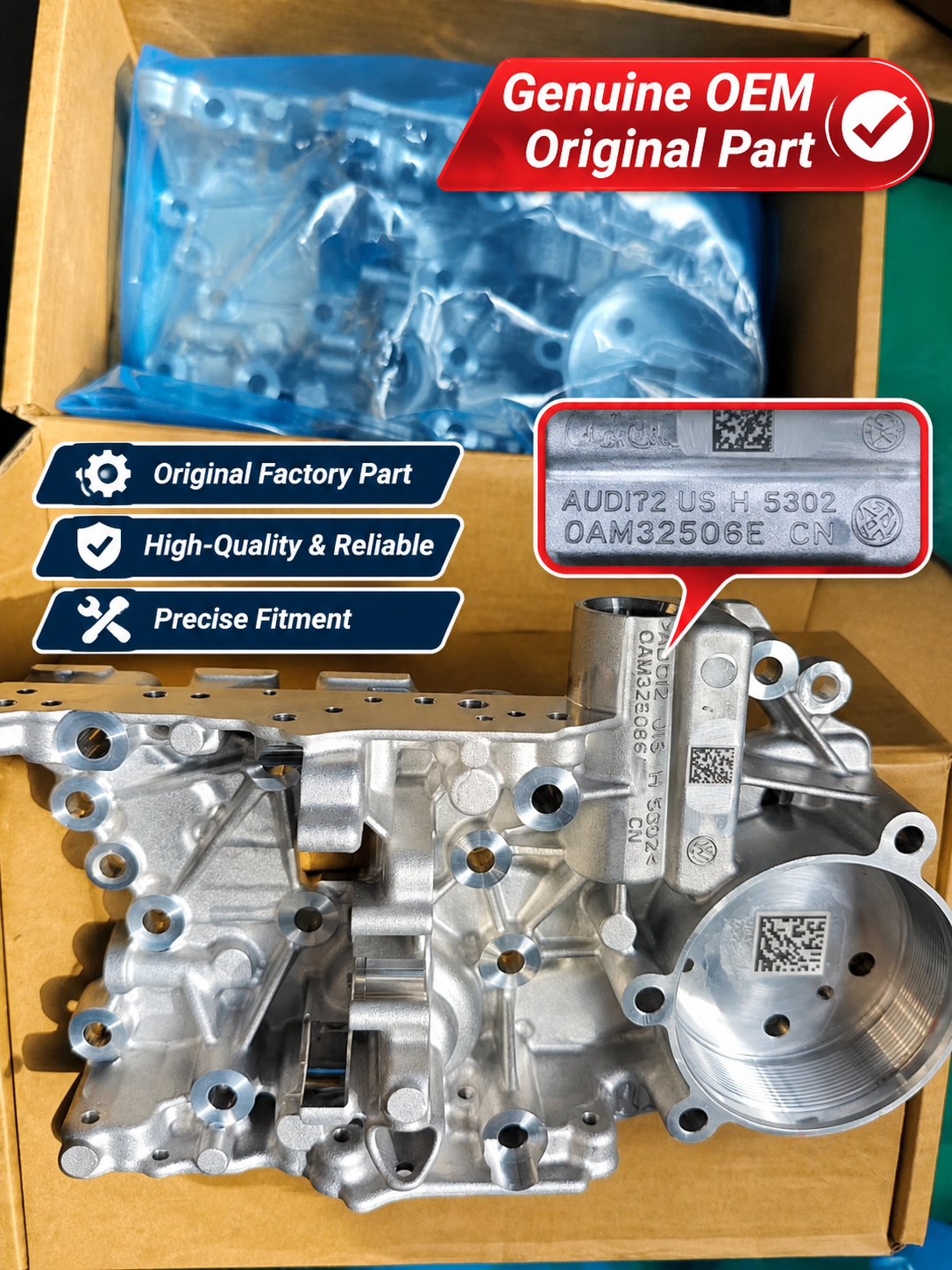
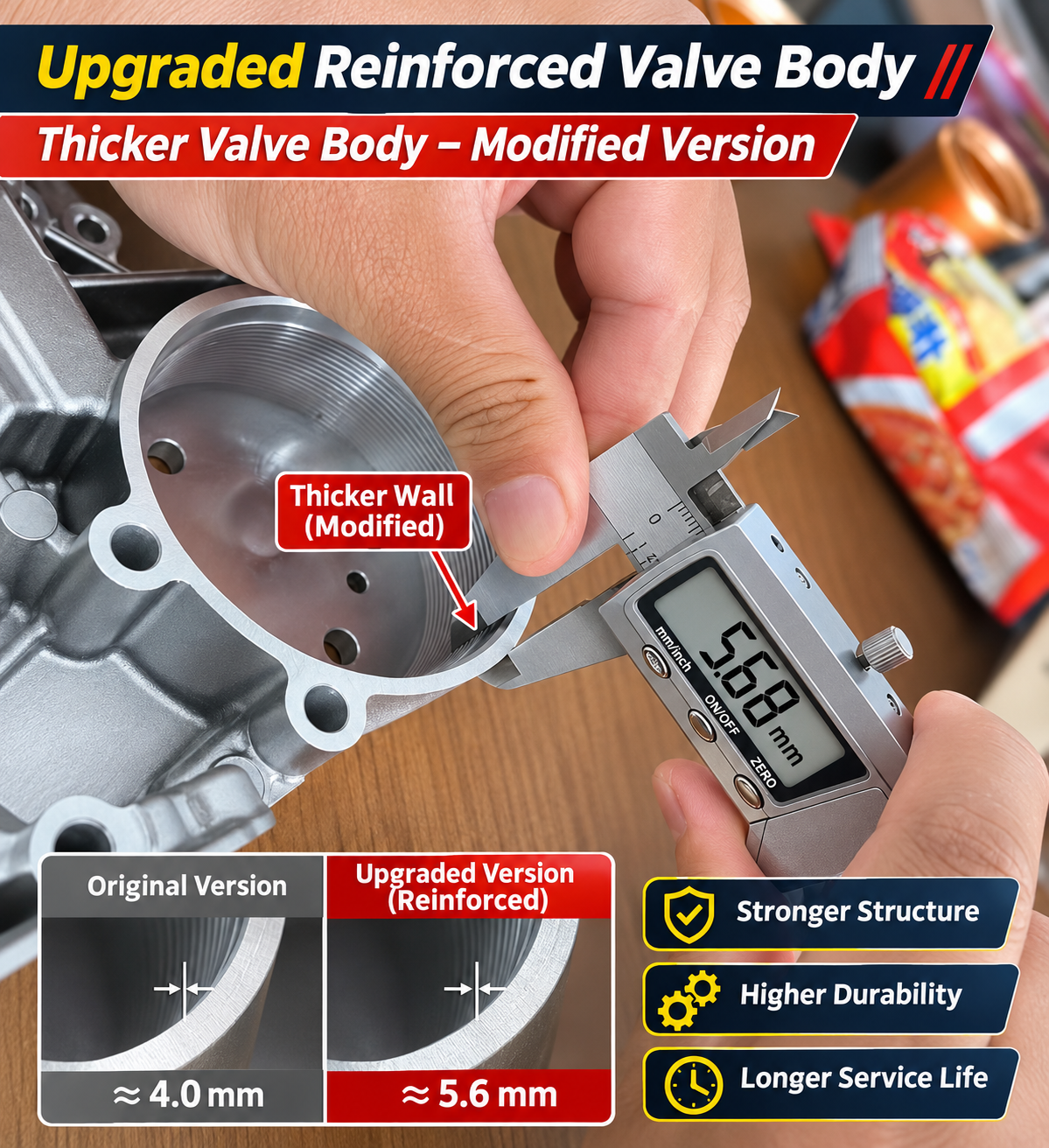
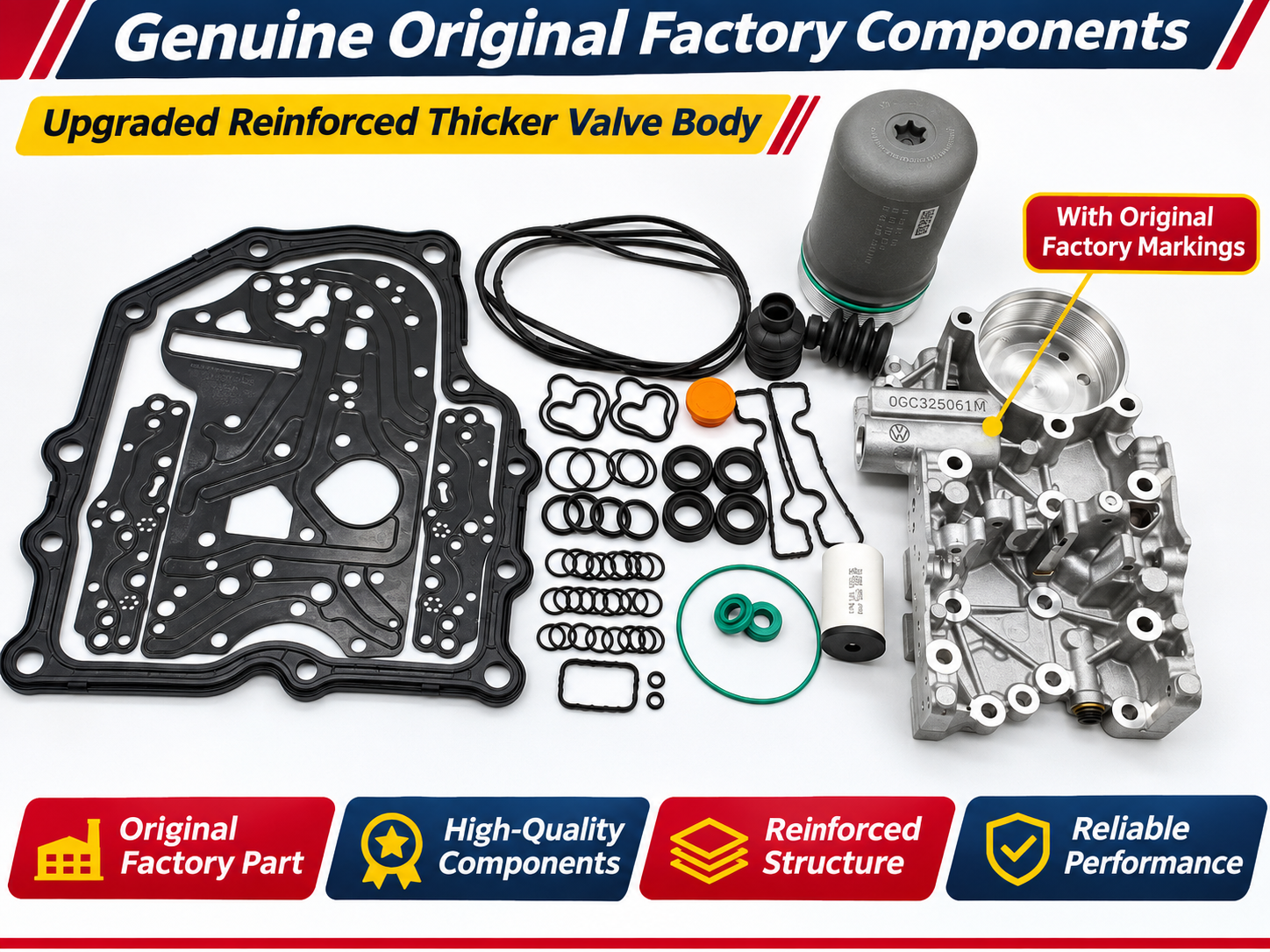
This guide explains how to evaluate the reinforced-housing claim on RunningRoo's DQ200 0AM mechatronic listing. It focuses on the physical upgrade and the evidence worth requesting before purchase. It does not promise a cure for every DSG complaint, extra engine torque capacity or a maintenance-free transmission. Australian buyers should begin with a professional diagnosis and then match the proposed assembly to the vehicle's VIN, engine code, gearbox identity and existing control-unit reference.
What RunningRoo currently offers
The verified RunningRoo website title describes a DQ200 0AM DSG mechatronic with a reinforced thick valve body, TCU reference 0AM927769D and a programming reference in the title. The corresponding eBay item, 365060451423, also uses “Thickened Valve Body” in its title. Both links identify a real sales offer, rather than an illustration of a hypothetical upgrade. The website description lists valve-body reference 0AM325065S and a remanufactured valve-body-plus-TCU assembly.
There is an important supply detail to resolve. The current eBay description explicitly says programming is not included and can be arranged separately. The website description also asks customers who need programming to provide their VIN or a photograph. Consequently, do not treat the short “+Program” wording in a title as a promise that your vehicle's programming is automatically included in the advertised price. Obtain written confirmation of the exact unit, preparation and service before ordering.
The listing establishes that RunningRoo markets a reinforced or thickened product. It does not, by itself, establish a measured wall thickness, a named alloy, a comparative fatigue result or a guaranteed service life. Those details should be requested if they are important to the purchasing decision. This separation lets a buyer discuss the advertised feature accurately without turning an unmeasured description into a technical specification.
Why housing integrity belongs in the discussion
Volkswagen's official New Zealand mechatronics campaign information explains that a component failure in some DQ200 units can cause hydraulic pressure loss and interrupt power transmission. Separately, Volkswagen's US recall report 19V-866 describes reduced wall thickness around an accumulator-housing thread in affected units. These documents explain why housing integrity is a legitimate engineering concern. They are not an endorsement or test certificate for any aftermarket component. Volkswagen: mechatronics campaign background; NZ scope Volkswagen US recall report 19V-866; affected-unit background only
A recall also has a defined population. A similar gearbox name does not prove that an Australian vehicle is included, that its original housing has the same issue, or that an aftermarket repair is the manufacturer's campaign remedy. Ask a Volkswagen Group dealer to check the VIN for applicable campaigns before paying for a private repair. Keep the dealer's response with the workshop assessment so the decision is based on the car in front of you.
For a buyer, the useful question is therefore specific: what physical feature has been changed on the offered assembly, and how does the supplier identify that version? Asking this question is more productive than asking whether all older DQ200 transmissions are weak. It creates an answer that can be recorded on a quotation, compared with the delivered item and discussed with the installing transmission specialist.
Define the changed component precisely
The phrase “valve body” can be used loosely in online listings. A customer may mean the hydraulic block, the complete mechatronic assembly, the accumulator mounting area or even the control electronics. Before comparing two offers, ask the supplier to name the changed part and identify it on a photograph. A labelled image of the current stock is preferable to a generic marketing picture of a complete transmission.
Next, ask whether the reinforcement is part of a replacement casting, a machined component, an inserted repair arrangement or another construction. These are questions to resolve, not descriptions of this product that have been independently verified. Do not assume that an attractive outside finish shows how an internal region was manufactured. Similarly, a photograph with a ruler is useful only when the measurement location, unit and reference surface are clear.
Request an identifier that follows the part through the sale: a stock reference, version description, batch marking or invoice wording. If the supplier later sends another photograph, that identifier helps establish whether both images show the same offered version. A buyer does not need to become a materials engineer. The goal is simply to make “reinforced” mean something traceable rather than allowing it to remain an interchangeable advertising adjective.
| Claim or question | Evidence to request | What it does not establish |
|---|---|---|
| Thickened housing | Current-stock photograph and identification of changed area | A numerical thickness without measurement |
| Reinforced construction | Written description of the supplied version | Guaranteed lifetime or immunity to all faults |
| Valve body plus TCU | Itemised supplied-parts list and control-unit label | Automatic suitability for every DQ200 vehicle |
| Tested assembly | Test scope and identification of the unit tested | Correct operation after installation in another vehicle |
| Programming available | Written service scope, cost and required information | Programming included merely because of a title |
| Australian supply | Confirmed stock, pickup appointment or dispatch estimate | Delivery on a particular day without confirmation |
Keep structural claims separate from driving claims
An owner may understandably hope that a reinforced component will also make shifts smoother, eliminate judder and allow a tuned engine to produce more torque. Each of those is a separate claim requiring its own evidence. A structural description does not provide a calibration specification, clutch assessment or vehicle-level durability test. The workshop should describe the diagnosed fault and explain which part of the proposed repair addresses it.
For example, consider a hypothetical vehicle with a documented hydraulic concern and an unrelated complaint during low-speed manoeuvring. A quotation may correctly address the hydraulic component while leaving the second complaint subject to further assessment. Calling the whole job an “upgrade” should not erase that distinction. Ask for the expected outcome in ordinary language: which symptom is the repair intended to resolve, and which observations still need investigation?
Avoid using a friend's successful repair as a fitment certificate. Their car may have different identifiers, service history or repair contents even when the badge and year appear similar. Their experience can suggest useful questions to ask, but the purchasing decision should still use your own inspection record. This is particularly important when comparing used vehicles with undocumented transmission work or an engine replacement.
Build a fitment file before the workshop removes anything
Start with the complete VIN and the registration details, then add the engine code and gearbox code as identified by the workshop. Include a clear photograph of the current TCU label and record the full suffix of each part number. Do not shorten 0AM927769D to “0AM unit” in the order notes. Similar-looking references are not a substitute for an application check.
The file should also say whether the installed assembly is believed to be original. If there is an earlier invoice, ask the workshop to review it. A replacement unit fitted years ago may explain why the physical label and a catalogue lookup appear different. Where the information conflicts, resolve the discrepancy before purchasing rather than choosing whichever number most closely resembles an advertisement.
Send the supplier only the vehicle information needed to check the order. A readable label photograph is useful; unrelated personal details on paperwork are not. Keep the supplier's written confirmation alongside the quotation. That gives both the customer and the installer a consistent reference when the parcel arrives and prevents a telephone conversation from becoming the only record of an important compatibility decision.
Assess the quotation as a complete repair proposal
For this product, the physical assembly and the preparation service need separate lines of explanation. Ask what arrives in the box, whether any electronics are supplied, which identifiers have been checked and what programming remains for the workshop. The current description's programming qualification makes that conversation essential. A complete written answer is more valuable than an assurance that the item is simply “ready to go”.
Also confirm the treatment of the removed assembly, any exchange requirement, packaging instructions and the process for reporting a discrepancy before installation. These are commercial questions rather than assumed terms of RunningRoo's offer. Read the actual terms supplied for your order. Do not send a unit away or dismantle a delivered assembly based on an assumption about how a supplier normally handles another product.
Compare prices only after those scope questions are answered. An assembly price, a separately arranged programming service and an installed workshop quotation describe different purchases. A useful comparison records each component of the job without inventing an average Australian labour rate. Your workshop can quote its own inspection, fitting and verification work once it knows the exact vehicle and proposed parts.
Receiving a reinforced assembly without losing traceability
When the item arrives, compare the paperwork and visible labels with the agreed order before it enters the installation process. Photograph the package, the identification marks and the relevant exterior views. Do not remove protective packaging unnecessarily or open hydraulic sections merely to satisfy curiosity. Ask the supplier how to inspect the advertised feature safely if it is not visible externally.
If the delivered identification differs from the quotation, pause and ask for clarification. A different suffix may have an explanation, but that explanation should be checked by the responsible specialist rather than inferred from a web search. Keeping the unit in its supplied condition while the question is resolved protects the quality of the evidence and avoids confusing a supply issue with an installation issue.
After fitting, ask the workshop to connect its completion record to the same unit identification. The record should describe the work performed and the outcome of the vehicle-specific checks selected by the technician. It should not merely repeat “reinforced valve body installed”. A useful repair history tells a future technician what was changed and how the car behaved when the work was completed.
Related RunningRoo workshop video
RunningRoo: DQ200 mechatronic valve-body pressure-loss repair. This is related workshop context, not proof that the filmed component is the exact supplied reinforced version. Verify all procedures against current manufacturer information for the vehicle; the video does not establish product dimensions, fitment or performance guarantees.
Buying locally in Melbourne and elsewhere in Australia
RunningRoo is an Australian-operated parts business in Blackburn, Victoria. Melbourne customers can arrange local pickup by appointment, while interstate customers can ask about fast dispatch from confirmed stock. Check availability and timing before booking the car into a workshop, particularly when programming information must be reviewed before an assembly is prepared. A stock indication is not a confirmed workshop completion date.
Friendly support is most useful when the enquiry is specific. Send the VIN, engine and gearbox identification, the full OE references and the specialist's parts request. Explain whether you need the physical assembly only or want to discuss the separate programming service. Call 0425 890 125 if a label or supply detail is unclear, and retain the written answer with the order.
This approach keeps the purchase focused on an identifiable product and an agreed repair. It also avoids turning local pickup into an informal installation booking. Confirm what RunningRoo supplies and what your chosen workshop performs, then arrange collection or dispatch accordingly. The website and eBay links below are the actual matched offers reviewed for this guide; their live terms should be checked again when ordering.
Frequently asked questions
Does “thickened” mean the DQ200 cannot fail again?
No. The term describes an advertised physical feature, not immunity to every possible transmission problem. Ask which area is changed and what evidence supports the description. The diagnosed fault, correct application and completed vehicle checks still determine whether the proposed repair is appropriate. No verified lifetime or failure-rate guarantee has been established for this guide.
Is this a torque upgrade for a tuned car?
Do not treat it as one. The reviewed offer does not provide a verified vehicle-level torque increase or approval for a tuned application. Tell the workshop and supplier about any modifications before ordering. They need to assess the actual application rather than assuming that a reinforced hydraulic component changes every other limit in the transmission.
Is programming included in the advertised price?
Obtain a written answer. The titles mention programming, but the current eBay description says it is arranged separately and the website description asks for vehicle information when programming is needed. Specify the required service and who will perform the remaining work. Do not order on the title alone.
Will 0AM927769D fit every seven-speed DSG?
No universal fitment claim is made here. Provide the complete VIN, engine code, gearbox code and existing TCU label. The full reference, including the final letter, must be reviewed with the application. A seven-speed description or vehicle badge is not enough to authorise a replacement.
Can I inspect the reinforced area at pickup?
Ask in advance what can be shown on the supplied version without opening or disturbing the unit. A current-stock image, version identifier and written description may be the appropriate evidence. Melbourne pickup is by appointment; it should not be assumed to include dismantling, testing or installation services.
What should I send RunningRoo first?
Send the VIN, engine and gearbox identifiers, a readable photograph of the current control-unit label and the workshop's diagnosis or parts request. State that you are enquiring about the thickened valve-body-plus-TCU offer. RunningRoo can then discuss the current product and programming scope through the official product links or on 0425 890 125.
Related reading: DQ200 Mechatronic: Common Part Numbers and What They Mean. This separate guide covers a different component or search question; it does not establish interchangeability with the product discussed here.
Sources and scope
Product details and availability were checked on 10 November 2026. Retailer listings establish the offer; manufacturer sources below support only the technical points identified in the article. Current vehicle-specific workshop information takes priority over general background.