
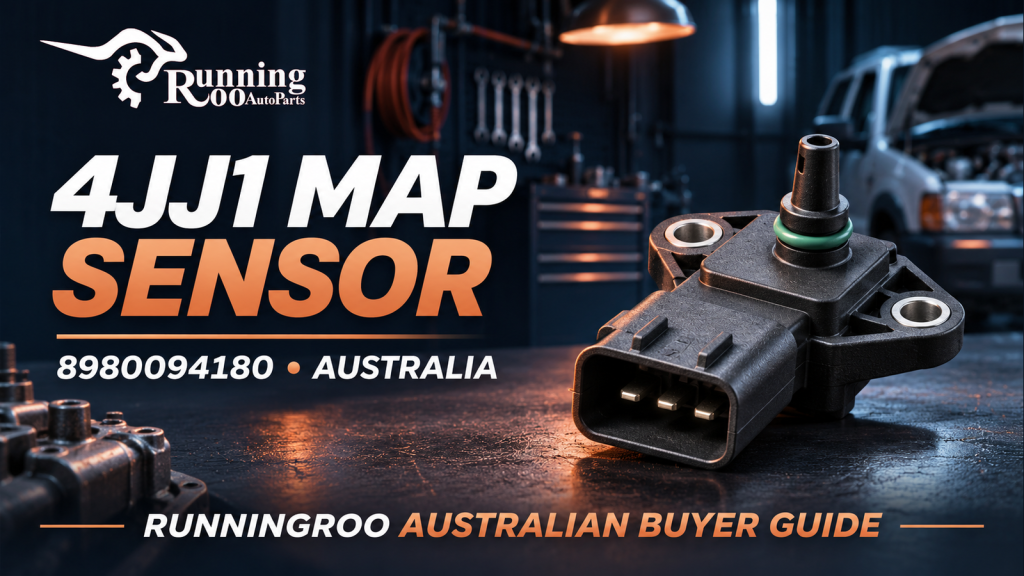
A search for a 4JJ1 MAP sensor in Australia often follows a loss-of-power complaint or an engine warning. The part may be small, but choosing it correctly requires more than matching the words D-Max, Rodeo or Colorado. RunningRoo's listing identifies a three-pin manifold absolute pressure sensor using OE reference 8980094180 for specified 4JJ1-TCX applications. The vehicle identity, connector and diagnostic findings should all agree before a replacement is ordered.

This guide helps Australian owners prepare a useful enquiry for the listed sensor and understand the workshop's assessment. It is not a promise that replacing a MAP sensor will cure every diesel performance problem. Technical testing must use the correct vehicle wiring information and manufacturer procedure. Provide the VIN, engine code and existing sensor reference, and let a qualified technician establish whether the sensor, its connections or another part of the system needs attention.
Identify the exact RunningRoo offer
The verified website product describes a MAP sensor for Holden Rodeo RA, Colorado RC and Isuzu D-Max TF with the 3.0-litre 4JJ1-TCX diesel engine. It lists OE reference 8980094180, also written as 898009-4180 or 8-98009418-0, and a three-pin connector. The matching eBay item is 365537385457. These are real current offers, not links to a generic sensor search page.
The listed applications are a starting point for confirmation. The website gives particular date ranges, but build details and the actual installed engine should still be checked before purchase. Do not extend the description to every D-Max generation, every Colorado engine or every sensor carrying a similar housing shape. Ask RunningRoo to confirm the application using the complete vehicle information.
The listing identifies one sensor in the package. Do not assume that a wiring repair, connector replacement, intake repair or diagnostic service is included. If the workshop has identified another required item, have it listed separately. Keeping the supplied contents explicit helps the owner compare the parts purchase with an installed repair quotation without confusing the two.
Understand what a MAP-sensor enquiry is asking
MAP means manifold absolute pressure. HELLA's manufacturer information describes a pressure-sensing element that sends an electrical signal to the engine control unit. Its published material also distinguishes sensors that combine pressure and intake-air-temperature functions from other designs. This is general technical background, not proof that the RunningRoo sensor is made by HELLA or uses the same pin assignment as an illustrated HELLA unit. HELLA: manifold pressure sensor function; general background, not this item manufacturer or pinout
For the buyer, the practical lesson is to match the actual sensor type and connector rather than treating every intake sensor as interchangeable. A workshop request for a manifold pressure sensor should not become an order for an air-mass sensor merely because both appear in discussions of diesel performance. Ask the technician to provide the component name and checked OE reference together.
An online description may use MAP, boost pressure sensor or manifold pressure sensor in related searches. Those words help locate information, but they do not establish interchangeability between different applications. The number, electrical arrangement, mounting and vehicle match remain the important ordering details. If the workshop uses different terminology, have it confirm that its requested component is the one represented by 8980094180.
Report the symptoms without deciding the failed part
Tell the workshop when the concern occurs and what the driver actually notices. Useful details include whether the warning is intermittent, whether the problem appeared after recent work and whether operating conditions seem relevant. Record the warning text or code report if available, but avoid turning a generic code description into an instruction to replace the sensor immediately.
HELLA's MAP-sensor troubleshooting guidance includes checking connectors and wiring, pressure connections where applicable, stored diagnostic information, and power and earth supplies with suitable equipment. That supports a structured assessment rather than replacing the sensor on the basis of a symptom alone. The exact checks and expected values for a 4JJ1-TCX vehicle must come from its appropriate technical information. HELLA: MAP sensor troubleshooting, general manufacturer guidance
Ask the technician to explain the finding in a short note: what was checked, what was observed and why a replacement is recommended. The owner does not need to perform electrical tests personally. The purpose is to distinguish an identified sensor problem from a broad suspicion based on an engine warning. That distinction is valuable before buying a part and when reviewing the result afterwards.
| Ordering or diagnosis check | Record for the enquiry | Do not assume |
|---|---|---|
| Vehicle | VIN, model series and build details | Every D-Max or Colorado uses this sensor |
| Engine | Confirmed 4JJ1-TCX identity | All 3.0-litre diesels share the application |
| Reference | 8980094180 and markings on the existing sensor | Similar-looking numbers are equivalent |
| Connector | Clear photograph and three-pin identification | Matching pin count proves the whole application |
| Workshop findings | Relevant scan and inspection conclusion | An engine warning proves sensor failure |
| Package | One sensor as described; other items confirmed separately | A connector or wiring repair is included |
| Completion | Technician's vehicle-specific verification | Clearing a warning alone establishes the repair |
Check the connector without creating a new problem
A clear photograph of the existing connector and sensor label can be useful when the workshop can obtain it safely. Ask the technician to provide the image rather than forcing a connector apart simply for a shopping enquiry. The photograph should show the relevant shape and identification clearly; a distant engine-bay picture may not answer the supplier's fitment question.
Three pins are one identification feature, not a complete compatibility test. The technician should check the appropriate wiring information and application. Do not bridge terminals, apply an external voltage or copy a pinout from a different sensor because the plugs look similar. This guide provides no universal pin assignment or test voltage for the listed vehicle families.
If wiring or connector condition is part of the diagnosis, ask whether the repair quotation addresses it separately from the sensor. Replacing one component should not silently imply that a harness issue has also been repaired. The job sheet should make the scope visible so the owner understands what the workshop expects the new sensor to change.
Keep cleaning advice application-specific
Online discussions often recommend cleaning a sensor whenever a diesel has a performance complaint. Before doing anything to the component, ask the workshop whether cleaning is appropriate for the identified design and condition. A generic solvent recommendation or a video showing another sensor is not a manufacturer-approved procedure for this particular part.
Do not scrape a sensing opening, insert a tool into it or apply an improvised cleaning process to prove a theory. The technician should decide how the component can be inspected and what the manufacturer permits. If the assessment supports replacement, preserve the old part in the condition requested by the workshop or supplier until any questions have been resolved.
The purchasing question is also different from the cleaning question. RunningRoo can help identify the offered replacement, while the workshop determines the appropriate treatment of the existing component. Keeping those roles clear prevents a product enquiry from becoming an unsupported remote repair instruction. It also avoids describing a replacement sensor as a universal cure for contamination elsewhere in the intake system.
Prepare a useful parts request for an older work ute
For a vehicle with a long service history, tell the workshop about any known engine or intake-related replacement work. A label on the installed component may need to be reconciled with the original vehicle record. Do not hide that uncertainty by selecting the closest-looking online photograph. A few extra details at the enquiry stage can prevent a mismatch after the car has been booked in.
If the ute is used by several drivers, ask each regular driver for a brief factual description of the concern. Keep the notes concise and avoid collecting guesses about failed parts. A consistent symptom history helps the technician decide what to investigate. It also gives the owner a clearer basis for assessing whether the reported issue was observed after repair.
Where a workshop is ordering on behalf of a business, use one job reference across the parts enquiry, quotation and invoice. Confirm who will receive the parcel and who will check it before installation. This administrative detail matters when the vehicle is booked for a short downtime window and a missing label photograph or unanswered fitment question could delay the order.
Compare the delivered sensor before installation
Keep the order confirmation and compare the supplied package with the agreed reference. Ask the installer to check the relevant physical and identification details before fitting. If there is a discrepancy, contact RunningRoo while the part is still in its supplied condition. Do not alter a connector or mounting feature to make a questionable item fit.
The workshop should retain the identification of the actual part installed in the service record. A line stating only “sensor replaced” is less useful than a component description and reference tied to the vehicle. If the product is supplied under a replacement reference confirmed by the seller, retain that explanation as well. This keeps later enquiries grounded in the real order.
The old part can be useful for comparison, but it is not automatically a reliable master sample. It may have been changed previously. Have the technician assess any differences using the application information rather than assuming that the oldest available item must be correct. The final decision should reconcile the vehicle, manufacturer information and supplied part.
Ask how the repair was verified
At collection, ask the workshop to explain the checks completed and whether the original concern was reproduced or resolved during its assessment. Where scan data or electrical testing were relevant, the technician should interpret the result. An owner should not be expected to infer success from an unexplained screenshot or from the fact that a warning was cleared.
If the concern was intermittent and did not occur during the assessment, record that limitation honestly. Agree what details to provide if it returns. A date, operating context and warning description are more useful than a message saying only that the sensor “did not work”. Do not continue driving through a serious problem merely to gather a more dramatic example.
Keep any unrelated recommendations separate from the completed sensor job. The workshop may identify another item requiring attention, but that should be explained and quoted on its own merits. A clear record protects the owner from assuming a single sensor replacement covered every possible source of reduced performance on an older diesel vehicle.
Local support for Australian buyers
RunningRoo is Australian-operated and based in Blackburn, Victoria. Melbourne local pickup is by appointment, and fast dispatch is available to discuss once the correct item and stock are confirmed. Friendly support is most effective when the enquiry includes the VIN, engine code, OE number and the workshop's request. Call 0425 890 125 before ordering if the identification is uncertain.
For an interstate workshop, confirm the delivery address and timing after the application has been checked. Do not schedule the vehicle solely around a general shipping statement. The linked website product and matching eBay listing provide the live offer, and their current terms should be reviewed at purchase. Correct identification remains more important than ordering quickly from a model-name search.
Frequently asked questions
Is 8980094180 the same written reference as 8-98009418-0?
The RunningRoo listing presents these as alternative formats of the reference for this sensor. Still provide the complete marking and vehicle details for confirmation. Do not extend that observation to other numbers that merely look similar, and do not omit the engine or connector information from the enquiry.
Does this fit all Isuzu D-Max models?
No universal claim is made. The listing describes particular TF and 4JJ1-TCX applications, alongside specified Rodeo and Colorado applications. Have RunningRoo check the VIN, build information and existing sensor reference. Later generations and other engines should not be included simply because they share the D-Max name.
Will a new MAP sensor fix low power?
Only diagnosis can determine whether this sensor is responsible for the concern. The workshop should assess the relevant system and explain the evidence supporting replacement. A performance complaint or warning by itself is not a guarantee that a sensor purchase will resolve the issue.
Is a three-pin connector enough to confirm fitment?
No. Pin count is only one detail. The application, reference, connector design and appropriate electrical information must also agree. Do not modify a plug or use an unrelated wiring diagram to make a part appear suitable. Ask for confirmation before installation.
Can I clean the sensor instead of replacing it?
Ask the technician to assess the actual design and condition using the relevant manufacturer guidance. No universal cleaner or cleaning method is recommended here. Avoid scraping or probing the sensing area, and do not treat a video of another component as approval for this one.
Can RunningRoo help with a workshop parts enquiry?
Yes, contact the business with the VIN, engine code, full OE reference and the technician's requested component. Use the matched website or eBay offer, or call 0425 890 125. Melbourne pickup is by appointment, and dispatch timing should be confirmed against current stock and the completed fitment check.
Related reading: Isuzu 4JJ1 Timing Chain Kit: D-MAX, Rodeo and Colorado Repair Planning. This separate guide covers a different component or search question; it does not establish interchangeability with the product discussed here.
Sources and scope
Product details and availability were checked on 10 November 2026. Retailer listings establish the offer; manufacturer sources below support only the technical points identified in the article. Current vehicle-specific workshop information takes priority over general background.