
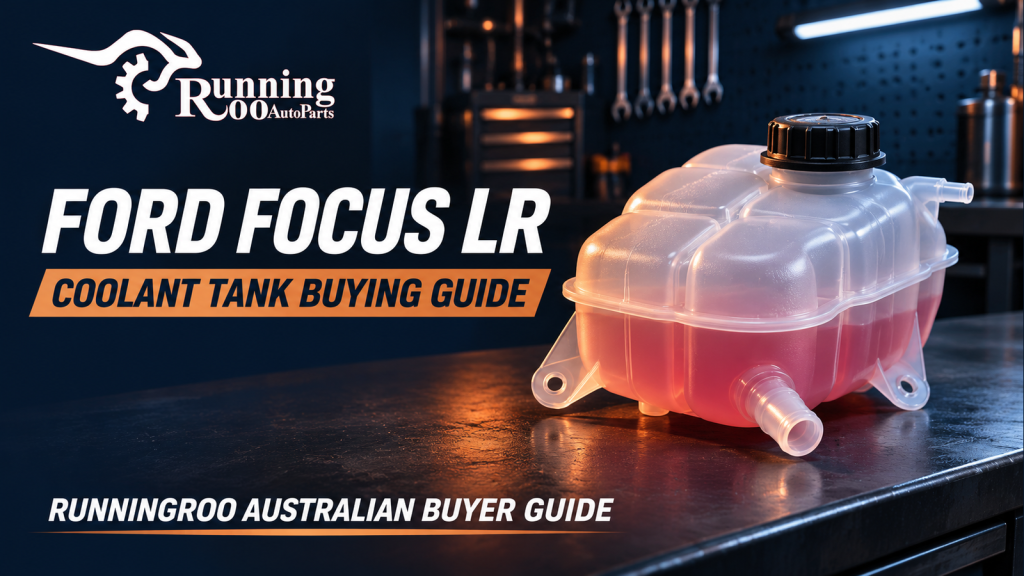
If you are looking for a Ford Focus LR coolant tank in Australia, the first job is to establish the correct reservoir and the reason it needs replacement. A translucent bottle that looks similar in a photograph may have different mounting points, hose connections or cap requirements. RunningRoo has a current Focus LR overflow-bottle listing, but its title and description use different year ranges. That makes a VIN and physical-fitment check especially important before ordering.

This guide explains how to prepare that check, discuss a suspected leak with a workshop and define the contents of the repair. It is written for Australian buyers of the listed reservoir, not as a universal Focus cooling-system repair manual. Provide the VIN, engine code, build details and any moulded reference on the existing tank. Let the technician confirm the diagnosis and follow the correct manufacturer information for the actual vehicle.
Read the complete listing before relying on the year
The verified RunningRoo website product and matching eBay item 365523621964 are titled for a Ford Focus coolant overflow bottle covering 2000–2005 LR hatch and sedan applications. However, the website description refers to 1998–2004 and names several engine sizes. Those ranges should not be merged into a new universal fitment promise. Ask the supplier to check your specific vehicle and the old tank before placing the order.
The product title is useful for finding the offer, while the actual application check resolves whether it belongs on your car. Provide build information rather than relying only on the year of first registration. If the engine or cooling components have been changed, disclose that history. A replacement engine or earlier repair can make an apparently straightforward model-year lookup less reliable.
Also ask what is supplied with the bottle. Do not assume a cap, hoses, clips or other fittings are included because a photograph shows them near the reservoir. Obtain confirmation of the actual package and let the workshop specify any additional items. This avoids confusing a reservoir purchase with a complete cooling-system refresh.
Make the first inspection a cold-system inspection
Ford's official owner guidance warns against removing a coolant reservoir cap while the engine is running or the system is hot. It also describes checking the level against the reservoir's marks with the engine cold. These are useful safety principles, but the linked 2022 Ranger owner material is used only for general safety; it is not an LR fitment catalogue or a source for this vehicle's exact coolant specification. Use the correct manual for the identified car. Ford 2022 Ranger owner information: general cold-system safety only; not Focus LR fitment or specification evidence
For a parts enquiry, you do not need to open a hot system. Arrange for the workshop to obtain any necessary photographs and identification safely. If the car has overheated or is losing coolant, ask a professional whether it should be driven at all. Do not make a trip to collect a replacement bottle on the assumption that topping up has resolved the underlying concern.
When describing the issue, distinguish what you observed from what has been diagnosed. A low level, visible residue, a damaged bottle or an overheating warning are different observations. The technician should assess the source and significance of the concern. Calling every loss of coolant a failed reservoir can lead to an incomplete repair if the bottle is not the only problem.
Gather the physical identification that photographs can show
Ask for clear views of the existing tank, its mounting arrangement, hose connections and any moulded part reference. Include a wider view showing where it sits in the engine bay. A close-up of an isolated translucent corner may be too limited for a useful comparison, while a single distant photograph can hide the details that matter.
The workshop can compare those details with the supplier's current product information. Where a connector, bracket or neck appears different, resolve the difference before buying. Do not assume that a flexible hose can compensate for the wrong connection position or that a mounting tab can be modified without consequence. The order should be for the correct application rather than an improvised adaptation.
If the old tank is heavily stained or its markings are unreadable, state that limitation. The supplier may need other vehicle information or another photograph. Avoid inventing a part number from an indistinct moulding. A tentative reading can be sent as a question, but it should not become the only basis for an order that the workshop is expected to install.
| Check | What to supply or confirm | Reason for checking |
|---|---|---|
| Vehicle identity | VIN, build details, LR series and engine code | Resolves the listing's differing year ranges |
| Existing reservoir | Photographs and readable moulded reference | Supports a physical application comparison |
| Connections | Hose positions, neck and mounting details | Prevents choosing by overall shape alone |
| Package contents | Bottle, cap and fittings confirmed individually | Avoids assuming a complete kit |
| Diagnosis | Workshop's identified leak or damage | Connects the part to the actual repair |
| Coolant and procedure | Specification and method for the exact vehicle | Avoids using a different Ford manual as a repair recipe |
| Handover | Completed checks and any follow-up advice | Documents the result beyond fitting the bottle |
Ask the workshop to define the leak assessment
A useful assessment explains why the reservoir is being replaced. If the technician has identified visible damage, ask for that finding to be recorded. If the concern requires further testing, ask what the next inspection stage will establish. The owner should understand whether the bottle is the confirmed source, one of several findings or a preventative item proposed during other work.
The workshop should select appropriate testing from the correct vehicle information. This guide does not prescribe a universal test pressure or tell owners to pressurise a cooling system themselves. A pressure figure from another vehicle is not an acceptable substitute for the manufacturer's procedure. Ask the technician to explain the outcome rather than requesting an arbitrary number from an online discussion.
If overheating occurred, make sure that fact is included in the job history. Replacing a visibly damaged bottle does not by itself establish that every consequence or other cause of the event has been assessed. Let the workshop explain the necessary scope. A clear diagnosis protects the customer from treating a new plastic reservoir as proof that the entire cooling system has been restored.
Treat the cap and bottle as separate ordering questions
The cap may appear to be a small accessory, but its identity and condition should be considered by the installer according to the vehicle information. Ask whether the supplied offer includes it and whether the existing cap is intended to be reused. Do not choose a replacement solely by colour or because it screws onto a similar-looking neck.
Record the answer on the quotation. If the workshop requests a separate cap or another fitting, identify that item explicitly. A line reading “coolant tank kit” can be misleading if the actual order contains only the bottle. Precise contents help both the supplier and installer check that everything required for the agreed job is available before the vehicle is dismantled.
The same principle applies to clips and hoses. Do not assume they need replacement without an assessment, but do not assume they are supplied with the tank either. The workshop should identify the actual requirements. This keeps the purchase focused and avoids an unnecessary bundle of parts selected from a different Focus version.
Choose coolant by the correct specification
Ford's published guidance cautions against mixing unsuitable coolant types and directs owners to the vehicle's specification. For this LR repair, ask the technician to identify the applicable requirement from the correct manual or service information. Do not use the colour of the old fluid or a product photograph to select a coolant, and do not copy a specification from a later Focus article. Ford 2022 Ranger owner information: general cold-system safety only; not Focus LR fitment or specification evidence
If the history of the existing fluid is unknown, tell the workshop. It can decide what the repair procedure requires and quote the relevant work. The owner should not try to make the history appear certain by guessing what a previous owner used. An honest unknown is more useful to the technician than an unsupported statement that the system contains a particular product.
Ask what refill and verification work is included with the reservoir replacement. The appropriate method belongs to the identified vehicle and should be performed by the responsible technician. This guide deliberately avoids a universal bleed sequence, fill quantity or waiting time. Those details are application-dependent and should not be inferred from a generic bottle listing.
Plan the purchase around the workshop booking
Once the application and contents are confirmed, ask RunningRoo about current stock and dispatch or pickup timing. Then confirm the workshop appointment. This sequence is particularly useful for an older car where the existing tank reference may take time to identify. Booking first and ordering by an uncertain year range can create avoidable downtime if the application needs clarification.
If the workshop accepts customer-supplied parts, ask what it needs before the appointment. Send the confirmed product reference and contents rather than just a screenshot of the sale price. The installer can then tell you whether another item or inspection stage is required. Obtain the workshop's own terms for the arrangement rather than assuming all repairers handle supplied parts the same way.
For a vehicle that cannot safely be driven, discuss transport separately from the parts order. RunningRoo's local collection option does not establish that the car is fit to travel or that fitting is included at the pickup location. Keep the supply and workshop responsibilities clear so a convenient collection arrangement does not become an unsafe plan to drive an overheating car.
Check the delivered reservoir before it is fitted
Compare the received item with the agreed order and the relevant physical features of the old tank. Keep the packaging and confirmation available while the installer completes the check. If the neck, mounting or connections differ, ask the supplier for clarification before proceeding. Do not modify the new bottle to resolve an unexplained mismatch.
Ask the workshop to record what was fitted and what completion checks it performed. If the original concern involved a low level or visible leakage, the handover should explain the outcome of the relevant assessment. A new-looking tank is not, by itself, a diagnostic result. The owner should also understand any separate recommendations or follow-up instructions.
If a concern returns, contact the workshop with the date, observed condition and repair reference. Avoid repeatedly opening the system or adding unrelated products in an attempt to prove the cause. The technician should assess the new observation in context. Keeping the part identification and original job sheet helps make that conversation efficient and specific.
Australian supply with Melbourne support
RunningRoo is Australian-operated and based in Blackburn, Victoria. Melbourne local pickup is by appointment, and fast dispatch can be discussed once the correct part and stock are confirmed. Friendly support is available on 0425 890 125. Have the VIN, engine code and old reservoir photographs ready, especially because the current listing uses differing year ranges.
Use the matched website and eBay links to discuss this exact bottle. Review the live terms and package contents at purchase rather than relying on an old screenshot. The product has a recorded sale and remains available at the time of preparation, but that history does not replace the application check for your own Focus LR.
Frequently asked questions
Does the listing cover 1998–2005 without exceptions?
That should not be assumed. The title and description show different ranges. Ask RunningRoo to confirm your VIN, build details, engine and existing reservoir configuration. Do not combine the two ranges into a broader guarantee that neither the supplier nor the vehicle manufacturer has confirmed for your car.
Is the cap included with the new bottle?
Confirm the current package contents before ordering. A photograph or the general word “tank” does not settle whether a cap, clips or hoses are included. Ask the workshop what it requires and have any separately supplied items identified on the order.
Can I open the reservoir while the engine is hot?
No. Ford warns against removing the cap while the engine is running or the cooling system is hot. Arrange inspection with the engine cold and follow the appropriate vehicle guidance. Do not open a hot system merely to obtain a photograph for a parts enquiry.
Will a new reservoir cure overheating?
It depends on the diagnosis. The workshop must establish the source of the problem and assess any other relevant findings. A reservoir replacement should not be advertised as a universal cure for overheating or unexplained coolant loss without examining the vehicle.
Can I choose coolant by colour?
Use the specification for the identified vehicle, confirmed by the workshop or correct Ford information. Colour alone is not the ordering basis. Tell the technician if the existing coolant history is unknown, and ask what refill work the repair requires.
How do I arrange Melbourne collection?
Contact RunningRoo on 0425 890 125 after confirming the application and current stock. Pickup in Blackburn is by appointment. If the car has overheated or is losing coolant, discuss safe transport with a professional rather than assuming it can be driven to collect the part.
Related reading: Coolant Temperature Sensor and Thermostat: Overheating, Rich Running and Replacement Guide. This separate guide covers a different component or search question; it does not establish interchangeability with the product discussed here.
Sources and scope
Product details and availability were checked on 10 November 2026. Retailer listings establish the offer; manufacturer sources below support only the technical points identified in the article. Current vehicle-specific workshop information takes priority over general background.