
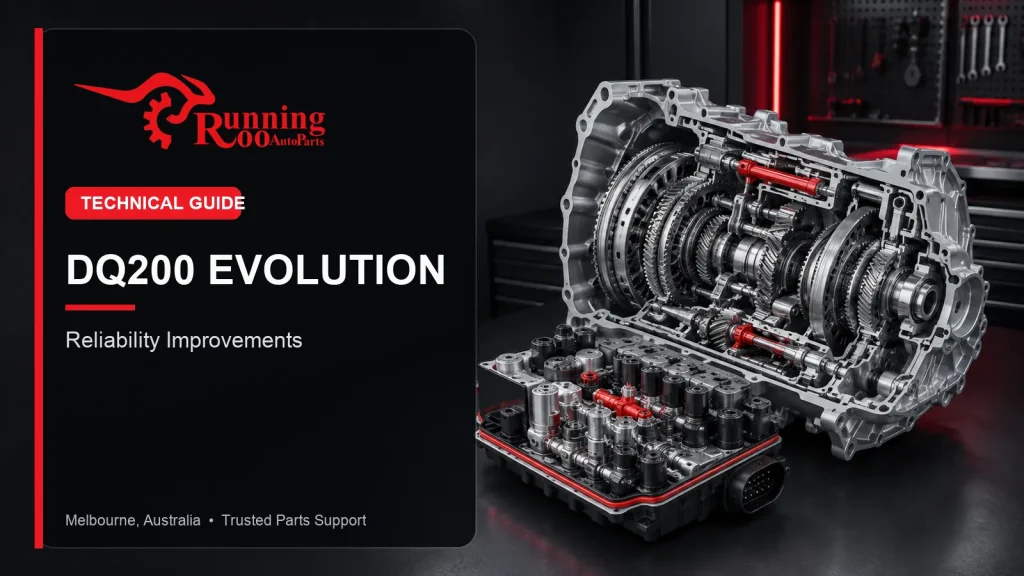
Over the past 18 years, Volkswagen’s dry dual-clutch transmission (DQ200 DSG) has undergone continuous refinement. What began as a highly efficient but sometimes problematic gearbox has matured into a widely used and much more reliable solution across many VW Group vehicles. Early concerns around clutch wear, drivability, and mechatronic reliability have been progressively addressed through improvements in materials, hardware design, and software calibration.
This article expands on those developments, with a focus on key components such as dq200 tcu, dq200 mechatronic unit, dq200 valve body, now enhanced with structured tables for clearer comparison and understanding.
1. Early Challenges and Root Causes
When the DQ200 was first introduced around 2008 in models like the Golf, Jetta, and Polo, it aimed to deliver improved fuel efficiency and fast shifting. However, real-world conditions—especially stop-start city driving in Australia—revealed several weaknesses.
Common Early Issues
| Issue Type | Description |
|---|---|
| Clutch Wear | Premature wear due to heat and friction in dry clutch design |
| Low-Speed Jerking | Poor calibration caused hesitation and rough engagement |
| Mechatronic Failures | High failure rate of dq200 mechatronic unit |
| Hydraulic Instability | Inconsistent pressure within dq200 valve body system |
| Shift Logic | Early dq200 tcu lacked adaptive intelligence |
At the core of most problems was the dq200 mechatronic, combining electronic and hydraulic control functions.
2. Hardware Improvements: Component Evolution
2.1 Clutch System Upgrades
| Upgrade Area | Improvement Detail | Result |
|---|---|---|
| Friction Material | Higher heat resistance | Reduced wear |
| Pressure Plate | Redesigned structure | More consistent engagement |
| Cooling Design | Improved heat dissipation | Lower overheating risk |
2.2 dq200 valve body Enhancements
| Feature सुधार | Early Version | Improved Version |
|---|---|---|
| Solenoid Response | Slower | Faster and more precise |
| Oil Flow Design | Pressure loss common | Optimised hydraulic routing |
| Sealing | Leakage issues | Enhanced sealing reliability |
The improved dq200 valve body plays a critical role in smoother gear transitions.
2.3 dq200 mechatronic unit Improvements
| Component Area | Improvement | Benefit |
|---|---|---|
| Hydraulic Pump | Stronger internal design | Longer lifespan |
| Accumulator | More stable pressure control | Smoother operation |
| Electronics | Better heat/moisture protection | Reduced failure rate |
The modern dq200 mechatronic unit is far more robust compared to early versions.
3. Software Evolution: dq200 tcu Advancements
Key Improvements in dq200 tcu
| Function | Early Behaviour | Current Behaviour |
|---|---|---|
| Shift Logic | Fixed patterns | Adaptive to driving style |
| Low-Speed Control | Jerky | Smooth creeping |
| Gear Selection | Frequent unnecessary shifts | Optimised shift timing |
| Clutch Engagement | Abrupt | Gradual and controlled |
The dq200 tcu now delivers a much more refined and intelligent driving experience.
4. Driving Experience Comparison
| Driving Condition | Early DQ200 Experience | Modern DQ200 Experience |
|---|---|---|
| Take-off | Hesitation / jerk | Smooth and controlled |
| Traffic Driving | Clutch overheating | Improved thermal management |
| Gear Changes | Noticeable shifts | Nearly seamless |
| Overall Comfort | Inconsistent | Much more refined |
This improvement is largely due to better coordination between dq200 mechatronic and dq200 tcu.
5. Reliability Improvements Over Time
| Component | Early Failure Rate | Current Reliability Level |
|---|---|---|
| Clutch System | High | Moderate to Low |
| Mechatronic Unit | High | Significantly Improved |
| Valve Body | Moderate | Stable |
| TCU Software | Basic | Highly Advanced |
Upgraded dq200 mechatronic unit and dq200 valve body have been key contributors.
6. Repair Strategy Evolution
| Repair Approach | Old Method | Modern Method |
|---|---|---|
| Diagnosis | Limited | Advanced fault code analysis |
| Repair Scope | Full replacement | Targeted component repair |
| Cost | High | More cost-effective |
| TCU Replacement | Rarely separated | dq200 tcu can be replaced individually |
This shift allows workshops to repair rather than replace entire systems.
7. Future Outlook
| Development Area | Expected Direction |
|---|---|
| Software | AI-based adaptive shifting |
| Materials | Higher durability friction components |
| System Design | Modular and easier to repair |
| Integration | Smarter vehicle system communication |
FAQ
1. What’s the difference between dq200 mechatronic and dq200 mechatronic unit?
They refer to the same integrated system combining hydraulic and electronic control.
2. Can the dq200 tcu be replaced separately?
Yes. The dq200 tcu can be replaced independently, but requires programming and calibration.
3. What are the symptoms of a faulty dq200 valve body?
| Symptom | Description |
|---|---|
| Hard Shifting | Sudden gear engagement |
| Delayed Response | Lag when selecting gears |
| Fault Codes | P17BF, P189C etc. |
4. Does a faulty dq200 mechatronic unit always need replacement?
No. Many issues can be repaired by replacing specific internal components.
5. How to extend DQ200 lifespan?
| Recommendation | Reason |
|---|---|
| Avoid constant creeping | Reduces clutch wear |
| Drive smoothly | Minimises stress on system |
| Early diagnostics | Prevents major failures |
Conclusion
Over nearly two decades, the DQ200 has transformed into a mature and reliable transmission. Continuous advancements in dq200 tcu software, dq200 mechatronic unit durability, and dq200 valve body performance have significantly improved both drivability and longevity.
With proper maintenance and informed repair strategies, today’s DQ200 systems can deliver excellent performance and long-term reliability—making them a solid choice in modern Volkswagen vehicles.
If you have any questions regarding any DQ200 gearbox-related issues, please feel free to contact us at any time.
We are based in Blackburn South, Melbourne, and provide 24/7 free pickup service (by appointment only) for your convenience.
📞 Phone: 0425 890 125
🛒 eBay Store: https://www.ebay.com.au/itm/365819799559?_skw=dq200&itmmeta=01KTGWC00ZCHGVEPKYYAZ4QXV0&hash=item552c8f2807:g:np8AAeSwNI1pRHw3
At RunningRoo Auto Parts, we are here to help with any DQ200 diagnostics, parts, or technical enquiries—don’t hesitate to reach out.
Awesome thank you
Cheers mate! 😊 Really appreciate it — thanks heaps for your support!
— RunningRoo Auto Parts 🇦🇺