
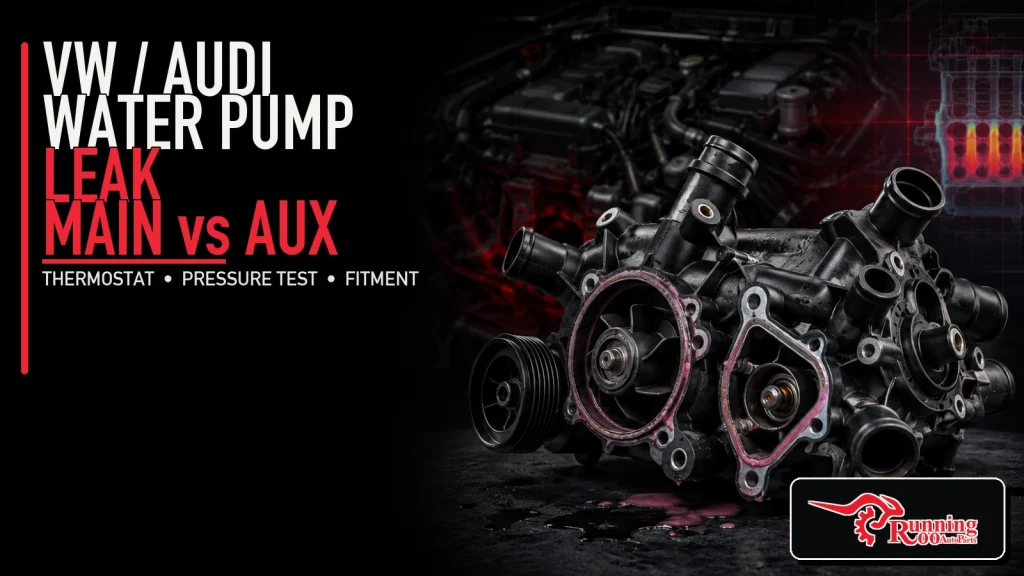
A pink or white coolant crust under a VW or Audi intake area may point toward a water-pump or thermostat-housing leak, but the group includes many engines and more than one pump function. Some vehicles use a mechanically driven main pump and integrated thermostat housing; others also use electric auxiliary pumps for turbocharger, heater or after-run circulation.
Ordering the first search result for ‘Golf/A4/Q5 water pump’ can therefore solve the wrong circuit. This guide separates main-pump housing leaks from auxiliary-pump faults, explains the tests that matter, and shows how to compare 06L121111G and broader multi-model listings without treating every VW Group engine as identical.
Quick answer: pressure-test the cold cooling system, trace the highest fresh wet point and identify the exact engine code before ordering. Decide whether the fault is the main pump/thermostat housing or an auxiliary circulation pump. Match the original number, hose layout, connector and drive type; model names such as Golf, A4 or Q5 are not enough.
RunningRoo support for VW and Audi water pumps
- High-quality aftermarket replacement – OEM fit
- 2-Year Warranty – reliability guaranteed
- Direct factory supply = competitive price
- Fast and friendly support
Call us: 0425 890 125
24/7 Free Pickup Available in Melbourne – By appointment only
RunningRoo Auto Parts – Based in Melbourne, Australia 🇦🇺
Main pump, thermostat housing or auxiliary pump?
The main coolant pump moves heat from the engine to the radiator and is often packaged with a thermostat or control housing on modern turbo petrol engines. A seal, plastic housing, mating surface or shaft area can leak. Depending on design, a thermostat fault may also cause slow warm-up or overheating without an obvious external leak.
An auxiliary electric pump serves a smaller branch of the system and may operate under specific temperature, heater or shutdown conditions. It has electrical diagnostics and hose routing that differ from the main pump. Locating the source before disassembly prevents a parts-only repair that leaves the real leak or circulation fault untouched.
Symptoms that deserve proper diagnosis
- Coolant warning or repeated need to top up
- Pink/white crystalline residue around a housing seam
- Sweet coolant smell after parking
- Temperature rising under load or at low road speed
- Cabin heat becoming inconsistent
- Auxiliary-pump circuit or performance fault codes
- Coolant collecting on the undertray away from the true source
Fitment and fault comparison
| Evidence | Main pump/thermostat housing | Auxiliary electric pump |
|---|---|---|
| Location | Mounted at the engine’s primary coolant circuit | Separate small pump in a branch hose circuit |
| Drive/control | Mechanical or integrated module, engine dependent | Electrical connector and ECU-controlled operation |
| Typical test | Cold pressure test, thermal behaviour and housing inspection | Activation test plus power, ground and flow checks |
| Ordering data | Engine code and housing/part number | Pump number, connector and hose orientation |
Use these patterns as evidence, not as a substitute for vehicle-specific service information. More than one fault can exist, especially after previous steering, electrical or cooling-system work.
A step-by-step diagnostic sequence
1. Let the system cool fully
Do not remove the cap from a hot pressurised system. Once cold, check level and coolant condition. Oil contamination, heavy rust or repeated mixing of incompatible coolant requires a broader diagnosis than one visible leak.
2. Pressure-test and trace upward
Apply only the specified test pressure and inspect with good lighting. Coolant travels along housings, brackets and undertrays, so find the highest fresh wet point rather than replacing the component directly above the puddle.
3. Scan for thermal and pump faults
Save engine-cooling, thermostat, temperature-sensor and auxiliary-pump codes. Compare temperature data for plausibility. An implausible sensor can command unexpected fan or pump behaviour.
4. Identify the pump circuit
Use the engine code and hose routing to determine whether the leaking or non-operating component is the main pump/thermostat assembly or an auxiliary pump. Command an electric pump with a capable scan tool where supported.
5. Inspect adjoining components
Check the thermostat module, union pipes, O-rings, oil cooler interfaces, reservoir, cap and hose flanges. Aged plastic can crack nearby during a repair, so document brittle or stained components before dismantling.
6. Match the exact original number
Record the VIN, engine code, build date and the full number moulded or printed on the housing. Compare 06L121111G or any superseding number through a reliable catalogue and verify ports, sensors and connectors.
Before ordering VW and Audi water pumps parts
- High-quality aftermarket replacement – OEM fit
- 2-Year Warranty – reliability guaranteed
- Direct factory supply = competitive price
- Fast and friendly support
Call us: 0425 890 125
24/7 Free Pickup Available in Melbourne – By appointment only
RunningRoo Auto Parts – Based in Melbourne, Australia 🇦🇺
Four RunningRoo product options to compare
These links are relevant catalogue options, not automatic fitment approval. Confirm the VIN, build date, original part number, connector or hose layout and required functions with RunningRoo or a qualified workshop before ordering.
1. VW/Audi water pump thermostat housing 06L121111G — A part-number-led housing assembly for selected applications.
2. Audi/Skoda/VW water pump and thermostat kit — A broad model listing that still requires engine-code and original-number checks.
3. Audi A4/A6/Q5/TT, Skoda and VW coolant water pump — Compare the drive, housing, sensor and port layout with the removed assembly.
4. VW Touareg/Amarok and Audi auxiliary cooling pump — An auxiliary-pump option—do not confuse it with the engine’s main water pump.
Repair quality: sealing, bleeding and proof
Clean the mating surface without damaging it, replace specified seals and fasteners, and tighten the housing in the correct sequence. Inspect plastic union pipes and hose ends before reassembly. Use coolant that meets the exact vehicle specification; colour alone is not a reliable standard.
Fill and bleed with the manufacturer procedure, using vacuum filling where specified. Then repeat the pressure test, command auxiliary pumps when applicable and monitor live temperature through warm-up. Reinspect after a full heat cycle because a cold dry housing is not final proof.
- Find the highest fresh leak point under controlled pressure
- Identify main versus auxiliary pump function
- Use engine code, VIN and original component number
- Inspect thermostat, unions, O-rings and brittle hoses
- Use specified coolant and bleeding procedure
- Repeat pressure and operating-temperature checks
More RunningRoo workshop videos
Watch more technical and workshop content from the official RunningRoo Auto Parts YouTube channel:
- Timing Chain Installation Step-by-Step | Precision Matters!
- Audi Q5 EA888 Timing Chain Explained | Replacement Process
Why Choose RunningRoo?
- High-quality aftermarket replacement – OEM fit
- 2-Year Warranty – reliability guaranteed
- Direct factory supply = competitive price
- Fast and friendly support
Call us: 0425 890 125
24/7 Free Pickup Available in Melbourne – By appointment only
RunningRoo Auto Parts – Based in Melbourne, Australia 🇦🇺
Frequently asked questions
Why does my VW or Audi water pump keep leaking?
Possible causes include an incorrect part, damaged mating surface, poor sealing, excessive system pressure or an adjoining plastic component. Recheck the true source rather than assuming the new pump failed.
Is 06L121111G the same for every Golf, Tiguan, Q3 and Q5?
No. Treat the number as a fitment reference and verify it against the exact engine, VIN, build date and original housing.
What is an auxiliary water pump?
It is a separate electrically driven circulation pump for a branch of the cooling system. Its purpose and location vary, and it does not automatically replace the main engine pump.
Can I top up with water and keep driving?
A small emergency addition may be addressed in the owner’s manual, but repeated topping-up is not a repair. Coolant loss or overheating needs prompt leak and system diagnosis.
Final recommendation
The useful diagnosis is not simply ‘water pump leak’—it identifies which pump circuit, which housing or seal, and which exact engine application. Pressure-test cold, trace the source, distinguish main from auxiliary and verify the repair through a full bleed and heat cycle.
This article provides general technical information. Confirm fitment and procedures against current manufacturer service data. Airbag, braking, steering and cooling-system work should be completed by a suitably qualified technician.