
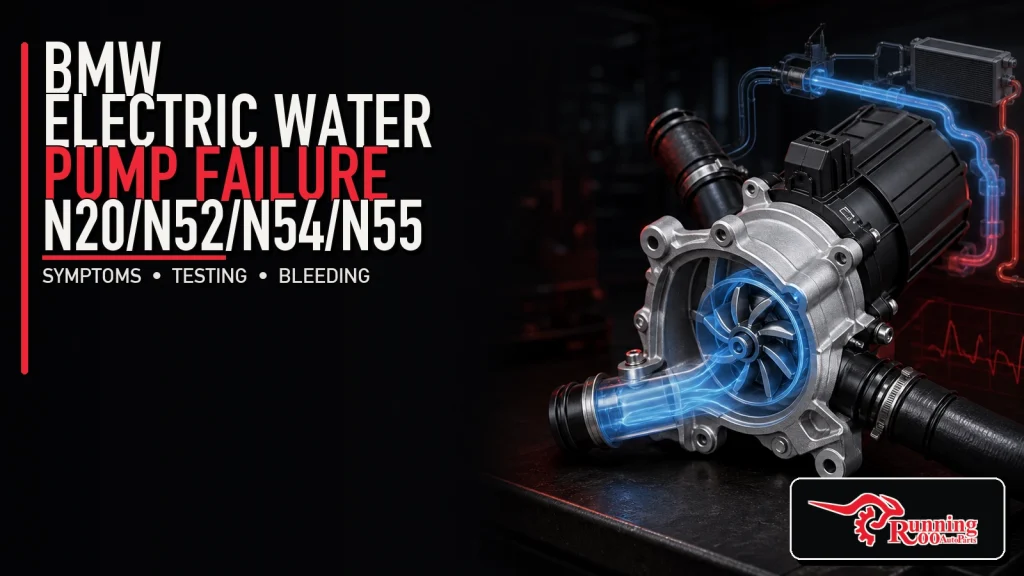
BMW electric coolant pumps can fail without the belt squeal or shaft-noise pattern owners expect from a conventional mechanical pump. The first obvious sign may be a temperature warning, reduced power, a cooling fan running hard or a stored pump-speed communication fault. Continuing to drive can turn a cooling-system repair into cylinder-head or engine damage.
Fitment is equally important. A 320i with an N20 does not automatically use the same pump as a 323i with an N52 or a 335i with an N54/N55, and product listings may cover wide chassis ranges. This guide explains safe diagnosis, the difference between symptom and proof, and the engine-code checks required before choosing a pump.
Quick answer: stop safely if the temperature warning turns red or coolant is lost. When the engine is cold, check coolant level and visible leaks, scan for pump and thermostat faults, command the pump with a capable scan tool and confirm power, ground and communication. Order by VIN, engine code and original part number—not by BMW series alone.
RunningRoo support for BMW electric water pumps
- High-quality aftermarket replacement – OEM fit
- 2-Year Warranty – reliability guaranteed
- Direct factory supply = competitive price
- Fast and friendly support
Call us: 0425 890 125
24/7 Free Pickup Available in Melbourne – By appointment only
RunningRoo Auto Parts – Based in Melbourne, Australia 🇦🇺
How an electric coolant pump changes diagnosis
An electronically controlled pump can vary coolant flow independently of engine speed. The engine control unit may monitor requested and actual pump operation, while the thermostat and fan work as part of the same thermal-management strategy. A weak pump can therefore create fault codes or fan behaviour before a driver sees a severe overheat.
The pump is only one part of the circuit. Low coolant, trapped air, a sticking thermostat, wiring resistance, a blown fuse, a restricted radiator or a leak can produce overlapping symptoms. A replacement should follow a system test, and the cooling system must be bled with the correct procedure after any component is opened.
Symptoms that deserve proper diagnosis
- Yellow or red engine-temperature warning
- Cooling fan running at very high speed
- Reduced-power or limp-home operation
- Electric-pump speed, current or communication faults
- Cabin heat changing as coolant flow becomes unstable
- Coolant loss or crusted residue around pump and hoses
- Overheating that returns after an incomplete bleed
Fitment and fault comparison
| Engine family | Common vehicle examples | Fitment focus |
|---|---|---|
| N20 four-cylinder turbo | Selected F20/F30/F10/E84 models | Match VIN, engine suffix and original pump number |
| N52 naturally aspirated six | Selected E/F-series 23i/25i/28i/30i | Do not substitute an N20 pump by chassis alone |
| N54/N55 turbo six | Selected 135i/335i/535i/X models | Verify connectors, output and superseded numbers |
| Model badge only | 320i, 328i, 335i, X1, X3 and others | Insufficient evidence without engine identification |
Use these patterns as evidence, not as a substitute for vehicle-specific service information. More than one fault can exist, especially after previous steering, electrical or cooling-system work.
A step-by-step diagnostic sequence
1. Respond to the warning safely
If the vehicle reports a serious overheat, reduce load and stop in a safe place. Do not open a hot cooling system. Repeated driving or restarting to see whether the warning disappears risks expensive heat damage.
2. Inspect only when fully cold
Check the specified coolant level and look for staining at the pump, thermostat, expansion tank, radiator, hose joints and undertray. A low level requires leak diagnosis; topping up does not explain where the coolant went.
3. Scan the thermal-management system
Save current, shadow/history and pending faults where supported. Review coolant-temperature plausibility and any pump speed, current, shutdown or communication codes. A sensor plausibility fault can mislead the control strategy.
4. Run the approved activation test
A capable BMW scan tool can request pump operation and display response. Listen and observe coolant circulation only as the service procedure permits. A silent pump still needs power, ground, fuse and connector checks before condemnation.
5. Test the thermostat and circuit
Evaluate thermostat command, radiator temperature change, fan response and wiring. Replacing a pump while leaving a stuck thermostat, damaged connector or major leak unresolved can recreate the overheat.
6. Identify the engine and original pump
Decode the VIN, confirm N20, N52, N54 or N55 and read the old pump number. Compare mounting points, electrical connector, hose arrangement and any verified supersession before ordering.
Before ordering BMW electric water pumps parts
- High-quality aftermarket replacement – OEM fit
- 2-Year Warranty – reliability guaranteed
- Direct factory supply = competitive price
- Fast and friendly support
Call us: 0425 890 125
24/7 Free Pickup Available in Melbourne – By appointment only
RunningRoo Auto Parts – Based in Melbourne, Australia 🇦🇺
Four RunningRoo product options to compare
These links are relevant catalogue options, not automatic fitment approval. Confirm the VIN, build date, original part number, connector or hose layout and required functions with RunningRoo or a qualified workshop before ordering.
1. BMW N20 electric water pump for selected 320i/520i/X1 — An N20B20A-focused listing; confirm chassis, production date and original number.
2. BMW electric pump for selected 135i/335i/535i/X models — A broad six-cylinder catalogue option that requires engine-code verification.
3. BMW X3 F25 N52N water pump 11517583836 — A part-number-specific route for selected N52N X3 x28i applications.
4. Genuine BMW water pump 11518635089 — Compare 11518635089 and any supersession with the VIN-based catalogue.
Bleeding and verification after pump replacement
Replace seals, single-use fasteners and coolant specified for the exact vehicle. Inspect the thermostat and ageing hoses while access is available. Keep electrical connectors dry and route wiring and hoses away from moving or hot components.
BMW electric-pump systems often use a defined automated bleed sequence. Maintain battery support if required, set the controls exactly as specified and monitor coolant level without opening a hot system. After repair, clear faults, verify commanded pump response, pressure-test for leaks and confirm stable temperature on a controlled drive.
- Do not drive through a red temperature warning
- Confirm the system is cold before opening
- Scan and activate the pump before replacement
- Identify N20, N52, N54 or N55 from reliable data
- Match the original pump and thermostat arrangement
- Use the correct fill, bleed and final verification procedure
More RunningRoo workshop videos
Watch more technical and workshop content from the official RunningRoo Auto Parts YouTube channel:
- BMW Owners Beware: Timing Chain Guide Failure Around 150,000 km
- BMW N20 Timing Chain Guide Plate Replacement
Why Choose RunningRoo?
- High-quality aftermarket replacement – OEM fit
- 2-Year Warranty – reliability guaranteed
- Direct factory supply = competitive price
- Fast and friendly support
Call us: 0425 890 125
24/7 Free Pickup Available in Melbourne – By appointment only
RunningRoo Auto Parts – Based in Melbourne, Australia 🇦🇺
Frequently asked questions
How long can I drive with a failing BMW water pump?
There is no safe fixed distance. A pump can lose output quickly. Treat a serious temperature warning as a stop-and-diagnose event.
Can a BMW electric water pump fail without leaking?
Yes. The electronic motor or control circuitry can fail while the housing remains dry. Conversely, a leak does not prove the motor has failed.
Should the thermostat be replaced with the pump?
Inspect and test it. Replacement may be sensible when its condition, stored faults, age or labour overlap supports it, but it should not be added blindly.
Does a new BMW pump need coding?
Requirements vary by vehicle and part. Even where coding is not required, correct bleeding, code clearing and an activation/temperature check are essential.
Final recommendation
BMW electric-pump diagnosis should prove both the pump fault and the engine fitment. Stop on a serious overheat, test the entire coolant circuit, identify the engine and original part, then finish the repair with the specified bleed sequence and live-data verification.
This article provides general technical information. Confirm fitment and procedures against current manufacturer service data. Airbag, braking, steering and cooling-system work should be completed by a suitably qualified technician.