
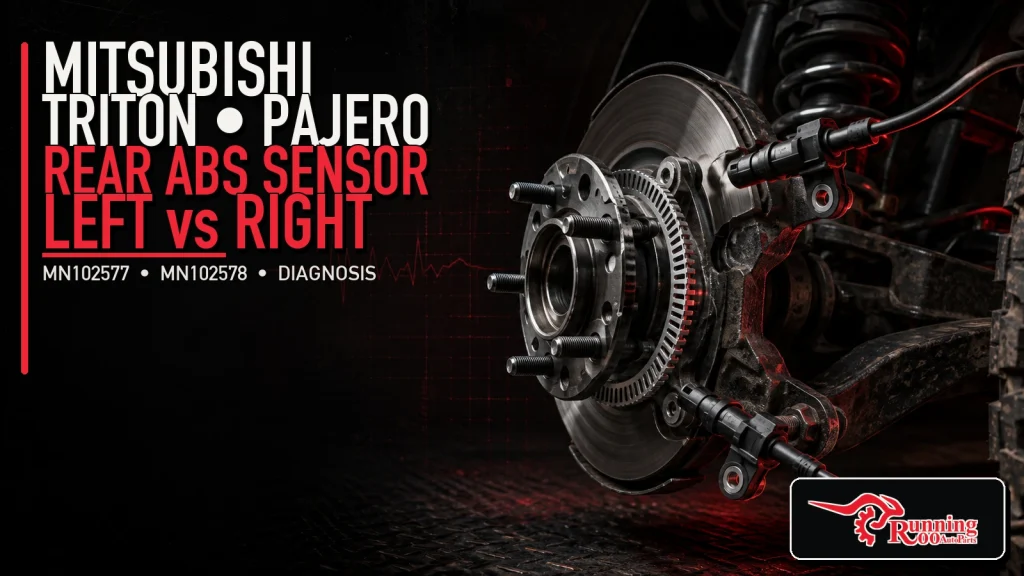
A Mitsubishi Triton or Pajero with ABS, traction-control and stability warnings may have one failed rear wheel-speed sensor, but a fault code naming a wheel does not make the sensor guilty. Damaged wiring, corrosion, excessive bearing movement, a contaminated magnetic encoder or a poor connector can distort the signal in exactly the same corner.
When the sensor is proven faulty, side matters. RunningRoo listings reference MN102577 for the rear left and MN102578 for the rear right, plus matched pair kits. This guide shows how to confirm the reported side, compare live wheel-speed data and decide whether one sensor or a left-and-right kit makes sense.
Quick answer: save the ABS code, confirm the vehicle’s left and right from the driver’s forward-facing position, then compare all four wheel speeds on a controlled test. Inspect the sensor, connector, harness route, bearing and encoder before replacement. Match MN102577 to the verified rear-left application and MN102578 to the verified rear-right application.
RunningRoo support for Mitsubishi rear ABS sensors
- High-quality aftermarket replacement – OEM fit
- 2-Year Warranty – reliability guaranteed
- Direct factory supply = competitive price
- Fast and friendly support
Call us: 0425 890 125
24/7 Free Pickup Available in Melbourne – By appointment only
RunningRoo Auto Parts – Based in Melbourne, Australia 🇦🇺
How the rear wheel-speed signal is produced
A wheel-speed sensor reads a toothed or magnetic encoder linked to the rotating hub or axle. The ABS controller compares the signals to manage anti-lock braking, traction control and stability functions. A missing, noisy or implausible signal can disable several systems and illuminate multiple warnings from one underlying fault.
The sensor is only half of the signal path. Air gap, mounting corrosion, encoder damage, wheel-bearing play, wiring movement and connector resistance all affect the waveform. That is why replacing a sensor without inspecting the corner can leave the same code active.
Symptoms that deserve proper diagnosis
- ABS, ASC/traction or stability warning lamps
- One wheel speed dropping to zero intermittently
- Low-speed ABS activation on a normal stop
- Cruise or hill-control functions becoming unavailable
- Fault returning when suspension movement tugs the harness
- Warning beginning after bearing, brake or axle work
Fitment and fault comparison
| Choice | Catalogue reference | When it is appropriate |
|---|---|---|
| Rear left | MN102577 | The left circuit and physical part are confirmed faulty |
| Rear right | MN102578 | The right circuit and physical part are confirmed faulty |
| Left + right pair | Matched rear pair listing | Both sides are faulty or preventive scope is justified |
| Sensor only | Not an encoder or bearing repair | Hub/encoder and harness have passed inspection |
Use these patterns as evidence, not as a substitute for vehicle-specific service information. More than one fault can exist, especially after previous steering, electrical or cooling-system work.
A step-by-step diagnostic sequence
1. Record every chassis-system code
Scan ABS/ASC before clearing. Note whether the code is electrical, open/short, signal implausibility or intermittent. A communication or voltage fault affecting the whole module should be handled before one wheel is blamed.
2. Confirm the named side
Vehicle left and right are defined while facing forward from the driver’s seat, not while standing in front of the vehicle. Verify the scan-tool label and inspect the corresponding rear harness.
3. Compare live wheel speeds
On a safe controlled lift or road test performed by a qualified technician, graph all four wheel speeds. Look for one signal that drops out, spikes or diverges at low speed. A static resistance value alone may miss an intermittent active-sensor fault.
4. Inspect harness and connector
Follow the cable from sensor to body connector. Look for tyre contact, stretched clips, impact damage, water entry, green corrosion or a fault that appears as the suspension moves.
5. Check the mounting and encoder
Remove rust or debris only as the service procedure permits. Inspect the sensor seat, air-gap condition, bearing play and the reluctor or magnetic encoder. A damaged encoder can produce a repeating dropout even with a new sensor.
6. Match side and part number
Use the VIN, model details and original sensor number. Compare cable length, connector keying, mounting tab and grommet positions. Select MN102577 or MN102578 only after the failed side is proven.
Before ordering Mitsubishi rear ABS sensors parts
- High-quality aftermarket replacement – OEM fit
- 2-Year Warranty – reliability guaranteed
- Direct factory supply = competitive price
- Fast and friendly support
Call us: 0425 890 125
24/7 Free Pickup Available in Melbourne – By appointment only
RunningRoo Auto Parts – Based in Melbourne, Australia 🇦🇺
Four RunningRoo product options to compare
These links are relevant catalogue options, not automatic fitment approval. Confirm the VIN, build date, original part number, connector or hose layout and required functions with RunningRoo or a qualified workshop before ordering.
1. Rear-left ABS sensor MN102577 — For selected left-rear Triton/L200/Pajero applications after fitment checks.
2. Rear-right ABS sensor MN102578 — The corresponding right-rear option; side and cable routing must match.
3. Rear left-and-right ABS sensor pair kit — A pair option when diagnosis or repair strategy supports replacing both sides.
4. Alternative rear ABS left-and-right pair listing — Compare the listed contents and vehicle coverage before purchase.
One sensor or both rear sensors?
If one sensor has a local impact or open circuit and the other side produces a clean waveform, replacing one can be appropriate. A pair may be reasonable when both signals are degraded, both harnesses share the same age-related damage or labour access makes a verified preventive repair worthwhile. Replacing both simply because one code appeared is not diagnosis.
Clean the mounting area carefully, route the cable through every original clip and keep it away from the tyre, spring, shock and exhaust. After repair, clear codes, graph the speeds again and perform a controlled low-speed brake check. Confirm ABS and stability warnings remain off.
- Verify left and right from the vehicle’s forward direction
- Save code type and live-data evidence
- Inspect cable, connector, bearing and encoder
- Match MN102577 left and MN102578 right
- Route the replacement through all factory retainers
- Recheck live wheel speeds and controlled braking
More RunningRoo workshop videos
Watch more technical and workshop content from the official RunningRoo Auto Parts YouTube channel:
- How to Check a VVT Sprocket | Camshaft & Timing Gear Inspection Guide
- What’s That Engine Noise? Timing Chain, Piston Knock & More Explained
Why Choose RunningRoo?
- High-quality aftermarket replacement – OEM fit
- 2-Year Warranty – reliability guaranteed
- Direct factory supply = competitive price
- Fast and friendly support
Call us: 0425 890 125
24/7 Free Pickup Available in Melbourne – By appointment only
RunningRoo Auto Parts – Based in Melbourne, Australia 🇦🇺
Frequently asked questions
Which side is MN102577?
RunningRoo’s relevant listing identifies MN102577 as rear left. Confirm the vehicle and original sensor because catalogue coverage can vary.
Which side is MN102578?
The relevant listing identifies MN102578 as rear right. Compare cable routing, connector and mounting points before installation.
Should I replace both rear ABS sensors?
Not automatically. Replace the failed components supported by codes, live data and physical inspection. A pair can be sensible when both sides show deterioration.
Why is the ABS light still on after a new sensor?
The code may need clearing, or the fault may be in the harness, connector, encoder, bearing, air gap, power supply or control module. Rescan and compare wheel-speed data.
Final recommendation
A wheel-specific ABS code is the start of the test, not the final answer. Confirm the side, graph the signal, inspect the complete corner and use MN102577 or MN102578 only when the vehicle and failure evidence agree.
This article provides general technical information. Confirm fitment and procedures against current manufacturer service data. Airbag, braking, steering and cooling-system work should be completed by a suitably qualified technician.