
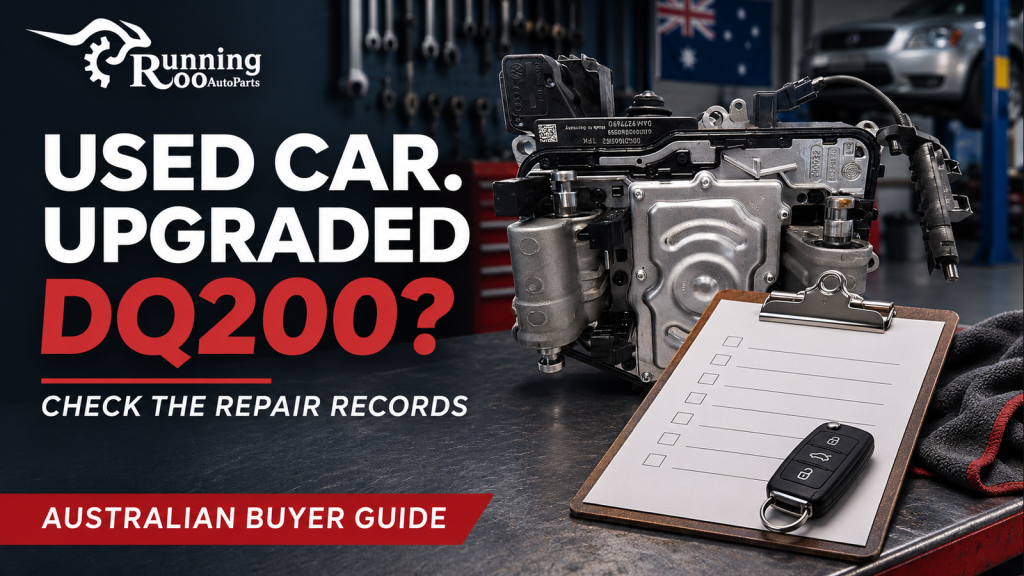
A used-car advertisement that says “DQ200 upgraded valve body fitted” deserves a closer look, but the phrase alone should not decide the purchase. For an Australian buyer, the important questions are what was fitted, which vehicle it was fitted to, when the work happened and what evidence describes the car's condition now. A reinforced component can be part of a documented repair without becoming a guarantee about the entire vehicle.
This guide is for someone considering a used car with a claimed DQ200 reinforced or thickened valve-body repair. It is not a guide to buying a second-hand mechatronic unit. The aim is to turn a short sales claim into a clear repair history that an independent workshop can assess, while keeping any future parts enquiry tied to the correct vehicle and installed assembly.
Start with the exact wording of the claim
Save the advertisement and ask the seller what “upgraded” means in this case. It might refer to a reinforced housing, an assembled replacement unit or another repair described informally. Do not fill in missing detail yourself. A seller may use a broad phrase simply because they are repeating what they remember from a workshop conversation.
Ask for the repair date, odometer reading at that time, workshop name and invoice. These items help establish a timeline. They do not require the seller to expose unrelated personal information; a copy can retain the relevant vehicle and repair details while omitting unnecessary payment or personal records. The useful evidence is the connection between this vehicle and this work.
Keep the distinction between “a part was bought” and “a part was fitted”. A retailer receipt can identify a supplied assembly, but the installation record connects it to a repair job. If the seller only has a purchase receipt, ask whether the workshop invoice or job record is available. Missing paperwork is a reason for further enquiry, not proof that the claim is false.
Match the repair record to the car in front of you
Check that the vehicle identifiers on the available records correspond with the car being inspected. A registration number alone can be less helpful than a VIN and dated job reference, particularly when ownership or registration details have changed. Ask the inspecting workshop to reconcile any discrepancy rather than relying on a similar model name or an attractive product photograph.
The engine code and transmission identification matter alongside the VIN when identifying parts. Obtain the full OE references and suffixes if they are recorded. An invoice that says only “DSG repair” does not establish the exact assembly or modification. It can still be useful evidence of work, but it supports a narrower conclusion than a detailed parts-and-labour record.
If the car has had more than one transmission repair, build the sequence in date order. A later unit replacement may mean an earlier reinforced-housing invoice no longer describes the assembly currently installed. Ask which unit is fitted now and whether the later job reused or replaced the earlier components. Avoid combining separate invoices into one imagined repair history.
Understand the different roles of the documents
A product listing describes an offer. A sales invoice records what was purchased. A workshop job record describes work carried out. A diagnostic report records findings at a particular time. None of these should be silently substituted for another. Together they can create a useful history, but each has limits that matter to a used-car buyer.
For example, a photograph of a thickened housing may support a supplier's description of a product range. It does not establish that the pictured sample is inside the car. A workshop invoice may document a mechatronic replacement without identifying every internal feature. Ask for clarification through the seller or with appropriate permission from the workshop rather than treating an online image as a serialised installation record.
Where a record is incomplete, write down the unanswered question. “Reinforced version not specified on invoice” is a clearer note than “gearbox probably upgraded”. Clear uncertainty helps the independent inspector decide what can be checked and what cannot be established without disproportionate work. It also keeps your purchasing decision grounded in evidence rather than assumptions.
| Document or observation | Useful question | Limit to remember |
|---|---|---|
| Advertisement | What does upgraded mean here? | Sales wording is not a technical report |
| Parts receipt | Which assembly or component was supplied? | Purchase does not prove installation |
| Workshop invoice | What work was completed on this VIN? | Brief descriptions may omit the exact modification |
| Diagnostic report | What was assessed and when? | Historical findings do not describe today's condition |
| Current independent inspection | What is the car's present condition? | Inspection scope must be agreed with the workshop |
| Warranty document | What terms apply to this purchase and owner? | Transfer or coverage must not be assumed |
Ask about the original repair reason without diagnosing the car yourself
The reason for the earlier repair provides context. Ask whether the workshop recorded a specific fault, an identified component problem or a broader replacement decision. You do not need to interpret every scan value yourself. Give the available record to the independent inspector and ask what it contributes to the assessment of the current vehicle.
Volkswagen's official New Zealand campaign information describes pressure-loss concerns in some affected DQ200 units and explains that inspection determines whether campaign repair is required. It does not mean every DQ200 is affected, every repaired unit had that fault or every Australian car qualifies for the same campaign. Check the vehicle's own recall status through the relevant local manufacturer channel. Volkswagen NZ mechatronics campaign background; not Australian eligibility or a handling manual
Do not use the existence of a reinforced replacement as proof that the car previously experienced a particular failure. Owners may choose different repair scopes for different reasons. The strongest account is the one supported by the job record. If the reason is unknown, record it as unknown and let the current inspection address the car's condition rather than inventing a historical diagnosis.
Arrange an independent inspection with a clear brief
Tell the inspecting workshop that the car is advertised as having a reinforced DQ200 valve-body repair and provide the documents in advance. Ask what its pre-purchase assessment includes and whether it can review the transmission identification and available repair history. The workshop should define the appropriate checks for the actual vehicle and the access permitted by the seller.
Avoid instructing a mechanic to perform a particular test copied from a general internet article. A proper assessment requires the right vehicle information, equipment and manufacturer procedure. This guide does not provide a road-test pattern, adaptation sequence or diagnostic threshold. Those details belong to the professional who can inspect the car and take responsibility for the assessment.
Ask the workshop to distinguish observed findings from matters outside the inspection scope. A clear report may say that a claimed internal modification cannot be visually confirmed without dismantling. That is an honest limit, not necessarily a negative finding. The buyer can then weigh the available paperwork and current condition without expecting a routine inspection to verify inaccessible internal dimensions.
Keep the reinforced part separate from the whole-car decision
A documented mechatronic repair answers one part of the vehicle-history question. It does not establish the condition of every other system, nor does it replace an overall pre-purchase inspection. Assess the car as a complete vehicle with the appropriate professional help. A recent parts invoice should not cause unrelated service history or current concerns to be ignored.
Similarly, do not assume that the cost of a past repair adds the same amount to the car's value. This article does not assign a resale premium or recommend a financial valuation. Its practical point is simpler: documentation can make a claim more understandable, while condition and the wider purchase assessment remain separate considerations.
If the seller presents the upgrade as a lifetime cure, ask for the written basis of that statement. The evidence available for the RunningRoo offer does not establish a universal lifetime guarantee. Keeping the conversation specific—part identity, repair date, workshop record and current assessment—is more useful than debating an undefined promise about all future transmission behaviour.
What a RunningRoo receipt would tell a future buyer
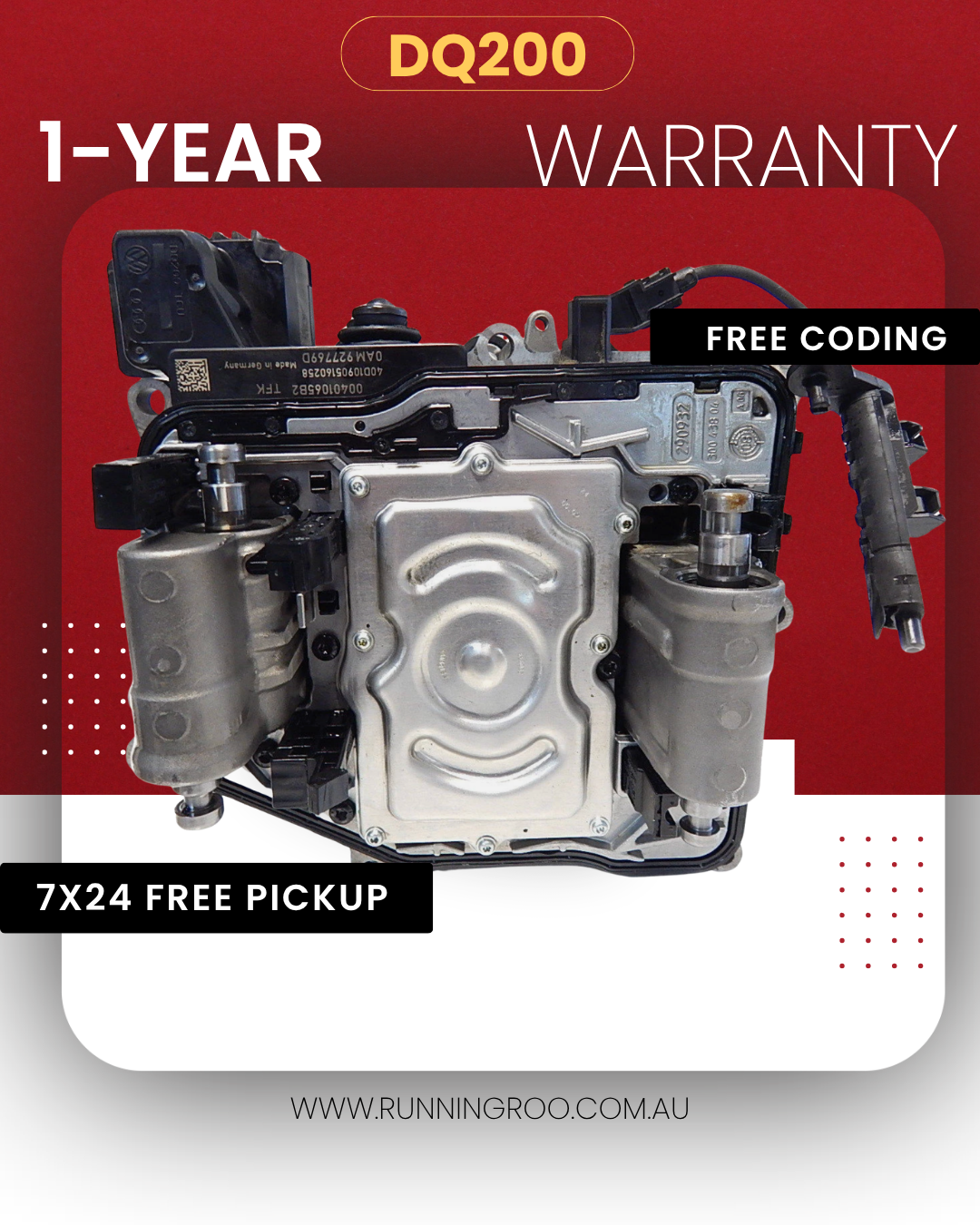
The current RunningRoo listing describes a remanufactured DQ200 0AM valve-body-and-TCU assembly, with references 0AM325065S and 0AM927769D. If a receipt for this offer appears in the vehicle's file, it can help identify the product that was ordered. The installed version and any agreed preparation should still be connected to the workshop's job record.
Programming must not be inferred from the title alone. The listing title mentions programming, while the description says no program is inside and asks for vehicle details if programming is required. For an existing repair, look for the actual order confirmation and workshop documentation. For a new order, obtain a written explanation of the preparation included and the installer's remaining responsibilities.
RunningRoo can help explain its own product offer and records available through the relevant order process. It cannot certify a used car's present condition from a photograph of an invoice. Provide the order reference through the appropriate customer channel, respect the original buyer's information, and let an independent workshop assess the vehicle itself.
Questions to resolve before relying on warranty language
Read the actual warranty document associated with the repair rather than copying a headline from today's listing. Ask who supplied the warranty, what component or work it covers and whether any transfer to a new owner is permitted. Obtain confirmation from the responsible provider. Do not assume that a retailer's current terms are identical to the terms of an earlier purchase.
This is a document-checking step, not legal advice or a statement about statutory rights. If warranty transfer or coverage is important to your purchase, resolve that question directly with the provider and seek appropriate advice if needed. A seller's informal assurance should not be rewritten as a confirmed contractual benefit without the relevant evidence.
Retain the response with the vehicle records. It is particularly useful to distinguish a parts warranty from labour arrangements and to identify whom to contact if a concern appears. The purpose is to know the actual process, not to assume that every possible future diagnostic or repair expense will be covered.
A practical example of an incomplete but useful history
Suppose a seller provides a retailer invoice for a reinforced assembly and a workshop invoice dated two weeks later. The retailer invoice identifies the product, while the workshop invoice lists the vehicle VIN and replacement work. That is a stronger connection than either document alone. The buyer can give both to an independent inspector and ask about the current vehicle rather than demanding an internal photograph.
Now suppose the workshop invoice only says “transmission work”. The buyer should ask for clarification, with the seller's cooperation, about whether the purchased assembly was fitted. Until that is answered, the record supports a parts purchase and some transmission work, but not necessarily the exact combined claim. Recording that distinction is fair to both the seller and buyer.
If the car later needs parts, the new owner will already have a useful starting file. Contact RunningRoo with the VIN, engine code, installed OE references and a fresh professional diagnosis. Australian-operated support in Blackburn VIC can help with current supply, fast dispatch subject to stock, and Melbourne pickup by appointment. Call 0425 890 125 before selecting a replacement from old paperwork alone.
Frequently asked questions
Is a car with a reinforced DQ200 valve body automatically a good purchase?
No single repair establishes the condition of the whole car. Verify the claim, review the wider service history and arrange an independent inspection. A documented upgrade can be useful information, but it should not replace assessment of the present vehicle or become a universal reliability promise.
Does a parts receipt prove the reinforced assembly is currently installed?
Not by itself. Connect the receipt to the workshop record and vehicle identity. Later repairs may also have changed the installed assembly. Ask for the timeline and current unit information rather than assuming that every part purchased during the car's history remains fitted today.
Can a pre-purchase inspection measure the reinforced housing internally?
The workshop must define its inspection scope. Internal modification may not be visible without dismantling, and a routine assessment should not be assumed to include that work. Ask what can be established from documentation, identification and the current condition, and retain any stated limitations in the report.
Does a campaign reference prove an Australian car needs this replacement?
No. Manufacturer campaigns have defined vehicle and market applicability. Check the particular VIN through the appropriate local manufacturer channel. The official campaign background cited here explains context only; it is not an Australian eligibility decision or a diagnosis of the car being purchased.
Will the original repair warranty automatically transfer to me?
Do not assume transfer. Ask the responsible warranty provider to confirm the actual terms for the earlier repair and any new-owner requirements. Keep its response with the vehicle file. This guide does not interpret legal rights or promise coverage for future parts, labour or diagnostic costs.
What information should I retain after buying the vehicle?
Keep the vehicle identifiers, dated repair invoices, parts references, available diagnostic reports and any confirmed warranty correspondence. For a future parts enquiry, add the current workshop diagnosis rather than relying solely on the old repair. RunningRoo can then offer friendly fitment support against the installed configuration and current product supply.
Related RunningRoo workshop video
RunningRoo: DQ200 mechatronic assembly and testing. This is related workshop context, not proof that the filmed component is the exact supplied item. Verify all procedures against current manufacturer information for the vehicle; the video does not establish product dimensions, fitment or performance guarantees.
Related reading: DQ200 Upgraded Valve Body Handover Australia: A Workshop Acceptance Checklist. This separate guide covers a different component or search question; it does not establish interchangeability with the product discussed here.
Sources and scope
Product details and availability were checked on 11 November 2026. Retailer listings establish the offer; manufacturer sources below support only the technical points identified in the article. Current vehicle-specific workshop information takes priority over general background.