
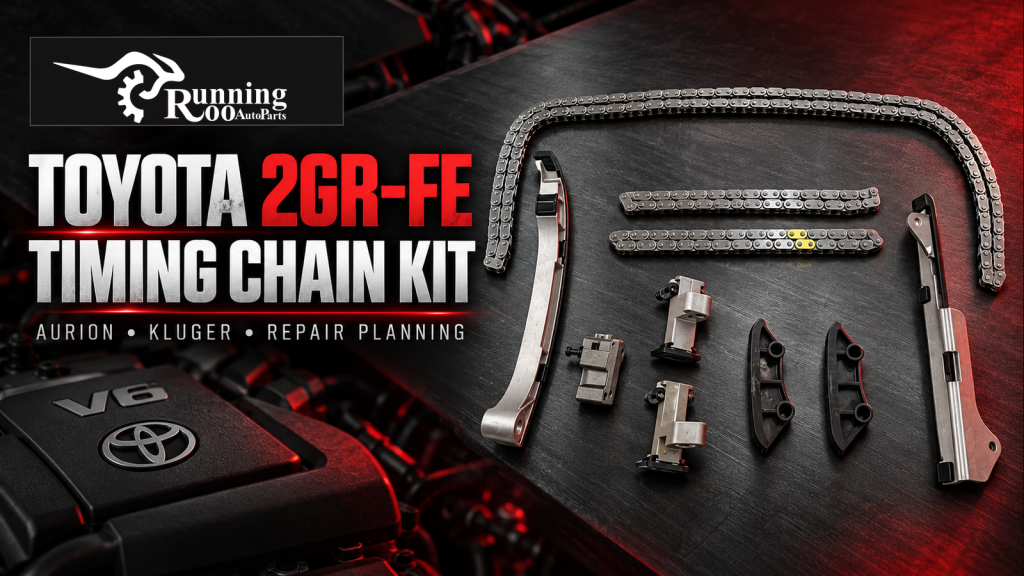
A Toyota 2GR-FE timing chain kit should be selected against the engine in the vehicle, the workshop’s findings and the parts actually included in the package. An Aurion, Kluger, RAV4 or Tarago badge is a useful starting point, but it cannot replace a VIN and engine-code check. The best purchase is a kit that matches a documented repair, with any additional gears, seals and service items identified before the vehicle occupies a workshop bay.
RunningRoo offers a Toyota 2GR-FE / 3GR / 4GR timing chain kit, with a corresponding active eBay listing. This guide concentrates on the 2GR-FE purchasing enquiry. The wider engine names in the listing are not a promise that every GR-family engine shares the same parts. Call 0425 890 125 with your VIN, engine code and workshop requirements for friendly support from an Australian-operated supplier in Blackburn, Melbourne. Local pickup is by appointment; fast dispatch for available stock can be arranged after order details are confirmed.
VIN · full engine code · OE reference
Workshop diagnosis · required components
Current package · extras · stock
Pickup appointment or dispatch
Start with the repair question, not just the vehicle badge
Owners usually arrive at a chain-kit search through one of three routes: a workshop has recommended replacement, an engine is being rebuilt, or a noise has prompted an online search. These situations need different conversations. A confirmed parts request can proceed to fitment and contents checks. A rebuild needs a broader inventory. An unexplained noise needs diagnosis before the shopping list becomes a repair decision.
For an Aurion or Kluger enquiry, send the complete VIN, build date and full engine designation. Include whether the engine is original, used, reconditioned or replaced with a unit from another vehicle. Where an engine has been exchanged, the registration record alone may describe the original installation. The workshop should reconcile the vehicle record with identification on the installed engine and any paperwork supplied with it.
Avoid shortening the identification to “Toyota V6” or “3.5 petrol”. Those descriptions leave important details unresolved. Likewise, a seller title that groups 2GR-FE, 3GR and 4GR should prompt a specific application check, rather than a conclusion that the entire group is interchangeable. Ask for a written confirmation tied to your enquiry, and retain it with the order and workshop quote.
What Toyota’s technical information establishes
Toyota’s T-TT-0012-10 technical tip describes the 2GR-FE timing relationships using a main chain and a No. 2 chain on each bank. The intake gears relate to the crankshaft through the main chain; each exhaust gear relates to its intake gear through the secondary chain. It also distinguishes bank-specific timing marks and cautions that correctly timed marks may not appear perfectly aligned. The document is Toyota-issued US-market information from 2010, reproduced in an archive. It is useful architectural background, not a current Australian fitment catalogue or a substitute for the applicable repair manual.
The practical purchasing consequence is that a workshop should describe the intended work by component and position. “Replace the chain” is not a sufficiently clear order instruction when several chain-related components are involved. Ask which items are required, which are already included and which will be assessed during dismantling. This makes the supplier’s task much more precise without asking the owner to perform engine timing work.
Separate advertised applications from confirmed fitment
The RunningRoo page lists several Toyota and Lexus applications. Treat these as search information that helps locate the product, then narrow the enquiry to the actual vehicle. A model-year span can contain different production specifications, and an Australian registration year is not necessarily the manufacturing year of an imported or previously stored vehicle.
A useful order enquiry contains a photograph of the vehicle identification plate, the complete engine code, and the OE references requested by the technician. If there are superseded numbers, ask the workshop to identify the current replacement reference and the source of that conclusion. A supplier SKU identifies a commercial item; it should not be mistaken for an original Toyota engineering number.
The same discipline applies when comparing this listing with a cheaper or more expensive package. Similar product names may conceal a difference in included gears, chain assemblies, tensioners or ancillary items. Compare written contents line by line. Do not assume a large product photograph shows everything that will be supplied, or that a smaller photograph means the package is incomplete.
Build a parts schedule before booking installation
The selected listing does not provide a sufficiently detailed written packing schedule to treat every pictured component as a contractual inclusion. Before ordering, request the current itemised contents and ask the workshop to mark them against its repair requirements. The aim is to identify omissions while the vehicle can still be planned sensibly, rather than after the timing cover is open.
| Planning item | Information to obtain | Why it matters to the order |
|---|---|---|
| Main and secondary chain requirements | Workshop list with positions and quantities | Prevents a vague single-chain request |
| Guides and tensioners | Current package inventory and required positions | Separates supplied parts from additional work |
| Camshaft timing gears | Retain, inspect or replace decision from technician | A chain-kit title does not establish gear inclusion |
| Crankshaft or idler components | OE references and repair scope where relevant | Avoids relying on resemblance in a photograph |
| Sealing and fastener requirements | Vehicle-specific workshop parts list | Keeps consumables separate from advertised kit contents |
| Fluids and final checks | Workshop quotation and applicable procedure | Makes the completed repair scope understandable |
Use the table as an order-planning worksheet, not as a universal replacement instruction. There is no benefit in adding unrelated parts simply because the engine is being opened. Equally, buying a chain set without discussing the items the technician has already identified can cause a second order and a delayed completion date.
Keep diagnosis and product selection connected
A workshop report should explain why the timing system is being investigated and what evidence supports the recommended repair. Ask for the complaint, operating conditions, stored fault information where applicable, and the checks used to reach the recommendation. “It sounds like a chain” is a starting observation, not the same thing as a completed diagnosis.
You can help by describing when the noise occurs, how long it lasts and whether the concern began after previous work. Provide service invoices rather than relying on a remembered oil-change interval. If a repair has already been attempted, list the parts fitted and the result. This gives the technician a useful history and prevents the supplier from receiving a parts request stripped of its context.
The blog is not an instruction to continue driving a noisy engine. Let the assessing technician determine whether the vehicle should be driven, recovered or left unused. Do not repeatedly restart it just to produce a better phone recording. The purpose of an enquiry is to support a sound repair decision, not to reproduce a symptom at the expense of the engine.
Compare the whole job rather than the box price
A useful quotation distinguishes diagnosis, parts, labour and any conditional work that can only be decided after inspection. Ask what is included in the initial estimate and what requires a further call. This is particularly helpful when comparing an economical chain package with a broader repair proposal containing other components.
A lower kit price does not automatically mean a lower completed repair cost. If another package contains items the workshop has specified, its higher purchase price may still make sense. Conversely, a bundle can include parts that are not required for this particular job. The fair comparison is between equivalent repair scopes and confirmed supplied contents, not between the largest product photos.
For supply planning, review the RunningRoo 2GR-related kit page alongside the matching eBay offer, then discuss the current package with the team on 0425 890 125. RunningRoo’s Melbourne local pickup by appointment can help coordinate a workshop booking. Customers elsewhere in Australia can request dispatch timing for available stock and confirm the delivery address before purchase.
A practical handover between owner, workshop and supplier
Imagine an owner has received a recommendation to renew timing components on an Aurion. Rather than asking the supplier to “send the Aurion kit”, the owner forwards the workshop’s parts schedule and the vehicle identifiers together. The supplier checks the selected package, returns an itemised confirmation and identifies anything that must be sourced separately. The workshop then approves the final order before booking the work.
This is an illustrative ordering process, not a claim about a specific customer’s repair. Its value is that the same information reaches everyone. If the workshop changes its assessment after inspection, the new request should state what changed. A photograph of an exposed assembly can assist, but the technician should still name the component and position instead of leaving the supplier to infer them from a camera angle.
Ask who will receive the parcel, who will inspect its contents and who is responsible for reporting a mismatch. A delivery to an owner followed by a separate trip to the workshop can work well, but it should be planned. Keep the packaging and order reference until the technician has checked the supplied parts against the agreed list.
Receiving the kit and recording the finished repair
On arrival, compare the delivery with the confirmed packing list before installation. Check identifiers, quantities and visible condition without dismantling components or removing protective materials unnecessarily. If something differs from the order, document it clearly and contact the supplier before fitting. The actual return or warranty terms should be read on the current sales channel rather than inferred from a blog.
After installation, ask for a service record describing the work performed, the parts used and any follow-up instructions from the technician. A clear invoice is useful for future maintenance and for any later owner of the vehicle. It also avoids confusion about whether a previous “timing job” included only chain components or also camshaft gears and other items.
Do not ask for a universal mileage promise from a replacement kit. Maintenance instructions, diagnosis and the condition of the whole engine remain relevant. Keep the vehicle-specific service schedule and any written workshop advice with the invoice. RunningRoo supplies parts and order support; the installing professional remains responsible for the repair procedure and final mechanical assessment.
Related RunningRoo video
Timing Chain Rattle: Wear Symptoms & When to Replace is a related video from the RunningRoo AutoParts channel. It provides general background, not a demonstration of this exact engine, selected product or installation procedure. Use it to prepare questions for the workshop; the actual repair still needs vehicle-specific manufacturer information and professional diagnosis.
Frequently asked questions
Does this kit fit every Toyota 3.5-litre V6?
No blanket conclusion should be drawn from engine capacity. Supply the VIN, full engine code and OE references, and ask for the particular application to be checked. The listing groups several GR-family names, while this article focuses on the 2GR-FE enquiry. Other suffixes, markets and engine histories need their own confirmation before any order is placed.
Are VVT gears included with the selected package?
Do not assume that they are. Obtain the current written contents and compare them with the workshop’s request. A photograph can help discuss the product, but it is not a substitute for an itemised supply confirmation. If the technician requires a particular camshaft timing gear, state the OE reference, bank and position separately.
Can I order using my registration number alone?
Registration information can help start an enquiry, but send the VIN and engine identification as well. Explain any engine replacement or import history. The aim is to identify what is installed today, not simply the model recorded when the vehicle was first registered. Your workshop can help collect the relevant identifiers without guessing.
Does a start-up noise prove the timing chain needs replacement?
A sound recording alone cannot provide that certainty. Have a qualified technician investigate the concern and explain the evidence behind the proposed repair. When ordering, provide the resulting parts request rather than asking the supplier to diagnose the engine from a brief description. This keeps the purchase connected to the actual repair decision.
Should I buy the kit before the workshop inspects the car?
You can research availability and prepare the vehicle details in advance. Final purchasing is clearer once the technician has defined the required components. If the workshop recommends ordering before dismantling, agree on the planned scope and how unexpected findings will be handled. Avoid treating a preliminary estimate as an exact packing list.
Can I collect from RunningRoo in Melbourne?
Yes, discuss local pickup by appointment with the team and confirm stock before travelling. For delivery, ask about fast dispatch for the particular available items and your destination. Friendly support from an Australian-operated supplier helps coordinate the order, but pickup and delivery arrangements should be confirmed against the current purchase rather than assumed.
Order with the workshop’s requirements in hand
Prepare one message containing your VIN, engine code, OE references, repair recommendation and required completion date. Link the RunningRoo Toyota GR-family timing chain kit or its corresponding eBay listing so the team knows exactly which package you are considering. Then call 0425 890 125 if you need help organising the enquiry.
RunningRoo is Australian-operated in Blackburn, Melbourne, with friendly support, local pickup by appointment and fast dispatch options for confirmed available stock. A precise enquiry helps turn a broad search for a Toyota timing chain into a practical order that your workshop can check and use with confidence.
Related RunningRoo reading
For the broader purchasing process, see Timing Chain Kit Fitment: How to Match the Right Kit to Your Engine and Timing Chain: Questions to Ask Your Mechanic Before the Repair. Keep the engine and component scope in this article attached to your specific enquiry.
Sources and verification scope
The RunningRoo website product and corresponding eBay Active Listing were checked on 11 October 2026. Stock and descriptions can change; confirm the current order before purchase. Manufacturer sources below support only the stated technical context, not aftermarket approval or universal fitment. Archived copies are identified.
- Toyota T-TT-0012-10: 2GR-FE Valve Timing Tips (2010) — Toyota-issued US technical tip archived on a third-party site; timing relationships, not current Australian parts applicability.