
Buying a Nissan SR20DE timing chain kit in Australia starts with identifying the engine that is actually in the car. Sentra, Infiniti G20, NX and 200SX names appear across different markets, and an older Nissan may have an imported or replacement engine. A familiar badge is a useful starting point, but it is not a reliable order reference on its own.
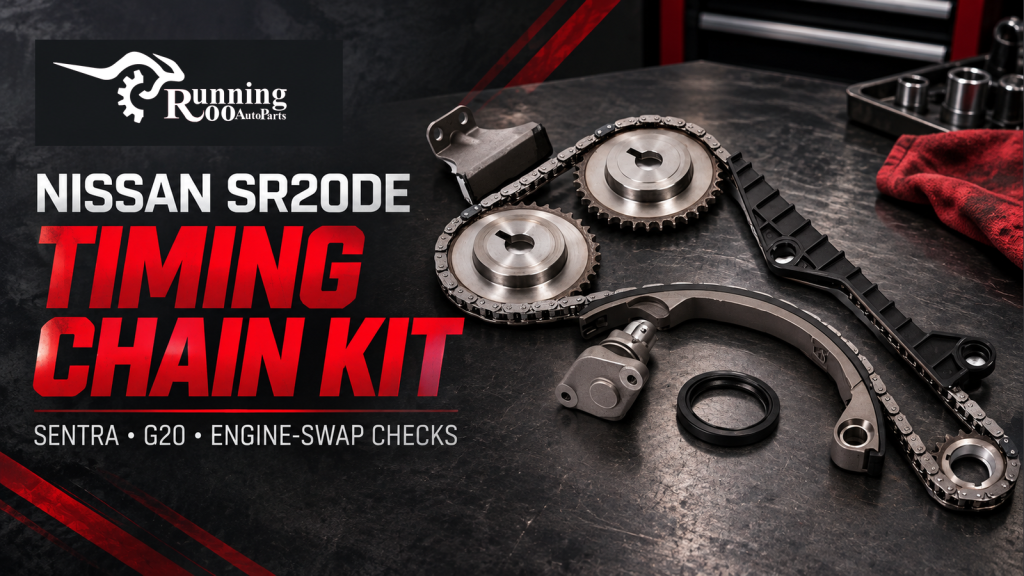
RunningRoo lists an SR20DE package with a chain, gears, tensioner, guides and an oil seal. This guide explains how to turn that listing into a clear workshop enquiry, especially when a vehicle has overseas history or an engine swap. It separates the merchant’s package description from Nissan’s technical information so that neither becomes an unsupported promise about your particular car.
Start with the RunningRoo SR20DE timing chain kit, or view the corresponding RunningRoo eBay item. For friendly support from an Australian-operated parts business in Blackburn, Melbourne, call 0425 890 125. Local pickup is available by appointment; ask about current stock and fast dispatch before organising workshop time.
VIN · full engine code · OE reference
Workshop diagnosis · required components
Current package · extras · stock
Pickup appointment or dispatch
Identify the engine before comparing kits
Record the VIN, complete engine code, production details and the OE references specified by your mechanic. With a standard car, these details help the supplier connect the vehicle to an appropriate parts enquiry. With an engine swap, also record the donor engine’s identity and any changes made during installation. The registration description might still describe the original engine rather than the hardware now fitted.
Do not shorten SR20DE to SR20 when ordering. This article does not establish interchangeability with SR20DET, SR20VE or another variant. Similar lettering, displacement or appearance does not resolve differences in an individual engine’s timing components. If the installed engine cannot be identified confidently, arrange that identification before purchasing internal parts.
A useful photograph set includes the engine identification marking, the existing parts where accessible, and any old packaging or receipts. Photographs support a written enquiry; they do not replace a workshop’s measurements or the appropriate Nissan parts information. Avoid dismantling a serviceable engine simply to collect pictures for an online order. Ask the mechanic what can be recorded safely during diagnosis.
Why the 200SX name needs particular care
The RunningRoo description references overseas applications including Sentra, NX, Infiniti G20 and a US-market 200SX. An Australian buyer should not read the word 200SX as confirmation that the kit fits every car sold here under that badge. Market, chassis and engine identity must stay attached to the model name throughout the enquiry.
For example, a request that says only “200SX timing kit” leaves the supplier to guess which application is intended. A request containing the VIN, market of origin, installed engine code and workshop OE references is much more useful. If the car is modified, say so at the beginning rather than after an order has been packed.
The listing also spans multiple years. Treat those dates as the seller’s application description, not a substitute for a vehicle-specific compatibility check. The age of an imported vehicle may be described by build year, first registration year or arrival in Australia; those dates are not necessarily identical. Preserve the actual production information wherever it is available.
What the advertised package includes
At the time of checking, the merchant’s written description identifies the following contents. These are supplied-package claims from the listing, not an independent Nissan approval of the aftermarket kit. Ask RunningRoo to confirm the current pack against the workshop request before payment or collection.
| Listed component | Advertised quantity or detail | Practical order check |
|---|---|---|
| Timing chain | One, described as 124 links | Confirm application and reference, not link count alone |
| Camshaft gears | Two | Match the requested components and any identifying references |
| Crankshaft gear | One | Confirm it belongs to the selected package |
| Chain tensioner | One | Check it is included in the current supplied set |
| Guides | Three | Ask the workshop to reconcile the guide positions |
| Oil seal | One | Confirm which seal is supplied and any additional seals required |
The included oil seal deserves its own question. A kit advertised with an oil seal does not automatically supply every seal or gasket disturbed by the repair. Ask the workshop to list its additional consumables separately. This avoids interpreting one useful inclusion as a complete sealing package for the whole engine.
Likewise, the presence of gears does not tell you whether every associated fastener, washer or ancillary component is supplied. Keep the kit list and the workshop’s repair list side by side. Anything absent from the pack description remains an open question until the supplier answers it in writing.
What Nissan’s workshop information contributes
The Nissan 2000 Sentra factory service manual, preserved in an archive, has separate engine sections. The relevant SR20DE material begins around EM-93; the QG18DE section in the same document must not be used as though it describes this engine. Nissan’s SR20DE timing-chain procedure identifies the component arrangement and warns against independently turning the crankshaft and camshafts after chain removal because of piston-to-valve contact risk.
That manufacturer information explains why a timing-chain job needs the correct procedure and trained handling. It does not validate this aftermarket package for every vehicle mentioned in an online title. The technician must select current information for the actual engine, including timing references, installation requirements and component inspection criteria. This buying guide deliberately does not reproduce a removal sequence or torque table.
Keep those two evidence sources separate: Nissan provides the technical procedure for the applicable engine, while RunningRoo confirms what it is supplying. A sound purchase needs both. Neither a generic manual download nor an attractive product photograph answers every fitment question by itself.
Ask for a diagnosis that supports the purchase
Before ordering, ask the workshop to describe the problem it has found and the evidence supporting chain-system work. A customer description such as “rattles sometimes” is valuable history, but it is not an itemised repair scope. Record when the symptom happens, what work preceded it and whether the vehicle has been modified.
The technician can then decide which manufacturer-directed inspections are relevant. Ask for the findings in plain language and request the parts needed to carry out the proposed repair. You do not need to prescribe a test sequence yourself. You do need to understand whether the kit is being purchased for a confirmed repair, an engine rebuild or a planned inspection whose final scope is still unknown.
If the workshop has not yet inspected the components, mark the order enquiry as provisional. A provisional enquiry can still establish likely availability, but it should not become a claim that one package will solve the fault. Agree who will authorise extra parts if dismantling reveals a different requirement.
Build an engine-swap parts record
For an engine-swapped Nissan, create a small record that can travel between the owner, mechanic and supplier. Include the vehicle VIN for identification, then separately identify the installed engine and donor details. This prevents the original vehicle identity from silently replacing the engine identity during a parts lookup.
Add a short modification summary. The most useful notes describe known changes and the documents supporting them, rather than a long list of performance claims. If previous invoices refer to a different engine code, flag the discrepancy instead of choosing whichever description produces an available kit.
When information is missing, tell RunningRoo exactly what remains uncertain. “Donor year unknown; workshop checking engine marking” is more useful than an invented year. Friendly support can help structure the enquiry, while the workshop remains responsible for establishing the physical configuration and repair requirements.
Compare complete quotes rather than kit headlines
Two quotations can appear to offer the same SR20DE repair while covering different work. One may include the listed gears and seal; another may price chain components separately. One workshop may include additional sealing materials and checks in labour, while another itemises them. Compare the written scope before comparing the total.
Ask each quote to distinguish the supplied timing package, extra parts, consumables, labour and verification after assembly. If a line says “complete kit,” ask for its contents. Complete can mean complete according to that seller’s package, rather than everything required for every possible repair on your engine.
You can share the SR20DE package page and matching eBay listing with the mechanic, then call 0425 890 125 to reconcile the order. RunningRoo’s Melbourne location makes appointment-based pickup an option for nearby workshops, while confirmed fast dispatch can support customers elsewhere in Australia.
Receive the parts before committing to dismantling
Where practical, organise delivery and a package check before the car occupies a workshop bay. Compare the supplier’s confirmed list with the unopened or carefully inspected contents. Keep the item number, invoice and packaging together so that an identification query can be resolved without reconstructing the order from memory.
If something appears different, photograph it and contact the supplier before installation. Do not modify a component to make it resemble an expected part, or assume a visible difference is harmless. The workshop and supplier should resolve the discrepancy using the appropriate identification information.
There is also value in agreeing who receives the parcel. A package delivered directly to a workshop should have the customer’s name and job reference attached to the order. If the owner collects locally, confirm the appointment and carry the written parts request. Clear handover details help prevent an otherwise correct package being associated with the wrong vehicle.
Plan the workshop handover and repair record
The parts order should remain connected to the final invoice. Ask the workshop to record what was actually replaced, which additional components were required and how the completed job was checked. This creates a useful history for the next owner or technician, particularly when the vehicle no longer matches its original factory specification.
Keep pre-repair findings separate from post-repair observations. If the original concern changes rather than disappears, describe the new behaviour accurately instead of assuming the kit itself explains it. Further diagnosis belongs with the technician and the correct engine information.
For an enthusiast car, that documentation can be more useful than an unsupported statement that the engine has been “fully sorted.” A dated parts list, engine identification and workshop record tell a future reader what work occurred. They also make subsequent ordering less dependent on a previous owner’s recollection.
Related RunningRoo video
Timing Chain Rattle: Wear Symptoms & When to Replace is a related video from the RunningRoo AutoParts channel. It provides general background, not a demonstration of this exact engine, selected product or installation procedure. Use it to prepare questions for the workshop; the actual repair still needs vehicle-specific manufacturer information and professional diagnosis.
Frequently asked questions
Does this SR20DE kit fit every Australian Nissan 200SX?
No such fitment claim is established here. The listing includes overseas application names, and 200SX does not identify one universal engine configuration across markets. Send the VIN, installed engine code, production details and relevant OE references. Modified or imported cars need their actual hardware checked rather than relying on the registration badge alone.
Can I order it for an SR20DET or SR20VE?
Do not assume interchangeability from the shared SR20 prefix. This guide concerns the merchant’s SR20DE package. If your engine carries another suffix, ask for a separately verified application and product reference. A supplier enquiry should state the complete code even when the mechanic believes some individual components may be related.
Are gears and an oil seal included?
The checked description lists two camshaft gears, one crankshaft gear and one oil seal alongside the chain, tensioner and three guides. Confirm the current contents before ordering. The oil seal’s inclusion does not mean every seal, gasket or fastener required for your workshop’s repair is supplied in the same box.
Is the archived Nissan manual enough to install the kit?
It is manufacturer-issued technical background for the specified vehicle and engine sections, not a universal installation authorisation. The technician must confirm applicability and use the correct repair information for the installed engine. The SR20DE section must also be distinguished from other engine sections within the same manual.
Can RunningRoo arrange Melbourne collection?
RunningRoo offers local pickup by appointment in Blackburn, Melbourne. Call ahead with the product reference and your fitment information so stock and the order can be checked. If collection is inconvenient, ask about fast dispatch, the destination and current handling arrangements; do not treat an enquiry as a guaranteed delivery date.
What should I send for a replacement-engine enquiry?
Send the vehicle VIN plus the installed engine code, donor details if known, OE references requested by the mechanic and clear identification photographs. State which information is missing. The vehicle’s original registration description can still be useful, but it should not be allowed to override the identity of a replacement engine.
Get the SR20DE order ready
A good SR20DE purchase joins three records: the engine identity, the workshop’s required components and the supplier’s confirmed package. That approach is especially useful for older imports and swaps, where a model name can conceal important uncertainty. It also gives everyone a practical way to resolve questions before labour and transport are committed.
Review the RunningRoo Nissan SR20DE kit, compare the corresponding eBay offer, and call 0425 890 125 with your details. RunningRoo provides Australian-operated, friendly parts support, Melbourne pickup by appointment and help arranging fast dispatch once fitment, stock and the order are confirmed.
Related RunningRoo reading
For the broader purchasing process, see Timing Chain Kit Fitment: How to Match the Right Kit to Your Engine and Timing Chain: Questions to Ask Your Mechanic Before the Repair. Keep the engine and component scope in this article attached to your specific enquiry.
Sources and verification scope
The RunningRoo website product and corresponding eBay Active Listing were checked on 11 October 2026. Stock and descriptions can change; confirm the current order before purchase. Manufacturer sources below support only the stated technical context, not aftermarket approval or universal fitment. Archived copies are identified.
- Nissan 2000 Sentra Factory Service Manual, EM-93 onward — Nissan-issued workshop manual archived by NICOclub; use SR20DE section, not QG18DE; market-specific workshop background.